Featured Snippet Answer
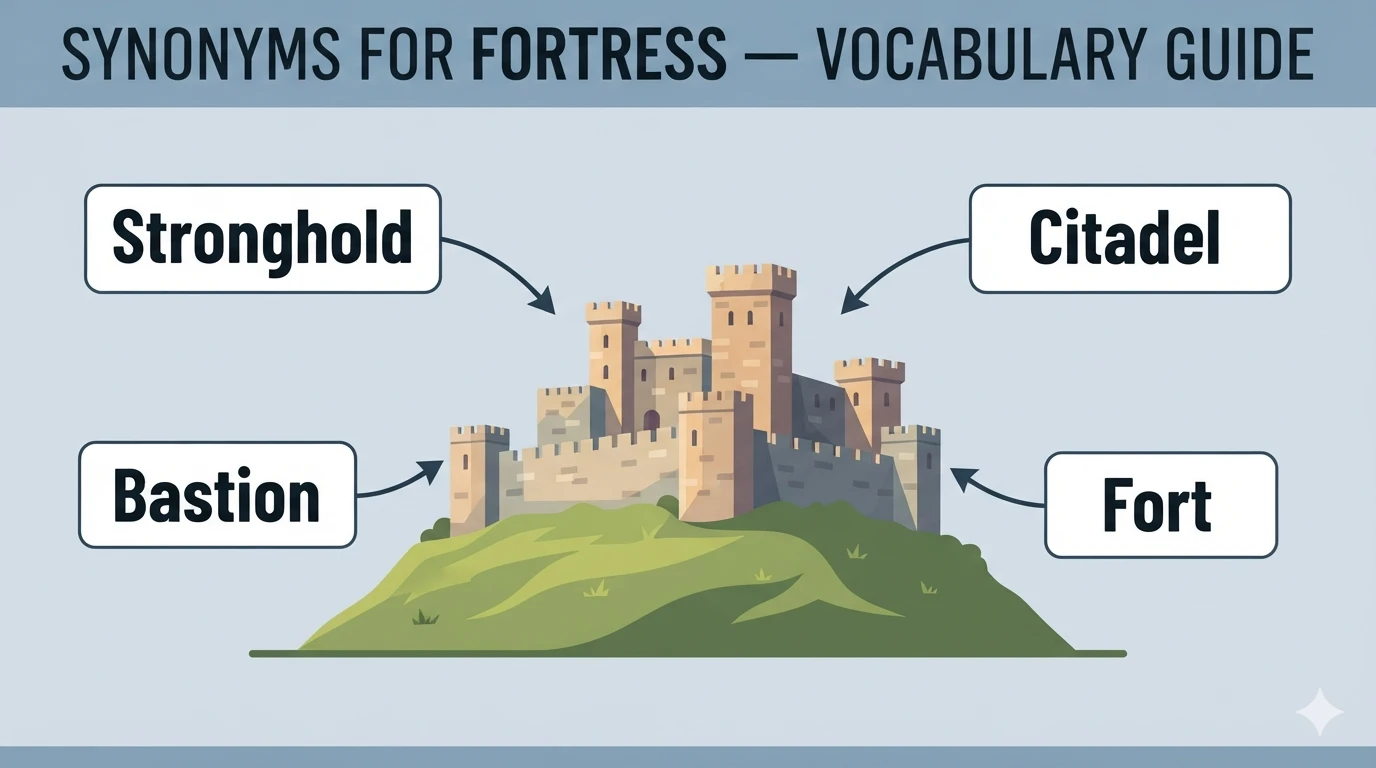
The best synonym for fortress is stronghold. A stronghold is a well-defended place built to protect people from attack, just like a fortress. Other close synonyms include citadel, fort, and bastion, each describing a slightly different type of defensive structure.
Imagine an old stone building on a hilltop, with thick walls and tall towers built to keep enemies out. That building is a fortress. But if you keep writing “fortress” over and over in a story or article, your sentences can start to feel repetitive.
A fortress is simply a strong building or place built for defense. It protects the people inside from attacks. Writers, students, and history lovers use this word often when describing castles, forts, and ancient defenses.
That’s why learning synonyms for fortress is so useful. Words like stronghold, citadel, and bastion let you describe the same idea with more variety and precision. If you’re writing a history essay, a fantasy story, or a travel blog about an old fortress, these words add depth to your writing.
Synonyms for Fortress — Summary Table
| Synonym | Relationship | Direct Replacement | Difficulty | Best Used For |
|---|---|---|---|---|
| Stronghold | Exact synonym | Yes | Intermediate | Daily conversation, writing |
| Citadel | Near synonym | Yes | Advanced | Literature, history |
| Fort | Near synonym | Yes | Beginner | Daily conversation |
| Castle | Contextual alternative | Sometimes | Beginner | Literature, history |
| Bastion | Near synonym | Sometimes | Advanced | Literature, technical writing |
| Garrison | Contextual alternative | Sometimes | Intermediate | Military, history |
| Bulwark | Near synonym | Sometimes | Advanced | Literature |
| Fortification | Exact synonym | Yes | Intermediate | Academic, technical writing |
| Keep | Contextual alternative | Sometimes | Intermediate | Literature, history |
| Redoubt | Near synonym | Sometimes | Advanced | Military, literature |
| Bunker | Contextual alternative | Sometimes | Intermediate | Technical, modern writing |
| Outpost | Contextual alternative | Sometimes | Intermediate | Military, daily conversation |
| Rampart | Contextual alternative | No | Advanced | Literature |
| Fastness | Near synonym | Yes | Advanced | Literature |
| Fortalice | Near synonym | Yes | Academic | Historical, academic writing |
Table of Contents
- Introduction
- Quick Facts Box
- Word Difficulty Level
- Synonyms for Fortress (detailed)
- Stronghold
- Citadel
- Fort
- Castle
- Bastion
- Garrison
- Bulwark
- Fortification
- Keep
- Redoubt
- Bunker
- Outpost
- Rampart
- Fastness
- Fortalice
- Antonyms of Fortress
- Words Commonly Confused with Fortress
- FAQs
- Conclusion
Quick Facts Box
- Focus Keyword: Fortress
- Part of Speech: Noun
- Simple Pronunciation: FOR-tris
- IPA Pronunciation: /ˈfɔːrtrɪs/
- Number of Syllables: 2
- Word Origin: Comes from the Old French word “forteresse,” which came from the Latin word “fortis,” meaning “strong.”
- Other Word Forms: fortresses (plural), fortify (verb), fortified (adjective), fortification (related noun)
- Formality Level: Neutral
Word Difficulty Level
Difficulty Level: Intermediate CEFR Level: B1
“Fortress” commonly appears in literature, history books, and military writing. It’s also popular in video games, fantasy novels, and travel content about ancient castles and defensive sites. Students studying history or reading adventure stories will meet this word often.
Synonyms for Fortress
1. Stronghold
Relationship: Exact synonym Direct Replacement: Yes Difficulty Level: Intermediate
Meaning: A stronghold is a place that is strongly defended and hard to attack.
Difference: Stronghold can also be used more broadly, such as describing a group’s main area of power, not just a physical building.
Best Used For: Daily conversation, writing
Examples:
- The rebels built their stronghold deep in the mountains.
- This city was once a stronghold for pirates.
2. Citadel
Relationship: Near synonym Direct Replacement: Yes Difficulty Level: Advanced
Meaning: A citadel is a fortress that protects or overlooks a city.
Difference: A citadel is usually located within or beside a city, while a fortress can stand alone anywhere.
Best Used For: Literature, history
Examples:
- The ancient citadel still stands above the old town.
- Soldiers retreated to the citadel when the city fell.
3. Fort
Relationship: Near synonym Direct Replacement: Yes Difficulty Level: Beginner
Meaning: A fort is a strong building made to protect soldiers or a place.
Difference: Fort is a simpler, smaller word often used for military bases, while fortress usually feels larger and older.
Best Used For: Daily conversation
Examples:
- The children built a fort out of pillows in the living room.
- Soldiers guarded the old fort near the river.
4. Castle
Relationship: Contextual alternative Direct Replacement: Sometimes Difficulty Level: Beginner
Meaning: A castle is a large building that was both a home and a defense for rulers.
Difference: A castle often includes living spaces for royalty, while a fortress is built mainly for defense.
Best Used For: Literature, history
Examples:
- The king lived in a castle surrounded by tall walls.
- Tourists visit the castle every summer to see its towers.
5. Bastion
Relationship: Near synonym Direct Replacement: Sometimes Difficulty Level: Advanced
Meaning: A bastion is a strong point built to defend a fortress or wall.
Difference: A bastion is often part of a larger fortress, not the whole structure itself.
Best Used For: Literature, technical writing
Examples:
- Soldiers stood watch from the corner bastion.
- The old bastion protected the harbor from enemy ships.
6. Garrison
Relationship: Contextual alternative Direct Replacement: Sometimes Difficulty Level: Intermediate
Meaning: A garrison is a place where soldiers live and defend an area.
Difference: Garrison can also mean the soldiers themselves, not just the building.
Best Used For: Military, history
Examples:
- The garrison held strong against the siege for months.
- A small garrison protected the border town.
7. Bulwark
Relationship: Near synonym Direct Replacement: Sometimes Difficulty Level: Advanced
Meaning: A bulwark is a strong wall or defense built to protect against attack.
Difference: Bulwark is often used in a symbolic sense, like a “bulwark against change,” not just as a physical building.
Best Used For: Literature
Examples:
- The thick bulwark protected the town from cannon fire.
- The old law stood as a bulwark against injustice.
8. Fortification
Relationship: Exact synonym Direct Replacement: Yes Difficulty Level: Intermediate
Meaning: A fortification is any structure built to strengthen defense.
Difference: Fortification is a broader term that can describe walls, ditches, and towers, not just one single building.
Best Used For: Academic, technical writing
Examples:
- Engineers studied the ancient fortification’s design.
- The city added new fortifications after the war.
9. Keep
Relationship: Contextual alternative Direct Replacement: Sometimes Difficulty Level: Intermediate
Meaning: A keep is the strongest, most protected part inside a castle or fortress.
Difference: A keep is only one part of a fortress, not the entire structure.
Best Used For: Literature, history
Examples:
- The family hid in the keep during the attack.
- Visitors climbed to the top of the ancient keep.
10. Redoubt
Relationship: Near synonym Direct Replacement: Sometimes Difficulty Level: Advanced
Meaning: A redoubt is a small, temporary fort used during battle.
Difference: A redoubt is usually smaller and less permanent than a fortress.
Best Used For: Military, literature
Examples:
- Troops built a redoubt to hold the hill overnight.
- The soldiers defended the redoubt until reinforcements arrived.
11. Bunker
Relationship: Contextual alternative Direct Replacement: Sometimes Difficulty Level: Intermediate
Meaning: A bunker is an underground shelter built for protection.
Difference: A bunker is usually underground and modern, while a fortress is often above ground and historical.
Best Used For: Technical, modern writing
Examples:
- The soldiers took cover in the underground bunker.
- The old war bunker is now open to tourists.
12. Outpost
Relationship: Contextual alternative Direct Replacement: Sometimes Difficulty Level: Intermediate
Meaning: An outpost is a small base set up away from the main area for defense or watch.
Difference: An outpost is usually smaller and farther from the center of power than a fortress.
Best Used For: Military, daily conversation
Examples:
- The scouts reported from a remote outpost in the desert.
- A tiny outpost guarded the mountain pass.
13. Rampart
Relationship: Contextual alternative Direct Replacement: No Difficulty Level: Advanced
Meaning: A rampart is a wide wall of earth or stone built for defense.
Difference: A rampart is only a wall, not a full fortress with rooms and towers.
Best Used For: Literature
Examples:
- Archers stood along the rampart, watching the horizon.
- The old rampart still circles the historic town.
14. Fastness
Relationship: Near synonym Direct Replacement: Yes Difficulty Level: Advanced
Meaning: A fastness is a secure, hard-to-reach place used for protection.
Difference: Fastness is an older, more literary word, less common in everyday speech.
Best Used For: Literature
Examples:
- The clan retreated to their mountain fastness.
- Few enemies dared to attack the hidden fastness.
15. Fortalice
Relationship: Near synonym Direct Replacement: Yes Difficulty Level: Academic
Meaning: A fortalice is a small fortress or fortified building.
Difference: Fortalice is a rare, historical word mostly used in academic or specialist writing.
Best Used For: Historical, academic writing
Examples:
- The historian described the ruins as a small fortalice.
- A fortalice once stood at the edge of the estate.
Antonyms of Fortress
| Antonym | Simple Meaning | Example |
|---|---|---|
| Open ground | An unprotected, exposed area | The army camped on open ground with no defense. |
| Vulnerable spot | A weak, undefended place | Enemies attacked the town’s most vulnerable spot. |
| Ruin | A destroyed or abandoned structure | Only a crumbling ruin remains of the old fort. |
| Unguarded place | A location without protection | Thieves entered through the unguarded gate. |
| Settlement | A simple, undefended living area | The settlement had no walls or towers. |
Words Commonly Confused with Fortress
Word: Palace
Difference: A palace is mainly a grand home for royalty, not built primarily for defense.
Example: The queen hosted a feast inside her palace.
Word: Castle
Difference: A castle often combines a home and defense, while a fortress focuses purely on protection.
Example: The castle had both a throne room and thick defensive walls.
Word: Wall
Difference: A wall is just one part of a fortress, not the whole defensive structure.
Example: The stone wall surrounded the fortress on all sides.
Word: Garrison
Difference: Garrison often refers to the soldiers stationed there, not the building itself.
Example: A small garrison guarded the fortress gate.
FAQs
What is another word for fortress?
Common alternatives include stronghold, citadel, fort, and bastion. Each word describes a slightly different type of defensive structure.
What is the closest synonym for fortress?
Stronghold is the closest synonym, since it also means a strongly defended place built to resist attack.
Can I replace fortress with castle in every sentence?
Not always. A castle often includes living spaces for royalty, while a fortress is built mainly for military defense.
Is fortress formal or informal?
Fortress is a neutral word. It works well in both everyday writing and formal historical or academic writing.
What is the opposite of fortress?
Common opposites include open ground, ruin, and unguarded place, since these describe unprotected or destroyed locations.
Why do we use synonyms for fortress in writing?
Synonyms help you describe different types of defensive structures accurately and keep your writing from sounding repetitive.
Conclusion
Learning synonyms for fortress helps you describe defensive places with more accuracy and style. Instead of repeating “fortress” again and again, you can use stronghold for general strength, citadel for a city-protecting structure, or bunker for a modern underground shelter. This variety makes history essays, fantasy stories, and travel writing far more engaging.
Try using one new synonym today in your next story or essay. With practice, these words will soon feel like a natural part of your vocabulary.