Featured Snippet Answer
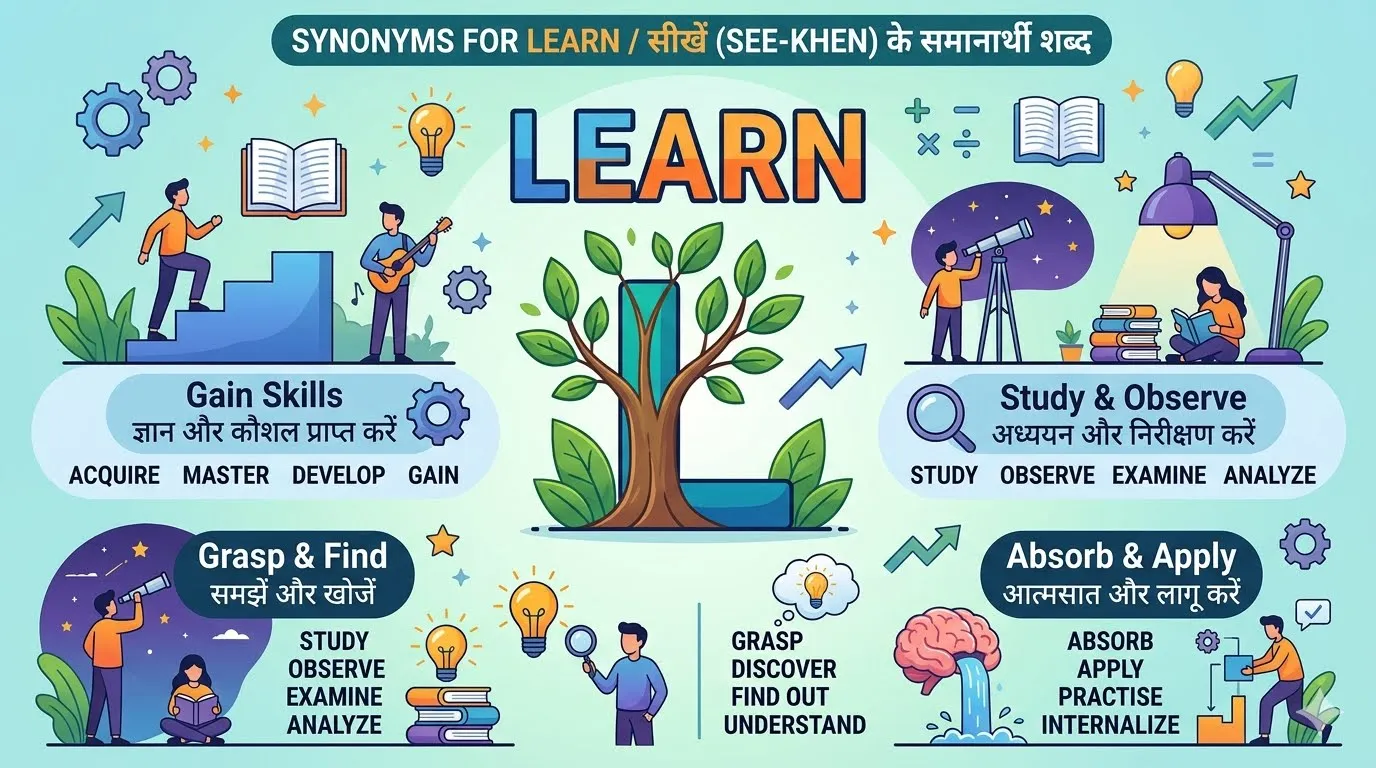
The best synonym for learning is study. Study means to spend time reading or practicing to gain knowledge, while learning simply means to gain knowledge or skill, no matter how. Other close synonyms include master, grasp, and absorb, each describing a different depth or speed of gaining new knowledge.
What Is a Synonym for Learn?
A synonym for learn is any word that means to gain knowledge, skill, or understanding, such as study, master, grasp, or absorb. These words share the same basic idea of gaining new information but differ in speed, depth, and formality.
Have you ever tried to learn a new language and felt proud after your first full sentence? That small win is what learning feels like.
Here’s a simple example: a child learns to ride a bike after falling a few times. That’s learning in action, gaining a new skill through practice.
Learn means to get new knowledge or a new skill, usually through study, practice, or experience. It’s one of the most common verbs in English, but using it too often makes writing feel repetitive.
That’s where synonyms come in. Students need variety for essays. Bloggers need fresh words to keep content engaging. Content writers need precision. Sometimes you study, sometimes you master, sometimes you pick up a skill casually. Knowing synonyms for learning helps you communicate exactly how knowledge was gained.
Table of Contents
- Study
- Master
- Grasp
- Absorb
- Acquire
- Understand
- Memorize
- Pick Up
- Train
- Discover
- Familiarize
- Comprehend
- Practice
- Educate Yourself
- Get the Hang Of
Quick Facts Box
| Detail | Information |
| Focus Keyword | Learn |
| Part of Speech | Verb |
| Simple Pronunciation | LURN |
| IPA Pronunciation | /lɜːrn/ |
| Syllables | 1 |
| Word Origin | From Old English “leornian,” meaning “to get knowledge, be taught, or study” |
| Other Word Forms | Learner (noun), Learning (noun/adjective), Learned (adjective) |
| Formality Level | Casual to Neutral |
Word Difficulty Level
Difficulty Level: Beginner CEFR Level: A1
“Learn” is one of the most basic verbs in English and is taught at the very start of language learning. It’s used everywhere in daily conversation, classrooms, business training, and academic writing making it one of the most versatile words in the language.
Synonyms for Learn
Here’s a quick-reference table before we go word by word.
| # | Synonym | Relationship | Direct Replacement | Difficulty | Best Used For |
| 1 | Study | Near synonym | Sometimes | Beginner | Academic writing |
| 2 | Master | Contextual alternative | Sometimes | Intermediate | Business writing |
| 3 | Grasp | Near synonym | Yes | Intermediate | Daily conversation |
| 4 | Absorb | Contextual alternative | Sometimes | Advanced | Creative writing |
| 5 | Acquire | Exact synonym | Yes | Intermediate | Academic/Business writing |
| 6 | Understand | Near synonym | Sometimes | Beginner | Daily conversation |
| 7 | Memorize | Contextual alternative | No | Beginner | Academic writing |
| 8 | Pick Up | Exact synonym | Yes | Beginner | Daily conversation |
| 9 | Train | Contextual alternative | Sometimes | Intermediate | Technical writing |
| 10 | Discover | Contextual alternative | Sometimes | Intermediate | Creative writing |
| 11 | Familiarize | Near synonym | Yes | Advanced | Business writing |
| 12 | Comprehend | Near synonym | Sometimes | Advanced | Academic writing |
| 13 | Practice | Contextual alternative | No | Beginner | Daily conversation |
| 14 | Educate Yourself | Exact synonym | Yes | Intermediate | Business/Academic writing |
| 15 | Get the Hang Of | Exact synonym | Yes | Beginner | Daily conversation |
1. Study: A Synonym for Learn
Relationship: Near synonym Direct Replacement: Sometimes Difficulty Level: Beginner
Meaning: Study means to spend time reading, practicing, or reviewing something to learn it well.
Difference: Study focuses on the process of gaining knowledge, while learning describes the actual result of that process.
Best Used For: Academic writing, daily conversation.
Examples:
- She stayed up late to study for her chemistry exam.
- He studies French every morning before work.
2. Master: A Synonym for Learn
Relationship: Contextual alternative Direct Replacement: Sometimes Difficulty Level: Intermediate
Meaning: Master means to learn a skill so well that you can do it easily and confidently.
Difference: Master implies a much higher level of skill than simply learning something for the first time.
Best Used For: Business writing, technical writing.
Examples:
- It took him two years to master the guitar.
- Our new intern is quickly mastering the sales software.
3. Grasp: A Synonym for Learn
Relationship: Near synonym Direct Replacement: Yes Difficulty Level: Intermediate
Meaning: Grasp means to understand an idea or concept clearly.
Difference: Grasp focuses on mental understanding, while learn can include physical skills too.
Best Used For: Daily conversation, academic writing.
Examples:
- It took me a while, but I finally grasped the math formula.
- She grasped the new software’s layout within minutes.
4. Absorb: A Synonym for Learn
Relationship: Contextual alternative Direct Replacement: Sometimes Difficulty Level: Advanced
Meaning: Absorb means to take in information naturally and thoroughly, almost without effort.
Difference: Absorb suggests passive, gradual learning, unlike the more active or general sense of learning.
Best Used For: Creative writing, literature.
Examples:
- Kids absorb new languages faster than adults do.
- He absorbed every detail of the lecture without taking notes.
5. Acquire: A Synonym for Learn
Relationship: Exact synonym Direct Replacement: Yes Difficulty Level: Intermediate
Meaning: Acquire means to gain a skill or piece of knowledge over time.
Difference: Acquire sounds more formal than learn and is common in academic or professional contexts.
Best Used For: Academic writing, business writing.
Examples:
- She acquired excellent negotiation skills during her internship.
- Children acquire language naturally by listening to those around them.
6. Understand: A Synonym for Learn
Relationship: Near synonym Direct Replacement: Sometimes Difficulty Level: Beginner
Meaning: Understanding means to know the meaning or reason behind something.
Difference: Understanding focuses on comprehension, while learning includes the whole process of gaining that comprehension.
Best Used For: Daily conversation, business writing.
Examples:
- Once she explained it twice, I finally understood the concept.
- Do you understand how the new system works?
7. Memorize: A Synonym for Learn
Relationship: Contextual alternative Direct Replacement: No Difficulty Level: Beginner
Meaning: Memorize means to learn something so well that you can remember it exactly, word for word.
Difference: Memorize focuses only on recall, while learning can include understanding, not just remembering.
Best Used For: Academic writing, daily conversation.
Examples:
- The actor had to memorize twenty pages of dialogue.
- I memorized the poem for tomorrow’s class.
8. Pick Up: A Synonym for Learn
Relationship: Exact synonym Direct Replacement: Yes Difficulty Level: Beginner
Meaning: Pick up means to learn something casually, often without formal teaching.
Difference: Pick up sounds more casual than learn and suggests an easy, natural process.
Best Used For: Daily conversation.
Examples:
- I picked up some Spanish just from watching movies.
- He picked up the new dance moves after watching it once.
9. Train: A Synonym for Learn
Relationship: Contextual alternative Direct Replacement: Sometimes Difficulty Level: Intermediate
Meaning: Train means to learn a skill through repeated practice, often with guidance.
Difference: Train focuses on structured practice, while learn can happen with or without a system.
Best Used For: Technical writing, business writing.
Examples:
- New employees train for two weeks before starting the job.
- She trained hard to learn proper posture for swimming.
10. Discover: A Synonym for Learn
Relationship: Contextual alternative Direct Replacement: Sometimes Difficulty Level: Intermediate
Meaning: Discover means to learn something new, often by accident or exploration.
Difference: Discover implies surprise or newness, while learn can happen intentionally or gradually.
Best Used For: Creative writing, daily conversation.
Examples:
- I discovered a great trick for organizing my emails.
- She discovered she loved painting during the pandemic.
11. Familiarize: A Synonym for Learn
Relationship: Near synonym Direct Replacement: Yes Difficulty Level: Advanced
Meaning: Familiarize means to make yourself learn about something until it feels comfortable and known.
Difference: Familiarize suggests a deliberate effort to get comfortable with something, more than general learning.
Best Used For: Business writing, technical writing.
Examples:
- Please familiarize yourself with the new safety rules before Monday.
- I spent an hour familiarizing myself with the app’s features.
12. Comprehend: A Synonym for Learn
Relationship: Near synonym Direct Replacement: Sometimes Difficulty Level: Advanced
Meaning: Comprehend means to fully understand something, often something complex.
Difference: Comprehend is more formal than learn and focuses purely on deep understanding.
Best Used For: Academic writing, literature.
Examples:
- It took several readings to comprehend the dense legal document.
- Young children may struggle to comprehend abstract ideas like time.
13. Practice: A Synonym for Learn
Relationship: Contextual alternative Direct Replacement: No Difficulty Level: Beginner
Meaning: Practice means to repeat an activity to learn or improve a skill.
Difference: Practice is the method used to learn, not the act of learning itself.
Best Used For: Daily conversation, technical writing.
Examples:
- He practices piano every evening after dinner.
- The more you practice speaking English, the faster you’ll learn it.
14. Educate Yourself: A Synonym for Learn
Relationship: Exact synonym Direct Replacement: Yes Difficulty Level: Intermediate
Meaning: Educate yourself means to actively seek out knowledge on a topic.
Difference: Educate yourself emphasizes personal effort and initiative more than the neutral word learn.
Best Used For: Business writing, academic writing.
Examples:
- She educated herself on investing by reading books and articles.
- It’s important to educate yourself before voting on local issues.
15. Get the Hang Of: A Synonym for Learn
Relationship: Exact synonym Direct Replacement: Yes Difficulty Level: Beginner
Meaning: Get the hang of means to learn how to do something after some practice, until it feels natural.
Difference: Get the hang of is very casual and usually refers to skills, not facts or information.
Best Used For: Daily conversation.
Examples:
- It took a few tries, but I finally got the hang of parallel parking.
- Once you get the hang of the keyboard shortcuts, you’ll work much faster.
Antonyms of Learn
| Antonym | Simple Meaning | Example |
| Forget | To fail to remember something | I completely forgot how to solve that equation. |
| Ignore | To pay no attention to something | He ignored the instructions and made a mistake. |
| Misunderstand | To understand something incorrectly | She misunderstood the assignment and did it wrong. |
| Unlearn | To deliberately forget a habit or skill | It’s hard to unlearn bad typing habits. |
| Neglect | To fail to give proper attention or care | He neglected his studies all semester. |
| Overlook | To fail to notice or consider something | I overlooked an important detail in the report. |
Words Commonly Confused with Learn
Word: Teach Difference: Teach means to help someone else gain knowledge, while learn describes gaining knowledge yourself. Example: My sister teaches math, and I learn from her lessons.
Word: Know Difference: Know describes already having information, while learn describes the process of gaining it. Example: I learned the rule yesterday, and now I know it well.
Word: Remember Difference: Remember means recalling something already learned, not the act of learning it. Example: I learned her name at the party, but I don’t remember it now.
Word: Realize Difference: Realize means suddenly becoming aware of something, which is different from the gradual process of learning. Example: I realized my mistake right after submitting the form, though I had learned the rule weeks earlier.
FAQs
What is another word for learning?
Common alternatives include study, acquire, grasp, and pick up, depending on how formal or casual the sentence needs to be.
What is the closest synonym for learn?
Acquire is one of the closest true synonyms, since it can replace “learn” in most formal sentences without changing the meaning.
What word can I use instead of learning in a resume?
Use acquired, mastered, or developed to sound more professional, such as “acquired strong project management skills.”
Is learning formal or informal?
Learn is neutral; it fits both casual conversation and formal writing equally well.
What is the opposite of learning?
The opposite of learn includes words like forget, ignore, or unlearn, which describe losing or avoiding knowledge.
Why do we use synonyms for learning in writing? Synonyms add precision and variety, letting you show exactly how knowledge was gained through study, practice, or discovery instead of repeating one word.
Conclusion
Learning synonyms for learning sharpens how you describe gaining knowledge. Use study for focused effort, master for expert-level skill, or pick up for casual learning.
This small habit makes emails, essays, and everyday conversations sound more precise and natural. Try swapping in one new synonym today, and watch your writing grow clearer with every sentence.