What Does Poor Mean?
Poor usually means having little or no money. Its closest synonym is needy, because both words describe people who lack money and need help. You can use poor for people, families, and areas. For example, a poor village may have no clean water or school.
Introduction
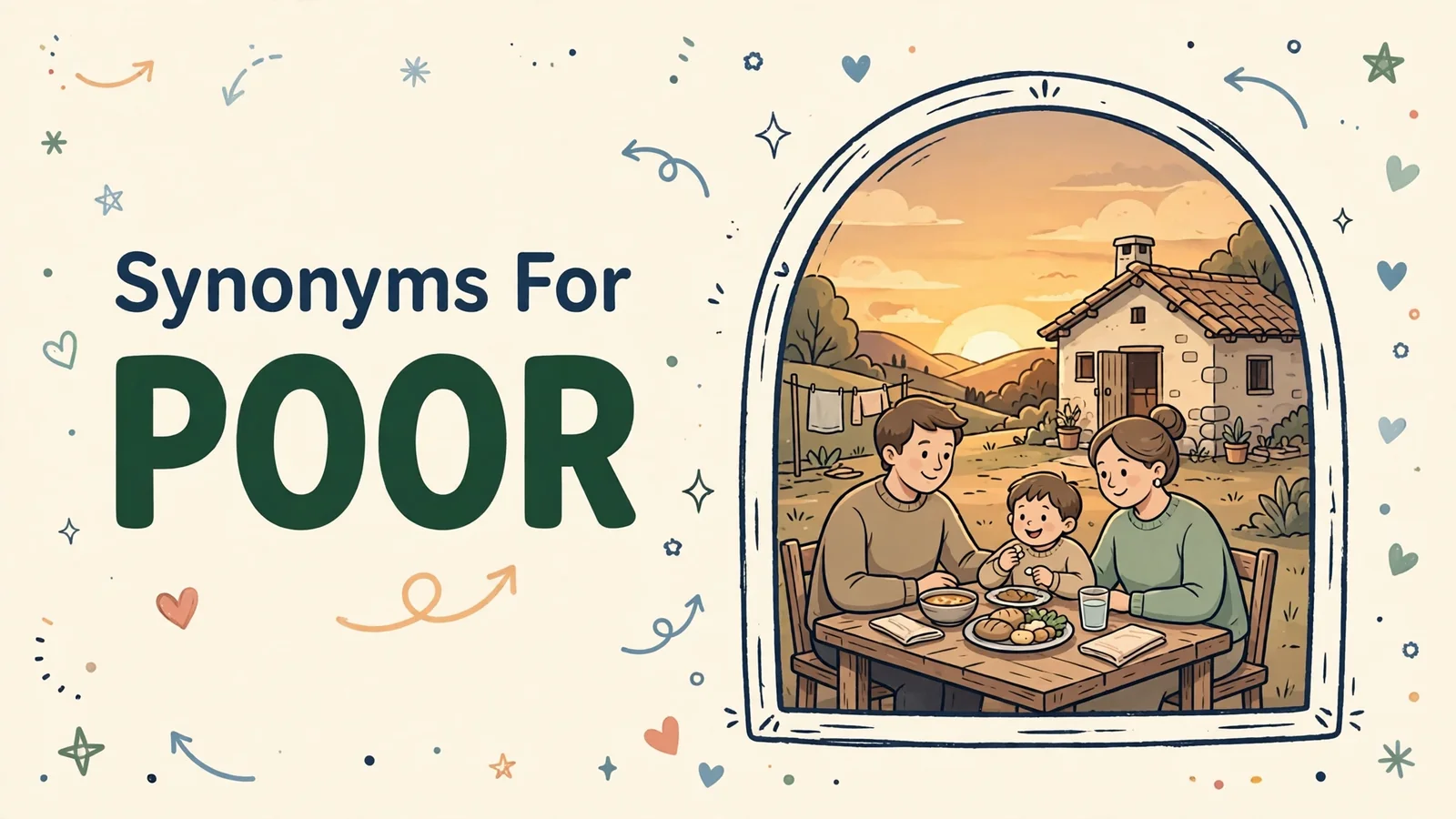
Last winter, Noah visited his cousin in a small town in Texas. The cousin’s house had 2 rooms for 6 people, and the roof leaked when it rained. Noah saw old shoes by the door and one shared blanket on the bed. He felt sad, but his cousin smiled and shared his lunch without a second thought. That day Noah learned that poor describes a lack of money, not a lack of heart. Poor usually means having little or no money. When you learn synonyms for poor, you can talk about hardship with care and respect, and make your writing more human. By the end, you will be able to pick the best word for poor in any sentence.
Table of 12 Synonyms for Poor
| No. | Synonym | Part of Speech | Simple Meaning |
|---|---|---|---|
| 1 | Needy | Adjective | Needs help for lack of money |
| 2 | Impoverished | Adjective | Very poor over long time |
| 3 | Destitute | Adjective | Has nothing left at all |
| 4 | Broke | Adjective | Has no money right now |
| 5 | Penniless | Adjective | Has no money at all |
| 6 | Indigent | Adjective | Formal, very poor and needy |
| 7 | Deprived | Adjective | Kept from things people need |
| 8 | Underprivileged | Adjective | Has fewer chances and money |
| 9 | Disadvantaged | Adjective | In a worse position than others |
| 10 | Low-income | Adjective | Earns only a small amount |
| 11 | Strapped | Adjective | Short of money for a time |
| 12 | Poverty-stricken | Adjective | Hit hard by long poverty |
Table of Contents
- Introduction
- Table of 12 Synonyms for Poor
- Quick Facts About Poor
- Meaning and Usage of Poor
- 1. Needy
- 2. Impoverished
- 3. Destitute
- 4. Broke
- 5. Penniless
- 6. Indigent
- 7. Deprived
- 8. Underprivileged
- 9. Disadvantaged
- 10. Low-income
- 11. Strapped
- 12. Poverty-stricken
- Antonyms of Poor
- Words Commonly Confused with Poor
- Frequently Asked Questions
- Conclusion
Quick Facts About Poor
- Focus keyword: poor
- Part of speech: adjective
- Pronunciation: POOR
- IPA: /pʊr/
- Number of syllables: 1
- Word origin: from Old French “povre”, meaning having little
- Other word forms: poverty (noun), poorly (adverb), poorer, poorest
- Formality level: neutral, used in both casual and formal writing
- Difficulty level: beginner
- CEFR level: A2
Meaning and Usage of Poor
Poor is an adjective. It most often means having little or no money. People use poor for families, areas, and countries. A poor family may struggle to buy food, clothes, or school books. Poor can also mean low quality, as in poor work or a poor result, which means not good enough. Poor health means weak health. In daily talk, poor often pairs with words like very and quite, as in very poor. The word works in both casual and school writing, but use it with care, since it describes real hardship. When you say someone is poor, you tell the reader that money is a daily worry for them.
1. Needy
Meaning: Needy means needing help because of a lack of money.
Examples:
- The needy family of 5 got food boxes from the church in Dallas.
- Needy students received 100 free books at the school fair.
2. Impoverished
Meaning: Impoverished means very poor over a long time.
Examples:
- The impoverished town had no clinic for 2000 people.
- Years of drought left the impoverished village with dry wells.
3. Destitute
Meaning: Destitute means having nothing left at all.
Examples:
- The destitute man slept on a bench for 10 cold nights.
- After the flood, 50 destitute families lost their homes.
4. Broke
Meaning: Broke means having no money right now.
Examples:
- After paying rent, Sam was broke for a week in March.
- The broke student had only 2 dollars left for lunch.
5. Penniless
Meaning: Penniless means having no money at all.
Examples:
- The penniless traveler walked 20 miles to reach the town.
- He arrived penniless in New York with one small bag.
6. Indigent
Meaning: Indigent is a formal word for very poor and needy.
Examples:
- The indigent mother of 3 asked the court for free aid.
- A charity helps indigent patients at the city hospital.
7. Deprived
Meaning: Deprived means kept away from things people need.
Examples:
- Children in the deprived area had no library for 5 years.
- The deprived school shared 30 old computers among 400 pupils.
8. Underprivileged
Meaning: Underprivileged means having fewer chances and less money than others.
Examples:
- Underprivileged kids got 500 free meals each week in summer.
- The program helps underprivileged teens learn coding in Boston.
9. Disadvantaged
Meaning: Disadvantaged means in a worse position than others, often for money reasons.
Examples:
- Disadvantaged pupils scored lower because they had no tutors.
- The disadvantaged district needs 10 new buses for schools.
10. Low-income
Meaning: Low-income means earning only a small amount of money.
Examples:
- Low-income workers earn less than 2000 dollars a month in the city.
- The low-income housing block has 120 small flats.
11. Strapped
Meaning: Strapped means short of money, often for a time.
Examples:
- Strapped for cash, Ella skipped lunch for 3 days.
- The strapped family cut spending by 300 dollars a month.
12. Poverty-stricken
Meaning: Poverty-stricken means hit hard by poverty over time.
Examples:
- The poverty-stricken region has 40 percent unemployment.
- Aid reached the poverty-stricken island after 2 long weeks.
Antonyms of Poor
| # | Antonym | Simple Meaning | Example |
|---|---|---|---|
| 1 | Rich | Has lots of money | The rich man owns 2 houses. |
| 2 | Wealthy | Has great money | The wealthy lady funds a school. |
| 3 | Affluent | Lives in comfort | The affluent suburb has wide roads. |
| 4 | Prosperous | Doing well in money | The prosperous port hires 300 men. |
| 5 | Well-off | Has enough money | The well-off clerk drives a new car. |
| 6 | Loaded | Informal, has lots of money | The loaded star bought a jet. |
| 7 | Comfortable | Has enough, lives at ease | They live a comfortable life now. |
| 8 | Flush | Has plenty right now | After the sale, he felt flush. |
Words Commonly Confused with Poor
Broke
Difference: Broke means no money right now, while poor means a longer lack of money.
Example: He is broke this week, but he is not poor.
Cheap
Difference: Cheap means low in price or quality, while poor means lacking money.
Example: The cheap shirt cost 5 dollars, but the buyer was not poor.
Bad
Difference: Poor work means low quality, while poor for a person means little money.
Example: Her poor grade did not mean her family was poor.
Frequently Asked Questions
What is another word for poor?
Needy is a great choice. It fits most sentences where poor fits, from people to families. For example, you can say a needy child instead of a poor child, and the meaning stays the same.
What is the closest synonym for poor?
Needy is the closest synonym. Both words mean lacking money and needing help. The small difference is that needy stresses the need for help, while poor stresses the lack of money.
Can I replace poor with broke in every sentence?
No, be careful. Broke means no money right now, while poor means a longer lack. Use broke for a short time, and poor for a lasting state.
Is poor formal or informal?
Poor is neutral, so it works in both casual talk and school writing. You can use it with friends, in emails, and in class. For very formal writing, impoverished or disadvantaged may sound better.
What is the opposite of poor?
The opposite of poor is rich. Wealthy is also a common opposite. Use rich for having lots of money, and wealthy for lasting wealth.
Conclusion
Synonyms make your English richer and clearer. When you know 12 words for poor, you can talk about hardship with care and respect. Needy fits people who need help, broke fits a short lack of money, and impoverished fits long-term poverty. Context matters most, so always ask which word matches the meaning you want. Practice these words in emails, essays, articles, and conversations. Your 30-second challenge: use 3 of these synonyms in your own sentences today. Small steps like this build strong vocabulary fast.