
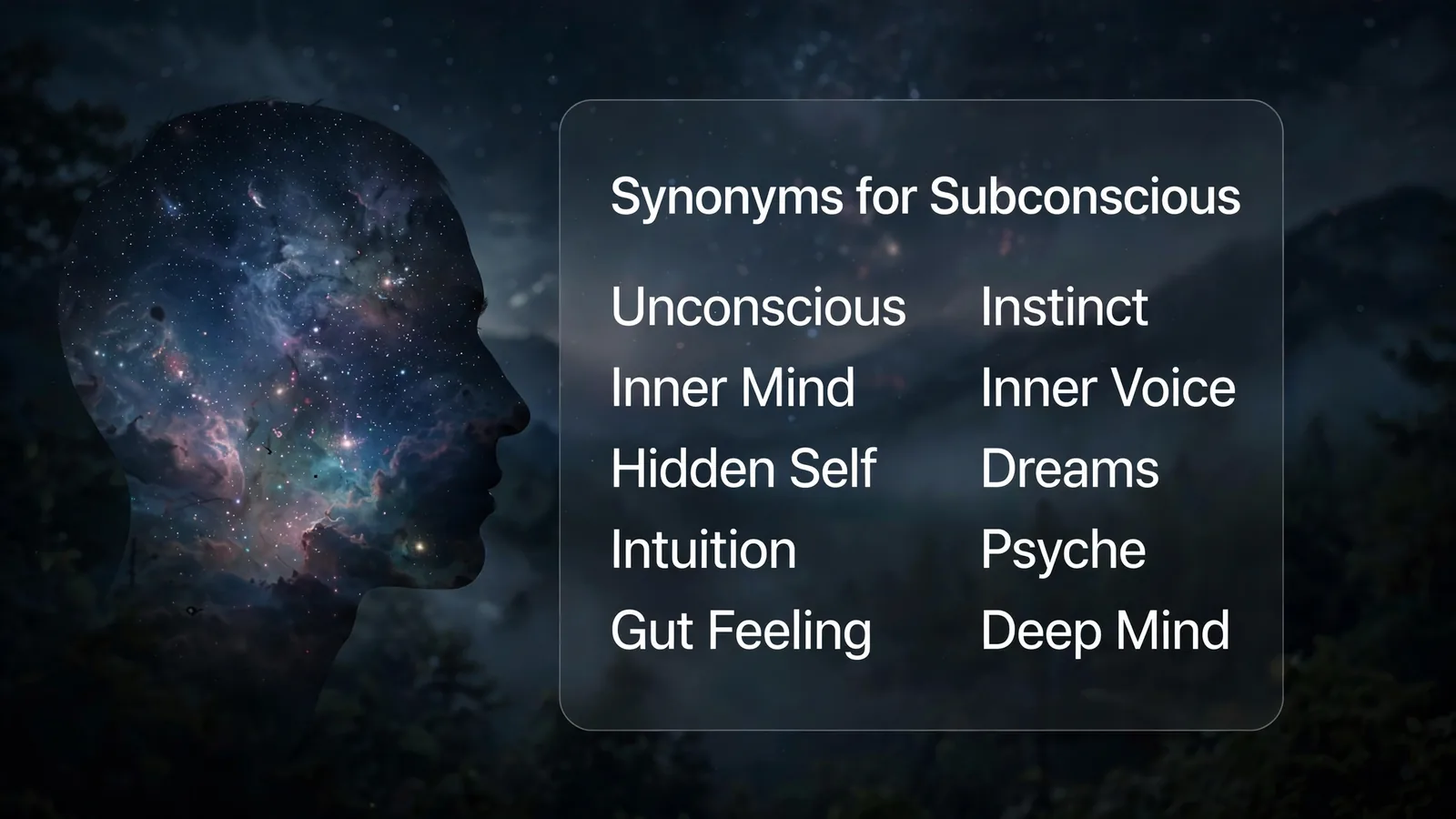
Featured Snippet Answer
The closest synonym for subconscious is unconscious. Both describe thoughts or feelings you are not fully aware of. Other good choices include subliminal, instinctive, intuitive, and involuntary. Pick the one that fits your sentence: unconscious for hidden mind processes, subliminal for barely noticed signals, and instinctive for natural reactions.
Maya had written the word subconscious six times on a single page. Her teacher in Chicago circled every one in red ink and wrote, “Try a fresh word!” Maya stared at the page for ten minutes.
Sound familiar? Subconscious describes thoughts, feelings, or actions that happen below your awareness. For example: “He had a subconscious fear of dogs.” But repeating the same word makes writing feel flat. That is why synonyms for subconscious are so useful. Words like unconscious, instinctive, and subliminal each add a different shade of meaning.
By the end, you will know 12 alternatives, what each one means, and exactly when to use it.
Table of 12 Synonyms for Subconscious
| No. | Synonym | Part of Speech | Simple Meaning |
|---|---|---|---|
| 1 | Unconscious | Adjective / Noun | Not aware; hidden in the mind |
| 2 | Subliminal | Adjective | Felt below the level of awareness |
| 3 | Instinctive | Adjective | Natural, without learning or planning |
| 4 | Intuitive | Adjective | Based on a gut feeling |
| 5 | Automatic | Adjective | Done without thinking |
| 6 | Involuntary | Adjective | Done without choice or control |
| 7 | Unintentional | Adjective | Not done on purpose |
| 8 | Reflexive | Adjective | Done as a quick automatic reaction |
| 9 | Unthinking | Adjective | Done without careful thought |
| 10 | Unwitting | Adjective | Not knowing what you are doing |
| 11 | Implicit | Adjective | Understood without being stated |
| 12 | Latent | Adjective | Present but hidden |
Table of Contents
- Introduction
- Table of 12 Synonyms for Subconscious
- Quick Facts About Subconscious
- Meaning and Usage of Subconscious
- Unconscious
- Subliminal
- Instinctive
- Intuitive
- Automatic
- Involuntary
- Unintentional
- Reflexive
- Unthinking
- Unwitting
- Implicit
- Latent
- Antonyms of Subconscious
- Words Commonly Confused with Subconscious
- Frequently Asked Questions
- Conclusion
Quick Facts About Subconscious
- Focus word: subconscious
- Part of speech: adjective and noun
- Pronunciation guide: sub-KON-shus
- IPA: /ˌsʌbˈkɒnʃəs/ (UK), /ˌsʌbˈkɑːnʃəs/ (US)
- Syllables: 3
- Origin: sub- is Latin for “under.” Conscious comes from Latin conscius, meaning “aware.” So the word literally means “under awareness.”
- Other word forms: subconsciously (adverb), subconsciousness (noun)
- Formality level: neutral
- Difficulty level: intermediate
Meaning and Usage of Subconscious
Subconscious describes mental activity you are not fully aware of. It can be an adjective (“a subconscious habit”) or a noun (“buried in the subconscious”).
People use it in four common places:
- Everyday talk: “I think I subconsciously copied her accent.”
- Self-help and wellness: goals, habits, and beliefs.
- Creative writing: characters with hidden fears or desires.
- Pop psychology: dreams and memories.
Here are two natural examples:
- Jin took the longer route to work, subconsciously avoiding the street where he had once had a bad fall.
- “My subconscious solved the puzzle while I slept,” said Rosa after a 9-hour night.
One useful note: many psychologists prefer the word unconscious or nonconscious in formal work. Subconscious is more common in everyday English.
1. Unconscious
Meaning: Describes thoughts, feelings, or habits that exist outside your awareness.
Examples:
- Tom’s unconscious bias led him to pick the first résumé from a pile of 40.
- Priya’s unconscious fear of flying began after one bumpy trip to Dubai in 2015.
2. Subliminal
Meaning: Describes a signal or message that affects your mind without you noticing it.
Examples:
- A subliminal hint of vanilla in the bakery made Omar buy two extra croissants.
- Ads often use subliminal cues, like the bright red of a soda can in a 30-second TV spot.
3. Instinctive
Meaning: Describes a natural reaction that you do not need to learn or plan.
Examples:
- When the ball flew toward her face, Maria’s instinctive reaction was to duck.
- Newly hatched sea turtles in Costa Rica make an instinctive dash toward the ocean.
4. Intuitive
Meaning: Describes understanding that comes from a gut feeling instead of step-by-step reasoning.
Examples:
- Chef Ahmed had an intuitive feel for when the biryani needed 5 more minutes.
- Daniel’s intuitive hunch told him to leave for Heathrow 2 hours early, and the traffic proved him right.
5. Automatic
Meaning: Describes something you do without thinking or effort, usually from habit.
Examples:
- After 10 years in Toronto, Lena’s morning coffee stop had become automatic.
- Typing the word “the” is automatic for Sam, because his fingers move on their own.
6. Involuntary
Meaning: Describes an action your body does without your choice or control.
Examples:
- An involuntary shiver ran through Ravi as he stepped into the 4°C lake.
- Blinking is involuntary, and most people do it roughly 15 times a minute.
7. Unintentional
Meaning: Describes something that happens by accident, not on purpose.
Examples:
- Chloe’s unintentional reply-all email reached 200 coworkers.
- The unintentional pun in Jake’s speech made the whole room in Dublin laugh.
8. Reflexive
Meaning: Describes a quick, automatic reaction, like a reflex.
Examples:
- Nina’s reflexive grab saved the glass before it hit the tile.
- At the dentist, Omar gave a reflexive flinch the moment the drill started at 9:15.
9. Unthinking
Meaning: Describes something done without careful thought or attention.
Examples:
- After 3 hours of scrolling, Elena made an unthinking click on the wrong link.
- Her unthinking comment about Mark’s new haircut hurt more than she meant it to.
10. Unwitting
Meaning: Describes a person who does something without knowing the full truth or effect.
Examples:
- Greg became an unwitting star when a stranger filmed him dancing at Waterloo Station.
- The tourists were unwitting helpers in the scam when one carried a stranger’s bag in Rome.
11. Implicit
Meaning: Describes something understood or felt without being said directly.
Examples:
- Researchers at Harvard helped create the Implicit Association Test to measure hidden attitudes.
- Her smile carried an implicit message: the meeting was over.
12. Latent
Meaning: Describes a quality that exists but has not yet shown itself.
Examples:
- Kofi’s latent talent for drawing appeared at age 30 in a Nairobi art class.
- A latent fear of heights surfaced when Aisha reached the 40th floor.
Antonyms of Subconscious
| # | Antonym | Simple Meaning | Example |
|---|---|---|---|
| 1 | Conscious | Aware and awake | Leo made a conscious choice to quit at age 35. |
| 2 | Aware | Knowing what is happening | Are you aware that the shop closes at 6 p.m.? |
| 3 | Deliberate | Done carefully on purpose | Her deliberate pause lasted exactly 3 seconds. |
| 4 | Intentional | Planned and meant | The intentional delay gave the team 2 extra days. |
| 5 | Voluntary | Done by free choice | Hana joined the beach cleanup in Bali as a voluntary helper. |
| 6 | Mindful | Paying full attention | Sam took 5 mindful breaths before his speech. |
| 7 | Premeditated | Planned in advance | The prank was premeditated, with a script written a week earlier. |
Words Commonly Confused with Subconscious
Conscious
Difference: This is the opposite, not a synonym. It means you are aware of your thoughts and actions.
Example: Carlos made a conscious effort to drink 8 glasses of water a day.
Preconscious
Difference: This is a technical psychology term. It describes memories you are not thinking about right now but can recall easily. The subconscious is usually harder to reach.
Example: Your childhood phone number is preconscious until someone asks you for it.
Semiconscious
Difference: This means partly awake, like someone who is drowsy or half-knocked out. It describes a physical state, not hidden thoughts.
Example: After the marathon in Boston, Dan lay semiconscious on the grass for a minute.
Unconscious (medical meaning)
Difference: In medicine, unconscious means completely out, as in fainting or deep sleep. In psychology, it matches subconscious. Check the context before you use it.
Example: The goalkeeper was unconscious for 30 seconds after the collision.
Frequently Asked Questions
What is another word for subconscious?
Unconscious is the most common alternative. Depending on your sentence, you can also use subliminal, instinctive, intuitive, automatic, involuntary, or implicit. Each word shifts the meaning a little, so check the context before swapping. Reading the examples above will help you choose the one that sounds natural.
Is subconscious the same as unconscious?
Not always. In everyday speech, people use them almost interchangeably. In psychology, though, unconscious is the standard term, and subconscious is seen as less precise. Also, unconscious can mean “knocked out or asleep,” which subconscious never means. Use it carefully to avoid confusion.
Is subconscious formal or informal?
It is neutral. You can use it in school essays, blog posts, and casual chats. In scientific writing, many researchers prefer unconscious, implicit, or nonconscious because they are more precise. For everyday writing, subconscious is perfectly fine and easy to understand.
What is the opposite of subconscious?
The main opposite is conscious, meaning aware of what is happening. Other opposites include deliberate, intentional, and voluntary, which describe actions done on purpose. Choose conscious when talking about the mind, and deliberate or intentional when talking about actions.
Can I use “instinctive” instead of subconscious in any sentence?
No. Instinctive means natural and unlearned, like a baby’s grip. Subconscious can include learned habits and buried feelings. “Subconscious fear of failure” works, but “instinctive fear of failure” sounds odd. Match the word to the source of the reaction: nature or the hidden mind.
Which synonym is best for writing a story?
Use subliminal for sneaky signals, unwitting for characters who do not know what they are doing, and latent for hidden talents or fears. Instinctive works best for fast physical reactions. Picking the exact word makes your scene sharper and your characters feel more real.
Conclusion
Synonyms make your vocabulary richer and your writing sharper. Each word for subconscious carries its own shade: subliminal is sneaky, instinctive is natural, and latent is hidden. That is why context matters. The closest word is not always the right one.
Try using these words in emails, essays, articles, and conversations.
30-second challenge: Write three sentences right now, each using a different synonym from this list.
Small words, used well, change how people hear you.