Have you ever noticed how two living things can depend on each other to survive? A bee gets food from a flower while helping the flower with pollination. This is a simple example of symbiosis.
The word symbiosis is often used in biology, science, and academic writing. It describes a close relationship between two different organisms. Because the word can sound technical, writers sometimes look for synonyms for symbiosis or simpler ways to explain the same idea.
However, not every related word has exactly the same meaning. Some words describe cooperation, while others describe dependence or a close relationship. Choosing the right alternative helps you keep your writing accurate.
In this guide, you will learn useful synonyms for symbiosis, their meanings, differences, difficulty levels, and natural examples.
Featured Snippet
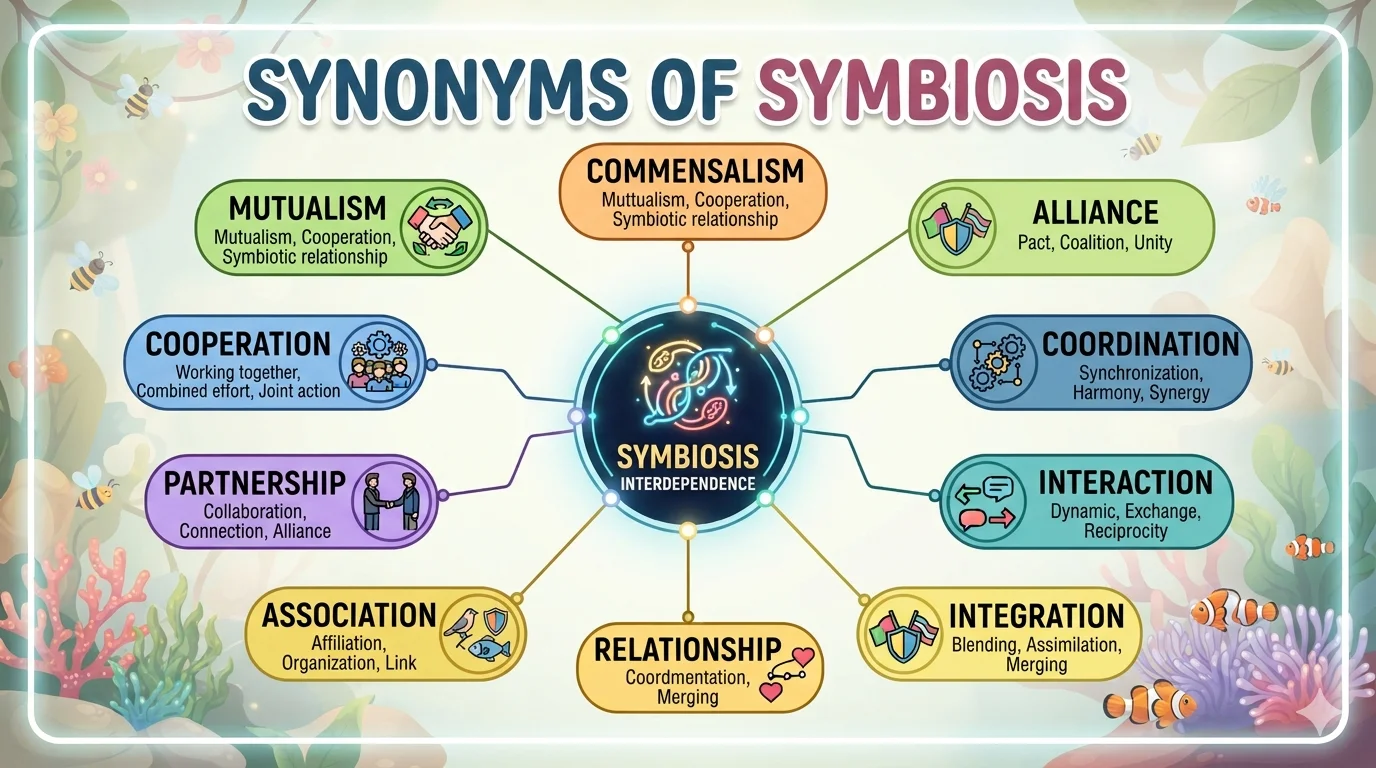
The best synonym for symbiosis is mutualism when both organisms benefit from the relationship. Other close alternatives include interdependence, cooperation, association, partnership, coexistence, and biological interaction. However, these words are not always exact synonyms, so the correct choice depends on the type of relationship being described.
Summary Table: Synonyms for Symbiosis
| Synonym / Related Term | Relationship | Direct Replacement | Difficulty | Best Used For |
| Mutualism | Near synonym | Sometimes | Advanced | Biology |
| Interdependence | Near synonym | Sometimes | Intermediate | Science and general writing |
| Association | Contextual alternative | Sometimes | Intermediate | Biology and academic writing |
| Cooperation | Contextual alternative | No | Beginner | General relationships |
| Partnership | Contextual alternative | No | Beginner | General and business writing |
| Interrelationship | Near synonym | Sometimes | Advanced | Academic writing |
| Coexistence | Related term | No | Intermediate | Ecology |
| Interaction | Related term | No | Beginner | Science |
| Dependency | Related term | No | Intermediate | Biological relationships |
| Collaboration | Contextual alternative | No | Intermediate | Human activities |
| Alliance | Contextual alternative | No | Intermediate | Groups and organizations |
| Connection | Related term | No | Beginner | General writing |
| Relationship | Near synonym | Sometimes | Beginner | General explanation |
| Association | Contextual alternative | Sometimes | Intermediate | Scientific contexts |
| Co-dependence | Related term | Sometimes | Advanced | Mutual dependence |
Table of Contents
- Introduction
- Featured Snippet
- Summary Table
- Quick Facts About Symbiosis
- Meaning and Usage
- Synonyms and Related Terms
- Antonyms of Symbiosis
- Words Commonly Confused with Symbiosis
- Frequently Asked Questions
- Conclusion
- Image SEO
- SEO Extras
Quick Facts About Symbiosis
| Fact | Details |
| Focus keyword | synonyms for symbiosis |
| Word | Symbiosis |
| Part of speech | Noun |
| Pronunciation | sim-by-OH-sis |
| IPA | /ˌsɪmbaɪˈoʊsɪs/ |
| Syllables | 4 |
| Difficulty Level | Advanced |
| Common field | Biology and ecology |
| Main meaning | A close relationship between different organisms |
| Formality | Academic / Technical |
| Common users | Scientists, students, researchers, educators |
| Common contexts | Biology, ecology, science writing |
Word Origin
The word symbiosis comes from Greek roots meaning “living together.” It is mainly used to describe close biological relationships between different organisms.
Related Word Forms
- Symbiosis — noun
- Symbiotic — adjective
- Symbiotically — adverb
- Symbiont — an organism living in a symbiotic relationship
Meaning and Usage of Symbiosis
Symbiosis refers to a close and often long-term relationship between organisms of different species.
A useful example is the relationship between certain fungi and plant roots. The fungus can help the plant obtain nutrients, while the plant provides food to the fungus.
The word is most common in biology and ecology. It is also sometimes used outside science to describe two people, businesses, or systems that work closely together.
It is important to remember that symbiosis does not always mean that both organisms benefit. In biology, different types of symbiotic relationships can have different effects on the organisms involved.
Mutualism: A Synonym for Symbiosis
Relationship: Near synonym
Direct Replacement: Sometimes
Difficulty Level: Advanced
Meaning: Mutualism is a relationship in which both organisms benefit.
Difference: Mutualism is more specific than symbiosis because it focuses on relationships where both sides benefit.
Best Used For: Biology, ecology, academic writing, and science education.
Examples:
- Bees and many flowering plants have a mutualistic relationship.
- The bacteria in some animal digestive systems can have a mutualistic relationship with their hosts.
Interdependence: A Synonym for Symbiosis
Relationship: Near synonym
Direct Replacement: Sometimes
Difficulty Level: Intermediate
Meaning: Interdependence means that two or more organisms or systems depend on each other.
Difference: Interdependence describes mutual dependence, while symbiosis specifically refers to a close biological relationship.
Best Used For: Science, ecology, economics, and general writing.
Examples:
- The study showed the interdependence of plants and insects in the ecosystem.
- Forest species often show strong interdependence.
Association: A Synonym for Symbiosis
Relationship: Contextual alternative
Direct Replacement: Sometimes
Difficulty Level: Intermediate
Meaning: Association means a connection or relationship between two things.
Difference: Association is broader than symbiosis and does not necessarily mean that organisms depend on each other.
Best Used For: Biology, academic writing, research, and science.
Examples:
- Researchers found an association between the two species.
- The association between the fungus and the plant is important for the ecosystem.
Cooperation: A Synonym for Symbiosis
Relationship: Contextual alternative
Direct Replacement: No
Difficulty Level: Beginner
Meaning: Cooperation means working together to achieve a useful result.
Difference: Cooperation does not require a long-term biological relationship, so it is broader than symbiosis.
Best Used For: General writing, science, teamwork, and education.
Examples:
- The two species showed cooperation while sharing food resources.
- Cooperation among organisms can help an ecosystem remain stable.
Partnership: A Synonym for Symbiosis
Relationship: Contextual alternative
Direct Replacement: No
Difficulty Level: Beginner
Meaning: Partnership means two sides working or living together for a shared purpose.
Difference: Partnership is common in everyday and business language, while symbiosis is more scientific.
Best Used For: General writing, business, biology explanations, and informal science content.
Examples:
- The plant and fungus form a useful partnership.
- Their natural partnership helps both organisms survive.
Interrelationship: A Synonym for Symbiosis
Relationship: Near synonym
Direct Replacement: Sometimes
Difficulty Level: Advanced
Meaning: Interrelationship means the way two or more things are connected and affect each other.
Difference: It is broader than symbiosis and does not necessarily describe a biological partnership.
Best Used For: Academic writing, ecology, research, and science.
Examples:
- Scientists studied the interrelationship between soil organisms.
- The interrelationship of species can shape an entire ecosystem.
Coexistence: A Related Term
Relationship: Related term
Direct Replacement: No
Difficulty Level: Intermediate
Meaning: Coexistence means living or existing together.
Difference: Coexistence does not mean that organisms help or depend on one another.
Best Used For: Ecology, environmental science, and general writing.
Examples:
- The research explored the coexistence of several species in the forest.
- Coexistence allows different animals to share the same habitat.
Interaction: A Related Term
Relationship: Related term
Direct Replacement: No
Difficulty Level: Beginner
Meaning: Interaction means that two or more things affect each other.
Difference: Interaction is much broader and can happen without a long-term relationship.
Best Used For: Science, biology, education, and general writing.
Examples:
- The study examined the interaction between insects and plants.
- Animal interaction can change the balance of an ecosystem.
Dependency: A Related Term
Relationship: Related term
Direct Replacement: No
Difficulty Level: Intermediate
Meaning: Dependency means relying on something or someone for support.
Difference: Dependency focuses on reliance, while symbiosis focuses on a close relationship between organisms.
Best Used For: Biology, ecology, medicine, technology, and general writing.
Examples:
- The plant has a strong dependency on certain soil organisms.
- Researchers measured the dependency of the species on their habitat.
Collaboration: A Contextual Alternative
Relationship: Contextual alternative
Direct Replacement: No
Difficulty Level: Intermediate
Meaning: Collaboration means working together toward a shared goal.
Difference: Collaboration usually describes people or organizations rather than biological relationships.
Best Used For: Business, education, research, and human relationships.
Examples:
- The scientists worked in collaboration to study the ecosystem.
- Their collaboration produced a useful environmental report.
Alliance: A Contextual Alternative
Relationship: Contextual alternative
Direct Replacement: No
Difficulty Level: Intermediate
Meaning: An alliance is a cooperative relationship between two or more groups.
Difference: Alliance usually describes people, groups, countries, or organizations rather than organisms.
Best Used For: Politics, business, history, and general writing.
Examples:
- The two organizations formed an alliance to protect the forest.
- Their environmental alliance supported several conservation projects.
Connection: A Related Term
Relationship: Related term
Direct Replacement: No
Difficulty Level: Beginner
Meaning: Connection means a link between two things.
Difference: Connection is very broad and does not show the specific biological meaning of symbiosis.
Best Used For: General writing, education, and simple explanations.
Examples:
- Scientists discovered a connection between the two species.
- The connection between soil health and plant growth is important.
Relationship: A Near Synonym
Relationship: Near synonym
Direct Replacement: Sometimes
Difficulty Level: Beginner
Meaning: A relationship is a connection between two or more living things or things.
Difference: Relationship is much broader than symbiosis and does not necessarily involve close biological dependence.
Best Used For: General writing, education, and introductory explanations.
Examples:
- The relationship between the organisms is important to the ecosystem.
- Researchers examined the relationship between the plant and its microbes.
Co-dependence: A Related Term
Relationship: Related term
Direct Replacement: Sometimes
Difficulty Level: Advanced
Meaning: Co-dependence means that two sides depend strongly on each other.
Difference: It emphasizes mutual dependence and is not a general replacement for biological symbiosis.
Best Used For: Academic discussions, biology, ecology, and systems research.
Examples:
- The species developed a strong form of co-dependence over time.
- Their co-dependence makes changes in the habitat especially important.
Antonyms of Symbiosis
There is no single perfect antonym for symbiosis because it describes a type of relationship rather than a simple quality. However, these terms can express contrasting ideas depending on context.
| Antonym / Contrast | Simple Meaning | Example |
| Isolation | Being separate from others | The species survived in isolation. |
| Separation | Being kept apart | Separation prevented the organisms from interacting. |
| Independence | Not depending on another | The organism showed greater independence. |
| Detachment | Lack of close connection | Detachment reduced contact between the species. |
| Disconnection | Lack of a link | The disconnection changed the ecosystem. |
Words Commonly Confused with Symbiosis
Mutualism
Mutualism is not always a complete synonym for symbiosis. It specifically describes a relationship in which both organisms benefit.
Parasitism
Parasitism is a type of close biological relationship in which one organism benefits while the other is harmed. It can be considered a type of symbiotic relationship in many biological classifications.
Commensalism
Commensalism describes a relationship where one organism benefits while the other is generally neither helped nor harmed.
Cooperation
Cooperation means working together, but it does not necessarily involve a close, long-term biological relationship.
Coexistence
Coexistence simply means living or existing together. Two organisms can coexist without having a symbiotic relationship.
FAQs
What is another word for symbiosis?
There is no single perfect replacement for symbiosis in every situation. Depending on the context, useful alternatives include mutualism, interdependence, association, interrelationship, and relationship. In scientific writing, however, symbiosis is often the most accurate word.
What is the closest synonym for symbiosis?
Mutualism is often considered a close term when both organisms benefit from the relationship. However, mutualism is more specific, while symbiosis is a broader term for close biological relationships between different organisms.
Can I replace symbiosis with mutualism?
Sometimes, but not always. If both organisms benefit, mutualism may be appropriate. If the relationship has a different effect, such as one organism benefiting while another is harmed, mutualism would not accurately describe it.
Is symbiosis a formal or informal word?
Symbiosis is a formal and technical scientific term. It is especially common in biology, ecology, research papers, textbooks, and academic writing. In simple explanations, words such as relationship or interaction may be easier for beginners.
What is the opposite of symbiosis?
Symbiosis does not have one exact opposite. Depending on the context, words such as isolation, separation, independence, detachment, or disconnection can describe contrasting situations.
Why do we use synonyms for symbiosis?
Using related words can make scientific writing easier to understand and reduce repetition. However, writers should be careful because terms such as mutualism, cooperation, and coexistence have different meanings and should not be treated as exact synonyms.
Conclusion
Learning synonyms for symbiosis can help you explain biological relationships in clearer ways. Words such as mutualism, interdependence, association, and interrelationship are useful, but each has its own meaning.
The key is to choose the word that matches your context. Use symbiosis when you need the precise scientific term, and use broader alternatives when a simpler explanation is more suitable.
Practice these words in essays, science articles, class notes, and conversations. Understanding the difference between them will make your vocabulary stronger and your writing more accurate.