What Is Transparent?
Transparent means clear and easy to see through, so nothing is hidden. The closest synonym is clear, because both words describe something open and easy to understand. Other top synonyms are obvious, see-through, lucid, and honest. People use transparent for clear glass, open water, or a person who hides nothing at all.
Introduction
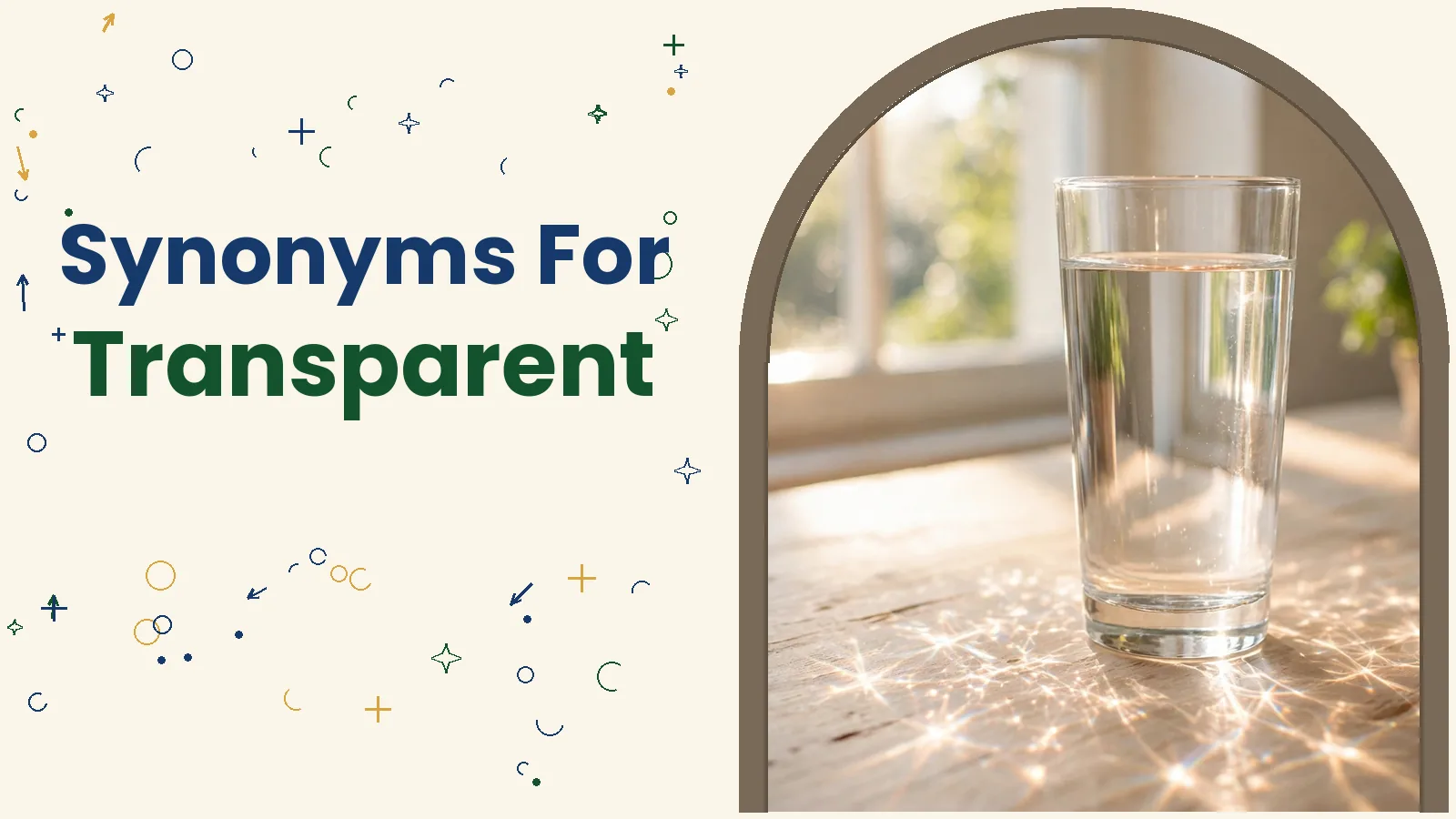
Sara held a glass of water up to the light in her kitchen in Lahore. She could see straight through it to the window behind, and her little brother laughed at the trick. That moment shows what transparent means. It describes something you can see through, like glass or clean water. It also describes a person or a plan that hides nothing. Learning synonyms for transparent helps you describe clarity in fresh ways. Instead of using one word again and again, you can pick clear, obvious, or honest and match your words to the moment. By the end, you will choose the right synonym for transparent in any sentence with ease.
Table of 20 Synonyms for Transparent
| No. | Synonym | Part of Speech | Simple Meaning |
|---|---|---|---|
| 1 | Clear | Adjective | Easy to see or understand |
| 2 | Obvious | Adjective | Easy to notice at once |
| 3 | See-through | Adjective | Lets light pass through |
| 4 | Lucid | Adjective | Clear and easy to follow |
| 5 | Plain | Adjective | Simple and easy to see |
| 6 | Open | Adjective | Hides nothing at all |
| 7 | Honest | Adjective | Truthful and sincere |
| 8 | Frank | Adjective | Direct and truthful |
| 9 | Candid | Adjective | Honest and open |
| 10 | Straightforward | Adjective | Simple and direct |
| 11 | Crystal-clear | Adjective | Perfectly clear |
| 12 | Pellucid | Adjective | Very clear and pure |
| 13 | Limpid | Adjective | Clear and calm |
| 14 | Translucent | Adjective | Lets some light through |
| 15 | Sheer | Adjective | Very thin and light |
| 16 | Diaphanous | Adjective | Fine and almost see-through |
| 17 | Glassy | Adjective | Smooth like glass |
| 18 | Unclouded | Adjective | Free of clouds or doubt |
| 19 | Evident | Adjective | Plain to see |
| 20 | Understandable | Adjective | Easy to understand |
Table of Contents
- Introduction
- Table of 20 Synonyms for Transparent
- Quick Facts About Transparent
- Meaning and Usage of Transparent
- Grammar and Sentence Patterns for Transparent
- 1. Clear
- 2. Obvious
- 3. See-through
- 4. Lucid
- 5. Plain
- 6. Open
- 7. Honest
- 8. Frank
- 9. Candid
- 10. Straightforward
- 11. Crystal-clear
- 12. Pellucid
- 13. Limpid
- 14. Translucent
- 15. Sheer
- 16. Diaphanous
- 17. Glassy
- 18. Unclouded
- 19. Evident
- 20. Understandable
- Choose the Right Synonym for Transparent
- Transparent Synonyms by Category
- Antonyms of Transparent
- Words Commonly Confused with Transparent
- Common Mistakes with Transparent
- Writing Tips for Transparent
- American vs. British English Notes for Transparent
- Practice Exercises for Transparent
- Frequently Asked Questions
- Quick Vocabulary Quiz on Transparent
- Conclusion
Quick Facts About Transparent
- Focus keyword: synonyms for transparent
- Part of speech: adjective
- Simple pronunciation guide: trans-PAR-ent
- IPA pronunciation: /trænsˈpær.ənt/
- Number of syllables: 3
- Word origin: from Latin transparere, meaning to show through
- Other word forms: transparency (noun), transparently (adverb)
- Formality level: neutral, works in casual and formal writing
- Difficulty level: easy to intermediate
- CEFR level: B1
Meaning and Usage of Transparent
Transparent describes something you can see through, like a clean window or a glass of water. It also describes ideas, plans, and people that hide nothing. A transparent price list shows every cost. A transparent leader shares the truth with the team. People use transparent for glass, water, and air, and also for honest speech and open rules. In daily life, you can call a clear explanation transparent when it leaves no doubt. Use it when you want to praise openness, or when you describe a material that light passes through.
Grammar and Sentence Patterns for Transparent
The basic pattern is subject + be + transparent, as in “The glass is transparent.” You can also place it before a noun: “a transparent plan.” It often follows words like very, fully, and completely for extra force.
Common pairings:
- transparent + noun: “a transparent bottle” (Ali bought a transparent bottle to see the water level in Karachi.)
- transparent + about: “transparent about money” (The school was transparent about money with 400 parents in Lahore.)
- transparent + in: “transparent in his dealings” (Ahmed was transparent in his dealings with 20 shop owners.)
- make something transparent: “make the rules transparent” (The team made the rules transparent for all 50 members.)
- fully transparent: “fully transparent process” (The test was a fully transparent process for 300 students.)
One common mistake is writing “transparent to see through.” The correct form is simply “transparent,” since the meaning already includes seeing through.
1. Clear
Meaning: Clear means easy to see, hear, or understand without confusion.
Examples:
- The clear water in the lake showed 10 small fish near the bank in Murree.
- A clear message from Sara told the class about the trip on Friday.
Best Used When: You describe something easy to see or understand.
Tone: Neutral and plain.
Common Collocations: clear water, clear answer, clear sky.
Connotation: Plain and direct, with a sense of ease.
When Not to Use This Word: Do not use it for a person who hides nothing in business.
2. Obvious
Meaning: Obvious means so easy to notice that nobody needs to think hard.
Examples:
- The obvious crack in the wall worried the owner of the old house in Multan.
- An obvious smile on Bilal’s face told his mother he had passed the test.
Best Used When: You describe something anyone can spot at once.
Tone: Neutral and direct.
Common Collocations: obvious answer, obvious mistake, obvious choice.
Connotation: Direct and certain, with no doubt at all.
When Not to Use This Word: Do not use it for glass or thin cloth you can see through.
3. See-through
Meaning: See-through means light passes through, so you can see what is behind.
Examples:
- The see-through bag at the airport held 3 books and a blue scarf.
- A see-through curtain in Hina’s room let the morning sun into the house.
Best Used When: You describe cloth, plastic, or glass you can see through.
Tone: Casual and simple.
Common Collocations: see-through bag, see-through dress, see-through plastic.
Connotation: Simple and visual, easy to picture.
When Not to Use This Word: Do not use it for honest people or open plans.
4. Lucid
Meaning: Lucid means clear and easy to follow, like a bright and simple idea.
Examples:
- The lucid notes helped 40 students pass the science test in Faisalabad.
- A lucid talk by the doctor explained the new medicine in 10 minutes.
Best Used When: You describe clear thinking, writing, or speech.
Tone: Formal and smart.
Common Collocations: lucid explanation, lucid dream, lucid writing.
Connotation: Bright and intelligent, with a sense of order.
When Not to Use This Word: Do not use it for glass, water, or thin cloth.
5. Plain
Meaning: Plain means simple and easy to see, with nothing hidden or fancy.
Examples:
- The plain truth about the late bus made 25 passengers angry in Rawalpindi.
- A plain sign outside the shop showed the price of bread in big letters.
Best Used When: You describe a simple truth or a clear fact.
Tone: Neutral and honest.
Common Collocations: plain truth, plain English, plain fact.
Connotation: Honest and simple, with no decoration.
When Not to Use This Word: Do not use it for water or glass you can see through.
6. Open
Meaning: Open means hiding nothing, so everyone can see or know the truth.
Examples:
- The open meeting let 60 parents ask any question in the school hall.
- An open letter from the mayor explained the new road plan in Lahore.
Best Used When: You describe honest people, talks, or rules.
Tone: Warm and friendly.
Common Collocations: open mind, open discussion, open policy.
Connotation: Warm and welcoming, with trust.
When Not to Use This Word: Do not use it for glass or a clear liquid.
7. Honest
Meaning: Honest means truthful and sincere, with no lies or tricks.
Examples:
- The honest shopkeeper returned 500 rupees to the old man in Sukkur.
- An honest report by the student told the teacher about the broken window.
Best Used When: You describe truthful people or truthful words.
Tone: Warm and respectful.
Common Collocations: honest answer, honest person, honest mistake.
Connotation: Respectful and good, full of trust.
When Not to Use This Word: Do not use it for glass, water, or thin fabric.
8. Frank
Meaning: Frank means direct and truthful in what you say, even when it is hard.
Examples:
- The frank doctor told the patient about his 3 month treatment in Karachi.
- A frank talk with her friend helped Sara fix the problem in one evening.
Best Used When: You describe plain, direct speech.
Tone: Honest and plain.
Common Collocations: frank answer, frank discussion, frank opinion.
Connotation: Honest and clear, with no hiding.
When Not to Use This Word: Do not use it for a clear liquid or thin cloth.
9. Candid
Meaning: Candid means honest and open, saying what you really think.
Examples:
- The candid interview with the singer ran for 45 minutes on the radio in Islamabad.
- A candid photo of the children playing in the park won a prize in Lahore.
Best Used When: You describe honest words or natural, unposed photos.
Tone: Formal and warm.
Common Collocations: candid answer, candid photo, candid talk.
Connotation: Natural and sincere, with no acting.
When Not to Use This Word: Do not use it for glass or clear water.
10. Straightforward
Meaning: Straightforward means simple and direct, with no tricks or confusion.
Examples:
- The straightforward guide helped Ali fix his bike in 20 minutes in Quetta.
- A straightforward question from the teacher made the whole class think hard.
Best Used When: You describe simple plans, guides, or questions.
Tone: Neutral and practical.
Common Collocations: straightforward answer, straightforward plan, straightforward person.
Connotation: Practical and clear, with no fuss.
When Not to Use This Word: Do not use it for a material you can see through.
11. Crystal-clear
Meaning: Crystal-clear means perfectly clear, like a fine crystal or pure water.
Examples:
- The crystal-clear stream in Hunza showed every stone on the river bed.
- A crystal-clear voice on the phone told Sara the exam result at 9 in the morning.
Best Used When: You describe perfect clarity in sight or sound.
Tone: Vivid and strong.
Common Collocations: crystal-clear water, crystal-clear sound, crystal-clear idea.
Connotation: Bright and pure, with a sense of perfection.
When Not to Use This Word: Do not use it for honest people or open rules.
12. Pellucid
Meaning: Pellucid means very clear and pure, so light passes through easily.
Examples:
- The pellucid lake near Skardu showed the mountains in its calm water.
- A pellucid poem by the young writer touched 200 readers at the book fair.
Best Used When: You write in a literary style about pure clarity.
Tone: Formal and literary.
Common Collocations: pellucid water, pellucid prose, pellucid sky.
Connotation: Elegant and rare, like a fine poem.
When Not to Use This Word: Do not use it in casual speech or text messages.
13. Limpid
Meaning: Limpid means clear and calm, like still water on a quiet day.
Examples:
- The limpid pool behind the farm reflected the blue sky in the morning.
- Her limpid eyes showed the joy she felt at the prize ceremony in Peshawar.
Best Used When: You describe calm, clear water or eyes in stories.
Tone: Literary and gentle.
Common Collocations: limpid water, limpid eyes, limpid pool.
Connotation: Gentle and peaceful, like a quiet morning.
When Not to Use This Word: Do not use it for honest people or business rules.
14. Translucent
Meaning: Translucent means letting some light through, but not a full clear view.
Examples:
- The translucent paper on the window softened the bright sun in the office.
- A translucent jelly sweet glowed red when Sara held it up to the lamp.
Best Used When: You describe frosted glass, thin paper, or jelly.
Tone: Neutral and exact.
Common Collocations: translucent glass, translucent skin, translucent paper.
Connotation: Soft and gentle, with a glow.
When Not to Use This Word: Do not use it when you can see fully and sharply through something.
15. Sheer
Meaning: Sheer means very thin and light, so light passes through easily.
Examples:
- The sheer curtain in the bedroom moved in the soft breeze from the sea.
- A sheer scarf of fine silk covered the bride’s hair at the wedding in Hyderabad.
Best Used When: You describe thin cloth or a fine, light material.
Tone: Elegant and soft.
Common Collocations: sheer fabric, sheer curtain, sheer dress.
Connotation: Light and delicate, with a soft touch.
When Not to Use This Word: Do not use it for honest speech or open plans.
16. Diaphanous
Meaning: Diaphanous means so fine and light that it is almost see-through.
Examples:
- The diaphanous wings of the dragonfly shone in the sun near the pond.
- A diaphanous veil of mist covered the hills above Abbottabad at dawn.
Best Used When: You describe delicate fabric, wings, or mist in writing.
Tone: Literary and delicate.
Common Collocations: diaphanous wings, diaphanous veil, diaphanous gown.
Connotation: Delicate and dreamy, like a fairytale.
When Not to Use This Word: Do not use it in everyday speech or simple writing.
17. Glassy
Meaning: Glassy means smooth and shiny like glass, often calm and clear.
Examples:
- The glassy surface of the lake showed the moon at midnight in Naran.
- His glassy eyes looked tired after the long night of study in Lahore.
Best Used When: You describe a smooth, shiny surface or calm water.
Tone: Visual and calm.
Common Collocations: glassy surface, glassy eyes, glassy water.
Connotation: Smooth and still, with a quiet shine.
When Not to Use This Word: Do not use it for honest people or open rules.
18. Unclouded
Meaning: Unclouded means free of clouds, doubt, or worry, so all is clear.
Examples:
- The unclouded sky over the desert promised a hot day in Bahawalpur.
- An unclouded mind helped the young lawyer win the case in 2 hours.
Best Used When: You describe a clear sky or a mind free of doubt.
Tone: Calm and hopeful.
Common Collocations: unclouded sky, unclouded mind, unclouded joy.
Connotation: Bright and hopeful, with no shadow.
When Not to Use This Word: Do not use it for glass or thin cloth.
19. Evident
Meaning: Evident means plain to see, so clear that anyone can notice it.
Examples:
- The evident joy on the children’s faces made the teacher smile in Sialkot.
- An evident mistake in the bill cost the shop 2,000 rupees last week.
Best Used When: You describe a fact or feeling that is plain to see.
Tone: Formal and sure.
Common Collocations: evident joy, evident mistake, evident truth.
Connotation: Sure and certain, with proof in front of you.
When Not to Use This Word: Do not use it for glass or a clear liquid.
20. Understandable
Meaning: Understandable means easy to understand, so anyone can follow it.
Examples:
- The understandable guide helped 30 new workers learn the job in a day.
- An understandable story in the book made the young readers laugh in class.
Best Used When: You describe simple words, guides, or stories.
Tone: Friendly and helpful.
Common Collocations: understandable reason, understandable guide, understandable fear.
Connotation: Helpful and kind, easy to follow.
When Not to Use This Word: Do not use it for a material you can see through.
Choose the Right Synonym for Transparent
| If you mean… | Use this word |
|---|---|
| Easy to see or understand | Clear |
| Anyone can spot it at once | Obvious |
| Light passes through cloth or plastic | See-through |
| Clear thinking or writing | Lucid |
| A simple, plain truth | Plain |
| A person or talk that hides nothing | Open |
| A truthful person | Honest |
| Perfectly clear water or sound | Crystal-clear |
| Some light passes, not a full view | Translucent |
| Thin, light cloth | Sheer |
| A fact plain to see | Evident |
| Easy to follow | Understandable |
Transparent Synonyms by Category
Clear to see: Clear, Obvious, Evident, Understandable, Plain. Use this group when the main point is easy seeing or easy understanding.
See-through materials: See-through, Translucent, Sheer, Diaphanous, Glassy, Crystal-clear, Pellucid, Limpid. Use this group when light passes through a thing.
Honest and open: Open, Honest, Frank, Candid, Straightforward. Use this group when people, words, or rules hide nothing.
Clear mind and sky: Lucid, Unclouded. Use this group when thoughts or skies are free of confusion.
Antonyms of Transparent
| # | Antonym | Simple Meaning | Example |
|---|---|---|---|
| 1 | Opaque | Blocks all light | The opaque wall kept the bright sun out of the room. |
| 2 | Cloudy | Not clear, full of mist | The cloudy water in the river hid the stones below. |
| 3 | Murky | Dark and unclear | The murky pond near the village smelled bad in summer. |
| 4 | Hidden | Kept out of sight | The hidden plan surprised the whole team in Lahore. |
| 5 | Secretive | Hides the truth | A secretive man never told his friends about his job. |
| 6 | Vague | Unclear and fuzzy | The vague answer did not help the 20 students at all. |
| 7 | Foggy | Full of fog | A foggy morning slowed the traffic on the road to Murree. |
Related Expressions: crystal clear, an open book, nothing to hide, lay all the cards on the table, clear as day.
Word Family: transparent (adjective), transparency (noun), transparently (adverb).
Words Commonly Confused with Transparent
Translucent
Difference: Translucent lets some light through but you cannot see clearly through it, while transparent lets you see fully and sharply through it.
Example: The translucent bathroom window let light in, but Sara could not see the garden through it.
Apparent
Difference: Apparent means seeming true at first sight, while transparent means truly clear and open, with nothing hidden.
Example: The apparent winner of the race changed when the judges checked the photo in Lahore.
Transference
Difference: Transference is a word from psychology about moving feelings from one person to another, while transparent is about seeing through or being open.
Example: The teacher explained transference to her 15 psychology students in Islamabad.
Parent
Difference: Parent means a mother or father, while transparent means clear or open. They share sounds, but their meanings are far apart.
Example: The parent of the young boy thanked the teacher after the prize ceremony.
Common Mistakes with Transparent
Mistake: The glass is very transparent to see through.
Correction: The glass is very transparent.
Why: Transparent already means you can see through it.
Mistake: He is a transparent liar.
Correction: He is an obvious liar.
Why: Transparent means open and honest, not easy to spot in a bad way.
Mistake: She gave a transparently answer to the class.
Correction: She gave a transparent answer to the class.
Why: Use the adjective transparent before a noun, not the adverb transparently.
Mistake: The water is transparently clear today.
Correction: The water is crystal clear today.
Why: Do not stack two clear words when one strong word is enough.
Writing Tips for Transparent
- Emails: Use straightforward for a simple, direct tone. Example phrase: “Here is a straightforward list of the costs for June.”
- Essays: Use lucid for clear thinking. Example phrase: “Her lucid argument won the debate in Lahore.”
- Blog posts: Use crystal-clear for vivid praise. Example phrase: “This crystal-clear guide will help you in 10 minutes.”
- Stories: Use limpid for a poetic touch. Example phrase: “The limpid pool mirrored the evening sky.”
- Social media: Use clear for short, warm praise. Example phrase: “Clear and simple, just the way I like it.”
American vs. British English Notes for Transparent
Transparent means the same in American and British English, and people pronounce it almost the same way. See-through is common in both places. Candid is used a little more in American writing, while straightforward is common everywhere. No real spelling difference exists for transparent or its synonyms.
Practice Exercises for Transparent
1. Fill in the blank: The ___ water in the lake showed the stones below. (Hint: clear) 2. Fill in the blank: She gave a ___ answer and hid nothing from the class. (Hint: honest) 3. Rewrite this sentence using a synonym for transparent: The glass lets you see right through it. 4. Rewrite this sentence using a formal synonym: Her clear writing helped the students a lot. 5. Match the synonym to its meaning: (a) translucent, (b) lucid, (c) sheer, (d) candid, (e) evident. Meanings: lets some light through, clear and easy to follow, very thin and light, honest and open, plain to see.
Frequently Asked Questions
What is another word for transparent?
Clear is the most common and safest choice. It works in almost every sentence where you would use transparent for clarity. Obvious fits when something is easy to spot. Honest fits when a person hides nothing. See-through fits for glass, plastic, and thin cloth. Pick the word that fits what you want to describe.
What is the closest synonym for transparent?
Clear is the closest synonym, because both words describe something easy to see or understand. Crystal-clear comes next when the clarity is perfect, like pure water. See-through is closest when you mean a material that light passes through. Each word is close, but clear matches the widest range of uses.
Can I replace transparent with clear in any sentence?
Most of the time, yes, when transparent means easy to see or understand. You can say a clear plan instead of a transparent plan. But you cannot replace transparent with clear for a person who hides nothing in a formal report. Use open or honest there. Use see-through for glass and thin cloth.
Is transparent formal or informal?
Transparent is neutral, so it works in casual chats and in formal writing too. Clear and plain are also neutral. Lucid, candid, and pellucid sound more formal. See-through and sheer sound casual. Choose the level that fits your reader and your topic.
What is the opposite of transparent?
Opaque is the simplest opposite for materials, since it means blocking all light. Cloudy and murky fit for water that you cannot see through. Secretive fits when a person hides the truth. Vague fits when words are unclear. Choose the opposite that matches what you want to say.
Quick Vocabulary Quiz on Transparent
1. Sara held a glass of water up to the light and saw straight through it. Which word fits best? A) Opaque B) Transparent C) Cloudy D) Vague 2. The team shared every cost with the parents in one open list. Which word fits best? A) Secretive B) Honest C) Murky D) Foggy 3. Her thin silk scarf let the light pass through it. Which word fits best? A) Sheer B) Opaque C) Cloudy D) Vague 4. The frosted window let in light but hid the garden view. Which word fits best? A) Transparent B) Translucent C) Clear D) Plain 5. Ali wrote a simple guide that all 30 workers could follow. Which word fits best? A) Vague B) Straightforward C) Murky D) Secretive
Conclusion
Synonyms make your vocabulary richer and your writing more alive. When you learn words like clear, honest, and crystal-clear, you can match each word to the moment and speak with more color. Context always matters, so pick the synonym that fits the feeling, the place, and the people you describe. Try these words in emails, essays, articles, and daily chats. Take the 30-second challenge: use 3 of these synonyms in your own sentences today. For the exact meaning and more examples, see the Cambridge Dictionary entry for transparent. Start small, keep going, and your English will grow stronger every day.