Featured Snippet Answer
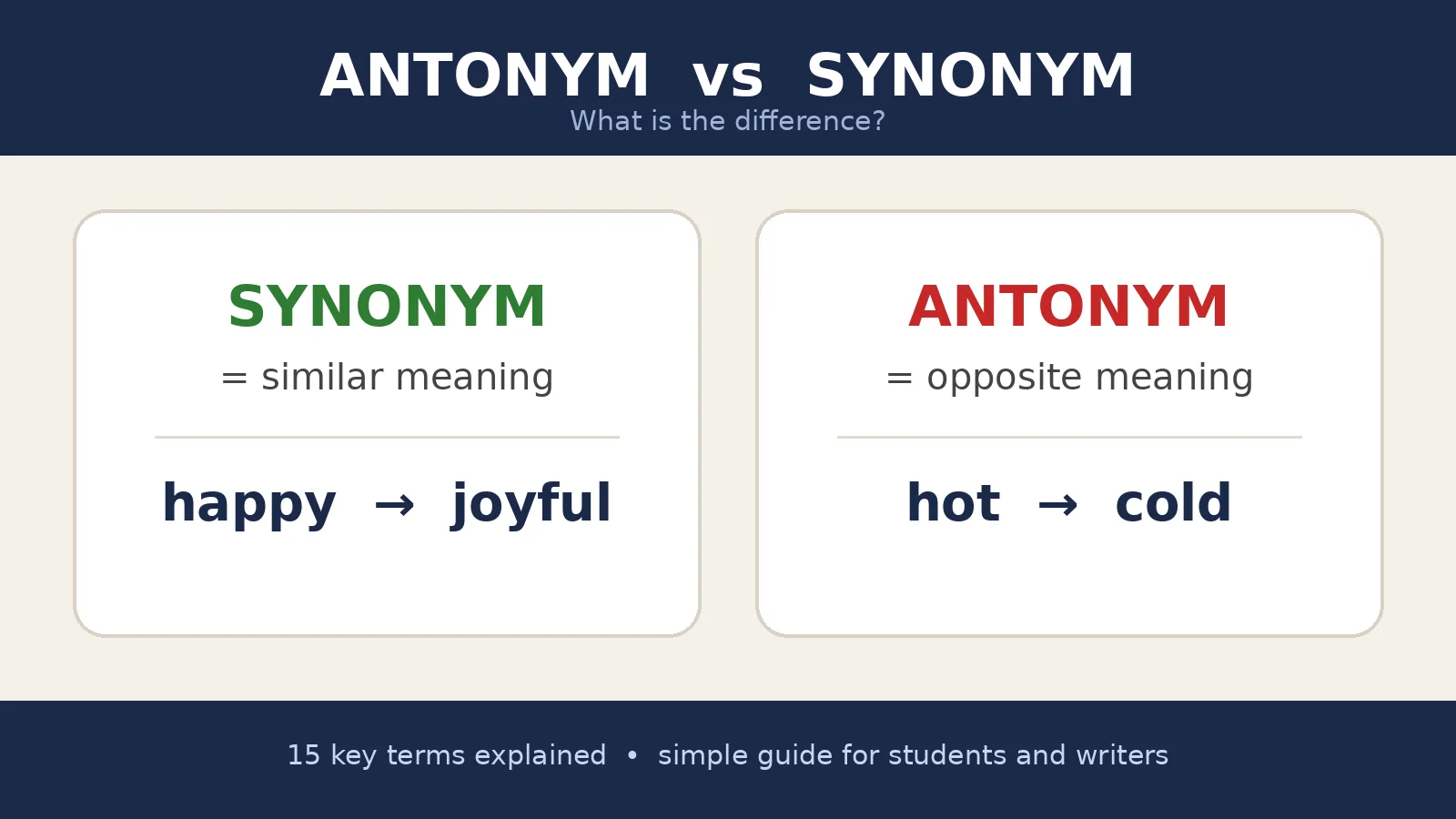
A synonym is a word with the same or almost the same meaning as another word, like big and large. An antonym is a word with the opposite meaning, like hot and cold. Synonyms help you avoid repeating words. Antonyms help you show contrast. Context decides which word fits best.
Daniel was ten minutes into his school essay when his teacher in Leeds looked over his shoulder. He had written “good” seven times. She smiled and said, “Find me a word that means good, and one that means the opposite.”
That was his first lesson in synonyms and antonyms. So, what is an antonym and synonym? A synonym is a word with a similar meaning, such as good and great. An antonym is a word with an opposite meaning, such as good and bad. Knowing both makes your writing and speaking more colorful and precise.
By the end, you will know how to spot, use, and tell apart both types of words.
Table of 12 Synonym Pairs for “What Is an Antonym and Synonym”
| No. | Synonym | Part of Speech | Simple Meaning |
|---|---|---|---|
| 1 | Big / Large | Adjective | Of great size |
| 2 | Happy / Glad | Adjective | Feeling pleased |
| 3 | Buy / Purchase | Verb | Get something with money |
| 4 | Begin / Start | Verb | Take the first step |
| 5 | Smart / Clever | Adjective | Quick to learn or think |
| 6 | Mistake / Error | Noun | Something done wrong |
| 7 | Fast / Quick | Adjective | Moving or acting at speed |
| 8 | Help / Assist | Verb | Make a task easier |
| 9 | Scared / Afraid | Adjective | Feeling fear |
| 10 | Rich / Wealthy | Adjective | Having a lot of money |
| 11 | Finish / Complete | Verb | Bring to an end |
| 12 | Little / Small | Adjective | Not large in size |
Table of Contents
- Introduction
- Table of 12 Synonym Pairs for “What Is an Antonym and Synonym”
- Quick Facts About Synonym and Antonym
- Meaning and Usage of Synonym and Antonym
- Big / Large
- Happy / Glad
- Buy / Purchase
- Begin / Start
- Smart / Clever
- Mistake / Error
- Fast / Quick
- Help / Assist
- Scared / Afraid
- Rich / Wealthy
- Finish / Complete
- Little / Small
- Antonym Pairs: Opposites With Examples
- Words Commonly Confused with Synonym and Antonym
- Frequently Asked Questions
- Conclusion
Quick Facts About Synonym and Antonym
- Focus words: synonym, antonym
- Part of speech: both are nouns
- Pronunciation guide: SIN-uh-nim (synonym), AN-tuh-nim (antonym)
- IPA: /ˈsɪnənɪm/ (synonym), /ˈæntənɪm/ (antonym)
- Syllables: 3 each
- Origin: Both come from Greek. Onyma means “name.” Syn- means “together” or “same,” so synonym means “same name.” Anti- means “against” or “opposite,” so antonym means “opposite name.”
- Other word forms: synonymous, synonymy, synonymously (synonym); antonymous, antonymy (antonym)
- Formality level: neutral
- Difficulty level: intermediate
Meaning and Usage of Synonym and Antonym
A synonym is a word that means the same, or nearly the same, as another word. An antonym is a word that means the opposite.
You will meet them in many places:
- School: vocabulary tests and reading lessons.
- Writing: blog posts, essays, and ad copy.
- Language learning: building words faster.
- Everyday talk: choosing a softer or stronger word.
Here are two natural examples:
- Mei wrote “large” instead of “big” so her 500-word report sounded less repetitive.
- Coach Ravi told his team, “Do not say weak. Say tired, and then let’s fix it.”
One key point: very few synonyms are perfect twins. Most are near-synonyms, so they share a core meaning but differ in feeling, strength, or formality.
1. Big / Large
Meaning: Two adjectives that describe something of great size.
Examples:
- Tariq ordered a large pizza with 12 slices for the match night.
- Zoe’s big brother drove 400 km to Edinburgh for her graduation.
2. Happy / Glad
Meaning: Two adjectives that describe a pleased and positive feeling.
Examples:
- Nora was glad when the 7:15 train to Manchester arrived on time.
- Kenji felt happy all day after his first piano recital.
3. Buy / Purchase
Meaning: Two verbs that mean to get something by paying for it, with purchase sounding more formal.
Examples:
- Lucy plans to buy a used bike for £80 on Saturday.
- The school will purchase 30 new laptops before September.
4. Begin / Start
Meaning: Two verbs that mean to take the first step in an action.
Examples:
- Class will begin at 9 a.m. in Room 14.
- Hamza will start his new job in Dubai on the first Monday of March.
5. Smart / Clever
Meaning: Two adjectives that describe someone quick to learn or solve problems.
Examples:
- Amelia made a clever shortcut that cut her homework time to 20 minutes.
- Sofia’s smart idea saved the team 3 days of work.
6. Mistake / Error
Meaning: Two nouns that mean something done incorrectly, with error sounding more technical.
Examples:
- Tom’s biggest mistake was leaving his passport in the Madrid hotel.
- The app showed an error after 5 failed login tries.
7. Fast / Quick
Meaning: Two adjectives that describe speed, though quick often describes short actions.
Examples:
- Usain’s car is fast, but it only goes 60 km/h inside the city.
- Priya took a quick look at the menu and ordered in 10 seconds.
8. Help / Assist
Meaning: Two verbs that mean to make a task easier for someone, with assist sounding more formal.
Examples:
- Carlos will help his mom carry 6 bags of groceries.
- A nurse at Mercy Hospital assisted the doctor during the 3-hour surgery.
9. Scared / Afraid
Meaning: Two adjectives that describe the feeling of fear.
Examples:
- Leo was scared of the dark until he turned 9.
- Hana felt afraid when the plane shook above the Alps.
10. Rich / Wealthy
Meaning: Two adjectives that describe having a lot of money or property.
Examples:
- The wealthy family in Monaco owned 3 yachts.
- Max says he is not rich, but he saved $10,000 in two years.
11. Finish / Complete
Meaning: Two verbs that mean to bring something to an end.
Examples:
- Bella will finish her 5 km run before sunrise.
- Please complete the 2-page form and hand it to Mr. Okafor.
12. Little / Small
Meaning: Two adjectives that describe something not large in size.
Examples:
- A little girl in Paris held a small umbrella over her 4-year-old brother.
- Raj lives in a small flat with just 2 rooms.
Note: These pairs are near-synonyms. In some sentences they are not interchangeable. You say “a big mistake” but not “a large mistake,” and you say “little brother” more naturally than “small brother.” Always check the sentence.
Antonym Pairs: Opposites With Examples
| # | Antonym | Simple Meaning | Example |
|---|---|---|---|
| 1 | Hot / Cold | Opposite temperatures | The tea was hot, but the soup was cold after 20 minutes. |
| 2 | Alive / Dead | Opposite states of life | Ava checked if the plant was alive after 2 weeks of no water. |
| 3 | Buy / Sell | Opposite actions in trade | Omar will buy the car, and Ben will sell it for $4,000. |
| 4 | Early / Late | Opposite times | Maria arrived early at 7:30, but Jon came late at 8:15. |
| 5 | Strong / Weak | Opposite strengths | The strong rope held 90 kg, but the weak one snapped. |
| 6 | Open / Close | Opposite actions with a door or lid | Please open the window at noon and close it at 6 p.m. |
| 7 | Always / Never | Opposite in how often | Ella always drinks water, but she never drinks soda. |
Types of antonyms: Hot/cold are gradable, so there are in-between words like warm. Alive/dead are complementary, so there is no middle. Buy/sell are relational, because one cannot happen without the other.
Words Commonly Confused with Synonym and Antonym
Homonym
Difference: Homonyms are words that sound or look the same but have different meanings. They are not about similar or opposite meanings.
Example: The word “bat” can mean a flying animal or a cricket tool.
Homophone
Difference: Homophones sound the same but have different spellings and meanings. They are neither synonyms nor antonyms.
Example: “Their” and “there” are homophones that confuse many learners.
Acronym
Difference: An acronym is a short form made from the first letters of words. People sometimes mix up the sound of “acronym” and “antonym.”
Example: NASA is an acronym for the National Aeronautics and Space Administration.
Hyponym
Difference: A hyponym is a more specific word inside a bigger group. It is a “type of” relationship, not a same-meaning one.
Example: “Poodle” is a hyponym of “dog.”
Frequently Asked Questions
What is an antonym and synonym in simple words?
A synonym is a word that means the same or almost the same as another word, like begin and start. An antonym means the opposite, like begin and end. Think of synonyms as friends with similar ideas, and antonyms as rivals with opposite ideas.
Are synonyms always exactly the same in meaning?
No. Most synonyms are only close in meaning. They often differ in strength, tone, or formality. For example, angry and furious both mean upset, but furious is much stronger. Always read your whole sentence before you swap one word for another.
Do all words have antonyms?
No. Many words have no true opposite. What is the opposite of table or banana? Antonyms mostly exist for adjectives, verbs, and some adverbs, such as hot/cold or open/close. Do not force an antonym when none fits naturally.
Can I replace any word with a synonym from a thesaurus?
Not safely. A thesaurus gives options, but not always the right fit. Saying “I am cognizant of my homework” sounds odd. A smart habit is to check one example sentence for the new word before you use it.
Why do teachers ask for both synonyms and antonyms?
They build vocabulary faster. When you learn brave, you also learn courageous (synonym) and cowardly (antonym). That makes three words from one. It also helps you understand new words by comparison, which is useful in reading tests and everyday conversation.
What is the difference between an antonym and a negative word?
An antonym is its own word, like happy and sad. A negative form adds a prefix, like happy and unhappy. Some antonyms are not exact opposites. Unhappy can mean “not happy,” while sad is a stronger, specific feeling.
Conclusion
Synonyms and antonyms make your vocabulary richer and your writing clearer. Synonyms stop you from repeating yourself, and antonyms help you compare ideas. But context matters. The closest word is not always the best one, so check how a word is used in a real sentence.
Practice them in emails, essays, articles, and conversations.