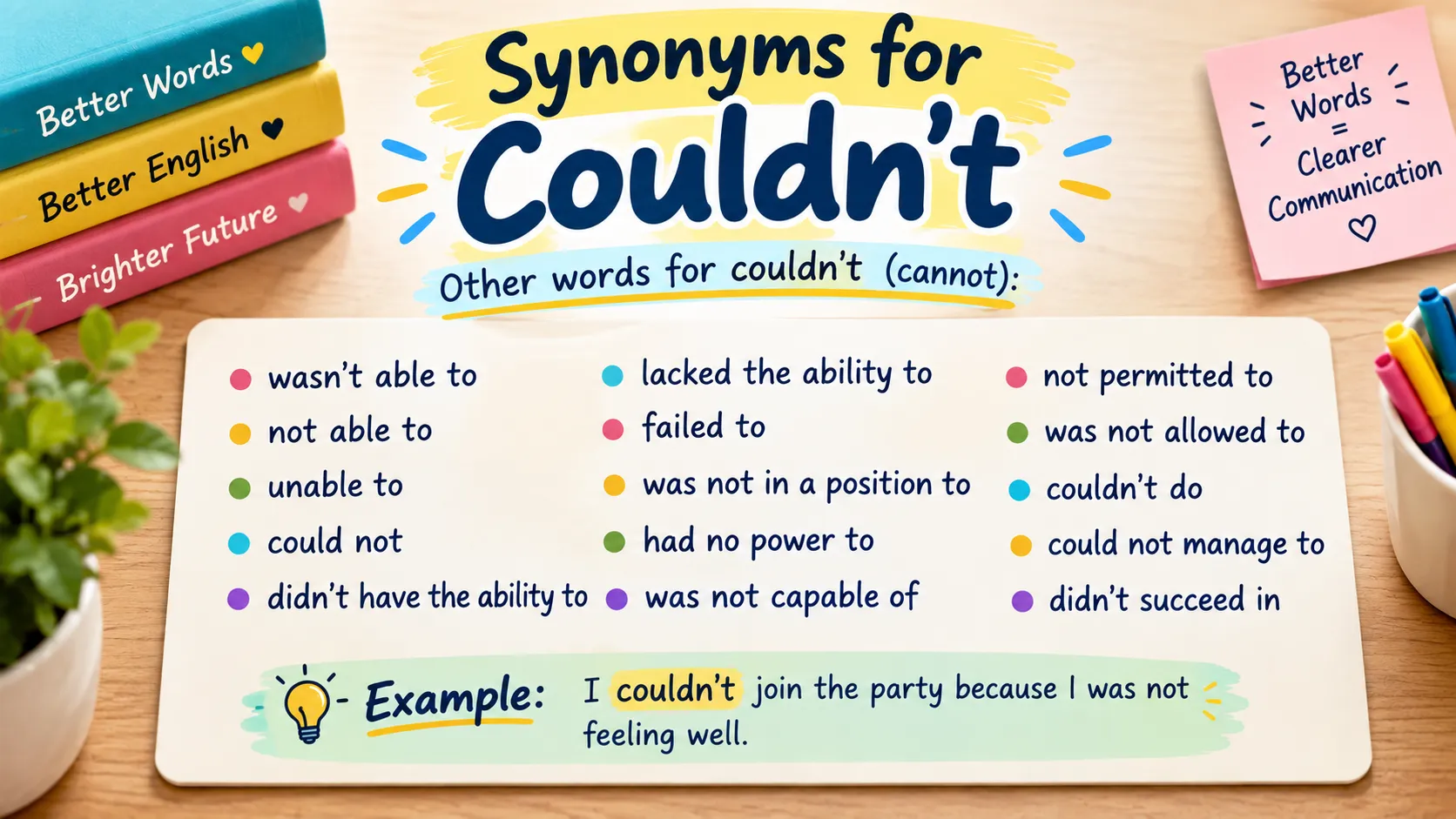
Featured Snippet Answer:
A common synonym for couldn’t is was unable to, since both phrases mean someone did not have the ability or chance to do something. Other close options include was not able to, failed to, and found it impossible to, which work well in both spoken and written English.
Have you ever noticed how often we use the word “couldn’t” in everyday speech? “I couldn’t finish the report.” “She couldn’t find her keys.” It’s such a common word that it can start to feel repetitive in writing.
Using different synonyms for couldn’t can make your sentences sound more varied and natural. This is especially helpful when you’re writing essays, stories, or emails where the same word keeps popping up.
In this article, you’ll find simple and useful synonyms for couldn’t, along with clear examples to show how each one works.
Synonyms for Couldn’t
Here’s a quick summary table of the most useful synonyms for couldn’t. Some work as direct replacements, while others fit better in specific situations.
| # | Synonym | Relationship | Direct Replacement | Difficulty | Best Used For |
|---|---|---|---|---|---|
| 1 | Was unable to | Exact synonym | Yes | Beginner | Daily conversation, writing |
| 2 | Was not able to | Exact synonym | Yes | Beginner | Daily conversation |
| 3 | Failed to | Near synonym | Sometimes | Intermediate | Business writing |
| 4 | Found it impossible to | Near synonym | Sometimes | Intermediate | Creative writing |
| 5 | Lacked the ability to | Near synonym | Sometimes | Intermediate | Academic writing |
| 6 | Was incapable of | Near synonym | Sometimes | Advanced | Formal writing |
| 7 | Was powerless to | Contextual alternative | Sometimes | Advanced | Creative writing |
| 8 | Was helpless to | Contextual alternative | Sometimes | Intermediate | Creative writing |
| 9 | Was not in a position to | Contextual alternative | Sometimes | Intermediate | Business writing |
| 10 | Was prevented from | Related term | No | Intermediate | Formal writing |
| 11 | Was unsuccessful in | Contextual alternative | Sometimes | Intermediate | Academic writing |
| 12 | Struggled to | Contextual alternative | Sometimes | Beginner | Daily conversation |
| 13 | Was hindered from | Related term | No | Advanced | Formal writing |
| 14 | Was denied the chance to | Related term | No | Intermediate | Creative writing |
| 15 | Simply could not | Exact synonym | Yes | Beginner | Daily conversation, emphasis |
Table of Contents
- Was Unable To
- Was Not Able To
- Failed To
- Found It Impossible To
- Lacked the Ability To
- Was Incapable Of
- Was Powerless To
- Was Helpless To
- Was Not in a Position To
- Was Prevented From
- Was Unsuccessful In
- Struggled To
- Was Hindered From
- Was Denied the Chance To
- Simply Could Not
Quick Facts About Couldn’t
- Focus keyword: Couldn’t
- Part of speech: Modal verb contraction (could + not)
- Simple pronunciation: KUD-uhnt
- Number of syllables: 2
- Word origin: A contraction of “could” (from Old English “cuðe,” meaning “knew how to”) and “not.”
- Other word forms: Could, cannot, can’t, couldn’t’ve
- Formality level: Informal to neutral (formal writing usually prefers “could not”)
- Difficulty level: Beginner
- CEFR level: A1
Meaning and Usage of Couldn’t
Couldn’t means someone was not able to do something. It’s the contraction of “could not” and is used to talk about a lack of ability, permission, or opportunity, usually in the past.
People use this word constantly in daily speech and casual writing. It’s common in stories, conversations, and personal messages.
For example, you might say, “I couldn’t sleep last night” or “He couldn’t finish the race because of an injury.” Both sentences show that something prevented an action from happening.
1. Was Unable To: A Synonym for Couldn’t
Relationship: Exact synonym
Direct Replacement: Yes
Difficulty Level: Beginner
Meaning: Was unable to means someone did not have the ability or opportunity to do something.
Difference: This phrase is more formal than couldn’t but means exactly the same thing.
Best Used For: Daily conversation, writing
Examples:
- “I was unable to attend the meeting because my flight got delayed.”
- “She was unable to open the jar no matter how hard she tried.”
2. Was Not Able To: A Synonym for Couldn’t
Relationship: Exact synonym
Direct Replacement: Yes
Difficulty Level: Beginner
Meaning: Was not able to means someone lacked the ability, time, or chance to do something.
Difference: This phrase is a slightly longer, more formal version of couldn’t with the same meaning.
Best Used For: Daily conversation
Examples:
- “We were not able to reach the campsite before it got dark.”
- “He was not able to explain why the printer stopped working.”
3. Failed To: A Synonym for Couldn’t
Relationship: Near synonym
Direct Replacement: Sometimes
Difficulty Level: Intermediate
Meaning: Failed to means someone tried to do something but did not succeed.
Difference: Failed to often suggests an attempt was made, while couldn’t can imply the action never started at all.
Best Used For: Business writing
Examples:
- “The company failed to deliver the shipment on time.”
- “He failed to notice the warning sign before the storm hit.”
4. Found It Impossible To: A Synonym for Couldn’t
Relationship: Near synonym
Direct Replacement: Sometimes
Difficulty Level: Intermediate
Meaning: Found it impossible to means something was so difficult that it could not be done at all.
Difference: This phrase adds emphasis, showing the task was extremely hard, while couldn’t is more neutral.
Best Used For: Creative writing
Examples:
- “She found it impossible to concentrate with the music blasting next door.”
- “They found it impossible to fix the leak without the right tools.”
5. Lacked the Ability To: A Synonym for Couldn’t
Relationship: Near synonym
Direct Replacement: Sometimes
Difficulty Level: Intermediate
Meaning: Lacked the ability to means someone did not have the skill or capacity to do something.
Difference: This phrase focuses on missing skill or capacity, while couldn’t can also refer to missing time or permission.
Best Used For: Academic writing
Examples:
- “The intern lacked the ability to operate the new software without training.”
- “He lacked the ability to lift the heavy box on his own.”
6. Was Incapable Of: A Synonym for Couldn’t
Relationship: Near synonym
Direct Replacement: Sometimes
Difficulty Level: Advanced
Meaning: Was incapable of means someone was completely unable to do something, often due to a lack of skill or resources.
Difference: This phrase sounds more formal and stronger than couldn’t, often used in serious or professional writing.
Best Used For: Formal writing
Examples:
- “The old system was incapable of handling that much data.”
- “He was incapable of hiding his disappointment after the loss.”
7. Was Powerless To: A Synonym for Couldn’t
Relationship: Contextual alternative
Direct Replacement: Sometimes
Difficulty Level: Advanced
Meaning: Was powerless to means someone had no control or ability to stop or change something.
Difference: This phrase suggests a lack of control over a situation, while couldn’t is more general.
Best Used For: Creative writing
Examples:
- “She was powerless to stop the tears once the sad music started playing.”
- “The team was powerless to prevent the merger from happening.”
8. Was Helpless To: A Synonym for Couldn’t
Relationship: Contextual alternative
Direct Replacement: Sometimes
Difficulty Level: Intermediate
Meaning: Was helpless to means someone felt unable to act or help in a difficult situation.
Difference: This phrase adds emotional weakness or vulnerability, unlike the more neutral couldn’t.
Best Used For: Creative writing
Examples:
- “He was helpless to comfort his friend during such a hard time.”
- “She was helpless to fix the situation once the damage was done.”
9. Was Not in a Position To: A Synonym for Couldn’t
Relationship: Contextual alternative
Direct Replacement: Sometimes
Difficulty Level: Intermediate
Meaning: Was not in a position to means someone did not have the authority, resources, or circumstances to do something.
Difference: This phrase often relates to circumstances or authority rather than personal ability, unlike couldn’t.
Best Used For: Business writing
Examples:
- “The manager was not in a position to approve the request without her supervisor’s sign-off.”
- “I was not in a position to comment on the ongoing investigation.”
10. Was Prevented From: A Synonym for Couldn’t
Relationship: Related term
Direct Replacement: No
Difficulty Level: Intermediate
Meaning: Was prevented from means an outside force or event stopped someone from doing something.
Difference: This phrase points to an external cause, while couldn’t can also describe a personal lack of ability.
Best Used For: Formal writing
Examples:
- “He was prevented from entering the building due to the fire alarm.”
- “The team was prevented from finishing the project because of a power outage.”
11. Was Unsuccessful In: A Synonym for Couldn’t
Relationship: Contextual alternative
Direct Replacement: Sometimes
Difficulty Level: Intermediate
Meaning: Was unsuccessful in means someone tried to do something but did not achieve the desired result.
Difference: This phrase implies an effort was made and failed, while couldn’t doesn’t always suggest an attempt happened.
Best Used For: Academic writing
Examples:
- “The researchers were unsuccessful in replicating the original results.”
- “She was unsuccessful in convincing her boss to extend the deadline.”
12. Struggled To: A Synonym for Couldn’t
Relationship: Contextual alternative
Direct Replacement: Sometimes
Difficulty Level: Beginner
Meaning: Struggled to means someone had a hard time doing something, often without fully succeeding.
Difference: Struggled to shows effort and difficulty, while couldn’t can suggest the action simply didn’t happen.
Best Used For: Daily conversation
Examples:
- “I struggled to stay awake during the long lecture.”
- “He struggled to carry all the groceries up the stairs at once.”
13. Was Hindered From: A Synonym for Couldn’t
Relationship: Related term
Direct Replacement: No
Difficulty Level: Advanced
Meaning: Was hindered from means something got in the way and made an action difficult or impossible.
Difference: This phrase focuses on an obstacle blocking progress, while couldn’t is more general and doesn’t always name a cause.
Best Used For: Formal writing
Examples:
- “The team was hindered from meeting the deadline due to supply delays.”
- “She was hindered from speaking clearly because of her sore throat.”
14. Was Denied the Chance To: A Synonym for Couldn’t
Relationship: Related term
Direct Replacement: No
Difficulty Level: Intermediate
Meaning: Was denied the chance to means someone was not given the opportunity to do something.
Difference: This phrase implies someone else blocked the opportunity, while couldn’t doesn’t always involve another person’s decision.
Best Used For: Creative writing
Examples:
- “He was denied the chance to explain his side of the story.”
- “She was denied the chance to say goodbye before he left.”
15. Simply Could Not: A Synonym for Couldn’t
Relationship: Exact synonym
Direct Replacement: Yes
Difficulty Level: Beginner
Meaning: Simply could not means the exact same thing as couldn’t, just written out in full for emphasis.
Difference: This phrase is identical in meaning but sounds slightly more formal or emphatic than the contraction.
Best Used For: Daily conversation, emphasis
Examples:
- “I simply could not believe the news when I heard it.”
- “She simply could not stop laughing during the movie.”
Antonyms of Couldn’t
Here are common antonyms, or opposite words, for couldn’t.
| # | Antonym | Simple Meaning | Example |
|---|---|---|---|
| 1 | Could | Had the ability or chance to do something | “She could finish the project early because she started ahead of time.” |
| 2 | Was able to | Had the ability or opportunity to do something | “He was able to fix the car by himself.” |
| 3 | Managed to | Succeeded in doing something despite difficulty | “They managed to catch the last train home.” |
| 4 | Succeeded in | Achieved something after trying | “She succeeded in passing the exam on her second attempt.” |
| 5 | Was capable of | Had the skill or capacity to do something | “He was capable of solving the puzzle in minutes.” |
Words Commonly Confused with Couldn’t
Couldn’t vs. Wouldn’t
Difference: Couldn’t means someone lacked the ability or chance to do something, while wouldn’t means someone refused or chose not to do something.
Example: “I couldn’t attend the party because I was sick, but he wouldn’t come even though he was free.”
Couldn’t vs. Shouldn’t
Difference: Couldn’t refers to being unable to do something, while shouldn’t refers to something not being advisable or recommended.
Example: “He couldn’t finish his homework in time, and honestly, he shouldn’t have waited so long to start.”
Couldn’t vs. Can’t
Difference: Couldn’t refers to inability in the past, while can’t refers to inability in the present or general situations.
Example: “I can’t swim now, and I couldn’t swim as a child either.”
FAQs
What is another word for couldn’t?
Some common alternatives include was unable to, was not able to, and simply could not. These phrases all describe a lack of ability or opportunity to do something, just with slightly different levels of formality.
What is the closest synonym for couldn’t?
Was unable to is considered the closest synonym, since it carries the exact same meaning and works in almost every sentence where couldn’t appears.
Can I replace couldn’t with any of these synonyms?
Yes, but not always directly. Phrases like was unable to and simply could not work as exact replacements, while others, like was prevented from or was denied the chance to, add a specific reason and shouldn’t be swapped in without context.
Is couldn’t formal or informal?
Couldn’t is a contraction, so it leans slightly informal. In formal writing, like essays or business reports, it’s common to write out “could not” instead.
What is the opposite of couldn’t?
The opposite of couldn’t is could, or phrases like was able to and managed to, which show that someone did have the ability or chance to do something.
Which synonym works best in formal writing?
Was not able to, was incapable of, and was prevented from tend to work best in formal writing, since they sound more polished than the casual contraction couldn’t.
Conclusion
Learning synonyms for couldn’t helps you avoid repeating the same phrase and adds more variety to your writing. It also lets you choose words that fit the tone you want, whether that’s casual, formal, or emotional.
Try using a few of these alternatives in your next story, email, or conversation. Paying attention to context will help you pick the phrase that fits best. Small word choices like these can make your writing feel more natural and engaging.