Featured Snippet Answer:
The closest synonym for biodegradable is degradable. Both words describe materials that break down naturally over time, often through the action of bacteria or other living organisms. Compostable and decomposable are also close, though each has a slightly different, more specific meaning.
Picture yourself in a grocery store, holding two bags. One label says “biodegradable,” and the other says “compostable.” You pause, wondering if they actually mean the same thing.
Biodegradable is a common word in product labels, science class, and environmental articles, but writers often need other ways to say it. Learning synonyms for biodegradable helps you write clearly without repeating the same word again and again.
This guide explains the closest synonyms for biodegradable, how each one is different, and when to use them. It’s especially useful for students, bloggers, and anyone writing about the environment.
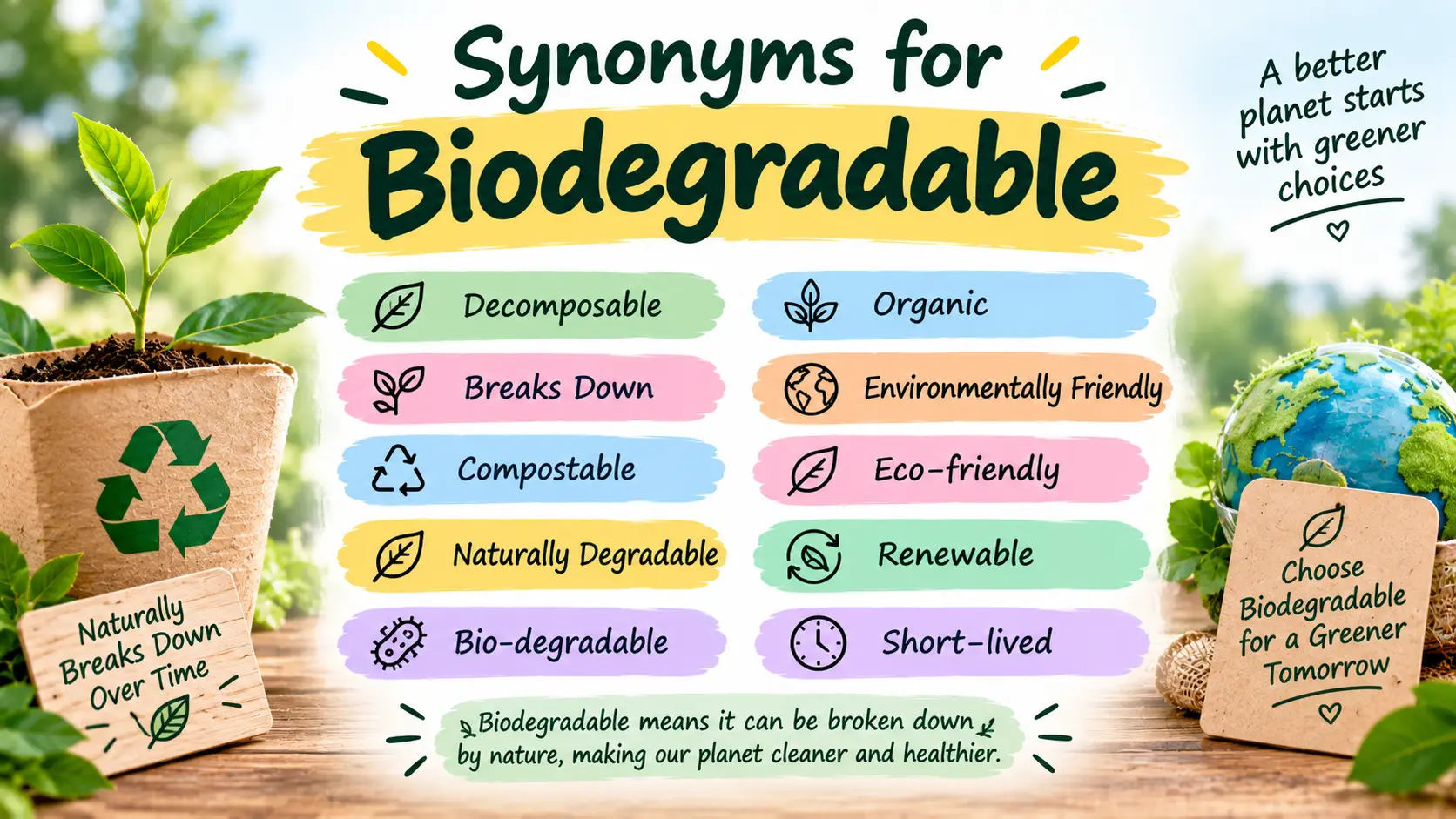
Synonyms for Biodegradable
| # | Synonym | Relationship | Direct Replacement | Difficulty | Best Used For |
|---|---|---|---|---|---|
| 1 | Degradable | Near synonym | Sometimes | Intermediate | Science writing, product labels |
| 2 | Decomposable | Near synonym | Sometimes | Intermediate | Science, environmental writing |
| 3 | Compostable | Contextual alternative | Sometimes | Beginner | Packaging, gardening |
| 4 | Bio-based | Related term | No | Advanced | Manufacturing, product design |
| 5 | Eco-friendly | Related term | No | Beginner | Marketing, everyday writing |
| 6 | Environmentally friendly | Related term | No | Beginner | Marketing, formal writing |
| 7 | Organic | Related term | No | Beginner | Food, farming, everyday writing |
| 8 | Perishable | Related term | No | Intermediate | Food storage, shipping |
| 9 | Sustainable | Related term | No | Beginner | Business, environmental writing |
| 10 | Green | Related term | No | Beginner | Marketing, casual conversation |
Table of Contents
- Degradable
- Decomposable
- Compostable
- Bio-based
- Eco-friendly
- Environmentally Friendly
- Organic
- Perishable
- Sustainable
- Green
Quick Facts About Biodegradable
- Focus keyword: biodegradable
- Part of speech: adjective
- Simple pronunciation: by-oh-dih-GRAY-duh-bul
- Number of syllables: 6
- Word origin: Formed from “bio-” (life) and “degradable” (able to break down), showing that living organisms help break the material down.
- Other word forms: biodegrade (verb), biodegradability (noun), biodegraded (adjective)
- Formality level: neutral, common in both scientific and everyday English
- Difficulty level: intermediate
- CEFR level: B2
Meaning and Usage of Biodegradable
Biodegradable describes materials that break down naturally over time, usually through the action of bacteria, fungi, or other living organisms. This process turns the material into simpler substances like water, carbon dioxide, and organic matter.
People use biodegradable most often when talking about packaging, waste, and environmental products. It’s a common word on labels for bags, utensils, and cleaning products.
Example 1: “The store switched to biodegradable bags to reduce plastic waste.” Example 2: “Food scraps are biodegradable, so they break down quickly in a compost pile.”
1. Degradable: A Synonym for Biodegradable
Relationship: Near synonym Direct Replacement: Sometimes Difficulty Level: Intermediate
Meaning: Degradable means capable of breaking down into smaller parts over time.
Difference: Degradable is a broader term and doesn’t always require living organisms, while biodegradable specifically involves natural biological processes.
Best Used For: Science writing, product labels.
Example 1: “The company advertised a new degradable plastic for its water bottles.” Example 2: “Sunlight and heat can make some materials degradable over several years.”
2. Decomposable: A Synonym for Biodegradable
Relationship: Near synonym Direct Replacement: Sometimes Difficulty Level: Intermediate
Meaning: Decomposable means able to break down and rot through natural processes.
Difference: Decomposable focuses on the breaking-down process itself, while biodegradable emphasizes that living organisms are doing the work.
Best Used For: Science, environmental writing.
Example 1: “Fallen leaves are decomposable and enrich the soil as they break down.” Example 2: “The teacher explained which classroom materials were decomposable and which were not.”
3. Compostable: A Synonym for Biodegradable
Relationship: Contextual alternative Direct Replacement: Sometimes Difficulty Level: Beginner
Meaning: Compostable means able to break down into nutrient-rich soil under composting conditions.
Difference: Compostable is more specific, since it requires the right composting environment, while biodegradable can happen in many different settings.
Best Used For: Packaging, gardening, everyday writing.
Example 1: “These compostable forks can go straight into your backyard compost bin.” Example 2: “She sorted the compostable packaging from the regular recycling.”
4. Bio-based: A Related Term for Biodegradable
Relationship: Related term Direct Replacement: No Difficulty Level: Advanced
Meaning: Bio-based means made from plant or animal materials instead of fossil fuels.
Difference: Bio-based describes what a material is made from, while biodegradable describes whether it breaks down naturally, so a product can be one without being the other.
Best Used For: Manufacturing, product design.
Example 1: “The packaging is bio-based, made mostly from cornstarch.” Example 2: “Researchers are developing bio-based alternatives to traditional plastic.”
5. Eco-friendly: A Related Term for Biodegradable
Relationship: Related term Direct Replacement: No Difficulty Level: Beginner
Meaning: Eco-friendly describes something that causes little to no harm to the environment.
Difference: Eco-friendly is a general, broad term, while biodegradable refers specifically to a material’s ability to break down naturally.
Best Used For: Marketing, everyday writing.
Example 1: “We switched to eco-friendly cleaning products for the whole house.” Example 2: “The brand markets itself as eco-friendly, using recycled materials in every product.”
6. Environmentally Friendly: A Related Term for Biodegradable
Relationship: Related term Direct Replacement: No Difficulty Level: Beginner
Meaning: Environmentally friendly means designed to reduce harm to nature and natural resources.
Difference: Environmentally friendly covers a wide range of practices, while biodegradable focuses only on how a material breaks down.
Best Used For: Marketing, formal writing.
Example 1: “The city introduced environmentally friendly buses to cut down on pollution.” Example 2: “Choosing environmentally friendly packaging was a top priority for the new brand.”
7. Organic: A Related Term for Biodegradable
Relationship: Related term Direct Replacement: No Difficulty Level: Beginner
Meaning: Organic describes something grown or made without synthetic chemicals, often related to food or farming.
Difference: Organic focuses on how something was produced, while biodegradable focuses on how it breaks down afterward.
Best Used For: Food, farming, everyday writing.
Example 1: “They only buy organic vegetables from the local farmers market.” Example 2: “The farm switched to organic methods to avoid using pesticides.”
8. Perishable: A Related Term for Biodegradable
Relationship: Related term Direct Replacement: No Difficulty Level: Intermediate
Meaning: Perishable describes something, usually food, that spoils or decays quickly if not stored properly.
Difference: Perishable focuses on spoiling quickly, often in days, while biodegradable can describe a much longer natural breakdown process.
Best Used For: Food storage, shipping.
Example 1: “Milk and meat are perishable items that need refrigeration.” Example 2: “The warehouse has a separate section for perishable goods.”
9. Sustainable: A Related Term for Biodegradable
Relationship: Related term Direct Replacement: No Difficulty Level: Beginner
Meaning: Sustainable describes practices or materials that can continue without permanently harming the environment.
Difference: Sustainable is about long-term impact and resource use, while biodegradable is specifically about a material breaking down naturally.
Best Used For: Business, environmental writing.
Example 1: “The company set a goal to use only sustainable materials by next year.” Example 2: “Sustainable farming practices help protect the soil for future generations.”
10. Green: A Related Term for Biodegradable
Relationship: Related term Direct Replacement: No Difficulty Level: Beginner
Meaning: Green is an informal word for anything that supports environmental protection.
Difference: Green is a casual, general term, while biodegradable is a more precise, technical description of how a material behaves.
Best Used For: Marketing, casual conversation.
Example 1: “More stores are going green by cutting down on plastic packaging.” Example 2: “Her new apartment building was built using green construction methods.”
Antonyms of Biodegradable
| # | Antonym | Simple Meaning | Example |
|---|---|---|---|
| 1 | Non-biodegradable | Not able to break down naturally | “Most plastic bottles are non-biodegradable and last for centuries.” |
| 2 | Non-degradable | Unable to break down over time | “The landfill was full of non-degradable waste.” |
| 3 | Persistent | Remaining in the environment for a long time | “Persistent chemicals can stay in soil for decades.” |
| 4 | Synthetic | Made artificially, often resistant to breaking down | “Synthetic fabrics don’t break down as easily as cotton.” |
| 5 | Indestructible | Unable to be destroyed or broken down | “Styrofoam is nearly indestructible in a natural environment.” |
Words Commonly Confused with Biodegradable
Compostable
Difference: Compostable materials need specific composting conditions to break down, while biodegradable materials can break down in various natural environments.
Example: “Not everything biodegradable is compostable, since composting needs the right heat and moisture.”
Recyclable
Difference: Recyclable means a material can be processed and reused, while biodegradable means it naturally breaks down over time.
Example: “The bottle is recyclable, but it isn’t biodegradable, since it doesn’t break down on its own.”
Eco-friendly
Difference: Eco-friendly is a broad term covering many environmentally conscious choices, while biodegradable refers specifically to natural breakdown.
Example: “An eco-friendly product isn’t always biodegradable, since it might just use less packaging.”
Sustainable
Difference: Sustainable describes long-term environmental impact, while biodegradable describes a specific material property.
Example: “A company can be sustainable overall while still using some materials that aren’t biodegradable.”
FAQs
What is another word for biodegradable?
Degradable is one of the closest words to biodegradable. Decomposable and compostable are also useful, though each carries a slightly different, more specific meaning.
What is the closest synonym for biodegradable?
Degradable is generally the closest match, since both describe materials that break down naturally over time through similar processes.
Can I replace biodegradable with any of these synonyms?
Not always. Words like eco-friendly or sustainable describe a broader idea, so they don’t always work as a direct replacement for biodegradable.
Is biodegradable formal or informal?
Biodegradable is neutral. It’s common in scientific writing, product labels, and everyday conversation about the environment.
What is the opposite of biodegradable?
The opposite of biodegradable is usually non-biodegradable or persistent, since these words describe materials that don’t break down naturally.
Which synonym is best for describing packaging?
For packaging, compostable or bio-based work especially well, since they describe how the material behaves or what it’s made from.
Conclusion
Learning synonyms for biodegradable helps you write more clearly about materials, waste, and the environment. Words like degradable, decomposable, and compostable each highlight a slightly different part of the same natural process.
Try using these words in your next essay, product description, or conversation about sustainability. Paying attention to context will help you choose the most accurate word every time.