Quick Answer:
The closest synonym for discombobulated is confused. Both words describe a state of mental disorder where someone can’t think clearly. “Discombobulated” is more informal and playful, while “confused” works in almost any situation, from casual chats to formal writing.
Have you ever walked into a room and instantly forgotten why you went there? That fuzzy, mixed-up feeling is exactly what “discombobulated” describes.
It’s a fun word, but using it too often can make your writing feel repetitive. That’s where synonyms for discombobulated come in handy.
Learning a few solid alternatives helps students, bloggers, and everyday English speakers sound more natural. In this guide, you’ll find simple, accurate synonyms for discombobulated, along with real examples and clear explanations of how each word is different.
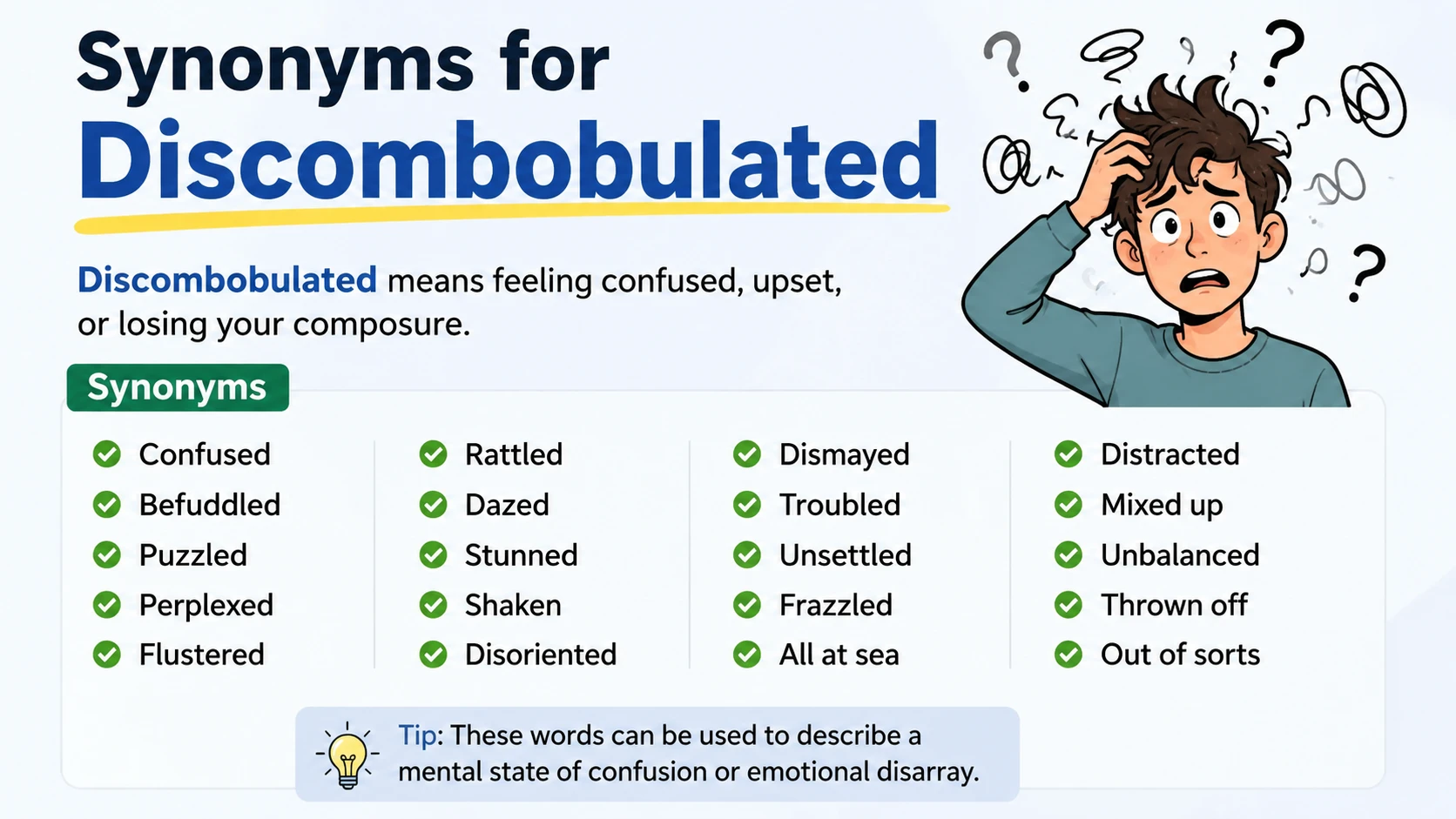
Synonyms for Discombobulated
| # | Synonym | Relationship | Direct Replacement | Difficulty | Best Used For |
|---|---|---|---|---|---|
| 1 | Confused | Exact synonym | Yes | Beginner | Daily conversation |
| 2 | Bewildered | Near synonym | Yes | Intermediate | Storytelling, creative writing |
| 3 | Disoriented | Near synonym | Yes | Intermediate | Descriptions of physical confusion |
| 4 | Perplexed | Near synonym | Sometimes | Intermediate | Academic and formal writing |
| 5 | Baffled | Near synonym | Sometimes | Intermediate | Daily conversation |
| 6 | Puzzled | Near synonym | Yes | Beginner | Daily conversation |
| 7 | Muddled | Near synonym | Yes | Intermediate | Describing unclear thinking |
| 8 | Flustered | Contextual alternative | Sometimes | Intermediate | Social or nervous situations |
| 9 | Dazed | Contextual alternative | Sometimes | Intermediate | Physical shock or surprise |
| 10 | Befuddled | Exact synonym | Yes | Advanced | Informal, humorous writing |
| 11 | Discomposed | Near synonym | Sometimes | Advanced | Formal or literary writing |
| 12 | Rattled | Contextual alternative | Sometimes | Intermediate | Stressful situations |
| 13 | Frazzled | Contextual alternative | Sometimes | Intermediate | Tiredness combined with confusion |
| 14 | Disconcerted | Near synonym | Sometimes | Advanced | Formal writing |
| 15 | Addled | Near synonym | Sometimes | Advanced | Informal, older-fashioned tone |
Table of Contents
- Introduction
- Meaning and Usage of Discombobulated
- Synonyms for Discombobulated
- Confused
- Bewildered
- Disoriented
- Perplexed
- Baffled
- Puzzled
- Muddled
- Flustered
- Dazed
- Befuddled
- Discomposed
- Rattled
- Frazzled
- Disconcerted
- Addled
- Antonyms of Discombobulated
- Words Commonly Confused with Discombobulated
- Frequently Asked Questions
- Conclusion
Quick Facts About Discombobulated
- Focus keyword: Discombobulated
- Part of speech: Adjective (past participle of the verb “discombobulate”)
- Simple pronunciation: dis-kum-BOB-yoo-lay-ted
- Number of syllables: 7
- Word origin: American English, from the 1800s. It was likely invented as a playful, mock-formal version of words like “discompose” or “discomfit.”
- Other word forms: discombobulate (verb), discombobulation (noun)
- Formality level: Informal
- Difficulty level: Advanced
Meaning and Usage of Discombobulated
Discombobulated means feeling confused, disoriented, or thrown off balance mentally. It usually describes a temporary state, not a permanent trait.
People often use it in casual conversation, since it has a playful, almost humorous tone. It fits situations like getting lost, facing a sudden change, or feeling mentally scattered.
Example 1: “After the long flight and the time difference, I felt completely discombobulated.”
Example 2: “The sudden fire alarm left the whole class discombobulated for a few minutes.”
1. Confused: A Synonym for Discombobulated
Relationship: Exact synonym
Direct Replacement: Yes
Difficulty Level: Beginner
Meaning: Confused means unable to think clearly or understand something properly.
Difference: “Confused” is more neutral and common, while “discombobulated” sounds more playful and informal.
Best Used For: Daily conversation, academic writing, business writing.
Examples: “I got confused halfway through the instructions and had to start again.” “She looked confused when the teacher changed the assignment last minute.”
2. Bewildered: A Synonym for Discombobulated
Relationship: Near synonym
Direct Replacement: Yes
Difficulty Level: Intermediate
Meaning: Bewildered means completely puzzled or confused, often by something unexpected.
Difference: “Bewildered” carries a stronger sense of surprise than “discombobulated.”
Best Used For: Storytelling, creative writing, daily conversation.
Examples: “He looked bewildered when he saw the crowd waiting outside his house.” “The tourists seemed bewildered by the confusing subway map.”
3. Disoriented: A Synonym for Discombobulated
Relationship: Near synonym
Direct Replacement: Yes
Difficulty Level: Intermediate
Meaning: Disoriented means losing your sense of direction, time, or surroundings.
Difference: “Disoriented” focuses more on physical or spatial confusion, while “discombobulated” can describe mental confusion in general.
Best Used For: Descriptions of physical confusion, medical or travel contexts.
Examples: “I felt disoriented after waking up in an unfamiliar hotel room.” “Spinning around too fast on the ride left the kids disoriented.”
4. Perplexed: A Synonym for Discombobulated
Relationship: Near synonym
Direct Replacement: Sometimes
Difficulty Level: Intermediate
Meaning: Perplexed means confused because something is difficult to understand or explain.
Difference: “Perplexed” sounds more formal and intellectual than “discombobulated.”
Best Used For: Academic writing, business writing.
Examples: “The professor looked perplexed by the strange results of the experiment.” “I was perplexed by the confusing terms in the contract.”
5. Baffled: A Synonym for Discombobulated
Relationship: Near synonym
Direct Replacement: Sometimes
Difficulty Level: Intermediate
Meaning: Baffled means totally confused because something doesn’t make sense.
Difference: “Baffled” often implies a stronger, more complete confusion than “discombobulated.”
Best Used For: Daily conversation, creative writing.
Examples: “The mechanic was baffled by the strange noise coming from the engine.” “I’m baffled by how quickly he finished such a difficult puzzle.”
6. Puzzled: A Synonym for Discombobulated
Relationship: Near synonym
Direct Replacement: Yes
Difficulty Level: Beginner
Meaning: Puzzled means confused because you can’t figure something out.
Difference: “Puzzled” is lighter and simpler than “discombobulated,” and it’s used more often in everyday speech.
Best Used For: Daily conversation, teaching contexts.
Examples: “She looked puzzled when the math problem didn’t match the answer key.” “He was puzzled by the sudden change in his friend’s mood.”
7. Muddled: A Synonym for Discombobulated
Relationship: Near synonym
Direct Replacement: Yes
Difficulty Level: Intermediate
Meaning: Muddled means unclear or confused, especially in thinking or planning.
Difference: “Muddled” focuses more on messy thinking, while “discombobulated” can also describe emotional or physical confusion.
Best Used For: Describing unclear thinking, writing feedback.
Examples: “My thoughts felt muddled after staying up all night studying.” “The instructions were so muddled that nobody understood the next step.”
8. Flustered: A Synonym for Discombobulated
Relationship: Contextual alternative
Direct Replacement: Sometimes
Difficulty Level: Intermediate
Meaning: Flustered means nervous and confused, usually because of pressure or embarrassment.
Difference: “Flustered” adds a nervous, anxious feeling that “discombobulated” doesn’t always include.
Best Used For: Social situations, workplace conversations.
Examples: “She got flustered when everyone stared at her during the presentation.” “He felt flustered trying to answer three questions at once.”
9. Dazed: A Synonym for Discombobulated
Relationship: Contextual alternative
Direct Replacement: Sometimes
Difficulty Level: Intermediate
Meaning: Dazed means stunned or unable to think clearly, often after a shock or surprise.
Difference: “Dazed” usually follows a sudden event, while “discombobulated” can happen gradually too.
Best Used For: Physical shock or surprise, storytelling.
Examples: “He looked dazed after bumping his head on the low doorway.” “The players seemed dazed after the unexpected loss.”
10. Befuddled: A Synonym for Discombobulated
Relationship: Exact synonym
Direct Replacement: Yes
Difficulty Level: Advanced
Meaning: Befuddled means confused, often in a way that feels foggy or slow.
Difference: “Befuddled” shares almost the same playful tone as “discombobulated,” making them very close in meaning.
Best Used For: Informal, humorous writing.
Examples: “Grandpa looked befuddled trying to set up his new phone.” “I was completely befuddled by the plot twist in that movie.”
11. Discomposed: A Synonym for Discombobulated
Relationship: Near synonym
Direct Replacement: Sometimes
Difficulty Level: Advanced
Meaning: Discomposed means unsettled or thrown off one’s usual calm state.
Difference: “Discomposed” is more formal and literary than “discombobulated.”
Best Used For: Formal or literary writing.
Examples: “The witness appeared discomposed under the lawyer’s sharp questioning.” “She felt momentarily discomposed by the unexpected compliment.”
12. Rattled: A Synonym for Discombobulated
Relationship: Contextual alternative
Direct Replacement: Sometimes
Difficulty Level: Intermediate
Meaning: Rattled means nervous and confused, usually because of a stressful event.
Difference: “Rattled” leans more toward being shaken emotionally, while “discombobulated” is more about mental confusion.
Best Used For: Stressful situations, sports and competition contexts.
Examples: “The pitcher looked rattled after giving up three runs in a row.” “That phone call really rattled me before the meeting.”
13. Frazzled: A Synonym for Discombobulated
Relationship: Contextual alternative
Direct Replacement: Sometimes
Difficulty Level: Intermediate
Meaning: Frazzled means exhausted and confused, usually from stress or too many tasks.
Difference: “Frazzled” combines tiredness with confusion, while “discombobulated” is mainly about confusion alone.
Best Used For: Describing stress or busy schedules.
Examples: “By Friday afternoon, the whole team looked frazzled.” “Juggling three deadlines left her completely frazzled.”
14. Disconcerted: A Synonym for Discombobulated
Relationship: Near synonym
Direct Replacement: Sometimes
Difficulty Level: Advanced
Meaning: Disconcerted means confused and slightly worried because of something unexpected.
Difference: “Disconcerted” includes a hint of worry or discomfort that “discombobulated” doesn’t always carry.
Best Used For: Formal writing, professional communication.
Examples: “He seemed disconcerted by the sudden change in the meeting agenda.” “The unexpected question left the speaker briefly disconcerted.”
15. Addled: A Synonym for Discombobulated
Relationship: Near synonym
Direct Replacement: Sometimes
Difficulty Level: Advanced
Meaning: Addled means confused, often to the point of not thinking straight.
Difference: “Addled” has an older-fashioned tone and is often used humorously, similar to “discombobulated.”
Best Used For: Informal, older-fashioned tone, creative writing.
Examples: “My addled brain couldn’t remember where I parked the car.” “He gave an addled excuse that didn’t make any sense.”
Antonyms of Discombobulated
| # | Antonym | Simple Meaning | Example |
|---|---|---|---|
| 1 | Composed | Calm and in control of your emotions | “She stayed composed even during the stressful interview.” |
| 2 | Collected | Calm and organized in your thinking | “He remained cool and collected under pressure.” |
| 3 | Calm | Free from confusion or stress | “The teacher stayed calm despite the noisy classroom.” |
| 4 | Clear-headed | Able to think clearly and logically | “A good night’s sleep left her clear-headed for the exam.” |
| 5 | Focused | Able to concentrate without distraction | “He stayed focused throughout the entire meeting.” |
| 6 | Unfazed | Not disturbed or confused by something | “She stayed unfazed by the last-minute changes.” |
| 7 | Oriented | Aware of your surroundings and situation | “After a few minutes, he felt fully oriented again.” |
Words Commonly Confused with Discombobulated
Confusing
Difference: “Confusing” describes something that causes confusion, while “discombobulated” describes how a person feels.
Example: “The confusing map made everyone feel discombobulated.”
Bewildering
Difference: “Bewildering” describes a situation, while “discombobulated” describes a person’s state of mind.
Example: “It was a bewildering day, and I felt completely discombobulated by the end of it.”
Disorientated
Difference: “Disorientated” is simply the British English version of “disoriented.” It doesn’t mean anything different, unlike “discombobulated,” which has its own distinct tone.
Example: “She felt disorientated after the long train journey.”
Flustrated
Difference: “Flustrated” is a nonstandard blend of “flustered” and “frustrated.” It isn’t considered correct English, unlike “discombobulated,” which is an accepted informal word.
Example: Avoid using “flustrated” in writing; use “flustered” or “frustrated” instead.
Decompose
Difference: “Decompose” means to break down or rot, and it has no connection to confusion at all. Some learners confuse it with “discombobulate” simply because the words sound similar.
Example: “The fallen leaves began to decompose after a few weeks.”
FAQS
What is another word for discombobulated?
“Confused” is the most common and simplest alternative. It works in almost any context, from casual conversation to formal writing, and carries the same basic meaning without the playful tone.
What is the closest synonym for discombobulated?
“Confused” and “befuddled” are the closest matches. “Confused” is more neutral, while “befuddled” keeps the same lighthearted, informal feeling as “discombobulated.”
Can I replace discombobulated with disoriented? Yes, in most cases. “Disoriented” works especially well when describing physical confusion, like losing your sense of direction, rather than general mental confusion.
Is discombobulated formal or informal?
“Discombobulated” is informal. It’s common in casual speech and lighthearted writing, but it’s usually avoided in academic papers, official reports, or formal business documents.
What is the opposite of discombobulated?
“Composed” and “clear-headed” are strong opposites. Both describe a calm, focused state of mind, which is the direct opposite of feeling discombobulated.
Which synonym works best in academic writing?
“Perplexed” or “disconcerted” are better choices for academic or professional writing, since they sound more formal than “discombobulated,” “befuddled,” or “addled.”
Conclusion
Learning synonyms for discombobulated makes your vocabulary stronger and more flexible. Instead of repeating the same word, you can choose one that matches the exact tone you need, whether that’s playful, formal, or emotional.
Try using words like “bewildered,” “perplexed,” or “flustered” in your next email, essay, or conversation. Paying attention to context will help you pick the perfect word every time.