Featured Snippet Answer
The closest synonym for studies is education. Both words refer to the process of learning, especially in school or university. “Education” is slightly broader and more formal, while “studies” often points to a specific subject or program, such as “graduate studies” or “language studies.”
Think about the last time you told someone, “I’m busy with my studies this week.” It’s a phrase almost every student uses. But repeating the same word again and again can make your writing feel flat.
Studies simply means the activity of learning, especially through reading, research, or coursework. For example, someone might say, “Her studies in biology led her to a career in medicine.”
Learning synonyms for studies helps you sound more natural and avoid repetition in essays, emails, and conversations. It also helps you match the right word to the right situation, If you’re talking about school, university, or personal research.
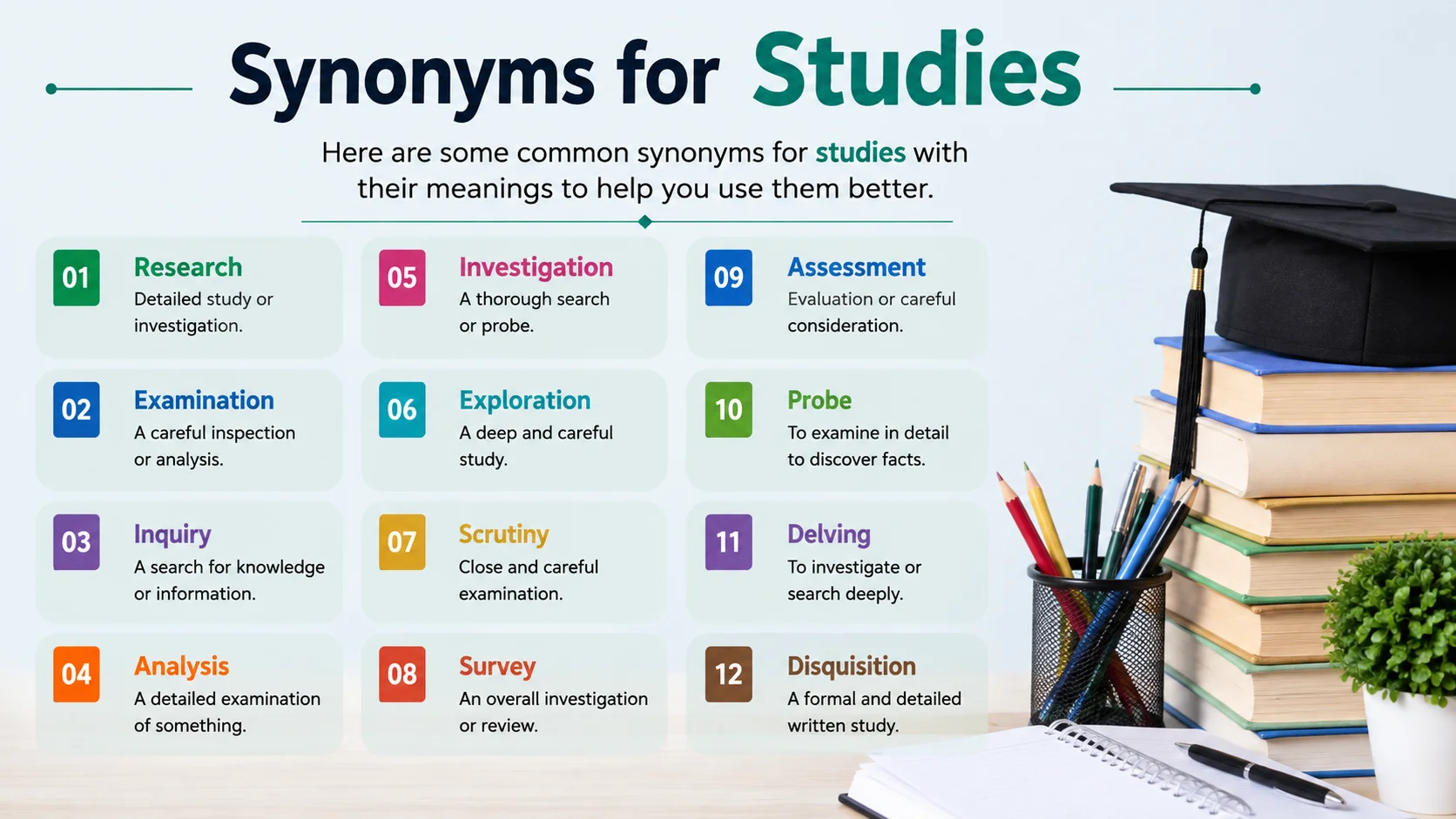
Synonyms for Studies
| # | Synonym | Relationship | Direct Replacement | Difficulty | Best Used For |
| 1 | Education | Near synonym | Sometimes | Beginner | Academic, daily conversation |
| 2 | Coursework | Near synonym | Sometimes | Intermediate | Academic writing |
| 3 | Schooling | Near synonym | Sometimes | Beginner | Daily conversation |
| 4 | Academics | Near synonym | Sometimes | Intermediate | Academic, business writing |
| 5 | Learning | Contextual alternative | Sometimes | Beginner | Daily conversation, academic writing |
| 6 | Training | Contextual alternative | Sometimes | Beginner | Business, daily conversation |
| 7 | Lessons | Contextual alternative | Sometimes | Beginner | Daily conversation |
| 8 | Schoolwork | Near synonym | Yes | Beginner | Daily conversation |
| 9 | Classes | Contextual alternative | Sometimes | Beginner | Daily conversation, academic writing |
| 10 | Research | Contextual alternative | Sometimes | Intermediate | Academic, technical writing |
| 11 | Curriculum | Related term | No | Intermediate | Academic writing |
| 12 | Instruction | Related term | No | Intermediate | Academic, formal writing |
| 13 | Scholarship | Related term | No | Advanced | Academic writing |
| 14 | Academia | Related term | No | Advanced | Academic writing |
Table of Contents
- Introduction
- Meaning and Usage
- Synonyms for Studies
- Education
- Coursework
- Schooling
- Academics
- Learning
- Training
- Lessons
- Schoolwork
- Classes
- Research
- Curriculum
- Instruction
- Scholarship
- Academia
- Antonyms
- Commonly Confused Words
- Frequently Asked Questions
- Conclusion
Quick Facts About Studies
- Focus keyword: Studies
- Part of speech: Noun (plural form of “study”)
- Simple pronunciation guide: STUH-deez
- IPA pronunciation: /ˈstʌdiz/
- Number of syllables: 2
- Word origin: From the Latin word studium, meaning “eagerness” or “application to learning.” It came into English through Old French in the 13th century.
- Other word forms: Study (singular noun/verb), Studied (past tense), Studying (present participle), Studious (adjective)
- Formality level: Neutral to formal
- Difficulty level: Beginner to intermediate
- CEFR level: A2–B1
Meaning and Usage of Studies
Studies refers to the activity of learning about a subject, usually through reading, classes, or research. It can describe a person’s overall education or a specific area they are learning about.
It’s commonly used in phrases like:
- “Graduate studies” or “language studies” for a specific field
- “My studies are going well” to describe school or university progress
- “Scientific studies” to describe research work
Examples:
- He decided to continue his studies in engineering after finishing high school.
- Her studies kept her busy every evening this semester.
1. Education: A Synonym for Studies
Relationship: Near synonym
Direct Replacement: Sometimes
Difficulty Level: Beginner
Meaning: Education refers to the process of teaching and learning, especially in schools.
Difference: Education is broader and refers to the whole system of learning, while studies often points to a specific subject or personal effort.
Best Used For:
- Academic writing
- Daily conversation
Examples:
- She values education more than anything else in life.
- His parents saved money for years to support his education abroad.
2. Coursework: A Synonym for Studies
Relationship: Near synonym
Direct Replacement: Sometimes
Difficulty Level: Intermediate
Meaning: Coursework refers to the assignments and tasks completed as part of a class or program.
Difference: Coursework focuses specifically on assignments and class tasks, while studies can refer to learning in a more general sense.
Best Used For:
- Academic writing
Examples:
- She spent the whole weekend finishing her coursework before the deadline.
- His coursework included essays, group projects, and lab reports.
3. Schooling: A Synonym for Studies
Relationship: Near synonym
Direct Replacement: Sometimes
Difficulty Level: Beginner
Meaning: Schooling refers to the education a person receives, especially during childhood or early years.
Difference: Schooling usually refers to formal education at school, while studies can apply to any level, including university or personal research.
Best Used For:
- Daily conversation
Examples:
- His early schooling took place in a small village school.
- Good schooling gave her the confidence to apply for university.
4. Academics: A Synonym for Studies
Relationship: Near synonym
Direct Replacement: Sometimes
Difficulty Level: Intermediate
Meaning: Academics refers to schoolwork or subjects related to formal education.
Difference: Academics often describes school performance in general, while studies can point to a specific subject someone is focused on.
Best Used For:
- Academic writing
- Business writing
Examples:
- He struggled to balance academics with his part-time job.
- Her strong academics helped her earn a scholarship.
5. Learning: A Synonym for Studies
Relationship: Contextual alternative
Direct Replacement: Sometimes
Difficulty Level: Beginner
Meaning: Learning refers to the process of gaining knowledge or skills.
Difference: Learning is a broader term that includes studies but also covers informal ways of gaining knowledge, like experience or observation.
Best Used For:
- Daily conversation
- Academic writing
Examples:
- Online learning made it easier for her to study while working full-time.
- His love of learning started when he was very young.
6. Training: A Synonym for Studies
Relationship: Contextual alternative
Direct Replacement: Sometimes
Difficulty Level: Beginner
Meaning: Training refers to the process of learning skills needed for a job or activity.
Difference: Training focuses on practical skills for a task or career, while studies often relates to academic subjects.
Best Used For:
- Business writing
- Daily conversation
Examples:
- She completed six months of training before starting her nursing job.
- The company offers training for new employees every month.
7. Lessons: A Synonym for Studies
Relationship: Contextual alternative
Direct Replacement: Sometimes
Difficulty Level: Beginner
Meaning: Lessons refers to individual periods of teaching or instruction on a topic.
Difference: Lessons usually refers to shorter, specific teaching sessions, while studies can describe an entire course or subject area.
Best Used For:
- Daily conversation
Examples:
- He takes piano lessons every Tuesday after school.
- Her Spanish lessons helped her feel confident during the trip.
8. Schoolwork: A Synonym for Studies
Relationship: Near synonym
Direct Replacement: Yes
Difficulty Level: Beginner
Meaning: Schoolwork refers to tasks or assignments given by a school or teacher.
Difference: Schoolwork usually refers to tasks for younger students, while studies can apply to older students or adults in any learning stage.
Best Used For:
- Daily conversation
Examples:
- She finished her schoolwork before dinner so she could relax later.
- His parents check his schoolwork every evening.
9. Classes: A Synonym for Studies
Relationship: Contextual alternative
Direct Replacement: Sometimes
Difficulty Level: Beginner
Meaning: Classes refers to scheduled sessions where students are taught a subject.
Difference: Classes points to the actual sessions attended, while studies refers to the overall effort or subject area being learned.
Best Used For:
- Daily conversation
- Academic writing
Examples:
- Her classes start early, so she wakes up before sunrise.
- He signed up for extra classes to improve his writing skills.
10. Research: A Synonym for Studies
Relationship: Contextual alternative
Direct Replacement: Sometimes
Difficulty Level: Intermediate
Meaning: Research refers to careful investigation into a subject to discover new facts.
Difference: Research focuses on discovering new information, while studies can simply mean learning existing material.
Best Used For:
- Academic writing
- Technical writing
Examples:
- Her research on climate change was published in a science journal.
- The team spent months on research before writing their final report.
11. Curriculum: A Related Term for Studies
Relationship: Related term
Direct Replacement: No
Difficulty Level: Intermediate
Meaning: Curriculum refers to the full set of subjects or courses taught in a school or program.
Difference: Curriculum describes the structure of what is being taught, while studies describes the actual act of learning it.
Best Used For:
- Academic writing
Examples:
- The new curriculum includes more hands-on science projects.
- Teachers reviewed the curriculum before the school year began.
12. Instruction: A Related Term for Studies
Relationship: Related term
Direct Replacement: No
Difficulty Level: Intermediate
Meaning: Instruction refers to the act of teaching or giving detailed information.
Difference: Instruction focuses on the teaching side, while studies focuses on the learner’s effort and progress.
Best Used For:
- Academic writing
- Formal writing
Examples:
- The manual provides clear instruction for beginners.
- Her music instruction started when she was only six years old.
13. Scholarship: A Related Term for Studies
Relationship: Related term
Direct Replacement: No
Difficulty Level: Advanced
Meaning: Scholarship refers to serious academic study and knowledge in a specific field.
Difference: Scholarship usually describes advanced, expert-level academic work, while studies can describe learning at any level.
Best Used For:
- Academic writing
Examples:
- His scholarship in ancient history earned him respect among professors.
- The award recognized her scholarship in environmental science.
14. Academia: A Related Term for Studies
Relationship: Related term
Direct Replacement: No
Difficulty Level: Advanced
Meaning: Academia refers to the environment or community of scholars, teachers, and researchers.
Difference: Academia describes the world or setting of higher learning, while studies describes the actual activity of learning within it.
Best Used For:
- Academic writing
Examples:
- She decided to stay in academia instead of joining a company.
- Life in academia often means long hours of reading and writing.
Antonyms of Studies
True opposites of “studies” are limited, since it describes an activity rather than a fixed quality. However, these words describe the opposite of spending time learning:
| # | Antonym | Simple Meaning | Example |
| 1 | Leisure | Free time without work or study | She spent her leisure time reading novels instead of textbooks. |
| 2 | Recreation | Activities done for fun or relaxation | Weekend recreation helped him recover from a stressful week of exams. |
| 3 | Play | Activity done for enjoyment, not learning | The children chose play over homework after school. |
| 4 | Idleness | The state of doing nothing productive | Long periods of idleness made him fall behind in his coursework. |
| 5 | Relaxation | Rest without mental effort | After finals, she needed a full week of relaxation. |
Words Commonly Confused with Studies
Study (singular)
Difference: “Study” can mean a single act of learning, a single research paper, or even a room used for reading and work. “Studies” usually refers to an ongoing, broader learning process.
Example: He built a small study in his house where he reads every evening.
Research
Difference: Research means investigating a topic to find new facts, while studies can simply mean learning existing information without discovering anything new.
Example: Her research uncovered new details about ancient trade routes.
Education
Difference: Education refers to the whole system or process of teaching and learning, while studies usually points to a specific subject or personal effort.
Example: Public education should be accessible to every child.
Studious (adjective)
Difference: “Studious” describes a person who studies a lot, while “studies” is the noun for the activity itself.
Example: She has always been a studious student who reads ahead of class.
Frequently Asked Questions
What is another word for studies?
A common alternative is education. It refers to the overall process of learning, though “studies” often points to a specific subject, like “medical studies” or “language studies.”
What is the closest synonym for studies?
Education is usually the closest match. Both words relate to learning, though studies can be more specific to a subject or program.
Can I replace studies with research in every sentence?
Not always. Research focuses on discovering new information, while studies can simply describe learning existing material through classes or reading.
Is studying formal or informal?
Studies are neutral to formal. It works well in academic writing, resumes, and everyday conversation about school or learning.
What is the opposite of studies?
Words like leisure, recreation, and play describe activities that are the opposite of spending time learning or working on coursework.
Which synonym is best for talking about university programs?
Coursework or academics work best for university programs, since they describe structured learning tied to a specific school or subject.
Conclusion
Using different synonyms for studies makes your writing sound more natural and less repetitive. Words like education, coursework, and academics each carry a slightly different meaning, so choosing the right one improves clarity.
Try using these words in your next email, essay, or conversation about school or learning. Paying attention to context will help you choose the best word every time.
The more you practice these words, the more confident and natural your English will become.