Quick Answer
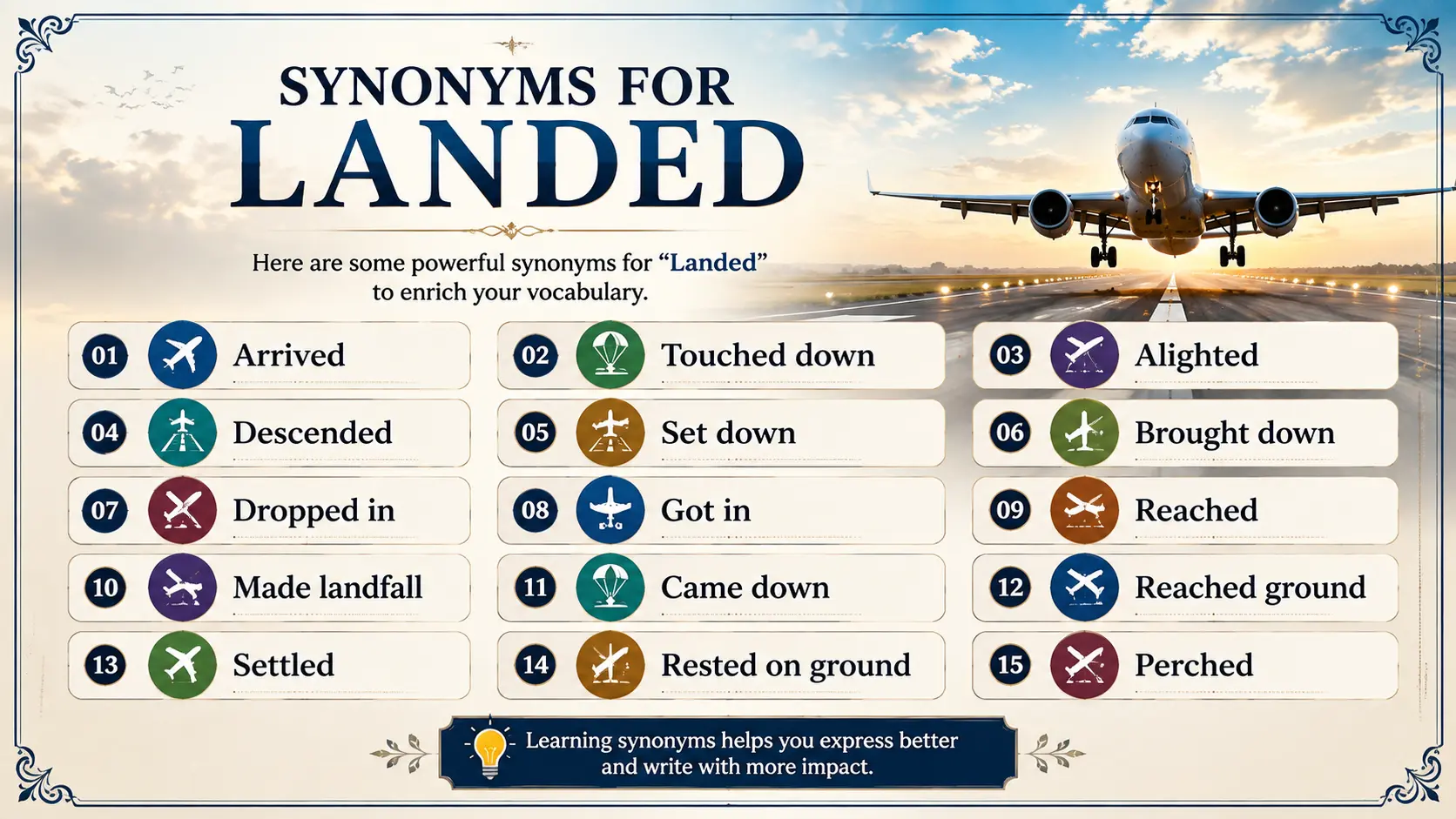
Synonyms for “landed” include arrived, touched down, alighted, disembarked, docked, settled, and reached. These words describe coming to rest on a surface after travel by air, sea, or land. The best choice depends on whether you mean a plane, a ship, a person, or an object.
Why “Landed” Matters in Everyday English
Have you ever written the same sentence three times because you kept repeating the word “landed”? You are not alone. This word shows up in travel stories, news reports, school essays, and daily chats about flights and trips.
“Landed” means to arrive somewhere and come to rest, usually after moving through the air or across water. A plane lands at an airport. A bird lands on a branch. A ship lands at a port. Learning strong alternatives for “landed” helps students write better essays, helps bloggers keep readers interested, and helps professionals sound more precise in reports and emails.
This guide gives you accurate, natural synonyms for landed, with clear meanings, real examples, and simple usage tips. You will also learn which words fit formal writing and which ones sound better in casual conversation.
Pronunciation
IPA: /ˈlæn.dɪd/
Pronounced as: LAN-did
The stress falls on the first syllable. Say “LAN” with a short “a” sound, then add “did” softly.
Part of Speech
Landed is most often used as a verb (past tense of “land”).
- Verb: The plane landed safely at noon.
- Adjective: Landed gentry once controlled most of the region. (This older use describes owning land, and it is far less common today.)
This guide focuses on the verb form, since that is what most people search for.
Grammar Usage Notes
“Landed” usually pairs with a preposition to show place or manner.
Common patterns:
- landed on (a surface) — The plane landed on the runway.
- landed at (a location) — We landed at Heathrow.
- landed in (a country or city) — They landed in Tokyo.
Common mistake:
Mistake: The bird landed on the tree. Correction: The bird landed on the tree. Explanation: Use “on” for a surface, not “to.” “To” shows direction, but “landed” already includes the idea of arrival, so “on” fits the resting place better.
Synonyms Overview Table
| Synonym | Strength | Formality |
| Arrived | Strong | Neutral |
| Touched down | Strong | Neutral |
| Alighted | Strong | Formal |
| Disembarked | Strong | Formal |
| Docked | Related | Neutral |
| Berthed | Related | Formal |
| Grounded | Related | Neutral |
| Settled | Related | Neutral |
| Reached | Strong | Neutral |
| Descended | Related | Neutral |
| Deplaned | Strong | Neutral |
| Anchored | Related | Neutral |
| Perched | Related | Informal |
| Roosted | Related | Informal |
| Beached | Related | Neutral |
| Made landfall | Strong | Formal |
| Set down | Strong | Neutral |
| Came to rest | Strong | Neutral |
| Pulled in | Related | Informal |
| Got in | Strongest | Informal |
| Hit the ground | Related | Informal |
| Made it | Related | Informal |
| Came ashore | Strong | Neutral |
| Touched ground | Strong | Neutral |
| Put down | Related | Informal |
Choose the Right Synonym
Not every synonym fits every situation. Use this quick comparison to pick the best word for your sentence.
Arrived vs. Landed: “Arrived” works for any type of travel, including cars and trains. “Landed” is specific to planes, birds, or ships. If you mean a general trip, choose “arrived.” If a plane touched the runway, “landed” or “touched down” fits better.
Docked vs. Landed: “Docked” is only for ships and boats at a harbor. Do not use “docked” for a plane or a person jumping down. Save it strictly for water travel.
Disembarked vs. Landed: “Disembarked” describes people getting off a ship, plane, or train. “Landed” describes the vehicle itself arriving. A plane lands; passengers then disembark from it.
Main Content: Detailed Synonyms
Arrived
Meaning: To come to a place after traveling.
Examples:
- Our flight arrived two hours late because of the storm.
- She arrived at the office before anyone else.
Best Used When: You want a general, simple word for reaching a destination by any method of travel.
Tone: Neutral
Common Collocations: arrived safely, arrived on time, newly arrived
CEFR Level: A2
Touched Down
Meaning: When a plane lands on the ground.
Examples:
- The jet touched down smoothly despite the strong winds.
- Passengers cheered when the aircraft touched down after the long flight.
Best Used When: You are describing an airplane specifically, especially in news or travel writing.
Tone: Neutral
Common Collocations: touched down safely, touched down early, just touched down
Alighted
Meaning: To get down from something or land gently, like a bird.
Examples:
- A sparrow alighted on the windowsill for a moment.
- The queen alighted from her carriage in front of the crowd.
Best Used When: You want a graceful, slightly old-fashioned word for a bird landing or a person stepping down.
Tone: Formal / Literary
Common Collocations: alighted gracefully, alighted from the train
Register: This word appears often in literature and formal writing, not casual speech.
Disembarked
Meaning: To get off a ship, plane, or other large vehicle.
Examples:
- Tourists disembarked from the cruise ship at dawn.
- The soldiers disembarked quickly once the boat reached shore.
Best Used When: You are writing about passengers leaving a large vehicle, not the vehicle arriving itself.
Tone: Formal
Common Collocations: disembarked from the ship, safely disembarked
When Not to Use This Word: Do not use “disembarked” for the vehicle itself. A ship does not “disembark.” Passengers disembark from the ship.
Docked
Meaning: When a ship stops and ties up at a harbor.
Examples:
- The cargo ship docked at the port just before sunrise.
- We watched as the ferry docked near the old lighthouse.
Best Used When: You need a word strictly for boats or ships arriving at a harbor or pier.
Tone: Neutral
Common Collocations: docked at the harbor, safely docked
Berthed
Meaning: When a ship is given a specific spot to stop at a port.
Examples:
- The tanker berthed at pier seven for unloading.
- The old naval ship remains berthed as a museum today.
Best Used When: You want a more technical, nautical word than “docked,” often used in shipping or naval contexts.
Tone: Formal
Common Collocations: berthed at the dock, permanently berthed
Frequency: Uncommon in everyday speech, common in maritime writing.
Grounded
Meaning: Forced to stay on the ground, or brought down to land.
Examples:
- Heavy fog grounded all flights at the airport for six hours.
- The pilot grounded the small plane safely in the field.
Best Used When: You mean a forced or emergency stop, not a routine, planned arrival.
Tone: Neutral
Common Collocations: grounded due to weather, grounded flights
Settled
Meaning: To come down and rest in one place after moving.
Examples:
- Dust settled on the furniture after the storm.
- The helicopter settled gently onto the rooftop pad.
Best Used When: You want to describe a slow, calm arrival, often for something light or an object.
Tone: Neutral
Common Collocations: settled softly, finally settled
Reached
Meaning: To arrive at a place after traveling some distance.
Examples:
- The hikers reached the summit just before noon.
- Our package reached its destination in three days.
Best Used When: You want a broad word for arriving anywhere, by any method, including on foot.
Tone: Neutral
Common Collocations: reached the destination, finally reached
Descended
Meaning: To move downward, often before landing.
Examples:
- The plane descended slowly through the clouds before landing.
- Climbers descended the mountain as the weather changed.
Best Used When: You want to describe the downward motion just before or during landing, not the moment of arrival itself.
Tone: Neutral
Common Collocations: descended rapidly, descended into the valley
Deplaned
Meaning: To get off an airplane after it lands.
Examples:
- Business travelers deplaned quickly to catch their next flight.
- We deplaned and walked straight to baggage claim.
Best Used When: You are writing specifically about passengers leaving an aircraft, often in airline or travel contexts.
Tone: Neutral
Common Collocations: deplaned at the gate, quickly deplaned
American vs. British English: “Deplaned” is common in American English. British English often prefers “got off the plane” or “disembarked.”
Anchored
Meaning: When a ship stops using a heavy weight to hold it in place, without necessarily reaching a dock.
Examples:
- The sailboat anchored in the quiet bay overnight.
- Fishing boats anchored near the reef at dawn.
Best Used When: A ship stops in open water rather than at a pier or dock.
Tone: Neutral
Common Collocations: anchored offshore, safely anchored
Perched
Meaning: To land and sit on a narrow or high spot, usually said of birds.
Examples:
- The owl perched silently on the fence post.
- A pigeon perched on the edge of the balcony rail.
Best Used When: You are describing a bird or small creature resting on something narrow, like a branch or wire.
Tone: Informal / Descriptive
Common Collocations: perched on a branch, perched high above
Roosted
Meaning: When a bird settles somewhere to rest or sleep, often at night.
Examples:
- The hens roosted in the barn as the sun went down.
- Crows roosted along the power lines every evening.
Best Used When: You want a word specific to birds settling for rest, especially at nightfall.
Tone: Informal
Common Collocations: roosted for the night, roosted together
Beached
Meaning: To come to rest on a shore, often referring to a boat or sea creature stuck on sand.
Examples:
- The small canoe beached itself on the sandy shore.
- A whale beached near the coastal town, worrying local residents.
Best Used When: Something from the water ends up stuck or resting on land, sometimes unexpectedly.
Tone: Neutral
Common Collocations: beached whale, accidentally beached
Made Landfall
Meaning: When a ship, storm, or aircraft reaches land after being over water.
Examples:
- The hurricane made landfall near the coast early Tuesday.
- The explorers’ ship made landfall after weeks at sea.
Best Used When: You are writing about storms or long sea voyages reaching shore, often in news reports.
Tone: Formal
Common Collocations: made landfall overnight, expected to make landfall
Set Down
Meaning: To bring something, often a vehicle, gently to the ground.
Examples:
- The helicopter set down carefully in the open field.
- The pilot set the small plane down on the grass strip.
Best Used When: You want a simple phrase for a controlled, gentle landing.
Tone: Neutral
Common Collocations: set down gently, set down safely
Came to Rest
Meaning: To finally stop moving and settle in one place.
Examples:
- The glider came to rest in an empty field beside the road.
- After the bumpy landing, the plane came to rest near the terminal.
Best Used When: You want to emphasize the final moment of stillness after motion.
Tone: Neutral
Common Collocations: finally came to rest, came to rest gently
Pulled In
Meaning: To arrive and stop, often used for boats, trains, or vehicles.
Examples:
- The ferry pulled in right on schedule.
- Our train pulled in ten minutes late.
Best Used When: You want a casual, spoken-style phrase for arrival.
Tone: Informal
Common Collocations: pulled in early, just pulled in
Got In
Meaning: A casual way to say something arrived.
Examples:
- Our flight got in around midnight.
- The delivery truck got in just before the store closed.
Best Used When: You are speaking casually or texting a friend about arrival times.
Tone: Informal / Spoken
Common Collocations: got in late, finally got in
Hit the Ground
Meaning: An informal way to describe landing, sometimes suggesting speed or force.
Examples:
- The paratrooper hit the ground and rolled to soften the impact.
- The small drone hit the ground harder than expected.
Best Used When: You want to suggest a fast, sudden, or forceful landing.
Tone: Informal
Common Collocations: hit the ground running, hit the ground hard
Made It
Meaning: A casual phrase meaning someone or something successfully arrived.
Examples:
- We made it to the airport just in time.
- The rescue team made it to the stranded hikers before dark.
Best Used When: You want to stress relief or success in reaching a destination, not the technical act of landing.
Tone: Informal
Common Collocations: finally made it, barely made it
Came Ashore
Meaning: To move from water onto land.
Examples:
- The fishermen came ashore before the storm hit.
- Sea turtles came ashore at night to lay their eggs.
Best Used When: Something or someone moves specifically from sea or water onto solid ground.
Tone: Neutral
Common Collocations: came ashore safely, came ashore at dawn
Touched Ground
Meaning: The exact moment a flying object reaches the ground.
Examples:
- The parachute touched ground gently in the open meadow.
- The rocket booster touched ground miles from the launch site.
Best Used When: You want to highlight the precise instant of contact with the earth.
Tone: Neutral
Common Collocations: barely touched ground, touched ground safely
Put Down
Meaning: A casual way to describe a controlled landing, often for small aircraft.
Examples:
- The pilot put the plane down in an empty field during the emergency.
- She put the helicopter down right beside the hospital.
Best Used When: You want an informal, spoken phrase for landing a small aircraft under control.
Tone: Informal
Common Collocations: put down safely, put it down smoothly
Synonym Categories
Strongest Synonyms
Arrived, Touched down, Alighted, Disembarked, Got in, Reached, Made landfall
Strong Synonyms
Deplaned, Set down, Came to rest, Beached, Came ashore, Touched ground
Related Words
Docked, Berthed, Grounded, Settled, Descended, Anchored, Perched, Roosted, Pulled in, Hit the ground, Made it, Put down
Commonly Confused Words
| Word | Difference | Example |
| Landed vs. Arrived | “Landed” is specific to planes, birds, or ships; “arrived” fits any travel method. | The train arrived (not landed) on time. |
| Docked vs. Anchored | “Docked” means tied to a pier; “anchored” means stopped in open water. | The yacht anchored offshore instead of docking at the busy pier. |
| Disembarked vs. Landed | “Landed” describes the vehicle; “disembarked” describes the people leaving it. | The plane landed, and then passengers disembarked. |
| Alighted vs. Perched | “Alighted” is the act of landing; “perched” describes sitting on something narrow after landing. | The bird alighted on the fence, then perched there for an hour. |
| Grounded vs. Landed | “Grounded” often implies a forced or emergency stop; “landed” can be routine. | Storms grounded the flight before it could even take off. |
Common Mistakes
Mistake: The ship landed at the harbor. Correction: The ship docked at the harbor. Explanation: “Landed” fits planes, birds, or people arriving on land. For ships at a harbor, native speakers usually say “docked” or “came into port.”
Mistake: She landed from the train. Correction: She got off the train. Explanation: “Landed” describes coming down from the air or water onto a surface. Trains move on land, so “landed” does not apply here.
Writing Tips
Using varied synonyms for “landed” makes your writing feel more skilled and natural. Here is how to apply them across different situations.
Essays work best with “arrived” or “reached” for general travel, saving “touched down” for airplane-specific scenes.
Emails stay clear when you keep it simple with “arrived” or “got in” while confirming travel plans with colleagues.
Blog posts gain more color when you mix in vivid words like “alighted” or “made landfall” for travel stories.
Stories feel more vivid with words like “perched,” “roosted,” or “came to rest” to paint a clearer picture for readers.
Social media posts sound natural and friendly with casual phrases like “got in” or “made it.”
Professional communication calls for neutral, precise words like “arrived,” “docked,” or “disembarked.”
Daily conversation flows best with relaxed phrases like “got in,” “pulled in,” and “made it.”
Mini Practice Exercises
Fill in the blank: Choose the best synonym for each sentence.
- The cruise ship _______ at the port early this morning. (docked / perched)
- A robin _______ on the garden fence and sang. (alighted / disembarked)
- Our flight _______ two hours behind schedule. (anchored / arrived)
- The hurricane is expected to _______ near the coast tonight. (make landfall / roost)
Answers: 1. docked, 2. alighted, 3. arrived, 4. make landfall
Related Vocabulary
Antonyms: departed, took off, left, launched
Related Expressions: touch down, come in for a landing, make it to shore, pull into port
Similar Vocabulary: arrival, approach, descent, landing
Word Family: land (noun/verb), landing (noun), lander (noun, as in a spacecraft lander)
FAQs
What is another word for landed on a plane?
The most common alternatives are “touched down” and “arrived.” “Touched down” is specific to aircraft reaching the runway, while “arrived” works for the entire journey ending. Both sound natural in travel writing, news reports, and everyday conversation about flights.
What do you call it when a bird lands?
You can say a bird “alighted,” “perched,” or “roosted.” “Alighted” describes the moment of landing, “perched” describes sitting on something narrow afterward, and “roosted” usually refers to settling down to rest, often at night.
Is “docked” the same as “landed”?
No. “Docked” is used only for ships and boats stopping at a harbor or pier. “Landed” applies to planes, birds, and general arrivals. Using “docked” for a plane or “landed” for a ship sounds incorrect to most English speakers.
What is a formal word for landed?
“Disembarked,” “alighted,” and “made landfall” all sound more formal than “landed.” These words appear often in academic writing, news articles, and literature, while everyday speech tends to favor simpler words like “arrived” or “got in.”
What is a casual synonym for landed?
Casual options include “got in,” “pulled in,” and “made it.” These phrases sound natural in text messages, quick conversations, and informal blog posts, but they may sound too relaxed for formal reports or academic essays.
Can “settled” mean the same as “landed”?
Yes, in certain contexts. “Settled” works well for something coming down gently, like dust, snow, or a helicopter. It suggests a slow, calm arrival rather than a sudden or forceful one, so it fits softer landing scenes.
Conclusion
Learning synonyms for landed gives your writing more color and precision. Instead of repeating the same word, you can now choose from arrived, touched down, alighted, disembarked, docked, and many more, depending on exactly what is arriving and how.
Better vocabulary leads to better writing, clearer speaking, and stronger communication overall. Try using these landed synonyms in your next email, essay, or story, and notice how much more natural and confident your English sounds.