What Is Mild?
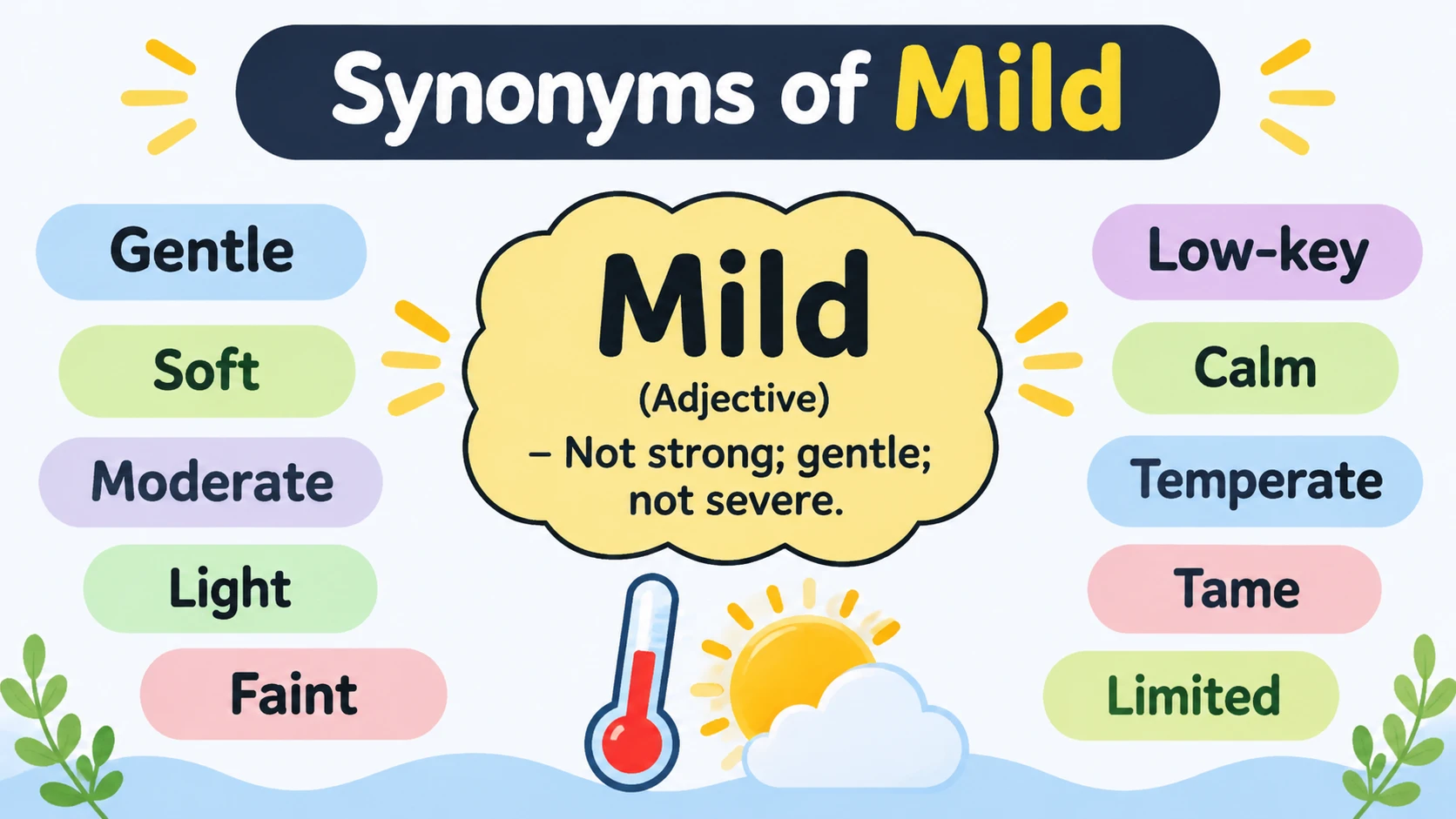
Mild describes something gentle, soft, or not extreme. The closest synonym is gentle, because both words mean “not harsh.” Other common synonyms include soft, moderate, light, and temperate. You can use mild for weather, food, medicine, or a person’s personality.
Priya was planning a trip to Lisbon in March. She wrote “the weather will be mild” in three emails to her friends. Then she noticed the repeat and thought, “There must be a better word.”
There is. Mild is a useful word, but it has many close cousins. Words like gentle, balmy, and lenient can say the same idea with more color.
Learning synonyms for mild helps you avoid repeating yourself. It also helps you pick the exact shade of meaning you want. A mild curry, a mild winter, and a mild teacher are not quite the same thing.
By the end, you will know 18 alternatives and exactly when to use each one.
Table of 18 Synonyms for Mild
| No. | Synonym | Part of Speech | Simple Meaning |
|---|---|---|---|
| 1 | Gentle | Adjective | Soft and kind, not rough |
| 2 | Soft | Adjective | Not loud, strong, or harsh |
| 3 | Moderate | Adjective | Not too much or too little |
| 4 | Light | Adjective | Small in amount or force |
| 5 | Temperate | Adjective | Neither very hot nor cold |
| 6 | Balmy | Adjective | Pleasantly warm and soft |
| 7 | Clement | Adjective | Mild and pleasant (weather) |
| 8 | Mellow | Adjective | Smooth, soft, and relaxed |
| 9 | Placid | Adjective | Calm and not easily upset |
| 10 | Easygoing | Adjective | Relaxed and easy to please |
| 11 | Lenient | Adjective | Not strict about punishment |
| 12 | Slight | Adjective | Small in degree |
| 13 | Faint | Adjective | Weak and hard to notice |
| 14 | Subtle | Adjective | Delicate and not obvious |
| 15 | Delicate | Adjective | Light and fine in flavor |
| 16 | Benign | Adjective | Harmless, not serious |
| 17 | Tender | Adjective | Gentle and caring |
| 18 | Meek | Adjective | Quiet and gentle (can sound weak) |
Table of Contents
- Introduction
- Table of 18 Synonyms for Mild
- Quick Facts About Mild
- Meaning and Usage of Mild
- Grammar and Sentence Patterns for Mild
- Gentle
- Soft
- Moderate
- Light
- Temperate
- Balmy
- Clement
- Mellow
- Placid
- Easygoing
- Lenient
- Slight
- Faint
- Subtle
- Delicate
- Benign
- Tender
- Meek
- Choose the Right Synonym for Mild
- Mild Synonyms by Category
- Antonyms of Mild
- Words Commonly Confused with Mild
- Common Mistakes with Mild
- Writing Tips for Mild
- American vs. British English Notes for Mild
- Practice Exercises for Mild
- Frequently Asked Questions
- Quick Vocabulary Quiz on Mild
- Conclusion
Quick Facts About Mild
- Focus word: mild
- Part of speech: adjective
- Pronunciation guide: rhymes with “child”
- IPA: /maɪld/
- Syllables: 1
- Origin: From Old English milde, meaning gentle or kind
- Other word forms: mildly (adverb), mildness (noun)
- Formality level: neutral
- Difficulty level: easy
- CEFR level: around B1
Meaning and Usage of Mild
Mild means not strong, not harsh, and not extreme. It tells the reader that something is gentle or low in force.
You will see it in many places:
- Weather: a mild winter, a mild breeze
- Food: mild cheddar, a mild salsa
- Health: a mild headache, mild symptoms
- People: a mild-mannered teacher
- Reactions: mild surprise, a mild protest
Here are two natural examples:
- Karachi had a mild evening in December, around 20°C.
- Omar ordered the mild curry because his little sister hates spice.
Grammar and Sentence Patterns for Mild
Mild is an adjective. It usually comes before a noun, or after a linking verb like is or feels.
Basic pattern: subject + be + mild / mild + noun
- The winter is mild.
- She gave a mild answer.
Common pairings to get right:
- gentle with (people, animals): Be gentle with the puppy.
- lenient on / with (rules, people): The judge was lenient on first-time offenders.
- moderate in (habits, tastes): Ravi is moderate in his spending.
- mild for (a time or season): It was mild for January.
- mildly + adjective: I was mildly annoyed.
Frequent mistake: Saying “lenient to the rules.” Say “lenient about the rules” or “lenient with students.”
1. Gentle
Meaning: Gentle means soft and kind, without anything rough or harsh.
Examples:
- Dr. Fatima has a gentle voice that calms her patients.
- A gentle 5 km walk along the canal suits my grandfather.
Best Used When: You want to describe kind people, soft touches, or easy movement.
Tone: warm, neutral
Common Collocations: gentle breeze, gentle touch, gentle reminder
2. Soft
Meaning: Soft describes something that is not loud, bright, or strong.
Examples:
- Lena played soft jazz while cooking dinner for six friends.
- The soft glow of a lamp lit Ahmed’s study at 11 p.m.
Best Used When: You describe sounds, light, colors, or textures that are low in force.
Tone: casual, gentle
Common Collocations: soft light, soft voice, soft music
3. Moderate
Meaning: Moderate means in the middle, not too much and not too little.
Examples:
- The Lahore forecast called for moderate rain, about 15 mm.
- Tom does moderate exercise for 30 minutes every morning.
Best Used When: You are measuring amounts, levels, or effort in a balanced way.
Tone: neutral, formal
Common Collocations: moderate temperature, moderate pace, moderate risk
4. Light
Meaning: Light means small in amount, weight, or force.
Examples:
- A light drizzle fell on Edinburgh during our 2 p.m. tour.
- Sana had a light lunch before her 3 o’clock exam.
Best Used When: You describe weather, meals, touch, or work that is not heavy.
Tone: casual, neutral
Common Collocations: light rain, light meal, light breeze
5. Temperate
Meaning: Temperate describes a climate or place that is never very hot or very cold.
Examples:
- Vancouver has a temperate climate, rarely above 25°C.
- New Zealand’s temperate weather makes hiking pleasant for Maria in April.
Best Used When: You write about climate, regions, or long-term weather.
Tone: formal, scientific
Common Collocations: temperate climate, temperate zone, temperate region
6. Balmy
Meaning: Balmy describes weather that is warm in a soft, pleasant way.
Examples:
- We ate dinner outside on a balmy night in Goa.
- A balmy 24°C afternoon made Jake leave his jacket at home.
Best Used When: You describe warm, gentle evenings or tropical breezes.
Tone: literary, pleasant
Common Collocations: balmy evening, balmy breeze, balmy weather
7. Clement
Meaning: Clement describes weather that is mild and pleasant.
Examples:
- The clement weather in Seville let the festival run all 10 days.
- Because of clement conditions, the ferry to Capri left on time.
Best Used When: You need a formal word for good, gentle weather.
Tone: formal, slightly old-fashioned
Common Collocations: clement weather, clement conditions, clement climate
8. Mellow
Meaning: Mellow means smooth, soft, and relaxed.
Examples:
- The café in Istanbul served a mellow coffee that Zara loved.
- After two weeks off, Daniel felt mellow and calm.
Best Used When: You describe flavors, sounds, light, or relaxed moods.
Tone: casual, friendly
Common Collocations: mellow flavor, mellow mood, mellow tune
9. Placid
Meaning: Placid means calm and not easily upset or disturbed.
Examples:
- The placid lake near Murree barely moved at dawn.
- Her placid baby slept through all 12 hours of the flight.
Best Used When: You describe still water or very calm people and animals.
Tone: literary, calm
Common Collocations: placid lake, placid nature, placid smile
10. Easygoing
Meaning: Easygoing describes a person who is relaxed and hard to upset.
Examples:
- My manager, Hassan, is easygoing about deadlines.
- Chloe’s easygoing roommate never minds a messy kitchen.
Best Used When: You describe a laid-back personality.
Tone: casual, friendly
Common Collocations: easygoing attitude, easygoing person, easygoing nature
11. Lenient
Meaning: Lenient means not strict, especially when giving punishment or following rules.
Examples:
- The judge was lenient and gave Marcus a 6-month sentence instead of two years.
- Ms. Khan is lenient with late homework during exam week.
Best Used When: You describe rules, teachers, parents, or punishments.
Tone: formal, neutral
Common Collocations: lenient sentence, lenient policy, lenient with
12. Slight
Meaning: Slight means small in degree and not very important.
Examples:
- Imran had a slight cold on Tuesday but went to work.
- There was a slight delay of 10 minutes at Heathrow.
Best Used When: You want to say that a problem or change is small.
Tone: neutral
Common Collocations: slight delay, slight change, slight chance
13. Faint
Meaning: Faint means weak and hard to see, hear, or smell.
Examples:
- Aisha noticed a faint smell of jasmine in the garden.
- A faint hum came from the old fridge at 2 a.m.
Best Used When: You describe a weak sound, smell, light, or feeling.
Tone: neutral, descriptive
Common Collocations: faint smile, faint sound, faint hope
14. Subtle
Meaning: Subtle means delicate and not obvious, so you must look closely to notice it.
Examples:
- The subtle spice in Nadia’s soup came from just 1 pinch of cardamom.
- There was a subtle change in Leo’s tone when he said goodbye.
Best Used When: You describe flavors, hints, or small differences.
Tone: thoughtful, slightly formal
Common Collocations: subtle flavor, subtle hint, subtle difference
15. Delicate
Meaning: Delicate describes something fine, light, and not overpowering.
Examples:
- The chef in Kyoto made a delicate broth with only 4 ingredients.
- A delicate perfume of roses filled Mira’s grandmother’s room.
Best Used When: You describe fine flavors, scents, or patterns.
Tone: elegant, descriptive
Common Collocations: delicate flavor, delicate scent, delicate touch
16. Benign
Meaning: Benign describes something harmless, such as an illness that is not serious.
Examples:
- The doctor told Mr. Evans the 2 cm growth was benign.
- Sara’s benign cough went away after three days.
Best Used When: You talk about medical conditions that are not dangerous.
Tone: formal, medical
Common Collocations: benign tumor, benign condition, benign effect
17. Tender
Meaning: Tender means gentle and caring, often showing soft feelings.
Examples:
- Grandma Rosa gave Elena a tender hug at the Milan station.
- The nurse spoke in a tender voice to the 5-year-old patient.
Best Used When: You describe loving or caring behavior.
Tone: emotional, warm
Common Collocations: tender care, tender moment, tender smile
18. Meek
Meaning: Meek means quiet and gentle, but it can suggest someone who does not stand up for themselves.
Examples:
- The meek new intern, Tariq, never spoke up in the 9 a.m. meetings.
- Her meek reply surprised everyone in the Dubai office.
Best Used When: You describe a very quiet, gentle person. Use carefully because it can sound negative.
Tone: literary, slightly negative
Common Collocations: meek voice, meek as a lamb, meek reply
Choose the Right Synonym for Mild
| If you mean… | Use this word |
|---|---|
| Pleasant, never-too-hot weather | Temperate |
| Warm, soft evening air | Balmy |
| A rule or punishment that is not strict | Lenient |
| A harmless illness | Benign |
| A kind, soft way of touching or speaking | Gentle |
| A relaxed, laid-back person | Easygoing |
| A flavor that is not strong | Delicate |
| A small change or problem | Slight |
Mild Synonyms by Category
Weather words: temperate, balmy, clement, light Use these when you describe the climate or a pleasant day.
People and personality words: gentle, easygoing, placid, meek, tender, lenient Use these when you describe how someone acts or treats others.
Sensory words: soft, mellow, faint, subtle, delicate Use these for sounds, smells, light, and flavors.
Size and level words: moderate, slight, light, benign Use these when you measure how big or serious something is.
Antonyms of Mild
| # | Antonym | Simple Meaning | Example |
|---|---|---|---|
| 1 | Harsh | Rough and unpleasant | The harsh winter in Moscow lasted until April. |
| 2 | Severe | Very serious or strict | Pedro had a severe headache all night. |
| 3 | Intense | Very strong | The 45°C heat in Multan was intense. |
| 4 | Extreme | Far beyond normal | Climbers faced extreme cold on Everest. |
| 5 | Fierce | Wild and powerful | A fierce storm hit Miami in August. |
| 6 | Strong | Having great force | Ali likes strong tea with his breakfast. |
| 7 | Spicy | Hot in taste | Hira asked for spicy chicken wings. |
Related Expressions: to put it mildly, mild-mannered, mild as milk, a mild winter, mild-tempered
Word Family: mildly (adverb), mildness (noun)
Words Commonly Confused with Mild
Bland
Difference: Bland means boring and without much flavor. Mild is not always negative, but bland usually is.
Example: The hospital soup was bland, but the mild curry at Raj’s restaurant had lovely flavor.
Weak
Difference: Weak means lacking strength in a bad way. Mild often means gently low in strength on purpose.
Example: The coffee was too weak, so Nina added a second scoop.
Timid
Difference: Timid means shy or fearful. A mild person is gentle but not always afraid.
Example: The timid boy hid behind his mother at the party.
Mildew
Difference: Mildew is a gray or white fungus that grows in damp places. It is not related in meaning to mild.
Example: Mildew grew on the bathroom wall after the January rains.
Common Mistakes with Mild
Mistake: The doctor said my fever is mildly.
Correction: The doctor said my fever is mild.
Why: Use the adjective mild after is. Use mildly only to describe a verb or an adjective.
Mistake: The teacher is lenient to late students.
Correction: The teacher is lenient with late students.
Why: Lenient pairs with with for people and on for offenses.
Mistake: The weather was gentle yesterday in Rome.
Correction: The weather was mild yesterday in Rome.
Why: Gentle usually describes touches, people, or breezes, not the weather in general.
Mistake: She is a mildly person.
Correction: She is a mild person.
Why: Do not use an adverb to describe a noun.
Writing Tips for Mild
- Emails: Choose moderate or slight for a professional tone. Example: “There was a slight delay in shipping.”
- Essays: Use temperate or benign for an academic tone. Example: “The region has a temperate climate.”
- Blog posts: Use gentle or easygoing to sound friendly. Example: “A gentle morning routine.”
- Stories: Use balmy, placid, or tender for vivid pictures. Example: “A balmy night in Havana.”
- Social media: Use mellow or soft for a casual vibe. Example: “Mellow Sunday vibes.”
American vs. British English Notes for Mild
Mild has the same meaning and spelling in American and British English. The pronunciation is the same too.
One small difference is in food. In the UK, “mild” can also name a type of light, dark-colored beer. Americans rarely use it this way.
The synonyms in this article are used the same way in both varieties.
Practice Exercises for Mild
- Fill in the blank: The sunny, warm evening in Bali felt very ______. (hint: pleasantly warm)
- Fill in the blank: The judge gave a ______ sentence to the first-time offender. (hint: not strict)
- Rewrite: Replace mild in this sentence with a synonym: “She has a mild personality.”
- Rewrite: Replace mild in this sentence with a synonym: “I felt a mild pain in my knee.”
- Match the synonym to its meaning:
- a. Placid
- b. Benign
- c. Subtle
- d. Clement
- e. Moderate
- Harmless, not serious
- Calm and not easily upset
- Delicate and not obvious
- Pleasant (about weather)
- Not too much or too little
FAQs
What is another word for mild?
Gentle is the most common alternative. Soft, moderate, light, and temperate also work well. The best choice depends on what you are describing.
What is the closest synonym for mild?
Gentle is usually the closest. Both words suggest something that is not harsh or strong. Gentle works well for people, touches, and breezes. For weather and flavor, mild is a little more natural, so check whether temperate or delicate fits better.
Can I replace mild with any synonym?
No. Synonyms are close but not identical. You can say “mild weather” or “temperate weather,” but “benign weather” sounds wrong. Benign mostly describes illness or harmless effects. Always check the context and common collocations first.
Is mild formal or informal?
Mild is neutral. You can use it in emails, essays, and daily speech without trouble. If you want a more formal tone, try moderate, temperate, or benign. For a more casual tone, try easygoing, soft, or mellow.
What is the opposite of mild?
Common opposites are harsh, severe, intense, and extreme. For food, spicy or strong is the opposite. For weather, harsh or extreme works. The right opposite depends on the meaning of mild in your sentence.
Is “mild” the same as “bland” when I describe food?
Not quite. Mild food has gentle heat or flavor, and many people enjoy it. Bland food has very little taste and is usually a complaint. A mild curry can still taste rich, while a bland curry tastes empty.
Quick Vocabulary Quiz on Mild
- Which word best describes a warm, soft evening breeze? (A) Harsh (B) Balmy (C) Severe (D) Intense
- Which word describes a teacher who does not punish strictly? (A) Lenient (B) Fierce (C) Extreme (D) Rough
- Which word fits a harmless medical condition? (A) Severe (B) Fierce (C) Benign (D) Harsh
- Which word suits a person who is relaxed and hard to upset? (A) Easygoing (B) Intense (C) Strict (D) Spicy
- Which word describes a flavor that is delicate and not obvious? (A) Harsh (B) Subtle (C) Extreme (D) Fierce
Conclusion
Synonyms make your vocabulary richer. They also keep your writing fresh, so readers do not see the same word again and again. Still, context matters. Balmy works for a tropical evening, but not for a mild headache.
Try your new words in emails, essays, articles, and daily conversations.
30-second challenge: Write three sentences right now, using three different synonyms for mild. Say them out loud.
Small words, practiced daily, become big skills.