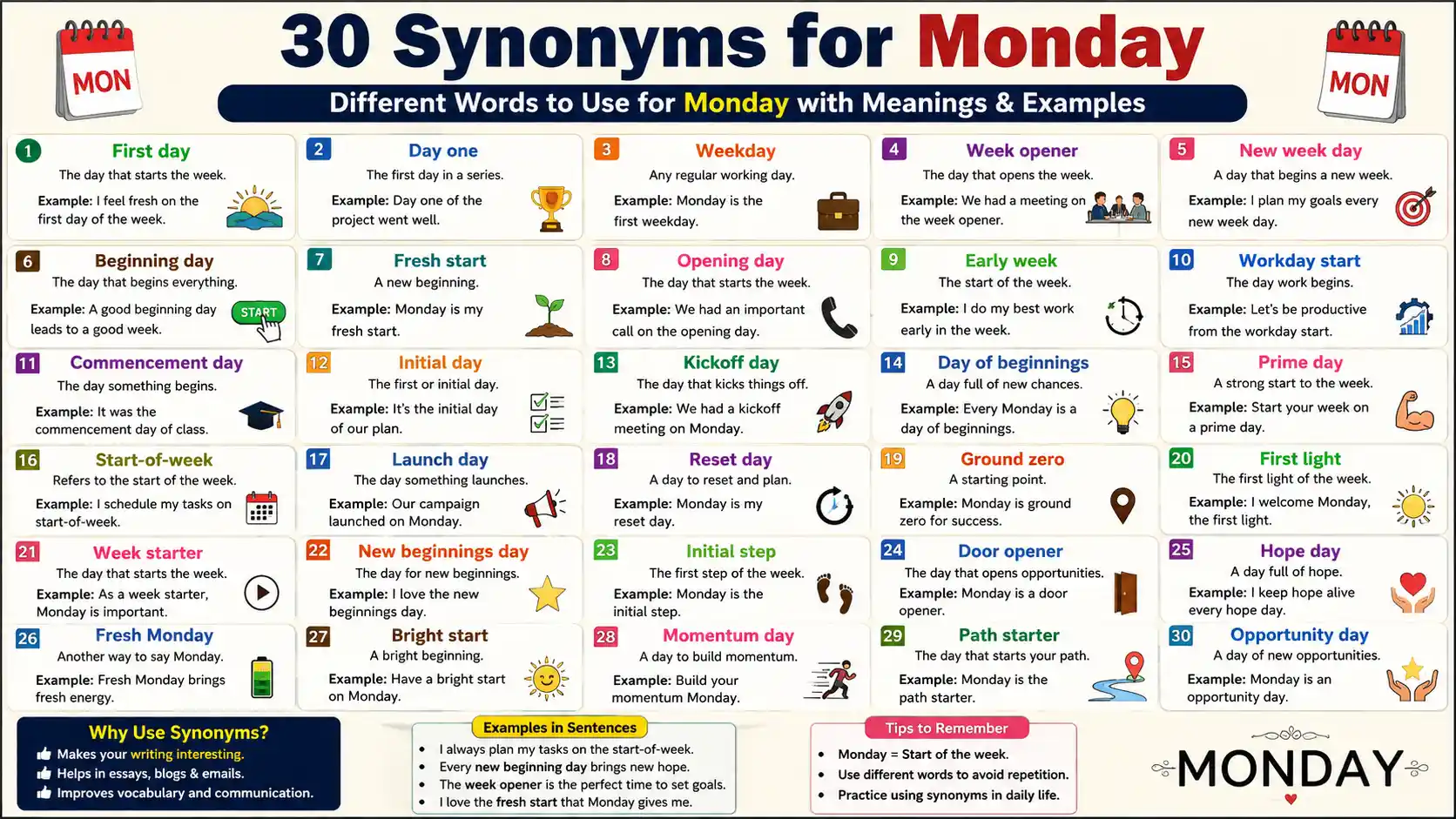
What Is a Synonym for Monday?
Monday does not have many true one-word synonyms because it is a specific day name. But people often use phrases like “start of the week,” “first workday,” or “Moon day” (its old meaning) instead of saying “Monday” directly. These words describe the same idea: the beginning of a new week.
Do you ever wake up and groan, “Ugh, it’s Monday again”? You are not alone. Monday marks the start of the work week for most people. It comes right after Sunday and kicks off five (or six) busy days ahead.
For example: “I have a big meeting on Monday morning.” Simple, right?
But if you write blogs, emails, or stories, saying “Monday” over and over can feel repetitive. That is where synonyms for Monday come in handy. Learning words like Monday alternatives helps students, bloggers, and everyday writers keep their sentences fresh and interesting.
In this guide, we will explore genuine words and phrases connected to Monday, along with simple meanings and real examples. If you are studying English or writing your next blog post, these Monday synonyms will help you say it differently.
Why Monday Doesn’t Have Many Direct Synonyms
Before we dive in, here is something important. Monday is a proper noun for the name of a specific day. Unlike words such as “happy” or “big,” it does not have dozens of interchangeable synonyms. Instead, English speakers use descriptive phrases, informal expressions, and related terms to talk about Monday in different ways. Below, you will find these grouped clearly so you know exactly how each one is used.
True Descriptive Phrases for Monday
Start of the Week
Meaning: This phrase means the very first day when a new week begins.
Examples: I always plan my meals at the start of the week. The gym is busiest at the start of the week.
First Day of the Work Week
Meaning: This describes the first working day after the weekend ends.
Examples: Most offices reopen on the first day of the work week. She checks her emails early on the first day of the work week.
Beginning of the Business Week
Meaning: This phrase points to when regular business activities restart after the weekend.
Examples: Stock markets often react at the beginning of the business week. We schedule our team calls at the beginning of the business week.
The Day After Sunday
Meaning: This is a simple, factual way to describe which day comes right after Sunday.
Examples: The day after Sunday always feels like a fresh start. He rests all weekend and works hard the day after Sunday.
Formal and Etymological Terms
Moon Day
Meaning: This is the original meaning of the word Monday, coming from old English and Latin roots linked to the moon.
Examples: Long ago, people named it Moon Day after the moon in the sky. Many languages still call Monday something close to Moon Day.
Lunar Day (Related Term)
Meaning: This related term connects to the moon-based origin of the word Monday, though it is mostly used in historical or linguistic writing.
Examples: Historians sometimes mention the lunar day when explaining ancient calendars. The lunar day naming pattern still shows up in French and Spanish today.
Everyday and Informal Usage Terms
Blue Monday
Meaning: This informal phrase describes a Monday that feels sad, tired, or hard to get through.
Examples: January is famous for having the year’s official Blue Monday. After a fun weekend, today feels like a total Blue Monday.
Case of the Mondays
Meaning: This casual expression means feeling grumpy, tired, or unmotivated at the start of the week.
Examples: He definitely has a case of the Mondays today. Coffee helps me fight off my case on Mondays.
raving Monday
Meaning: This informal phrase describes a Monday that is extremely busy or chaotic.
Examples: Between emails and meetings, it was a total raving Monday. Parents often call school mornings a raving Monday.
Fresh Start Day
Meaning: This friendly phrase describes Monday as a chance to begin something new, like a goal or habit.
Examples: I always treat Monday as my fresh start day for healthy eating. Many people pick a fresh start day to begin new workout routines.
Related Terms (Not Direct Synonyms)
These words are connected to Monday in meaning but should not be directly in a sentence.
Weekday
Meaning: This is a broader term for any working day, including Monday through Friday.
Examples: Monday is the first weekday of the calendar week. Traffic is heavier on weekdays than on weekends.
Workweek
Meaning: This term refers to the full block of working days, which usually starts on Monday.
Examples: Our workweek always begins on Monday morning. She plans her tasks for the entire workweek on Sunday night.
Onboarding Day (Business Context)
Meaning: In workplaces, this term sometimes refers to Monday as the day new tasks or projects officially begin.
Examples: Monday works well as our onboarding day for new hires. The team treats every Monday like a mini onboarding day for the week’s goals.
How to Use Monday Synonyms Naturally in Writing
Using synonyms for Monday does not mean forcing unusual words into every sentence. Instead, mix in phrases like “start of the week” or informal expressions like “case of the Mondays” when the tone fits. Blog posts, casual emails, and creative writing all benefit from this variety. Formal reports, on the other hand, should stick to clear phrases like “the first day of the work week.”
This small habit of swapping “Monday” with a natural alternative now and then makes your writing sound more human and less repetitive. It is a simple trick used by experienced writers, teachers, and content creators every day.
FQQs
What is another word for Monday?
There is no single perfect word, but common alternatives include “start of the week” and “first day of the work week.”
What is a synonym for Monday in a business context?
In business writing, “beginning of the business week” or “workweek start” are common and accurate choices.
Is “Blue Monday” a real term or just slang?
It is an informal cultural expression used to describe a gloomy or tiring Monday, not a formal synonym.
What word can I use instead of Monday in a sentence?
You can use phrases like “the day after Sunday” or “first weekday” depending on your sentence’s tone.
Why do we use synonyms for Monday in writing?
Synonyms help avoid repetition, keep readers interested, and make writing sound more natural and varied.
Conclusion
Learning synonyms for Monday, even simple phrases like “start of the week” or fun expressions like “case of the Mondays,” can make your writing feel fresh and human. If you are a student, blogger, or everyday English learner, practicing these words in emails, essays, and daily conversations will build your vocabulary naturally. Try using one new Monday alternative this week and notice how much smoother your writing sounds.