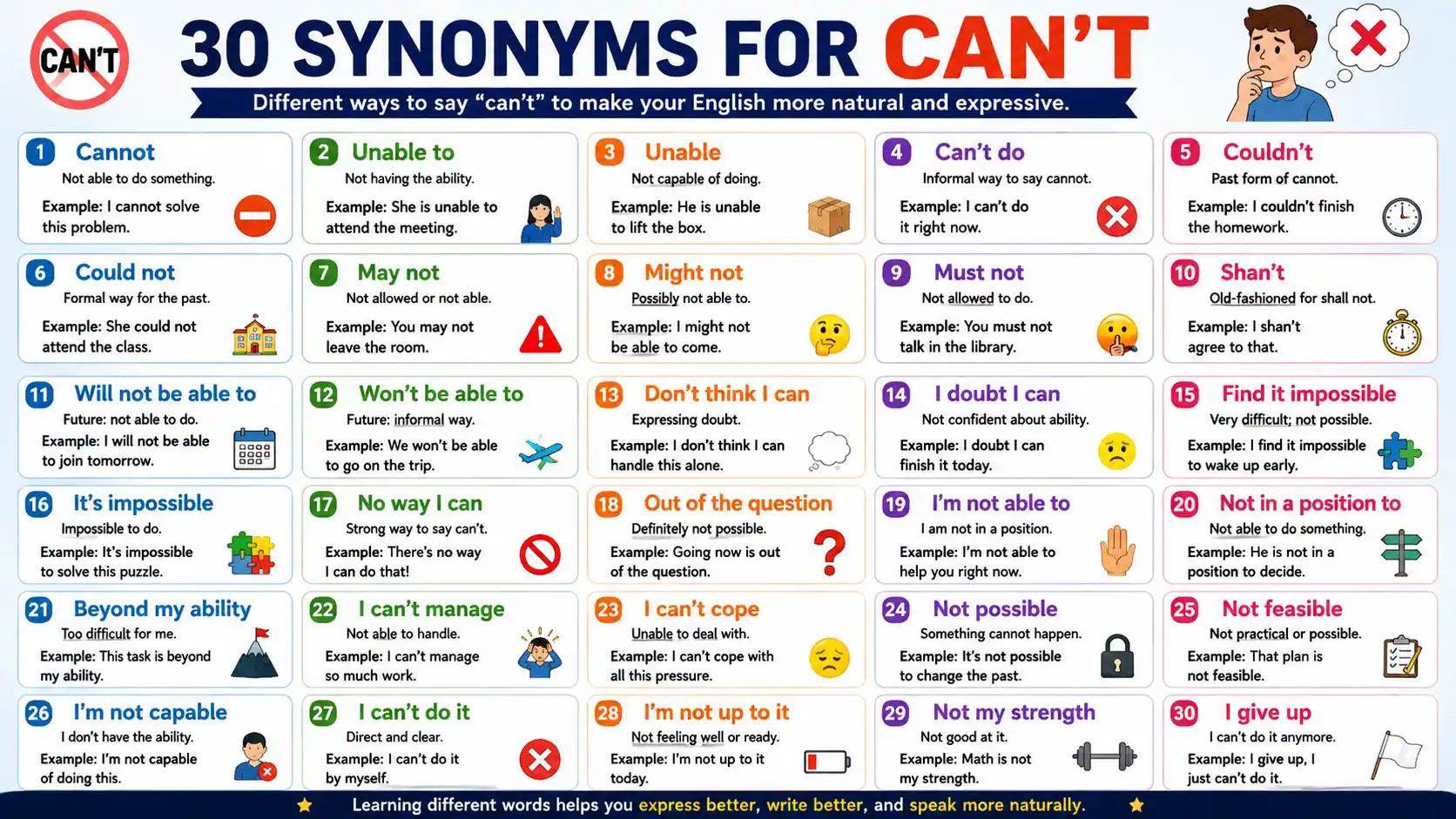
Meta Description: Looking for synonyms for can’t? Discover 24+ words with real examples, meanings, and usage tips to sound more natural and confident in English.
Quick Answer
The best synonyms for can’t are unable to, incapable of, not able to, powerless to, and not permitted to. Each word carries a slightly different meaning some describe a lack of skill or strength, while others describe rules or permission. Choosing the right one makes your writing clearer and more precise.
Have you ever written the same sentence five times in one paragraph because you kept using the word can’t? You are not alone. Most English learners lean on this one word for every kind of limitation — whether it’s a missing skill, a rule, or simple bad luck.
The truth is, English gives you many better options. If a machine has stopped working, you might say it’s incapable of running. If a rule stops you from entering a building, you’re not permitted to go in. Learning strong synonyms for can’t helps students, bloggers, writers, and professionals sound clearer and more confident.
In this guide, you’ll find simple meanings, fresh examples, grammar notes, and a quiz to help the words stick.
Pronunciation
Can’t IPA: /kænt/ (American) or /kɑːnt/ (British) Pronounced as: “kant” (US) or “kahnt” (UK)
Part of Speech
Can’t is a contraction of cannot, made from the modal verb can and the negative word not. It is always used as a modal verb before another verb.
- I can’t swim. (lack of ability)
- You can’t park here. (rule or permission)
- This can’t be true. (disbelief or impossibility)
Notice how the same word changes meaning depending on context. That’s exactly why having several synonyms matters — each one can carry a more exact meaning than the general word can’t.
Grammar Usage Section
Sentence pattern: subject + can’t/synonym + base verb (or “to” + verb, depending on the synonym).
- Can’t + base verb → I can’t drive.
- Unable to + base verb → I am unable to drive.
- Incapable of + verb+ing → I am incapable of driving right now.
Common prepositions: incapable of, unable to, not permitted to, prohibited from, disqualified from.
Common mistake: Writing “incapable to” instead of incapable of, or “unable of” instead of unable to. Prepositions do not swap between these phrases — each synonym has its own fixed partner word.
Synonyms Overview Table
| Synonym | Strength | Formality | CEFR Level | Frequency |
|---|---|---|---|---|
| Cannot | Strongest | Neutral | A1 | Very Common |
| Unable to | Strongest | Neutral/Formal | A2 | Very Common |
| Not able to | Strongest | Neutral | A2 | Very Common |
| Incapable of | Strong | Formal | B1 | Common |
| Lack the ability to | Strong | Formal | B2 | Common |
| Powerless to | Strong | Literary | B2 | Uncommon |
| Not in a position to | Strong | Formal/Business | B2 | Common |
| Not permitted to | Strong | Formal | B1 | Common |
| Forbidden to | Strong | Formal | B1 | Common |
| Prohibited from | Strong | Formal/Legal | B2 | Common |
| Restricted from | Related | Formal | B2 | Common |
| Disallowed from | Related | Formal | C1 | Uncommon |
| Not authorized to | Related | Business/Formal | B2 | Common |
| Ineligible to | Related | Formal | B2 | Common |
| Disqualified from | Related | Formal/Sports | B2 | Common |
| Unfit to | Related | Formal | B2 | Uncommon |
| Not equipped to | Related | Neutral | B1 | Common |
| Ill-equipped to | Related | Formal | C1 | Uncommon |
| Helpless to | Related | Literary | B2 | Uncommon |
| Lack the capacity to | Related | Formal/Academic | C1 | Uncommon |
| Not competent to | Related | Formal/Legal | C1 | Uncommon |
| Prevented from | Related | Neutral | B1 | Common |
| Hindered from | Related | Formal | C1 | Uncommon |
| Ill-suited to | Related | Formal | C1 | Uncommon |
Main Content: Detailed Synonyms
Cannot
Meaning: This word means a person is not able to do something.
Examples:
- She cannot attend the meeting because of a doctor’s appointment.
- The printer cannot connect to the new laptop.
Best Used When: You want a slightly more formal version of “can’t” in writing.
Tone: Neutral
Common Collocations: cannot help, cannot afford, cannot wait
Connotation: Plain and direct, with no extra emotion attached.
Unable to
Meaning: This phrase means someone does not have the power, skill, or chance to do something.
Examples:
- The team was unable to finish the project by Friday.
- Grandpa is unable to climb stairs anymore.
Best Used When: You want a polite, professional way to explain a limitation.
Tone: Formal
Common Collocations: unable to attend, unable to reach, unable to complete
Connotation: Softer and more respectful than “can’t,” often used in emails and reports.
Not Able To
Meaning: This phrase simply says a person has no way to do something right now.
Examples:
- I am not able to open this file on my phone.
- We were not able to book the flight in time.
Best Used When: You want a clear, everyday alternative without sounding too formal.
Tone: Neutral
Common Collocations: not able to attend, not able to access, not able to reply
Incapable Of
Meaning: This word describes someone or something that lacks the skill or quality needed for a task.
Examples:
- The old engine is incapable of reaching high speed.
- He seems incapable of admitting his mistakes.
Best Used When: You want to describe a deeper, ongoing lack of skill or character trait.
Tone: Formal
Common Collocations: incapable of lying, incapable of change, incapable of understanding
When Not to Use This Word: Avoid it for small, temporary problems. “Incapable” sounds heavier, so it fits personality traits or serious limits better than a simple missed task.
Lack the Ability To
Meaning: This phrase means a person does not have the natural skill to do something.
Examples:
- Some software still lacks the ability to translate slang correctly.
- New drivers often lack the ability to judge distance well.
Best Used When: You are writing academic or technical content about skill gaps.
Tone: Formal/Academic
Common Collocations: lack the ability to process, lack the ability to communicate
Powerless To
Meaning: This phrase describes a strong feeling of having no control over a situation.
Examples:
- The villagers felt powerless to stop the flood.
- She was powerless to change her brother’s mind.
Best Used When: You want to add emotional weight to storytelling or persuasive writing.
Tone: Literary
Common Collocations: powerless to stop, powerless to help, powerless to resist
Connotation: Carries a sense of helplessness or emotional struggle, more dramatic than “can’t.”
Not In a Position To
Meaning: This phrase means someone’s current situation stops them from doing something.
Examples:
- Our company is not in a position to offer a discount this quarter.
- I’m not in a position to make that decision alone.
Best Used When: You need a diplomatic, professional way to decline something in business writing.
Tone: Business/Formal
Common Collocations: not in a position to comment, not in a position to approve
Not Permitted To
Meaning: This phrase means a rule stops someone from doing something.
Examples:
- Visitors are not permitted to enter the lab without a badge.
- Students are not permitted to use phones during exams.
Best Used When: You are writing rules, signs, or policies.
Tone: Formal
Common Collocations: not permitted to smoke, not permitted to record
Forbidden To
Meaning: This word means something is strongly against the rules.
Examples:
- Employees are forbidden to share client data with outsiders.
- Children are forbidden to swim without an adult present.
Best Used When: You want to show a strict, serious rule.
Tone: Formal
Common Collocations: strictly forbidden, forbidden to enter
When Not to Use This Word: Avoid using it for casual, everyday limits — it can sound too strong for small situations, like being unable to find parking.
Prohibited From
Meaning: This phrase means an official rule or law blocks an action.
Examples:
- Drivers are prohibited from using phones while driving.
- The company is prohibited from selling that product in this region.
Best Used When: You are writing legal, government, or policy documents.
Tone: Formal/Legal
Common Collocations: legally prohibited, prohibited from entering
Restricted From
Meaning: This phrase means someone’s access or action is limited by a rule.
Examples:
- New employees are restricted from viewing certain files.
- Guests are restricted from using the staff elevator.
Best Used When: You describe partial or conditional limits, not a full ban.
Tone: Formal
Common Collocations: restricted from access, restricted from entering
Disallowed From
Meaning: This phrase means an authority does not allow an action.
Examples:
- The player was disallowed from continuing after breaking the rule.
- Late applicants are disallowed from joining the contest.
Best Used When: You want a slightly formal, less common word for official writing.
Tone: Formal
Common Collocations: disallowed from participating, disallowed from claiming
Not Authorized To
Meaning: This phrase means someone does not have official permission.
Examples:
- Interns are not authorized to sign contracts.
- I’m not authorized to share that information with you.
Best Used When: You write workplace policies or customer service replies.
Tone: Business/Formal
Common Collocations: not authorized to access, not authorized to approve
Ineligible To
Meaning: This word means someone does not meet the requirements needed.
Examples:
- Part-time staff are ineligible to receive the full bonus.
- He was ineligible to vote because he missed the registration deadline.
Best Used When: You describe requirements for programs, benefits, or competitions.
Tone: Formal
Common Collocations: ineligible to apply, ineligible to compete
Disqualified From
Meaning: This phrase means someone loses the right to take part because of a rule break.
Examples:
- The runner was disqualified from the race for a false start.
- The company was disqualified from bidding after missing the deadline.
Best Used When: You write about competitions, sports, or formal processes.
Tone: Formal/Sports
Common Collocations: disqualified from the contest, automatically disqualified
Unfit To
Meaning: This phrase means someone is not suitable or healthy enough for a task.
Examples:
- The doctor said he is unfit to travel this week.
- The old bridge is unfit to carry heavy trucks.
Best Used When: You describe health, safety, or suitability issues.
Tone: Formal
Common Collocations: medically unfit, unfit to drive
Not Equipped To
Meaning: This phrase means someone lacks the tools, training, or resources for a task.
Examples:
- Our small clinic is not equipped to handle major surgery.
- New hires are not equipped to manage the software yet.
Best Used When: You explain a practical gap in tools or training.
Tone: Neutral
Common Collocations: not equipped to handle, not equipped to manage
Ill-Equipped To
Meaning: This phrase means someone is poorly prepared or lacks the right resources.
Examples:
- The team was ill-equipped to face such harsh weather.
- Many schools are ill-equipped to teach coding classes.
Best Used When: You want a stronger, more formal version of “not equipped to.”
Tone: Formal
Common Collocations: ill-equipped to handle, ill-equipped to respond
Helpless To
Meaning: This phrase describes a feeling of being unable to act, often with sadness.
Examples:
- She felt helpless to comfort her crying child on the long flight.
- Workers were helpless to save the old factory from closing.
Best Used When: You want an emotional tone in stories or personal writing.
Tone: Literary
Common Collocations: helpless to prevent, helpless to watch
Lack the Capacity To
Meaning: This phrase means someone’s mind, body, or system cannot handle a task.
Examples:
- Some servers lack the capacity to store this much data.
- Young children often lack the capacity to understand complex rules.
Best Used When: You write academic, medical, or technical content.
Tone: Formal/Academic
Common Collocations: lack the capacity to process, mental capacity
Not Competent To
Meaning: This phrase means someone does not have the legal or professional skill required.
Examples:
- The court ruled he was not competent to stand trial.
- A junior staff member is not competent to approve major budgets.
Best Used When: You write legal, medical, or professional evaluations.
Tone: Formal/Legal
Common Collocations: legally competent, not competent to decide
Prevented From
Meaning: This phrase means something outside stops an action from happening.
Examples:
- Heavy traffic prevented us from reaching the airport on time.
- The storm prevented workers from finishing the roof.
Best Used When: You explain an outside cause blocking an action.
Tone: Neutral
Common Collocations: prevented from leaving, prevented from working
Hindered From
Meaning: This phrase means something slows or blocks progress toward a goal.
Examples:
- Poor internet hindered the students from finishing the online test.
- The old rules hindered small businesses from growing quickly.
Best Used When: You describe an obstacle that limits progress, not full failure.
Tone: Formal
Common Collocations: hindered from growing, badly hindered
Ill-Suited To
Meaning: This phrase means someone or something does not fit a role or purpose well.
Examples:
- This thin jacket is ill-suited to freezing winter weather.
- A shy speaker may be ill-suited to a loud sales job.
Best Used When: You describe mismatch between a person or item and a task.
Tone: Formal
Common Collocations: ill-suited to the role, ill-suited to the climate
Choose the Right Synonym
| If you mean… | Use this word |
|---|---|
| Lack of skill or strength | unable to, incapable of, lack the ability to |
| A rule blocks you | not permitted to, forbidden to, prohibited from |
| Missing tools or training | not equipped to, ill-equipped to |
| Emotional helplessness | powerless to, helpless to |
| Missing requirements | ineligible to, disqualified to |
| An outside force blocks you | prevented from, hindered from |
Synonym Categories
Strongest Synonyms: cannot, unable to, not able to, incapable of, lack the ability to
Strong Synonyms: powerless to, not in a position to, not permitted to, forbidden to, prohibited from, restricted from, disallowed from, not authorized to
Related Words: ineligible to, disqualified from, unfit to, not equipped to, ill-equipped to, helpless to, lack the capacity to, not competent to, prevented from, hindered from, ill-suited to
Commonly Confused Words
| Word | Difference | Example |
|---|---|---|
| Unable to vs. Unwilling to | Unable means no ability; unwilling means no desire. | He is unable to attend (he’s sick), not unwilling to attend (he doesn’t want to). |
| Forbidden vs. Restricted | Forbidden is a full ban; restricted is a partial limit. | Smoking is forbidden here, but access is only restricted for guests. |
| Incapable vs. Ineligible | Incapable refers to skill; ineligible refers to requirements. | He is incapable of running fast, but he’s ineligible to join because of his age. |
| Prevented vs. Hindered | Prevented means fully stopped; hindered means slowed down. | The strike prevented the flight from leaving, while heavy bags hindered our packing. |
| Disqualified vs. Unfit | Disqualified follows a rule break; unfit refers to health or suitability. | He was disqualified for cheating, while she was unfit to compete due to injury. |
Common Mistakes
Mistake: “She is incapable to swim.” Correction: “She is incapable of swimming.” Explanation: Incapable always pairs with of, never to.
Mistake: “We were unable of joining the call.” Correction: “We were unable to join the call.” Explanation: Unable always pairs with to, not of.
Mistake: “He is forbidden of entering the room.” Correction: “He is forbidden to enter the room.” Explanation: Forbidden uses to plus the base verb, not of.
Writing Tips
Emails: Use not able to or unable to for a polite, professional tone.
Essays: Try incapable of or lack the ability to for stronger academic language.
Blog Posts: Mix short synonyms like can’t with occasional stronger words like powerless to for variety.
Stories: Use helpless to or powerless to to add emotion to a scene.
Social Media: Keep it simple with can’t or not able to for a casual, friendly voice.
Professional Communication: Choose not in a position to or not authorized to to sound formal and respectful.
Daily Conversations: Stick with can’t or not able to since they sound most natural when speaking.
Writing Tip: Reading your sentence out loud helps you hear if a synonym sounds too stiff or too casual for the situation.
American vs. British English Notes
Most synonyms for can’t work the same way in both American and British English. The main difference is in the pronunciation of can’t itself: Americans say /kænt/, while British speakers often say /kɑːnt/. Formal phrases like not permitted to and prohibited from appear more often in British legal writing, while American English leans slightly more toward not authorized to in business settings.
Related Vocabulary
Antonyms: can, able to, capable of, permitted to, allowed to, qualified to
Related Expressions: out of the question, no way to, beyond someone’s reach, out of one’s hands
Word Family: ability, capable, capability, permission, permit, incapacity
Mini Practice Exercises
1. Fill in the blank: The intern is ___________ (not authorized) to send emails to clients directly.
2. Fill in the blank: Because of the storm, we were ___________ (prevented) from leaving the hotel.
3. Rewrite using a synonym: “I can’t attend the workshop tomorrow.” → I am ______________ the workshop tomorrow.
4. Matching: Match the word to its meaning — disqualified, ineligible, unfit → (a) does not meet requirements, (b) removed for breaking a rule, (c) not healthy or suitable enough.
Answer Key: 1. not authorized 2. prevented 3. unable to attend 4. disqualified–b, ineligible–a, unfit–c
FAQ Section
What is the strongest synonym for can’t? Unable to and incapable of are the strongest synonyms for can’t. They clearly show a lack of ability rather than just a rule or choice, making them useful in both formal writing and everyday speech.
What is a formal way to say can’t?
A formal way to say can’t is unable to, not in a position to, or not permitted to. These phrases sound more professional in emails, reports, and workplace conversations than the short word “can’t.”
What is a synonym for can’t in academic writing?
In academic writing, try lack the ability to, incapable of, or lack the capacity to. These phrases fit research papers, essays, and formal reports better than casual contractions.
Is “unable to” the same as “can’t”?
Yes, unable to means the same as “can’t,” but it sounds slightly more formal. Both describe a lack of power or possibility, so you can usually swap them in most sentences.
What is the opposite of can’t?
The opposite of “can’t” is can, able to, or capable of. These words show that someone has the power, permission, or skill to do something.
How do you say can’t in a polite way?
A polite way to say “can’t” is I’m not able to or I’m not in a position to. These softer phrases work well when declining requests at work or in customer service.
Vocabulary Quiz
1. Which word best fits: “Employees are ______ share passwords with anyone.” A) unable to B) forbidden to C) powerless to D) unfit to
2. Which synonym fits a rule-based limit? A) incapable of B) prohibited from C) helpless to D) lack the ability to
3. Choose the best word: “The old machine is ______ handling large orders.” A) not equipped to B) forbidden to C) disqualified from D) ineligible to
4. Which word shows emotional helplessness? A) not authorized to B) restricted from C) powerless to D) not competent to
5. Which pair uses the correct preposition? A) incapable to B) unable of C) forbidden of D) incapable of
Answer Key: 1-B, 2-B, 3-A, 4-C, 5-D
Conclusion
Learning strong synonyms for can’t helps you write and speak with more precision and confidence. Instead of repeating the same word, you can choose unable to for polite emails, powerless to for emotional stories, or prohibited from for formal rules. Try using a few new synonyms in your next essay, email, or conversation, and watch your vocabulary grow naturally over time.