Featured Snippet Answer
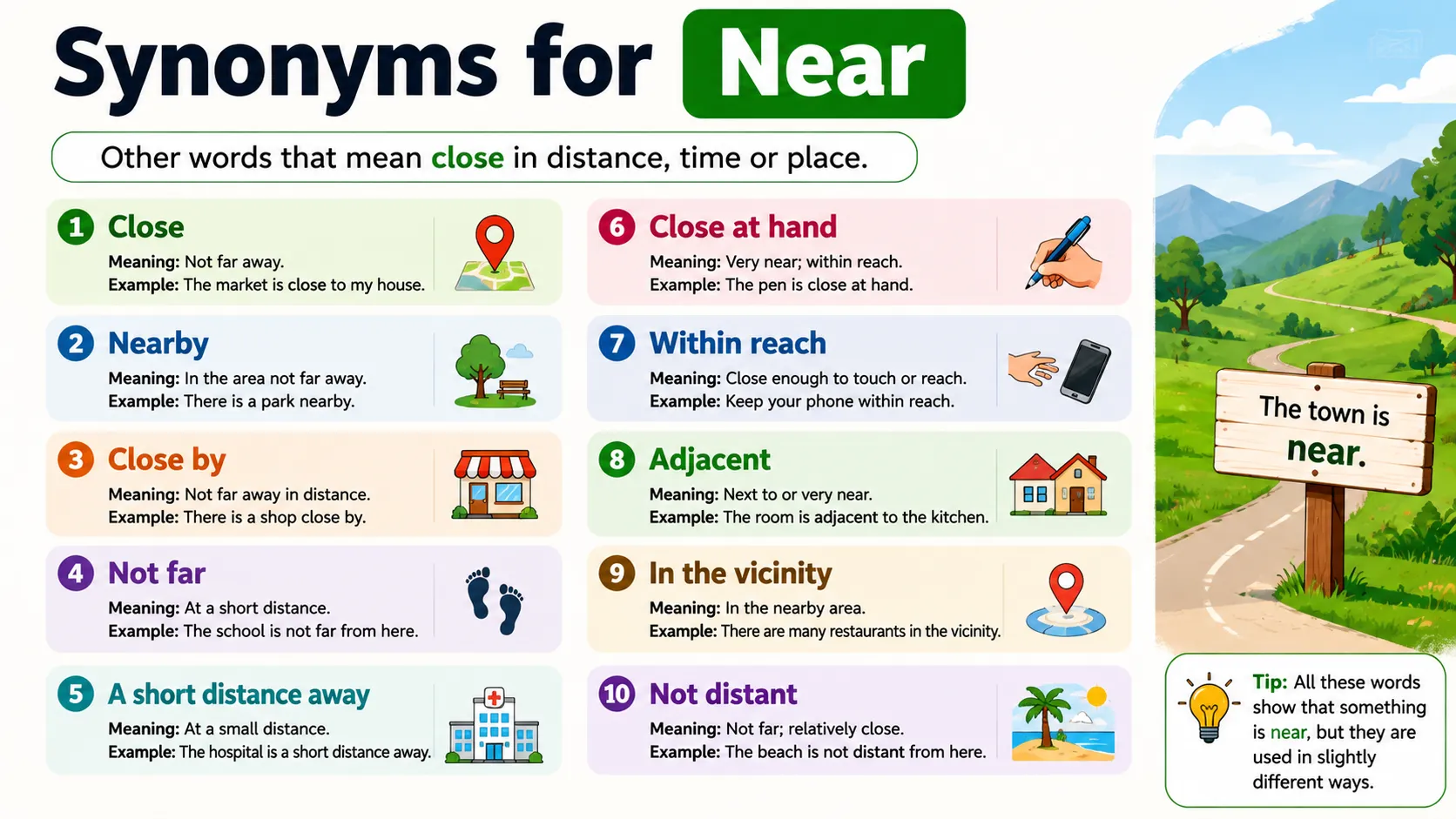
The closest synonym for “near” is “close.” Both words describe something that is a short distance away in space or time. For example, “The store is near my house” means the same as “The store is close to my house.” Other common alternatives include “nearby,” “adjacent,” and “not far from,” depending on the context.
Have you ever said, “The café is near my office,” and then repeated the word “near” three more times in the same paragraph? It happens to almost everyone. “Near” is a simple, useful word, but using it too often can make your writing sound repetitive.
That’s where synonyms for “near” come in handy. They let you describe distance and location with more variety and precision.
In this guide, you’ll learn simple, natural alternatives to “near.” We’ll explain what each word means, how it’s different, and when to use it. Whether you’re writing directions, a story, or a casual message, these synonyms for “near” will help your English sound clearer and more natural.
Synonyms for “Near”
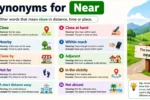
| # | Synonym | Relationship | Direct Replacement | Difficulty | Best Used For |
| 1 | Close | Exact synonym | Yes | Beginner | Daily conversation, writing |
| 2 | Close to | Exact synonym | Yes | Beginner | Daily conversation, directions |
| 3 | Nearby | Exact synonym | Yes | Beginner | Daily conversation, descriptions |
| 4 | Close by | Near synonym | Yes | Beginner | Daily conversation |
| 5 | Not far from | Near synonym | Yes | Beginner | Directions, casual writing |
| 6 | Adjacent | Near synonym | Sometimes | Intermediate | Formal or technical writing |
| 7 | Adjoining | Near synonym | Sometimes | Intermediate | Formal writing, real estate |
| 8 | Next to | Contextual alternative | Sometimes | Beginner | Daily conversation |
| 9 | Alongside | Contextual alternative | Sometimes | Intermediate | Descriptive or creative writing |
| 10 | Bordering | Contextual alternative | Sometimes | Intermediate | Geography, formal writing |
| 11 | Neighboring | Near synonym | Sometimes | Intermediate | Formal writing, geography |
| 12 | In the vicinity of | Contextual alternative | Sometimes | Advanced | Formal or academic writing |
| 13 | Within reach | Contextual alternative | Sometimes | Intermediate | Descriptive writing |
| 14 | Close at hand | Contextual alternative | Sometimes | Intermediate | Creative or descriptive writing |
| 15 | A stone’s throw from | Related term | No | Advanced | Creative writing, idiomatic speech |
| 16 | Within walking distance of | Contextual alternative | Sometimes | Intermediate | Directions, travel writing |
Table of Contents
- Introduction
- Meaning and Usage of “Near”
- Synonyms for “Near”
- Close
- Close To
- Nearby
- Close By
- Not Far From
- Adjacent
- Next To
- Alongside
- Neighboring
- In the Vicinity Of
- Close at Hand
- A Stone’s Throw From
- Antonyms of “Near”
- Words Commonly Confused with “Near”
- Frequently Asked Questions
- Conclusion
Quick Facts About “Near”
- Focus keyword: near
- Part of speech: Preposition, adjective, adverb
- Simple pronunciation guide: NEER
- IPA pronunciation: /nɪər/
- Number of syllables: 1
- Word origin: From Old English “near,” originally the comparative form of “neah,” meaning “nigh” or “close.”
- Other word forms: nearer, nearest, nearly, nearness
- Formality level: Neutral (used in both spoken and written English)
- Difficulty level: Beginner
- CEFR level: A1
Meaning and Usage of “Near”
“Near” describes something that is a short distance away, either in space or time. It can work as a preposition, adjective, or adverb, depending on the sentence.
People use “near” every day to give directions, describe locations, or talk about upcoming events. It’s one of the most common words for talking about closeness.
Example 1: “The bakery is near the train station.”
Example 2: “We’re getting near the end of the project.
1. Close: A Synonym for “Near”
Relationship: Exact synonym
Direct Replacement: Yes
Difficulty Level: Beginner
Meaning: “Close” means a short distance away, just like “near.”
Difference: “Close” and “near” are nearly interchangeable, but “close” is often used with “to” in sentences, such as “close to the park.”
Best Used For: Daily conversation, general writing
Examples:
- “Our new apartment is close to the subway station.”
- “She sat close to the window during the flight.”
2. Close To: A Synonym for “Near”
Relationship: Exact synonym
Direct Replacement: Yes
Difficulty Level: Beginner
Meaning: “Close to” means located a short distance from something.
Difference: This phrase works the same way as “near,” but it always needs an object after it, unlike “near,” which can stand alone.
Best Used For: Directions, casual conversation
Examples:
- “The pharmacy is close to my apartment building.”
- “We stayed close to the campfire to keep warm.”
3. Nearby: A Synonym for “Near”
Relationship: Exact synonym
Direct Replacement: Yes
Difficulty Level: Beginner
Meaning: “Nearby” means located a short distance away, often used as an adjective or adverb.
Difference: “Nearby” often stands alone in a sentence without needing “to,” while “near” usually needs a following noun.
Best Used For: Descriptions, daily conversation
Examples:
- “There’s a nearby park where kids play after school.”
- “I heard a dog barking nearby last night.”
4. Close By: A Synonym for “Near”
Relationship: Near synonym
Direct Replacement: Yes
Difficulty Level: Beginner
Meaning: “Close by” means very near in distance.
Difference: This phrase is slightly more casual and often used in spoken English rather than formal writing.
Best Used For: Daily conversation
Examples:
- “Is there a gas station close by?”
- “My grandmother lives close by, so we visit often.”
5. Not Far From: A Synonym for “Near”
Relationship: Near synonym
Direct Replacement: Yes
Difficulty Level: Beginner
Meaning: “Not far from” means the distance between two places is small.
Difference: This phrase focuses on the idea that a place is easy to reach, rather than simply being close.
Best Used For: Directions, casual writing
Examples:
- “The hotel is not far from the airport.”
- “Our new office is not far from the old one.”
6. Adjacent: A Synonym for “Near”
Relationship: Near synonym
Direct Replacement: Sometimes
Difficulty Level: Intermediate
Meaning: “Adjacent” means next to or touching something, often sharing a border or edge.
Difference: “Adjacent” is more specific than “near” because it usually means directly beside something, not just close in general.
Best Used For: Formal or technical writing
Examples:
- “The parking lot is adjacent to the main building.”
- “Her office is adjacent to the conference room.”
7. Next To: A Synonym for “Near”
Relationship: Contextual alternative
Direct Replacement: Sometimes
Difficulty Level: Beginner
Meaning: “Next to” means positioned directly beside something.
Difference: “Next to” is more precise than “near” because it shows an exact position, not just general closeness.
Best Used For: Daily conversation, directions
Examples:
- “The bookstore is right next to the coffee shop.”
- “He parked his car next to mine.”
8. Alongside: A Synonym for “Near”
Relationship: Contextual alternative
Direct Replacement: Sometimes
Difficulty Level: Intermediate
Meaning: “Alongside” means positioned beside something, often in a line or parallel direction.
Difference: “Alongside” often suggests movement or a shared path, which “near” does not always imply.
Best Used For: Descriptive or creative writing
Examples:
- “The trail runs alongside the river for two miles.”
- “She walked alongside her brother on the way to school.”
9. Neighboring: A Synonym for “Near”
Relationship: Near synonym
Direct Replacement: Sometimes
Difficulty Level: Intermediate
Meaning: “Neighboring” describes something located close by, often referring to towns, countries, or properties.
Difference: “Neighboring” is typically used before a noun, such as “neighboring town,” while “near” is more flexible in sentence position.
Best Used For: Formal writing, geography
Examples:
- “Farmers from the neighboring village came to sell their crops.”
- “Tourists often visit the neighboring islands during their trip.”
10. In the Vicinity Of: A Synonym for “Near”
Relationship: Contextual alternative
Direct Replacement: Sometimes
Difficulty Level: Advanced
Meaning: “In the vicinity of” means within a general area close to a place.
Difference: This phrase sounds more formal than “near” and often describes a broader area rather than an exact point.
Best Used For: Formal or academic writing
Examples:
- “The suspect was last seen in the vicinity of the train station.”
- “Several restaurants can be found in the vicinity of the hotel.”
11. Close at Hand: A Synonym for “Near”
Relationship: Contextual alternative
Direct Replacement: Sometimes
Difficulty Level: Intermediate
Meaning: “Close at hand” means easily available or within quick reach.
Difference: This phrase often emphasizes convenience or readiness, not just physical distance.
Best Used For: Creative or descriptive writing
Examples:
- “She kept her notebook close at hand during the meeting.”
- “A first aid kit should always be close at hand on a hike.”
12. A Stone’s Throw From: A Synonym for “Near”
Relationship: Related term
Direct Replacement: No
Difficulty Level: Advanced
Meaning: This idiom means a place is very close, almost within throwing distance.
Difference: Unlike “near,” this is an idiomatic expression and shouldn’t be used in formal or technical writing.
Best Used For: Creative writing, casual conversation
Examples:
- “Their new house is just a stone’s throw from the beach.”
- “The old bookstore is a stone’s throw from where I grew up.”
Antonyms of “Near”
| # | Antonym | Simple Meaning | Example |
| 1 | Far | A long distance away | “The airport is far from downtown.” |
| 2 | Distant | Located a great distance away | “They live in a distant part of the country.” |
| 3 | Remote | Far away and hard to reach | “The cabin sits in a remote area of the forest.” |
| 4 | Far away | A great distance from a place | “Her family lives far away, in another country.” |
| 5 | Far off | Distant in space or time | “The ship disappeared into the far off horizon.” |
| 6 | Apart | Separated by distance | “The two towns are miles apart.” |
Words Commonly Confused with “Near”
Nearly
Difference: “Nearly” is an adverb meaning “almost,” and it refers to degree or amount, not physical distance.
Example: “I nearly missed my flight this morning.”
Next
Difference: “Next” refers to order or sequence, not necessarily physical closeness.
Example: “Please turn to the next page in the book.”
Around
Difference: “Around” often means surrounding or approximately, rather than specifically close by.
Example: “There are trees all around the house.”
Close-knit
Difference: This phrase describes strong relationships between people, not physical distance.
Example: “They come from a close-knit family that meets every Sunday.”
FAQs
What is another word for “near”?
“Close” is the most common synonym for “near.” Both describe something located a short distance away. Other alternatives include “nearby,” “not far from,” and “adjacent,” depending on the sentence.
What is the closest synonym for “near”?
“Close” is the closest synonym because it shares the same core meaning and can replace “near” in most sentences without changing the meaning.
Can I replace “near” with “adjacent”?
Sometimes. “Adjacent” is more specific and usually means directly touching or bordering something, while “near” simply means a short distance away. Use “adjacent” only when the closeness is exact.
Is “near” formal or informal?
“Near” is neutral. It fits naturally into casual conversations, business writing, and academic texts without sounding too formal or too casual.
What is the opposite of “near”?
The opposite of “near” is “far,” which describes a long distance away. Other opposites include “distant,” “remote,” and “far off.”
Which synonym for “near” is best for formal writing?
“Adjacent,” “in the vicinity of,” and “neighboring” work well in formal or academic writing because they sound more precise and professional than casual phrases like “close by.”
Conclusion
Learning synonyms for “near” helps you describe distance and location with more variety. Instead of repeating the same word, you can choose a phrase that fits your tone, whether formal, casual, or descriptive.
Context always matters. A technical document needs a different word than a casual story.
Try using these synonyms for “near” in your next email, essay, or conversation. Small changes like this make your English sound clearer and more natural.