Featured Snippet Answer
The closest synonym for “shouldn’t” is “ought not to.” Both express advice or a negative recommendation. For example, “You shouldn’t skip breakfast” means the same as “You ought not to skip breakfast.” Other common alternatives include “must not,” “had better not,” and “it’s not advisable to,” depending on how strong or formal you want to sound.
Imagine your friend texts you, “I shouldn’t eat this whole pizza, but I will.” You’ve probably said something similar yourself. “Shouldn’t” is one of the most common words in English, and we use it every day to give advice, share opinions, or admit we’re doing something we probably shouldn’t.
But using the same word again and again can make your writing feel flat. That’s where synonyms for “shouldn’t” come in handy.
In this guide, you’ll learn simple, natural alternatives to “shouldn’t.” We’ll explain what each word means, how it’s different, and when to use it. Whether you’re writing an essay, a message, or a blog post, these synonyms for “shouldn’t” will help your English sound more natural and varied.
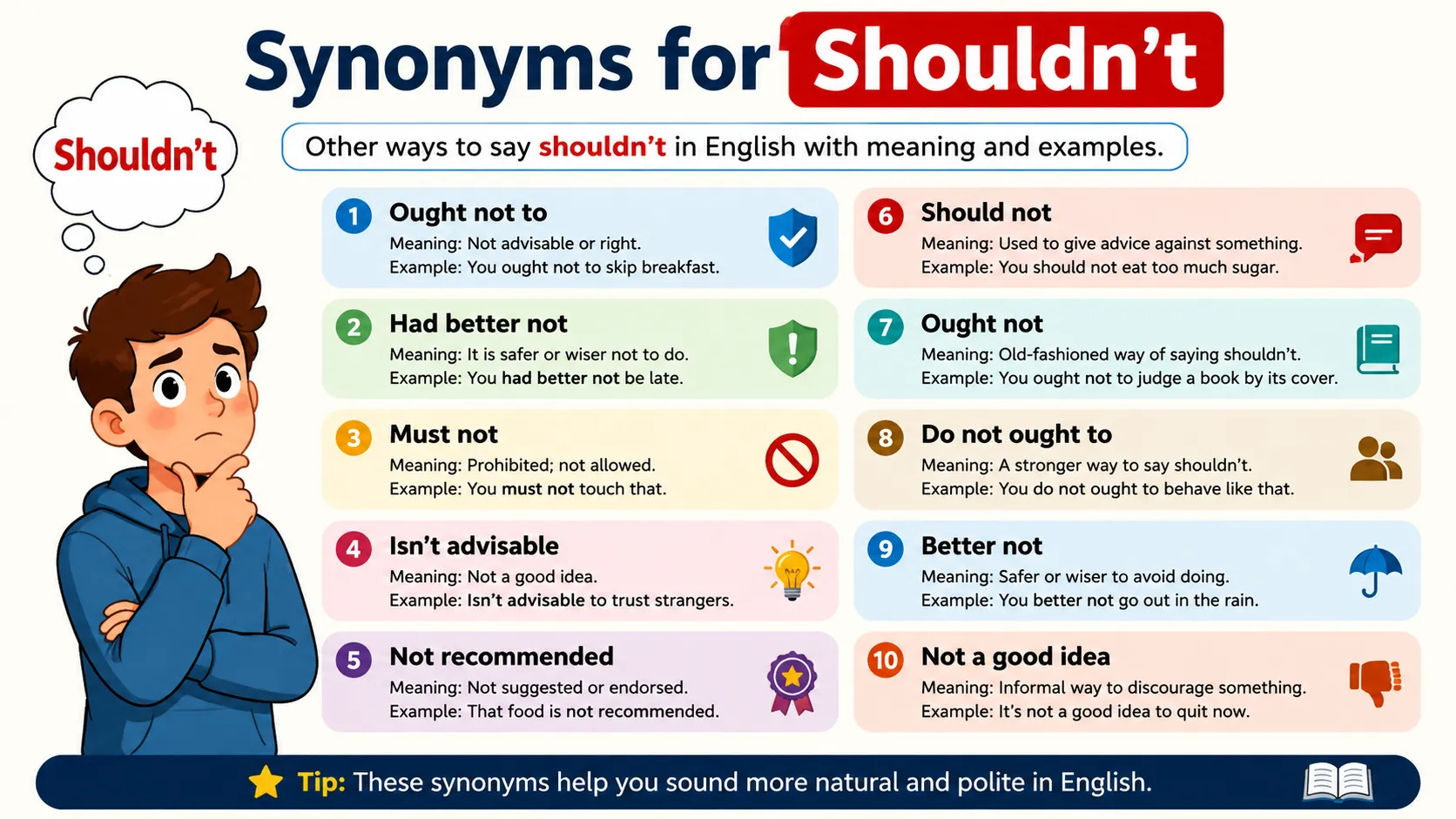
Synonyms for “Shouldn’t”
| # | Synonym | Relationship | Direct Replacement | Difficulty | Best Used For |
| 1 | Ought not to | Exact synonym | Yes | Intermediate | Formal writing, advice |
| 2 | Must not (mustn’t) | Near synonym | Sometimes | Beginner | Rules, strong warnings |
| 3 | Had better not | Near synonym | Sometimes | Intermediate | Daily conversation |
| 4 | Is not supposed to | Near synonym | Sometimes | Beginner | Daily conversation, rules |
| 5 | It’s not advisable to | Contextual alternative | Sometimes | Intermediate | Formal or academic writing |
| 6 | It would be wrong to | Contextual alternative | Sometimes | Intermediate | Ethical or moral advice |
| 7 | It is unwise to | Contextual alternative | Sometimes | Intermediate | Formal writing, warnings |
| 8 | It would be a mistake to | Contextual alternative | Sometimes | Intermediate | Advice, cautionary statements |
| 9 | Should refrain from | Near synonym | Sometimes | Intermediate | Formal or polite writing |
| 10 | Is not recommended to | Contextual alternative | Sometimes | Beginner | Instructions, guidelines |
| 11 | Is discouraged from | Contextual alternative | Sometimes | Intermediate | Formal or academic contexts |
| 12 | One ought not | Exact synonym | Yes | Advanced | Formal or literary writing |
| 13 | Is inappropriate to | Contextual alternative | Sometimes | Intermediate | Workplace or formal settings |
| 14 | Shall not | Related term | No | Advanced | Legal or formal documents |
| 15 | Is ill-advised to | Contextual alternative | No | Advanced | Formal writing, journalism |
| 16 | Better not to | Near synonym | Sometimes | Beginner | Casual conversation |
Table of Contents
- Introduction
- Meaning and Usage of “Shouldn’t”
- Synonyms for “Shouldn’t”
- Ought Not To
- Must Not (Mustn’t)
- Had Better Not
- Is Not Supposed To
- It’s Not Advisable To
- It Would Be Wrong To
- It Is Unwise To
- It Would Be a Mistake To
- Should Refrain From
- Is Not Recommended To
- Is Discouraged From
- One Ought Not
- Antonyms of “Shouldn’t”
- Words Commonly Confused with “Shouldn’t”
- Frequently Asked Questions
- Conclusion
Quick Facts About “Shouldn’t”
- Focus keyword: shouldn’t
- Part of speech: Modal verb (contraction of “should not”)
- Simple pronunciation guide: SHUD-ent
- IPA pronunciation: /ˈʃʊd.ənt/
- Number of syllables: 2
- Word origin: From Old English “sceolde,” the past tense of “sculan” (to owe or be obliged), combined with “not.”
- Other word forms: should, should not
- Formality level: Neutral (used in both spoken and written English)
- Difficulty level: Beginner
- CEFR level: A2
Meaning and Usage of “Shouldn’t”
“Shouldn’t” means it is not a good idea to do something. We use it to give advice, share an opinion, or point out a mistake.
It’s the negative form of “should,” which expresses advice or expectation. People use “shouldn’t” in daily conversation, writing, and even formal speech.
Example 1: “You shouldn’t stay up so late on a school night.”
Example 2: “She shouldn’t have said that during the meeting.”
1. Ought Not To: A Synonym for “Shouldn’t”
Relationship: Exact synonym
Direct Replacement: Yes
Difficulty Level: Intermediate
Meaning: “Ought not to” means the same as “shouldn’t” — it’s used to say something is not a good idea.
Difference: “Ought not to” sounds slightly more formal and less common in casual speech than “shouldn’t.”
Best Used For: Formal writing, advice columns, essays
Examples:
- “You ought not to ignore your doctor’s advice.”
- “He ought not to have left without saying goodbye.”
2. Must Not (Mustn’t): A Synonym for “Shouldn’t”
Relationship: Near synonym
Direct Replacement: Sometimes
Difficulty Level: Beginner
Meaning: “Must not” expresses a stronger rule or prohibition than “shouldn’t.”
Difference: “Shouldn’t” gives advice, while “must not” often states a rule that cannot be broken.
Best Used For: Rules, warnings, instructions
Examples:
- “You must not touch the hot stove.”
- “Passengers must not open the door while the train is moving.”
3. Had Better Not: A Synonym for “Shouldn’t”
Relationship: Near synonym
Direct Replacement: Sometimes
Difficulty Level: Intermediate
Meaning: “Had better not” warns someone about a possible bad result if they do something.
Difference: This phrase often includes a sense of consequence, while “shouldn’t” is more general advice.
Best Used For: Daily conversation, friendly warnings
Examples:
- “You had better not forget your sister’s birthday again.”
- “We had better not be late for the interview.”
4. Is Not Supposed To: A Synonym for “Shouldn’t”
Relationship: Near synonym
Direct Replacement: Sometimes
Difficulty Level: Beginner
Meaning: “Is not supposed to” means someone is expected not to do something, often because of a rule.
Difference: This phrase focuses on expectation or rules rather than personal opinion.
Best Used For: Daily conversation, workplace rules
Examples:
- “You’re not supposed to park here on weekdays.”
- “Employees are not supposed to use their phones during meetings.”
5. It’s Not Advisable To: A Synonym for “Shouldn’t”
Relationship: Contextual alternative
Direct Replacement: Sometimes
Difficulty Level: Intermediate
Meaning: This phrase means doing something is not a smart or safe choice.
Difference: It sounds more formal and objective than “shouldn’t.”
Best Used For: Formal writing, academic or professional contexts
Examples:
- “It’s not advisable to invest all your savings in one place.”
- “It’s not advisable to travel during a storm warning.”
6. It Would Be Wrong To: A Synonym for “Shouldn’t”
Relationship: Contextual alternative
Direct Replacement: Sometimes
Difficulty Level: Intermediate
Meaning: This phrase focuses on moral or ethical judgment, not just advice.
Difference: “Shouldn’t” can be about advice or ethics, while this phrase is specifically about right and wrong.
Best Used For: Ethical discussions, moral advice
Examples:
- “It would be wrong to blame him for something he didn’t do.”
- “It would be wrong to lie to your closest friends.”
7. It Is Unwise To: A Synonym for “Shouldn’t”
Relationship: Contextual alternative
Direct Replacement: Sometimes
Difficulty Level: Intermediate
Meaning: This phrase means an action shows poor judgment or is not smart.
Difference: It emphasizes practicality and good judgment rather than rules or ethics.
Best Used For: Formal writing, warnings about consequences
Examples:
- “It is unwise to make big decisions when you’re upset.”
- “It is unwise to ignore the terms of a contract.”
8. It Would Be a Mistake To: A Synonym for “Shouldn’t”
Relationship: Contextual alternative
Direct Replacement: Sometimes
Difficulty Level: Intermediate
Meaning: This phrase suggests an action would lead to a bad or regrettable outcome.
Difference: It focuses on the future result of an action rather than general advice.
Best Used For: Advice, cautionary statements
Examples:
- “It would be a mistake to quit your job without a backup plan.”
- “It would be a mistake to trust him again so quickly.”
9. Should Refrain From: A Synonym for “Shouldn’t”
Relationship: Near synonym
Direct Replacement: Sometimes
Difficulty Level: Intermediate
Meaning: “Should refrain from” means to hold back or avoid doing something.
Difference: This phrase sounds more formal and polite than “shouldn’t.”
Best Used For: Formal or polite writing, official notices
Examples:
- “Guests should refrain from smoking indoors.”
- “You should refrain from making promises you can’t keep.”
10. Is Not Recommended To: A Synonym for “Shouldn’t”
Relationship: Contextual alternative
Direct Replacement: Sometimes
Difficulty Level: Beginner
Meaning: This phrase means an action is not a good suggestion, often based on expert advice.
Difference: It’s more neutral and factual compared to the personal tone of “shouldn’t.”
Best Used For: Instructions, guidelines, product labels
Examples:
- “It is not recommended to mix these medications.”
- “It’s not recommended to leave children unattended near water.”
11. Is Discouraged From: A Synonym for “Shouldn’t”
Relationship: Contextual alternative
Direct Replacement: Sometimes
Difficulty Level: Intermediate
Meaning: This phrase means an action is not encouraged, often for safety or policy reasons.
Difference: It’s typically used in official or academic language rather than casual speech.
Best Used For: Formal or academic contexts, workplace policies
Examples:
- “Students are discouraged from using their phones during exams.”
- “Visitors are discouraged from feeding the animals at the zoo.”
12. One Ought Not: A Synonym for “Shouldn’t”
Relationship: Exact synonym
Direct Replacement: Yes
Difficulty Level: Advanced
Meaning: This is a formal, slightly old-fashioned way of saying “shouldn’t.”
Difference: It’s rarely used in everyday speech and appears mostly in formal or literary writing.
Best Used For: Formal or literary writing
Examples:
- “One ought not to judge others so quickly.”
- “One ought not to speak ill of the dead.”
Antonyms of “Shouldn’t”
| # | Antonym | Simple Meaning | Example |
| 1 | Should | It is a good idea to do something | “You should drink more water.” |
| 2 | Ought to | It is advisable to do something | “You ought to apologize to her.” |
| 3 | Must | It is necessary to do something | “You must finish your homework.” |
| 4 | Have to | It is required to do something | “I have to leave early today.” |
| 5 | Is advised to | It is recommended to do something | “Patients are advised to rest.” |
| 6 | Is supposed to | It is expected to do something | “You’re supposed to arrive at nine.” |
Words Commonly Confused with “Shouldn’t”
Wouldn’t
Difference: “Wouldn’t” refers to willingness or a hypothetical situation, not advice.
Example: “I wouldn’t do that if I were you.”
Couldn’t
Difference: “Couldn’t” expresses inability, not advice or opinion.
Example: “I couldn’t finish the report on time.”
Mustn’t
Difference: “Mustn’t” expresses a strict rule or prohibition, while “shouldn’t” is softer advice.
Example: “You mustn’t share your password with anyone.”
Needn’t
Difference: “Needn’t” means something is not necessary, not that it’s a bad idea.
Example: “You needn’t worry about the exam results.”
FAQs
What is another word for “shouldn’t”?
“Ought not to” is the closest synonym for “shouldn’t.” Both express that something is not a good idea. Other alternatives include “must not,” “had better not,” and “it’s not advisable to,” depending on tone and formality.
What is the closest synonym for “shouldn’t”?
“Ought not to” is the closest match because it carries the same meaning and grammatical function. It works as a direct replacement in most sentences, especially in formal writing.
Can I replace “shouldn’t” with “must not”?
Sometimes. “Must not” is stronger and usually refers to rules or prohibitions, while “shouldn’t” gives softer advice. Use “must not” only when the meaning truly involves a strict rule.
Is “shouldn’t” formal or informal?
“Shouldn’t” is neutral. It’s common in both spoken and written English, making it suitable for casual conversations, emails, and even semi-formal writing.
What is the opposite of “shouldn’t”?
The opposite of “shouldn’t” is “should,” which means an action is a good idea. Other opposites include “ought to,” “must,” and “is advised to.”
Which synonym for “shouldn’t” is best for formal writing?
“Ought not to,” “it’s not advisable to,” and “should refrain from” work well in formal writing because they sound more polished and professional than casual phrases like “had better not.”
Conclusion
Learning synonyms for “shouldn’t” helps you express advice and opinions with more variety. Instead of repeating the same word, you can choose a phrase that matches your tone, whether formal, casual, or somewhere in between.
Context always matters. A strong warning needs a different word than gentle advice.
Try using these synonyms for “shouldn’t” in your next email, essay, or conversation. Small changes like this make your English sound more natural and confident.