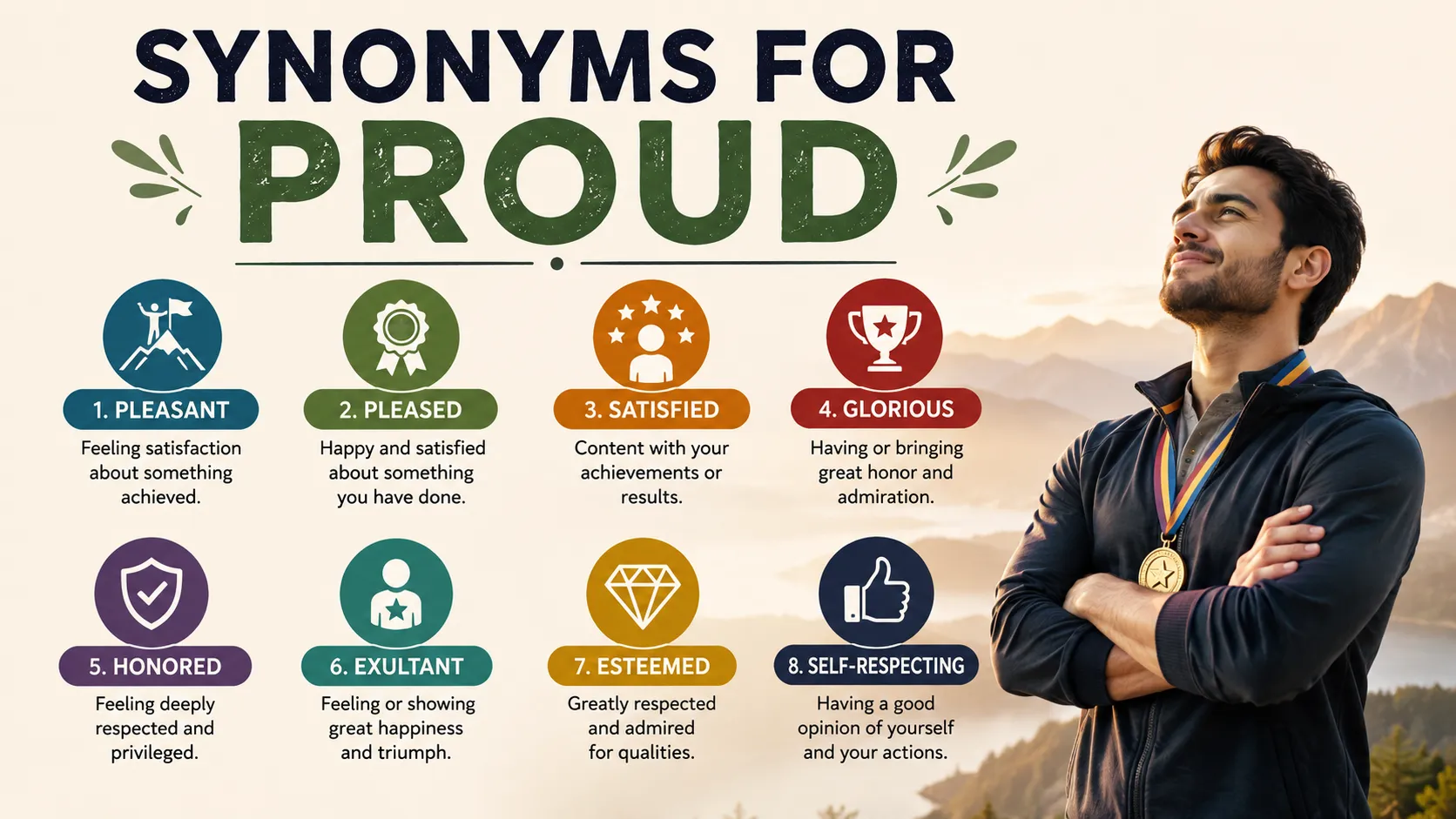
“Proud” usually means one of two things: feeling pleased and satisfied because of an achievement (yours or someone else’s), or having too much self-regard, bordering on arrogance. For the positive sense, close alternatives include pleased, satisfied, gratified, delighted, and honored. For the negative sense, you’re looking at words like arrogant, conceited, or self-satisfied. There isn’t one word that captures “proud” perfectly in every context. The right choice depends on which meaning you intend and how strong you want it to sound.
When your daughter finishes her first marathon, or your team lands a big client, “proud” is often the first word that comes to mind. It’s a warm, natural way to describe satisfaction tied to achievement your own or someone else’s. But “proud” has a second, less flattering side. Say someone is “too proud to admit they were wrong,” and suddenly the word signals stubbornness or excessive self-regard rather than warmth.
Because “proud” covers such different emotional territory, one synonym rarely fits every sentence. A parent congratulating a child needs a different word than a writer describing an overconfident character. This guide breaks the word down by meaning, so you can pick a synonym that actually fits whether you’re writing a card, a story, or a school assignment.
Quick Synonyms Table
| Word | Context / Sense | Type |
| Pleased | Positive achievement | Close Alternative |
| Satisfied | Positive achievement | Close Alternative |
| Gratified | Positive formal | Close Alternative |
| Delighted | Positive emotional | Close Alternative |
| Honored | Positive recognition | Close Alternative |
| Self-satisfied | Borderline smug | Close Alternative |
| Arrogant | Negative excess pride | Related Term |
| Conceited | Negative vanity | Related Term |
| Dignified | Neutral self-respect | Related Term |
| Humble | Opposite meaning | Related Term |
Main Synonym Sections
Pleased
Context/Sense: The everyday, positive sense of proud general satisfaction. Type: Close Alternative. Meaning: Feeling happy or content about something that happened. When to Use: Works in casual and semi-formal writing when you want a lighter tone than “proud.” Example: She was pleased with how the presentation turned out. Similar Words: Happy, glad. Difference: “Pleased” lacks the sense of personal investment or achievement that “proud” carries. You can be pleased about the weather, but not proud of it.
Satisfied
Context/Sense: Positive sense, tied to meeting a goal or standard. Type: Close Alternative. Meaning: Content because expectations or effort paid off. When to Use: Best when the emphasis is on effort meeting a result, rather than emotional warmth. Example: After months of practice, he felt satisfied with his performance. Similar Words: Content, fulfilled. Difference: “Satisfied” focuses on outcomes matching expectations; “proud” adds a stronger emotional and personal element.
Gratified
Context/Sense: Positive sense, formal register. Type: Close Alternative. Meaning: Pleased, often because one’s efforts were recognized or appreciated. When to Use: Suits formal writing, speeches, or professional acknowledgments. Example: The committee was gratified by the community’s response to the proposal. Similar Words: Honored, appreciative. Difference: “Gratified” sounds more formal and reserved than “proud,” which reads as warmer and more personal.
Delighted
Context/Sense: Positive sense, strong emotional reaction. Type: Close Alternative. Meaning: Feeling great pleasure or joy. When to Use: Good for expressing enthusiasm without implying achievement specifically. Example: Grandma was delighted to see the whole family together for the holiday. Similar Words: Thrilled, overjoyed. Difference: “Delighted” centers on joy, while “proud” centers on approval linked to accomplishment.
Honored
Context/Sense: Positive sense, tied to recognition from others. Type: Close Alternative. Meaning: Feeling respected or privileged because of external acknowledgment. When to Use: Fits situations involving awards, invitations, or public recognition. Example: He said he was honored to accept the award on behalf of his team. Similar Words: Privileged, flattered. Difference: “Honored” implies someone else conferred the recognition; “proud” can come from purely internal judgment.
Self-satisfied
Context/Sense: Borderline sense, leaning toward smugness. Type: Close Alternative. Meaning: Pleased with oneself, often excessively or visibly. When to Use: Use carefully it usually carries a mildly critical tone. Example: He wore a self-satisfied smile after winning the argument. Similar Words: Smug, pleased with oneself. Difference: Unlike neutral “proud,” “self-satisfied” often implies the person’s pleasure is a bit excessive or irritating to others.
Arrogant
Context/Sense: Negative sense excessive pride toward others. Type: Related Term. Meaning: Having an exaggerated sense of one’s own importance, often dismissive of others. When to Use: Describes behavior, not achievement-based pride. Example: His arrogant tone made it hard for colleagues to offer feedback. Similar Words: Haughty, condescending. Difference: Not interchangeable with “proud” arrogance is a personality trait, while pride can be a temporary, justified feeling.
Conceited
Context/Sense: Negative sense vanity about one’s own abilities. Type: Related Term. Meaning: Excessively proud of one’s appearance, abilities, or achievements. When to Use: Use for someone who talks about themselves in an inflated way. Example: She never stopped mentioning her awards, which came across as conceited. Similar Words: Vain, boastful. Difference: “Conceited” always carries criticism; “proud” can be entirely positive and well-earned.
Context & Usage
Choosing among these words depends mainly on tone and formality. “Pleased” and “satisfied” work well in everyday and workplace writing, while “gratified” and “honored” suit formal or ceremonial contexts, such as speeches or official statements. Words like “arrogant” and “conceited” belong to a completely different emotional register, critical rather than warm, so swapping them in for “proud” changes the meaning of a sentence, not just its style.
Spoken English also leans toward shorter, warmer words (“pleased,” “happy”), while written or formal English tolerates longer, more precise alternatives (“gratified,” “honored”). Intensity matters too: “delighted” and “thrilled” express stronger emotion than the plainer “satisfied.”
Common Mistakes
- Using “arrogant” or “conceited” as if they simply mean “very proud” they describe a character flaw, not intensity.
- Choosing “gratified” in casual conversation, where it can sound stiff or overly formal.
- Treating “honored” and “proud” as fully interchangeable, even though “honored” implies recognition from someone else.
- Overusing “self-satisfied” without realizing it usually sounds critical.
- Forgetting that “humble” is an antonym, not a synonym, of “proud.”
Comparison Table
| Word | Type | Formality | Best Context | Connotation/Nuance |
| Pleased | Close Alternative | Neutral | Everyday speech and writing | Mild, general satisfaction |
| Gratified | Close Alternative | Formal | Speeches, official statements | Reserved, appreciative |
| Honored | Close Alternative | Formal | Awards, recognition | Tied to others’ acknowledgment |
| Self-satisfied | Close Alternative | Neutral–informal | Character description | Slightly smug |
| Arrogant | Related Term | Neutral | Describing behavior/personality | Critical, negative |
Real-Life Examples
At work: A manager wanted to compliment her team after a successful product launch. She almost wrote, “I’m proud of everyone,” but chose “I’m honored to work with such a dedicated team” instead, since the achievement came from the group, not her own effort, a small shift that better matched who deserved the credit.
In an ESL classroom: A student wrote, “My teacher is very arrogant of my progress,” meaning to compliment her. Her tutor explained that “arrogant” describes an unpleasant personality trait, not warmth about someone’s success. “proud” or “pleased” was the word she actually needed.
Between friends: After a friend nailed a job interview, one texted, “So happy for you you should feel so satisfied right now!” rather than “proud,” since “satisfied” better captured the sense of relief and effort finally paying off, without sounding like she was taking credit herself.
Related Vocabulary
- Pride (noun) the feeling itself; “She spoke with pride about her hometown.”
- Prideful is an adjective often used critically, similar to arrogant.
- Take pride in a common collocation meaning to feel satisfaction from doing something well.
- Beaming often paired with “proud,” describing a visible expression of joy.
- Humility the antonym concept, valuing modesty over self-regard.
- Boastful related to conceited; emphasizes talking too much about one’s achievements.
- Sense of accomplishment is a phrase often used instead of “pride” in formal writing.
Pronunciation
“Proud” is pronounced /praʊd/ (rhymes with “loud” or “cloud”). A few synonyms worth noting: “gratified” is /ˈɡrætɪfaɪd/, and “conceited” is /kənˈsiːtɪd/, with stress on the second syllable.
Grammar Information
“Proud” is an adjective and is typically followed by “of” (“proud of his work”) or a “that” clause (“proud that she finished”). Its comparative and superlative forms are “prouder” and “proudest.” The related noun form is “pride,” and the adverb form is “proudly.” Most close synonyms follow similar patterns for example, “pleased with,” “satisfied with,” and “honored to.”
FAQs
Is “proud” always a positive word?
No. It’s positive when tied to achievement, but negative when it implies arrogance or stubbornness.
What’s the closest single-word synonym for “proud”?
There isn’t a perfect one-word match. “Pleased” and “satisfied” come closest for everyday use, but neither fully captures the personal, emotional weight of “proud.”
Is “arrogant” a synonym for “proud”?
Not directly. It’s related but describes an excessive, often unpleasant version of pride, not a simple substitute.
When should I use “honored” instead of “proud”?
Use “honored” when someone else has recognized or praised you, rather than when you’re evaluating your own achievement.
Can “proud” be used for other people, not just yourself?
Yes, “I’m proud of you” is one of its most common uses, expressing approval of someone else’s achievement.
Is “gratified” too formal for daily conversation?
Generally, yes. It fits speeches, letters, or professional writing better than casual conversation.
Conclusion
“Proud” carries more emotional range than it first appears from warm approval to a warning sign of arrogance. The best synonym depends entirely on which side of that range you mean, plus how formal or casual your writing needs to be. Keep the positive words (pleased, satisfied, honored, gratified) for genuine achievement, and reserve the negative ones (arrogant, conceited) for describing excess. Matching tone to meaning is what makes the substitute actually work.