
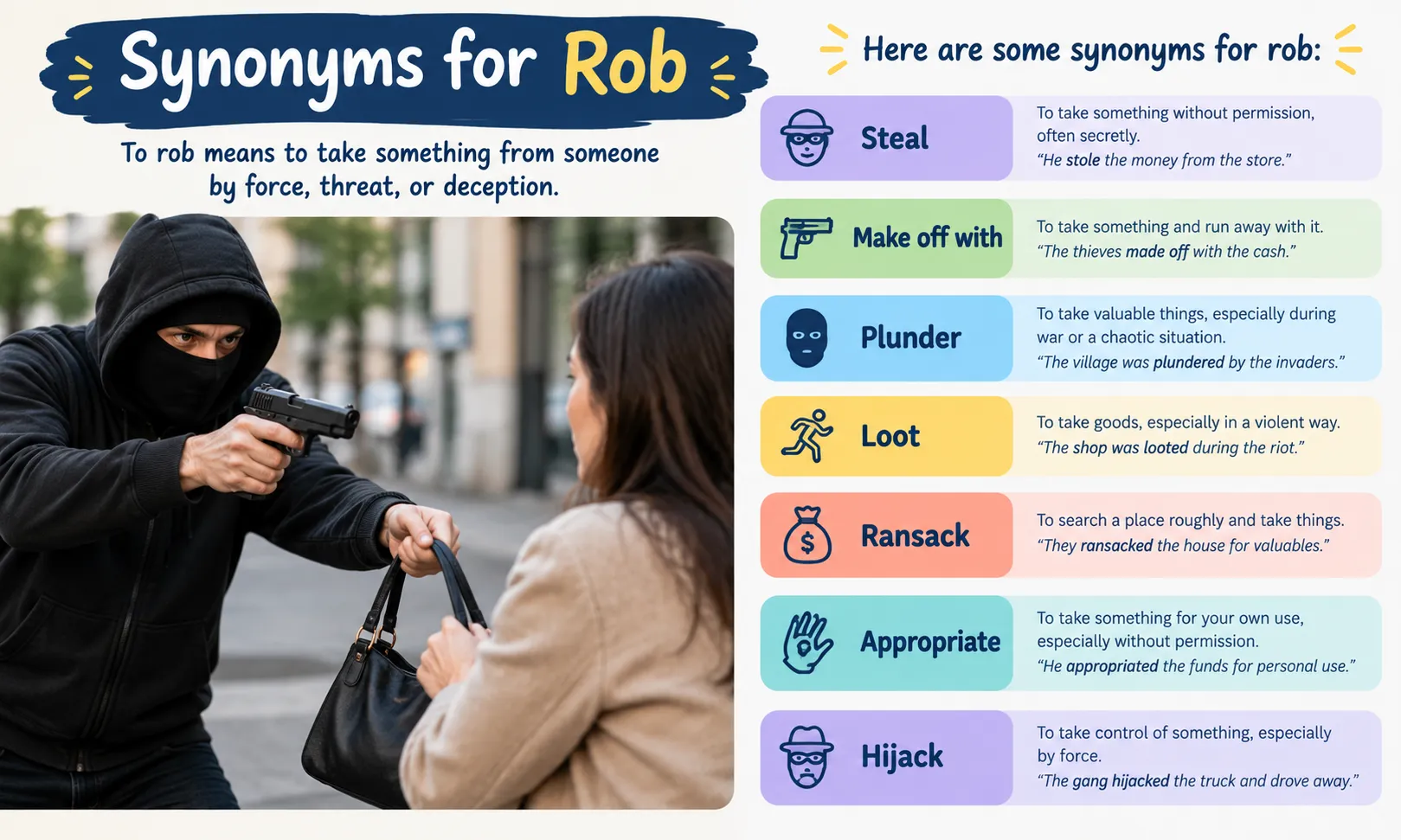
Featured Snippet Answer
The closest synonyms for rob are “steal,” “mug,” and “hold up.” Rob means to take property from a person or place by force or threat. “Steal” is the most common match, but it does not always involve force. Use “mug” for street attacks and “hold up” for armed robberies.
Picture a news writer with three crime stories due today. The first headline says, “Thieves rob corner store.” The second says, “Man robs bank.” By the third, the word already feels tired.
To rob means to take something from a person or place using force or threat. It is a strong word, so it helps to know your options. Learning synonyms for rob lets you match the exact situation.
A street attack, a riot, and a bank job are all different events. This guide shows other words for rob, with simple meanings and real examples. You will also see which words can replace “rob” directly and which cannot.
Synonyms for Rob
| # | Synonym | Relationship | Direct Replacement | Difficulty | Best Used For |
|---|---|---|---|---|---|
| 1 | Steal | Near synonym | Sometimes | Beginner | Daily conversation, general writing |
| 2 | Mug | Near synonym | Sometimes | Intermediate | Daily conversation, news writing |
| 3 | Hold up | Near synonym | Sometimes | Intermediate | News writing, creative writing |
| 4 | Stick up | Contextual alternative | Sometimes | Intermediate | Casual conversation, fiction |
| 5 | Burgle | Contextual alternative | Sometimes | Intermediate | Daily conversation, news writing |
| 6 | Loot | Contextual alternative | Sometimes | Intermediate | News writing, history |
| 7 | Plunder | Near synonym | Sometimes | Advanced | Literature, history, creative writing |
| 8 | Pillage | Contextual alternative | Sometimes | Advanced | History, literature |
| 9 | Pilfer | Contextual alternative | No | Advanced | Formal and literary writing |
| 10 | Rip off | Contextual alternative | Sometimes | Intermediate | Casual conversation |
| 11 | Deprive | Contextual alternative | Sometimes | Intermediate | Formal and academic writing |
| 12 | Swindle | Related term | No | Intermediate | News writing, business writing |
| 13 | Ransack | Related term | No | Intermediate | Creative writing, news writing |
| 14 | Carjack | Related term | No | Intermediate | News writing |
Table of ContentsSteal
- Mug
- Hold up
- Stick up
- Burgle
- Loot
- Plunder
- Pillage
- Pilfer
- Rip off
- Deprive
- Swindle
- Ransack
- Carjack
- Antonyms
- Commonly Confused Words
- Frequently Asked Questions
- Conclusion
Quick Facts About Rob
- Focus keyword: rob
- Part of speech: verb
- Pronunciation guide: rahb
- IPA: /rɑːb/ (US: /rɑb/)
- Syllables: 1
- Origin: From Old French rober, which came from a Germanic word meaning “to plunder.”
- Other word forms: robs, robbed, robbing, robber (noun), robbery (noun)
- Formality level: Neutral
- Difficulty level: Beginner
- CEFR level: Around B1
Meaning and Usage of Rob
To rob means to take money or property from someone by force, threat, or fear. The victim is often present when it happens. That is what separates robbing from many other crimes.
Grammar matters here. You rob a person or place, not a thing; you rob a bank but steal the money.
- “Two men robbed the pharmacy last night.”
- “They robbed him of his wallet and phone.”
You will see “rob” in news reports, crime stories, and everyday talk. It also works figuratively, as in “The heat robbed me of my energy.”
Detailed Synonyms for Rob
1. Steal: A Synonym for Rob
Relationship: Near synonym
Direct Replacement: Sometimes
Difficulty Level: Beginner
Meaning: To steal is to take something that belongs to someone else without permission.
Difference: “Steal” does not need force or threat. Also, the object of “steal” is the item, while the object of “rob” is the victim.
Best Used For:
- Daily conversation
- General writing
Examples:
- Someone stole my bike from the school gate.
- Kids once stole apples from the old man’s tree.
2. Mug: A Synonym for Rob
Relationship: Near synonym
Direct Replacement: Sometimes
Difficulty Level: Intermediate
Meaning: To mug someone is to attack and rob them in a public place.
Difference: “Mug” always involves a person, usually outdoors. “Rob” can also describe a shop, bank, or house.
Best Used For:
- Daily conversation
- News writing
Examples:
- Two men mugged a tourist near the train station.
- She was mugged on her way home but was not hurt.
3. Hold Up: A Synonym for Rob
Relationship: Near synonym
Direct Replacement: Sometimes
Difficulty Level: Intermediate
Meaning: To hold up a place is to rob it while threatening people, often with a weapon.
Difference: “Hold up” suggests a quick, threatening robbery of a business. “Rob” is wider and less specific.
Best Used For:
- News writing
- Creative writing
Examples:
- Masked men held up the jewelry store at noon.
- The cashier stayed calm when a stranger tried to hold up the gas station.
4. Stick Up: A Synonym for Rob
Relationship: Contextual alternative
Direct Replacement: Sometimes
Difficulty Level: Intermediate
Meaning: To stick up a person or place is to rob them at gunpoint.
Difference: “Stick up” is slang and sounds old-fashioned. “Rob” is neutral and works in any setting.
Best Used For:
- Casual conversation
- Fiction
Examples:
- In old Westerns, outlaws stick up the stagecoach.
- The character in the movie tried to stick up a diner with a toy gun.
5. Burgle: A Synonym for Rob
Relationship: Contextual alternative
Direct Replacement: Sometimes
Difficulty Level: Intermediate
Meaning: To burgle is to break into a building to steal things.
Difference: “Burgle” is about entering a building, often when no one is home. “Rob” usually means facing the victim. Americans often say “burglarize.”
Best Used For:
- Daily conversation
- News writing
Examples:
- Someone burgled our neighbors while they were on holiday.
- Police think the same gang burgled three houses on our street.
6. Loot: A Synonym for Rob
Relationship: Contextual alternative
Direct Replacement: Sometimes
Difficulty Level: Intermediate
Meaning: To loot is to steal goods during a riot, war, or disaster.
Difference: “Loot” is tied to chaos and crowds. “Rob” can happen on any normal day.
Best Used For:
- News writing
- History
Examples:
- Crowds looted shops during the blackout.
- Thieves looted the museum’s storage room before anyone noticed.
7. Plunder: A Synonym for Rob
Relationship: Near synonym
Direct Replacement: Sometimes
Difficulty Level: Advanced
Meaning: To plunder is to rob a place of its valuable things, often on a large scale.
Difference: “Plunder” sounds dramatic and covers big targets like ships, towns, or forests. “Rob” feels smaller and more everyday.
Best Used For:
- Literature
- History
- Creative writing
Examples:
- Pirates plundered ships along the coast.
- Illegal loggers plundered the forest of its rare trees.
8. Pillage: A Synonym for Rob
Relationship: Contextual alternative
Direct Replacement: Sometimes
Difficulty Level: Advanced
Meaning: To pillage is to rob and destroy a place, especially in war.
Difference: “Pillage” adds damage and violence on a large scale. “Rob” does not always mean destruction.
Best Used For:
- History
- Literature
Examples:
- Invading armies pillaged the town for food and gold.
- The villagers feared that raiders would pillage their farms.
9. Pilfer: A Synonym for Rob
Relationship: Contextual alternative
Direct Replacement: No
Difficulty Level: Advanced
Meaning: To pilfer is to steal small things in small amounts.
Difference: “Pilfer” is quiet and low-value, with no force or threat. “Rob” is serious and forceful, so the two are not interchangeable.
Best Used For:
- Formal writing
- Literary writing
Examples:
- Someone keeps pilfering pens from the office supply closet.
- He pilfered a few coins from the jar on the counter.
10. Rip Off: A Synonym for Rob
Relationship: Contextual alternative
Direct Replacement: Sometimes
Difficulty Level: Intermediate
Meaning: To rip someone off is to cheat them or charge far too much.
Difference: “Rip off” is informal and often means cheating rather than violence. It can also mean “steal” in casual speech.
Best Used For:
- Casual conversation
Examples:
- That souvenir shop ripped us off by charging triple.
- I felt ripped off when the new phone broke after a week.
11. Deprive: A Synonym for Rob
Relationship: Contextual alternative
Direct Replacement: Sometimes
Difficulty Level: Intermediate
Meaning: To deprive someone is to take away something they need or deserve.
Difference: “Deprive” matches only the figurative use of “rob,” as in “rob someone of a chance.” It never means a crime with force.
Best Used For:
- Formal writing
- Academic writing
Examples:
- The strict rules deprived the children of free playtime.
- A long illness deprived her of the chance to compete.
12. Swindle: A Related Term to Rob
Relationship: Related term (not a true synonym)
Direct Replacement: No
Difficulty Level: Intermediate
Meaning: To swindle is to take money from someone by lying or tricking them.
Difference: “Swindle” uses trickery, not force or threat. Robbery is open and aggressive, while a swindle is sneaky.
Best Used For:
- News writing
- Business writing
Examples:
- A fake charity swindled retirees out of their savings.
- He swindled investors with a company that did not exist.
13. Ransack: A Related Term to Rob
Relationship: Related term (not a true synonym)
Direct Replacement: No
Difficulty Level: Intermediate
Meaning: To ransack is to search a place roughly and leave it a mess.
Difference: “Ransack” describes the messy search, not the act of taking. Thieves often ransack a place while they rob it.
Best Used For:
- Creative writing
- News writing
Examples:
- Burglars ransacked the bedroom and tossed clothes everywhere.
- The kids ransacked the kitchen looking for snacks.
14. Carjack: A Related Term to Rob
Relationship: Related term (not a true synonym)
Direct Replacement: No
Difficulty Level: Intermediate
Meaning: To carjack is to take a car from its driver by force.
Difference: “Carjack” is one specific type of robbery. It is narrower than “rob,” so it cannot replace it in general sentences.
Best Used For:
- News writing
Examples:
- A man tried to carjack a taxi at a red light.
- News reports said a gang carjacked drivers near the highway.
Antonyms of Rob
| # | Antonym | Simple Meaning | Example |
|---|---|---|---|
| 1 | Give | To hand something to someone freely | She gave her old coat to a stranger. |
| 2 | Donate | To give money or goods to help others | We donated books to the local library. |
| 3 | Return | To bring something back to its owner | He returned the wallet he found. |
| 4 | Restore | To give back what was lost or taken | The police restored the stolen painting to the museum. |
| 5 | Protect | To keep someone or something safe | Guards protect the bank at night. |
| 6 | Repay | To give back money that you owe | I will repay you on Friday. |
Words Commonly Confused with Rob
Robbery
Difference: “Robbery” is the noun for the crime. “Rob” is the verb for the action. Robbery needs force or threat in most places.
Example: The robbery lasted less than two minutes.
Burglary
Difference: Burglary means breaking into a building to steal. It does not require a confrontation with the victim. Robbery does.
Example: The burglary happened while the family was at the beach.
Theft
Difference: “Theft” is a broad word for any act of stealing. Robbery is only one kind of theft, the kind that uses force or threat.
Example: Phone theft is common in crowded train stations.
Robe
Difference: “Robe” sounds similar but is unrelated. It is a loose piece of clothing, such as a bathrobe, and also a noun.
Example: He wore a soft robe after his shower.
FAQs
What is another word for rob?
Common alternatives include “steal,” “mug,” “hold up,” “burgle,” and “loot.” The best choice depends on the situation. Use “mug” for street attacks, “hold up” for shops and banks, and “loot” for chaos like riots. Always check whether force or a building is involved.
What is the closest synonym for rob?
“Steal” is the closest everyday synonym, since both words mean taking what is not yours. Still, “steal” does not need force. For a violent robbery, “hold up” or “mug” often fits better. For a person attacked on the street, “mug” is the closest match.
Can I replace rob with steal?
Sometimes. “Steal” works when you focus on the item taken, as in “steal money.” It does not work when the victim is the object. You rob a bank, but you cannot say “steal a bank.” Also, “steal” does not show force or threat.
Is rob formal or informal?
“Rob” is neutral. You can use it in conversation, news reports, essays, and stories. It is a plain, direct word. For a more formal tone, writers may choose “plunder” or “deprive,” depending on the meaning. Slang options like “stick up” and “rip off” are informal.
What is the opposite of rob?
There is no single opposite, but several words work. “Give,” “donate,” “return,” and “restore” all mean the reverse of taking. “Protect” works too, since it means keeping things safe from robbers. Choose the antonym that matches the situation in your sentence.
Which synonym is best in a particular context?
Street crime: use “mug”; banks and shops: use “hold up”; houses: use “burgle.”
During riots or disasters, use “loot.” For wars and old stories, use “plunder” or “pillage.” In everyday talk, “steal” is the safest choice.
Conclusion
Learning synonyms for rob helps you describe events more clearly. Each word adds a small detail, like where a crime happened or how it was done. That detail makes your writing sharper and more believable.
Context matters, so think about the setting, the force involved, and the tone before you choose. Try these words in emails, essays, articles, and everyday conversation. Pick one new word this week, and you will notice your vocabulary growing.