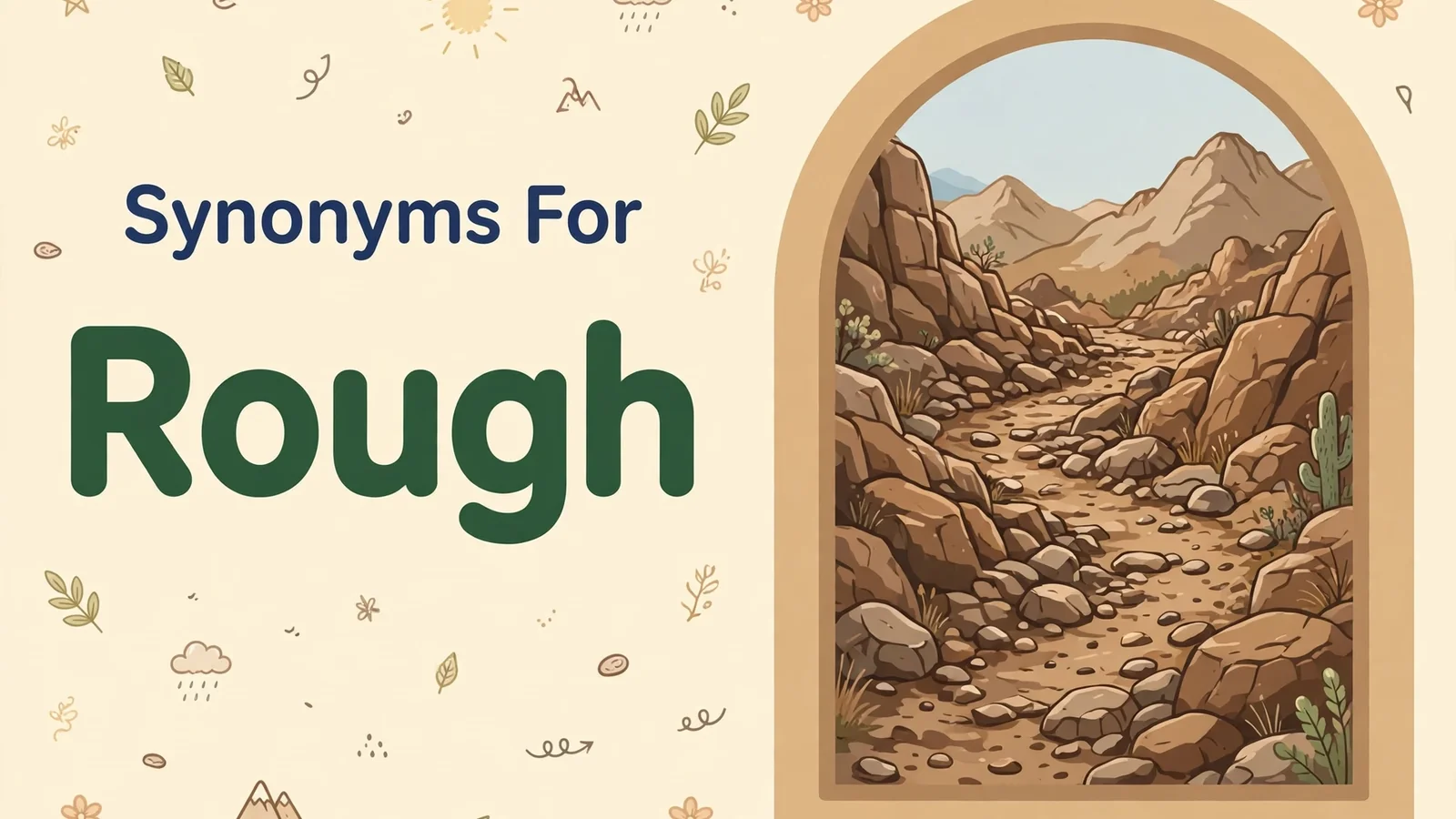
What Is Rough?
Rough means not smooth or gentle, with an uneven surface or harsh treatment. Its closest synonym is coarse, because both describe an uneven texture you can feel. Other top synonyms are bumpy, uneven, and tough. You can use rough for roads, skin, weather, and difficult times. For example, a rough road shakes the whole bus on the way to Naran.
Last winter, Kamran rode his old motorcycle from Mansehra toward Naran. After one hour, the paved road ended and stones rattled under his wheels for twenty kilometers. His hands hurt, his bag bounced, and dust covered his black jacket. Rough means uneven and not gentle, whether a road, a voice, or a difficult week. When you learn synonyms for rough, you can describe tough surfaces and hard times with exact words. This helps in stories, travel blogs, and daily talk. By the end, you will be able to pick the best word for rough in any sentence.
Table of 12 Synonyms for Rough
| No. | Synonym | Simple Meaning |
|---|---|---|
| 1 | Coarse | Rough in surface texture |
| 2 | Bumpy | Full of small bumps |
| 3 | Uneven | Not flat or level |
| 4 | Jagged | Sharp and uneven edges |
| 5 | Rugged | Strong and roughly uneven |
| 6 | Rocky | Full of rocks |
| 7 | Crude | Rough and unfinished |
| 8 | Harsh | Severely unkind or strong |
| 9 | Tough | Hard to bear or break |
| 10 | Approximate | Rough, not exact |
| 11 | Unfinished | Not yet complete or smooth |
| 12 | Wild | Rough and uncontrolled |
Table of Contents
- Introduction
- Table of 12 Synonyms for Rough
- Quick Facts About Rough
- Meaning and Usage of Rough
- Grammar and Sentence Patterns for Rough
- 1. Coarse
- 2. Bumpy
- 3. Uneven
- 4. Jagged
- 5. Rugged
- 6. Rocky
- 7. Crude
- 8. Harsh
- 9. Tough
- 10. Approximate
- 11. Unfinished
- 12. Wild
- Choose the Right Synonym for Rough
- Rough Synonyms by Category
- Antonyms of Rough
- Words Commonly Confused with Rough
- Common Mistakes with Rough
- Writing Tips for Rough
- American vs. British English Notes for Rough
- Practice Exercises for Rough
- Frequently Asked Questions
- Quick Vocabulary Quiz on Rough
- Conclusion
Quick Facts About Rough
- Focus keyword: rough
- Part of speech: adjective
- Pronunciation: RUFF (rhymes with “tough”)
- IPA: /rʌf/
- Number of syllables: 1
- Word origin: Old English “rūh”
- Other word forms: roughly (adverb), roughness (noun), rougher, roughest
- Formality level: neutral; works in casual and formal writing
- Difficulty level: beginner to intermediate
- CEFR level: around B2
Meaning and Usage of Rough
Rough describes an uneven surface, like a rocky path or coarse cloth. It also describes difficult times, like a rough week, and careless treatment, like rough handling. Writers use it for roads, skin, weather, estimates, and manners. A rough estimate is not exact. A rough voice sounds deep and uneven. The word often feels negative but can be neutral.
Grammar and Sentence Patterns for Rough
The basic pattern is: subject + be + rough, or rough + noun. Example: “The road is rough.”
The 3 most common pairings readers must get right:
- rough around the edges: “The young player is rough around the edges but talented.” (unpolished)
- a rough estimate / idea: “A rough estimate puts the cost at fifty thousand rupees.” (not exact)
- rough seas / weather: “Rough seas stopped the boats for two days.” (wild and dangerous)
One frequent mistake: “The sea was roughly yesterday.” The correction is “The sea was rough yesterday.” Always use the adjective rough after “was.”
1. Coarse
Meaning: Coarse means rough in texture, with large uneven grains.
Examples:
- The coarse salt from the Khewra mines feels like tiny stones.
- His coarse shirt from the village market scratched his neck all day.
Best Used When: describing rough textures like salt, cloth, or sand.
Tone: neutral, descriptive.
Common Collocations: coarse salt, coarse fabric, coarse sand.
Connotation: plain roughness you can feel with fingers.
When Not to Use This Word: avoid it for difficult times; coarse fits textures.
2. Bumpy
Meaning: Bumpy means full of small bumps that shake you.
Examples:
- The bumpy track to the fort shook our jeep for thirty minutes.
- Her bumpy flight from Karachi made her sick twice.
Best Used When: describing roads, rides, or flights that shake.
Tone: casual.
Common Collocations: bumpy road, bumpy ride, bumpy flight.
Connotation: uncomfortable shaking; mildly negative.
When Not to Use This Word: do not use it for people or manners; bumpy fits movement.
3. Uneven
Meaning: Uneven means not flat, with high and low parts.
Examples:
- The uneven floor in the old haveli tripped the waiter twice.
- His uneven handwriting on the exam paper cost him five marks.
Best Used When: describing floors, ground, or inconsistent quality.
Tone: neutral, formal.
Common Collocations: uneven ground, uneven surface, uneven performance.
Connotation: lack of balance; factual rather than emotional.
When Not to Use This Word: avoid it for deliberate rudeness; uneven is about shape.
4. Jagged
Meaning: Jagged means having sharp, uneven points like broken glass.
Examples:
- Jagged rocks near the Skardu river cut his shoes in one day.
- The jagged edge of the tin box needs tape before children touch it.
Best Used When: describing sharp rocks, edges, or outlines.
Tone: vivid, slightly alarming.
Common Collocations: jagged rocks, jagged edge, jagged line.
Connotation: danger in the shape; suggests cuts.
When Not to Use This Word: do not use it for soft things; jagged needs sharpness.
5. Rugged
Meaning: Rugged means strongly uneven and wild, often beautiful.
Examples:
- The rugged mountains of Hunza attract two thousand tourists yearly.
- His rugged face with a short beard suits the role of a shepherd.
Best Used When: describing wild landscapes or strong masculine looks.
Tone: admiring, literary.
Common Collocations: rugged mountains, rugged beauty, rugged coastline.
Connotation: wild strength; often positive and grand.
When Not to Use This Word: avoid it for small indoor things; rugged fits big nature.
6. Rocky
Meaning: Rocky means full of rocks or unsteady like a shaking boat.
Examples:
- The rocky path to the shrine tired the old pilgrims in an hour.
- Their rocky marriage of ten years finally found peace.
Best Used When: describing stony ground or unstable situations.
Tone: neutral to negative.
Common Collocations: rocky road, rocky start, rocky relationship.
Connotation: instability; suggests trouble ahead.
When Not to Use This Word: do not use it for textures like cloth; rocky fits ground and situations.
7. Crude
Meaning: Crude means rough and unfinished, not yet refined.
Examples:
- The crude drawing of a horse made the whole class laugh.
- They built a crude shelter from eight wooden poles near the river.
Best Used When: describing unfinished work, simple tools, or raw materials.
Tone: critical, formal.
Common Collocations: crude oil, crude drawing, crude methods.
Connotation: lack of polish; needs more work.
When Not to Use This Word: avoid it for polite criticism of people; crude can offend.
8. Harsh
Meaning: Harsh means severely unkind, strong, or unpleasant.
Examples:
- The harsh wind on the rooftop tore two shirts from the line.
- His harsh tone during the meeting silenced five junior staff.
Best Used When: describing severe weather, voices, or treatment.
Tone: negative, serious.
Common Collocations: harsh words, harsh winter, harsh light.
Connotation: severity that hurts; stronger than rough.
When Not to Use This Word: do not use it for simple uneven surfaces; harsh fits intensity.
9. Tough
Meaning: Tough means hard to bear, break, or defeat.
Examples:
- The tough leather bag survived five years of college travel.
- After his father’s death, Ahmed faced a tough year alone in Peshawar.
Best Used When: describing strong materials, difficult times, or strong people.
Tone: admiring or sympathetic.
Common Collocations: tough times, tough guy, tough decision.
Connotation: strength under pressure; often respectful.
When Not to Use This Word: avoid it for textures alone; tough fits endurance.
10. Approximate
Meaning: Approximate means roughly correct but not exact.
Examples:
- The approximate cost of the wedding in Gujranwala was eight lakh rupees.
- Give me an approximate time; I will reach between four and five.
Best Used When: describing estimates, guesses, or rough numbers.
Tone: formal, practical.
Common Collocations: approximate cost, approximate time, approximate number.
Connotation: honest guessing; not a lie, just not exact.
When Not to Use This Word: do not use it for surfaces or manners; approximate fits numbers.
11. Unfinished
Meaning: Unfinished means not yet complete, still raw or uneven.
Examples:
- The unfinished wall behind the school shows red bricks.
- She left her essay unfinished with only two paragraphs done.
Best Used When: describing incomplete work or raw surfaces.
Tone: neutral, factual.
Common Collocations: unfinished business, unfinished room, unfinished work.
Connotation: work in progress; neutral rather than bad.
When Not to Use This Word: avoid it for finished but bumpy things; unfinished means incomplete.
12. Wild
Meaning: Wild means rough, uncontrolled, and natural.
Examples:
- Wild winds from the Arabian Sea hit the coast at midnight.
- The wild garden behind the house had snakes twice last summer.
Best Used When: describing untamed nature, weather, or behavior.
Tone: vivid, dramatic.
Common Collocations: wild weather, wild animals, wild party.
Connotation: exciting lack of control; can be fun or scary.
When Not to Use This Word: do not use it for small indoor roughness; wild fits big nature.
Choose the Right Synonym for Rough
| If you mean… | Use this word |
|---|---|
| A road full of small shaking bumps | Bumpy |
| A texture like large salt grains | Coarse |
| Sharp rocks that can cut | Jagged |
| A beautiful wild mountain scene | Rugged |
| A cost that is not exact | Approximate |
| A difficult year after a loss | Tough |
| An incomplete wall of bricks | Unfinished |
| Severe cold wind on the roof | Harsh |
Rough Synonyms by Category
Surfaces and textures: coarse, bumpy, uneven, jagged, rocky. This group fits roads, ground, and touch.
Wild nature: rugged, wild, harsh. This group fits mountains, weather, and landscapes.
Unfinished things: crude, unfinished, approximate. This group fits work, estimates, and raw materials.
Hard times: tough, harsh. This group fits difficult periods and strong treatment.
Antonyms of Rough
| # | Antonym | Simple Meaning | Example |
|---|---|---|---|
| 1 | Smooth | Even to touch | The smooth table felt cool. |
| 2 | Even | Flat and level | They played on even ground. |
| 3 | Flat | Without curves | The flat desert ran for miles. |
| 4 | Gentle | Soft and careful | A gentle breeze moved the curtains. |
| 5 | Refined | Polished and elegant | Her refined manners charmed everyone. |
| 6 | Polished | Smooth and finished | His polished shoes shone brightly. |
Related Expressions: rough around the edges, take the rough with the smooth, rough it, a rough draft.
Word Family: rough (adjective), roughly (adverb), roughness (noun).
Words Commonly Confused with Rough
Tough
Difference: Tough means hard to break or bear, while rough means uneven to touch. A tough boxer is strong; a rough road is bumpy.
Example: The tough old lock refused to open for an hour.
Rude
Difference: Rude means bad-mannered toward people, while rough means uneven or careless. A rude reply insults; a rough voice just sounds deep.
Example: His rude answer at dinner shocked the guests.
Raw
Difference: Raw means natural and unprocessed, while rough means uneven in texture. Raw vegetables are uncooked; a rough wall is bumpy.
Example: She eats raw carrots from her garden daily.
Common Mistakes with Rough
Mistake: The sea was roughly yesterday.
Correction: The sea was rough yesterday.
Why: After “was,” use the adjective rough, not the adverb roughly.
Mistake: He had a roughly day.
Correction: He had a rough day.
Why: Roughly is an adverb; use the adjective rough before the noun day.
Mistake: The road is roughness.
Correction: The road is rough.
Why: Roughness is a noun; use the adjective rough after “is.”
Writing Tips for Rough
- Emails: Use “approximate” for polite estimates, like “the approximate budget is two lakh rupees.”
- Essays: Use “rugged” for landscape praise, like “the rugged beauty of the northern areas.”
- Blog posts: Use “bumpy” for travel stories, like “a bumpy ride worth every minute.”
- Stories: Use “jagged” for vivid danger, like “jagged shadows on the old wall.”
- Social media: Use “tough” for sympathy, like “tough day, but we move on.”
American vs. British English Notes for Rough
Rough is used the same way in American and British English, with the same spelling and meaning. No real difference exists between the two varieties for this word or its synonyms.
Practice Exercises for Rough
1. Fill in the blank: The ___ road shook the bus for an hour. (hint: full of bumps) 2. Fill in the blank: Give me an ___ cost for the repairs. (hint: not exact) 3. Rewrite using a synonym: The sea was very uneven yesterday. 4. Rewrite using a synonym: He had a difficult day at work. 5. Match: a) jagged b) rugged c) approximate with: 1) not exact 2) sharp rocks 3) wild mountains.
Frequently Asked Questions
What is another word for rough?
Coarse is the closest everyday alternative. It fits textures like cloth, salt, and sand. For example, you can say coarse fabric instead of rough fabric, and the meaning stays nearly the same.
What is the closest synonym for rough?
Coarse is the closest synonym because both describe an uneven texture you can feel. The small difference is that rough is wider and also fits difficult times, while coarse stays with texture.
Can I use tough instead of rough?
Only for strength or difficulty. Tough fits strong people and hard times. For a bumpy road or scratchy cloth, rough or coarse sounds natural, but tough road is wrong.
Is rough formal or informal?
Rough is neutral, so it works in casual talk, school essays, and office emails. For formal estimates, approximate is better than rough.
What is the opposite of rough?
The opposite of rough is smooth. Even and gentle are also good opposites. Use smooth for touch, even for flatness, and gentle for treatment.
Which synonym fits a mountain scene?
Rugged fits wild mountain beauty. Rocky fits stony ground. For example, the rugged peaks of Hunza sounds grand, while a rocky path sounds difficult to walk.
Quick Vocabulary Quiz on Rough
1. The ___ road shook the bus for an hour. A) bumpy B) silky C) mellow D) fluent 2. The ___ cost of the wedding was eight lakh rupees. A) approximate B) jagged C) sleek D) glossy 3. ___ rocks near the river cut his shoes. A) Jagged B) Mellow C) Even D) Flat 4. After his father’s death, he faced a ___ year. A) tough B) silky C) polished D) graceful 5. The ___ mountains of Hunza attract tourists. A) rugged B) bitter C) unkind D) flat
Conclusion
Synonyms for rough give your English real texture. Twelve new words let you describe bumpy roads, wild nature, and hard times with exact shades. Coarse fits rough touch, rugged fits grand mountains, and tough fits difficult days. Context decides everything, so always match the word to the feeling. Practice these words in emails, essays, articles, and conversations. Your 30-second challenge: use 3 of these synonyms in your own sentences today. For more examples, check the Cambridge Dictionary entry for rough: https://dictionary.cambridge.org/dictionary/english/rough. Small daily practice builds strong vocabulary fast.