
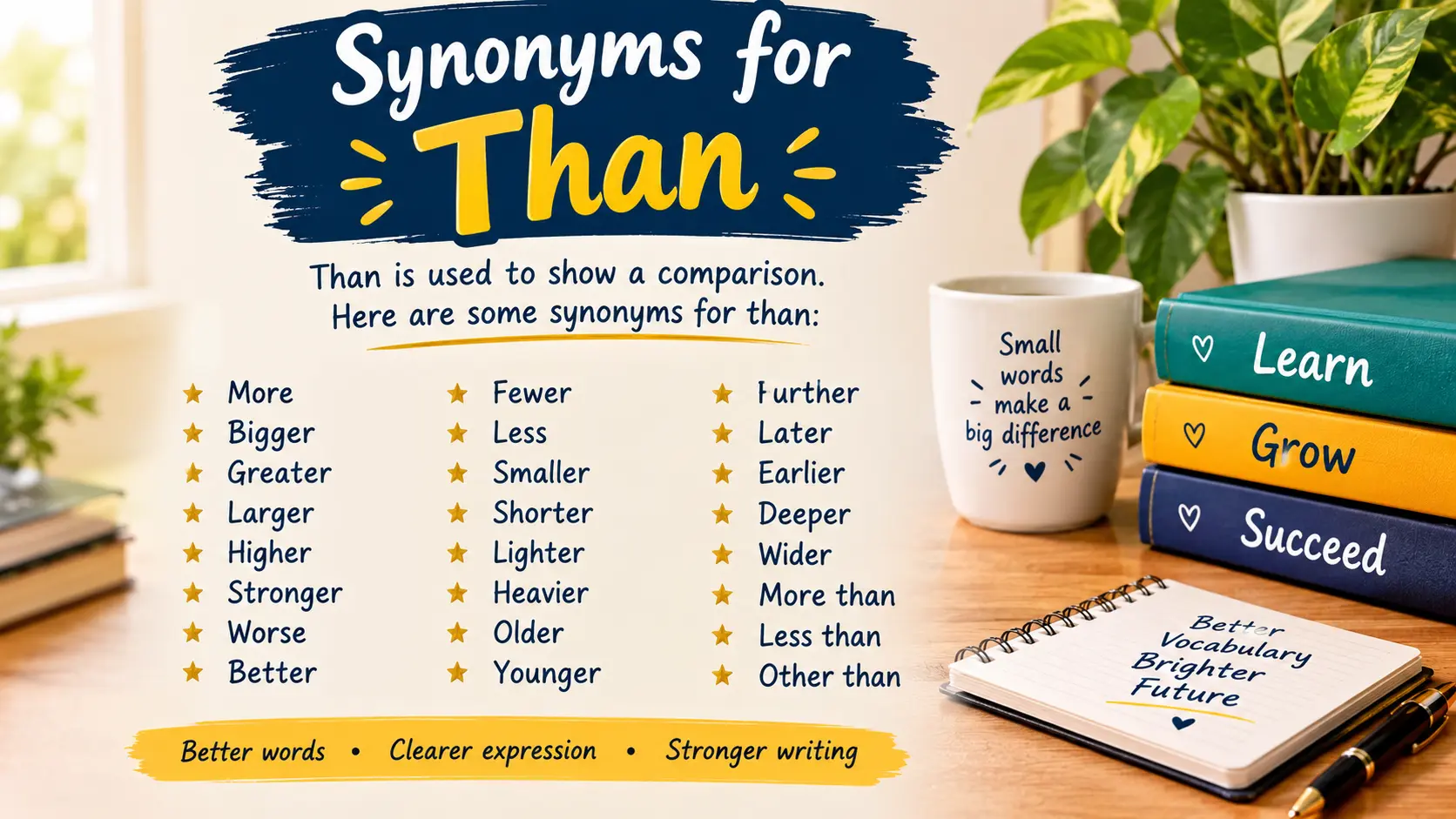
Featured Snippet Answer
Than has no true synonyms. It’s a function word (a conjunction/preposition) used only to introduce a comparison, like “bigger than this.” Words like “compared to” or “versus” serve a similar comparative purpose, but they aren’t direct grammatical replacements for “than” in most sentences.
Have you ever tried to look up a synonym for “than” and come up empty? You’re not alone. Someone writing “She is taller than her brother” might wonder if another word could work in that spot.
Here’s the honest answer: “than” doesn’t really have synonyms. It’s a small grammar word, called a function word, that connects two things being compared. It doesn’t carry its own meaning the way words like “big” or “happy” do.
This guide explains why “than” is different from most words you’d search synonyms for. You’ll also learn a few comparative words and phrases that do similar jobs in different types of sentences, so your writing stays clear and accurate.
Synonyms for Than
| # | Word/Phrase | Relationship | Direct Replacement | Difficulty | Best Used For |
|---|---|---|---|---|---|
| 1 | Compared to | Related term | No | Beginner | Daily conversation, writing |
| 2 | Compared with | Related term | No | Beginner | Academic writing |
| 3 | In comparison to | Related term | No | Intermediate | Formal/academic writing |
| 4 | Relative to | Related term | No | Advanced | Technical, academic writing |
| 5 | Versus (vs.) | Related term | No | Beginner | Sports, debates, comparisons |
| 6 | As opposed to | Related term | No | Intermediate | Formal writing, arguments |
| 7 | Against | Related term | No | Intermediate | Comparisons, contests |
Note: None of these words can simply replace “than” inside a sentence like “faster than a car.” They express comparison in a different grammatical way, usually needing a rewritten sentence. This is why they’re labeled related terms, not synonyms.
Table of Contents
- Compared to / Compared with
- In Comparison ToRelative ToVersusAs Opposed To
- Against
Quick Facts About Than
- Focus keyword: Than
- Part of speech: Conjunction, preposition
- Simple pronunciation: “than” (rhymes with “man”)
- IPA: /ðæn/
- Syllables: 1
- Word origin: From Old English þonne/þanne, originally the same word as “then”
- Other word forms: None (than does not change form)
- Formality level: Neutral — used in both formal and informal English
- Difficulty level: Beginner
- CEFR level: A1
Meaning and Usage of Than
“Than” is used to compare two things. It usually follows a comparative adjective or adverb, like “faster,” “better,” or “more.”
You’ll see it in sentences that measure one thing against another. It doesn’t have a meaning on its own — it only works as a connector.
Examples:
- My coffee is colder than yours.
- She finished the race faster than expected.
1. Compared to / Compared with: A Related Term for Than
Relationship: Related term
Direct Replacement: No
Difficulty Level: Beginner
Meaning: “Compared to” or “compared with” introduces a comparison between two things, usually at the start of a clause.
Difference: Unlike “than,” which sits between two compared items in one sentence, “compared to” needs its own clause structure. You can’t say “faster compared to a car” the same way you’d say “faster than a car” — the sentence has to be rebuilt.
Best Used For: Daily conversation, academic writing
Examples:
- Compared to last year, sales have doubled this quarter.
- Compared with her old apartment, this one feels huge.
2. In Comparison To: A Related Term for Than
Relationship: Related term
Direct Replacement: No
Difficulty Level: Intermediate
Meaning: “In comparison to” formally introduces two things being measured against each other.
Difference: This phrase is more formal and wordier than “than.” It works well at the start of a sentence, while “than” always connects mid-sentence.
Best Used For: Academic writing, business writing
Examples:
- In comparison to other cities, rent here is quite low.
- In comparison to last year’s numbers, this report looks promising.
3. Relative To: A Related Term for Than
Relationship: Related term
Direct Replacement: No
Difficulty Level: Advanced
Meaning: “Relative to” means measured in relation to something else, often used with numbers or data.
Difference: This phrase is common in technical or scientific writing, while “than” is used everywhere, including casual speech.
Best Used For: Technical writing, academic writing
Examples:
- The results were strong relative to expectations.
- Prices stayed stable relative to inflation this year.
4. Versus: A Related Term for Than
Relationship: Related term
Direct Replacement: No
Difficulty Level: Beginner
Meaning: “Versus” (often shortened to “vs.”) means directly against or in contrast with something.
Difference: “Versus” is used to name two competing sides, not to measure a difference in degree the way “than” does.
Best Used For: Daily conversation, sports, debates
Examples:
- It’s chicken versus beef for tonight’s dinner.
- The debate was framed as tradition versus progress.
5. As Opposed To: A Related Term for Than
Relationship: Related term
Direct Replacement: No
Difficulty Level: Intermediate
Meaning: “As opposed to” highlights a contrast, showing one option instead of another.
Difference: This phrase focuses on contrast and choice, while “than” focuses on measuring degree, like size or speed.
Best Used For: Formal writing, argumentative writing
Examples:
- She prefers walking, as opposed to driving, to work.
- We chose quality as opposed to quantity for this project.
6. Against: A Related Term for Than
Relationship: Related term
Direct Replacement: No
Difficulty Level: Intermediate
Meaning: “Against” can mean in contrast to or measured next to something else.
Difference: “Against” often implies opposition or contrast in a contest, while “than” is neutral and simply measures a difference.
Best Used For: Daily conversation, competitions
Examples:
- The team’s performance looked weak against last season’s record.
- He measured his height against the doorframe.
Antonyms of Than
Than does not have true antonyms. It’s a grammatical function word, not a descriptive word, so it doesn’t have an opposite meaning the way “hot” and “cold” do.
Words Commonly Confused with Than
Then
Difference: “Then” relates to time or sequence (what happens next), while “than” is used only for comparisons.
Example: We finished dinner, and then we watched a movie. (not “than”)
That
Difference: “That” is used to point to something or introduce a clause, not to compare two things.
Example: I think that she’s right. (not “than”)
As
Difference: “As” is used in equal comparisons (“as tall as”), while “than” is used in unequal comparisons (“taller than”).
Example: He is as tall as his father, but taller than his uncle.
Frequently Asked Questions
What is another word for than?
There isn’t a true direct replacement for “than.” It’s a grammar word used specifically to link two things in a comparison, so no other single word does exactly the same job in a sentence.
What is the closest synonym for than?
There’s no close synonym. Phrases like “compared to” express a similar idea but require restructuring the sentence, unlike “than,” which fits directly between two compared items.
Can I replace than with “compared to” in any sentence?
Not directly. You’d need to rewrite the sentence. For example, “bigger than a house” becomes “compared to a house, this is bigger.”
Is than formal or informal?
“Than” is neutral. It’s used in casual conversations, business writing, and academic papers equally.
What is the opposite of than?
There isn’t one. “Than” doesn’t carry meaning on its own, so it has no opposite word.
Why doesn’t than have synonyms like other words?
“Than” is a function word, similar to “and” or “but.” Function words connect ideas grammatically rather than describing something, so they usually don’t have synonyms.
Conclusion
“Than” is one of those small but essential words that doesn’t have a true synonym. Understanding this helps you avoid searching for a replacement that doesn’t exist, and instead use comparative phrases correctly when you need a different sentence structure.
Knowing the difference between “than” and words like “compared to” or “versus” will make your writing more accurate. Try noticing how you use “than” in your next email or essay — it’s a small word, but getting it right matters.