Quick Answer
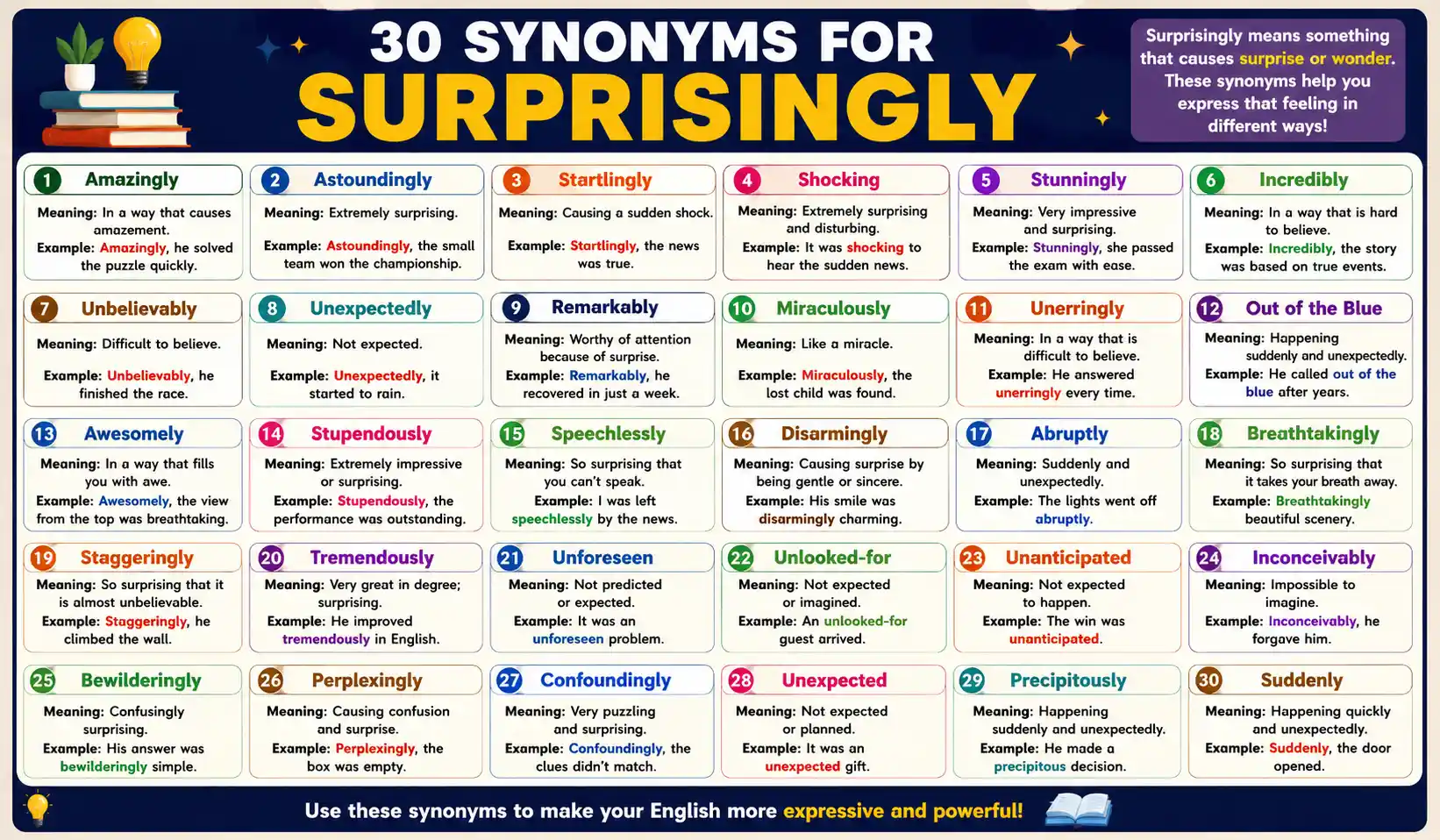
Synonyms for “surprisingly” include unexpectedly, astonishingly, remarkably, strikingly, shockingly, amazingly, and incredibly. Each word adds a slightly different flavor, some sound formal, some sound dramatic, and some fit best in everyday speech. This guide breaks down 25+ options so you always pick the right one.
Have you ever written the same sentence three times because “surprisingly” showed up too often? You’re not alone. It’s one of those handy adverbs that sneaks into essays, blog posts, and daily conversation and then repeats itself until your writing feels flat.
The good news is that English gives you plenty of ways to say surprisingly without sounding repetitive. Some options, like unexpectedly, work well in formal writing. Others, like shockingly, add drama to a story. And a few, like oddly, are perfect for casual chats.
This guide walks through the best synonyms for surprisingly, explains exactly when to use each one, and gives you simple, original example sentences you can learn from. If you’re a student, content creator, or simply someone who wants to sound more natural in English, you’ll find the right word here.
Pronunciation
Surprisingly
IPA: /sərˈpraɪzɪŋli/
Pronounced as: sur-PRY-zing-lee
Part of Speech
Surprisingly is an adverb. It modifies a verb, adjective, or entire sentence to show that something happened in a way that caused surprise.
- As a sentence adverb: Surprisingly, she finished the marathon in under four hours.
- As a modifier before an adjective: The test was surprisingly easy.
Most of the synonyms in this guide follow the same pattern they are adverbs built from adjectives (like astonishing → astonishingly), so they behave the same way grammatically.
Grammar Usage: How to Use These Synonyms Correctly
These adverbs usually appear in one of two places:
- At the start of a sentence, followed by a comma, to comment on the whole idea: Remarkably, the team won without their star player.
- Directly before an adjective, to intensify it: The hotel room was remarkably clean.
Common Mistake Box
Mistake: “The movie was surprisingly good, isn’t it?” Correction: “The movie was surprisingly good, wasn’t it?” Explanation: Tag questions must match the main verb’s tense, not the adverb. “Surprisingly” doesn’t change the grammar of the sentence around it, it just adds meaning.
Good to Know: Many of these synonyms (like astonishingly and shockingly) come from strong emotional adjectives. Avoid stacking two intensifiers together, such as “very surprisingly” native speakers rarely do this because the adverb is already strong on its own.
Synonyms Overview Table
| Synonym | Strength | Formality |
| Unexpectedly | Strong | Neutral |
| Astonishingly | Strongest | Formal |
| Remarkably | Strong | Neutral |
| Strikingly | Strong | Formal |
| Shockingly | Strongest | Informal |
| Unbelievably | Strongest | Informal |
| Amazingly | Strong | Neutral |
| Incredibly | Strong | Neutral |
| Startlingly | Strong | Formal |
| Curiously | Related | Literary |
| Oddly | Related | Informal |
| Staggeringly | Strongest | Formal |
| Bizarrely | Related | Informal |
| Weirdly | Related | Informal |
| Unpredictably | Related | Neutral |
| Miraculously | Strongest | Literary |
| Stunningly | Strongest | Formal |
| Interestingly | Related | Neutral |
| Ironically | Related | Neutral |
| Unusually | Strong | Neutral |
Main Content: Detailed Synonyms
Unexpectedly
Meaning: Something happens that nobody planned for or predicted.
Examples:
- The flight was delayed, but unexpectedly, we still made our connection.
- Her essay unexpectedly won first place in the competition.
Best Used When: You want a neutral, everyday word for something that broke a plan or a prediction.
Tone: Neutral
Common Collocations: unexpectedly high, react unexpectedly, ended unexpectedly
Astonishingly
Meaning: Something is so surprising that it feels almost hard to believe.
Examples:
- Astonishingly, the small startup outsold every major competitor in its first year.
- The old bridge is astonishingly still standing after two centuries of storms.
Best Used When: You want a strong, slightly formal word for something that leaves people amazed.
Tone: Formal
Common Collocations: astonishingly quick, astonishingly beautiful, astonishingly little
Remarkably
Meaning: Something stands out because it’s unusually good, calm, or different from what you’d expect.
Examples:
- He stayed remarkably calm during the emergency landing.
- The older hiker moved remarkably fast up the steep trail.
Best Used When: You’re praising a quality that impressed you, especially skill, calmness, or resilience.
Tone: Neutral
Common Collocations: remarkably similar, remarkably well, remarkably resilien
Strikingly
Meaning: Something is so noticeable that it immediately catches your attention.
Examples:
- The two sisters look strikingly alike, even though they’re not twins.
- His argument was strikingly different from everyone else’s on the panel.
Best Used When: You’re describing appearance, contrast, or a strong visual or intellectual impression.
Tone: Formal
Common Collocations: strikingly similar, strikingly obvious, strikingly beautiful
Shockingly
Meaning: Something is surprising in a way that feels sudden, upsetting, or hard to accept.
Examples:
- Shockingly, the restaurant closed its doors after just three months.
- The report revealed shockingly low pay for entry-level workers in the industry.
Best Used When: You want to express surprise that also carries disbelief or mild outrage.
Tone: Informal
Common Collocations: shockingly bad, shockingly cheap, shockingly honest
Unbelievably
Meaning: Something is so surprising that it seems almost impossible to accept as true.
Examples:
- The kids finished all their chores unbelievably fast this morning.
- Unbelievably, the lost dog walked ten miles back home on its own.
Best Used When: You’re speaking casually and want to add strong emotional emphasis.
Tone: Informal
Common Collocations: unbelievably lucky, unbelievably slow, unbelievably good
Amazingly
Meaning: Something causes wonder or delight because it’s better or more impressive than expected.
Examples:
- Amazingly, the injured player was back on the field within two weeks.
- The recipe turned out amazingly well for a first attempt.
Best Used When: You want a warm, positive tone rather than shock or disbelief.
Tone: Neutral
Common Collocations: amazingly simple, amazingly fast, work out amazingly
Incredibly
Meaning: Something is so surprising or extreme that it’s difficult to believe.
Examples:
- The professor explained the theory in an incredibly simple way.
- Incredibly, no one was hurt when the shelf collapsed.
Best Used When: You need a flexible word that works for both good and bad surprises.
Tone: Neutral
Common Collocations: incredibly difficult, incredibly rare, incredibly proud
Startlingly
Meaning: Something is surprising in a sudden way that catches you off guard.
Examples:
- The results were startlingly different from what the survey had predicted.
- Her voice was startlingly loud in the quiet library.
Best Used When: You want to emphasize suddenness along with surprise.
Tone: Formal
Common Collocations: startlingly clear, startlingly accurate, startlingly familiar
Curiously
Meaning: Something happens in a way that seems strange and makes you want to know more.
Examples:
- Curiously, the letter had no return address at all.
- The cat sat curiously still by the window all afternoon.
Best Used When: You’re writing narrative or descriptive text and want a thoughtful, slightly mysterious tone.
Tone: Literary
Common Collocations: curiously quiet, curiously absent, curiously enough
Oddly
Meaning: Something happens in a strange or unusual way, though not always dramatically so.
Examples:
- Oddly, the store was completely empty on a Saturday afternoon.
- He felt oddly comfortable in the new city within just a few days.
Best Used When: You want a light, conversational way to point out something a little strange.
Tone: Informal
Common Collocations: oddly specific, oddly satisfying, oddly familiar
Staggeringly
Meaning: Something is surprising because of its extreme size, scale, or degree.
Examples:
- The company reported staggeringly high profits this quarter.
- Staggeringly, over a million people applied for the same scholarship.
Best Used When: You’re talking about large numbers, statistics, or extreme scale.
Tone: Formal
Common Collocations: staggeringly high, staggeringly expensive, staggering amount
Bizarrely
Meaning: Something happens in a way that seems very strange or hard to explain.
Examples:
- Bizarrely, both strangers were wearing the exact same outfit.
- The meeting ended bizarrely early, with no real explanation.
Best Used When: You want to highlight something odd enough to raise eyebrows.
Tone: Informal
Common Collocations: bizarrely enough, bizarrely quiet, bizarrely specific
Weirdly
Meaning: A casual way of saying something felt unusual or hard to explain.
Examples:
- Weirdly, the power went out at the exact same time every night that week.
- I felt weirdly nervous before a meeting I’d done a hundred times.
Best Used When: You’re speaking casually with friends or writing in a relaxed, conversational tone.
Tone: Informal
Common Collocations: weirdly specific, weirdly calm, weirdly familiar
Unpredictably
Meaning: Something happens in a way that couldn’t have been guessed in advance.
Examples:
- The weather shifted unpredictably during the mountain climb.
- Prices moved unpredictably throughout the entire trading week.
Best Used When: You’re describing patterns, systems, or behavior that don’t follow a clear rule.
Tone: Neutral
Common Collocations: behave unpredictably, shift unpredictably, unpredictably fast
Miraculously
Meaning: Something happens in a way that seems almost impossible, as if by luck or fate.
Examples:
- Miraculously, the phone survived the fall without a single crack.
- The seedlings miraculously survived the frost that killed everything else.
Best Used When: You want to add a sense of wonder to a lucky or improbable outcome.
Tone: Literary
Common Collocations: miraculously survived, miraculously escaped, miraculously intact
Stunningly
Meaning: Something is so surprising or impressive that it leaves you momentarily speechless.
Examples:
- The debate ended with a stunningly simple argument that changed everyone’s mind.
- The team came back from a stunningly large deficit to win the game.
Best Used When: You want a dramatic, high-impact word, often for writing or public speaking.
Tone: Formal
Common Collocations: stunningly beautiful, stunningly obvious, stunningly effective
Interestingly
Meaning: Something is notable enough to catch your attention, though not necessarily shocking.
Examples:
- Interestingly, both scientists reached the same conclusion using different methods.
- The survey found, interestingly, that most people preferred the cheaper option.
Best Used When: You want a mild, thoughtful way to introduce a surprising detail without overstating it.
Tone: Neutral
Common Collocations: interestingly enough, interestingly similar, note interestingly
Ironically
Meaning: Something happens in a way that is the opposite of what you’d expect, often with a touch of humor.
Examples:
- Ironically, the fire station’s alarm system failed during the drill.
- The traffic reporter was, ironically, late to work because of traffic.
Best Used When: The surprise involves a contradiction or an unexpected twist of fate.
Tone: Neutral
Common Collocations: ironically enough, ironically named, ironically true
Unusually
Meaning: Something happens outside of what’s normal or typical.
Examples:
- It was unusually quiet in the office the whole week before the holiday.
- The lake stayed unusually warm well into October.
Best Used When: You’re comparing something to a normal baseline, especially with weather, behavior, or conditions.
Tone: Neutral
Common Collocations: unusually warm, unusually quiet, unusually low
Synonym Categories
Strongest Synonyms
Astonishingly, Shockingly, Unbelievably, Staggeringly, Miraculously, Stunningly
Strong Synonyms
Unexpectedly, Remarkably, Strikingly, Amazingly, Incredibly, Startlingly, Unusually
Related Words
Curiously, Oddly, Bizarrely, Weirdly, Unpredictably, Interestingly, Ironically
Commonly Confused Words
| Word | Difference | Example |
| Surprisingly vs. Suddenly | Surprisingly focuses on the reaction; suddenly focuses on speed or timing. | It happened suddenly, and surprisingly, no one panicked. |
| Astonishingly vs. Amazingly | Astonishingly leans toward disbelief; amazingly leans toward delight. | Astonishingly, the bridge held; amazingly, it looked brand new. |
| Oddly vs. Bizarrely | Oddly is mild; bizarrely is stronger and stranger. | It was oddly quiet, but bizarrely, the lights kept flickering on their own. |
| Unexpectedly vs. Unpredictably | Unexpectedly describes a single surprising event; unpredictably describes an ongoing pattern. | The storm hit unexpectedly, and the winds kept shifting unpredictably. |
| Ironically vs. Coincidentally | Ironically involves a contradiction; coincidentally just means two things happened by chance. | Coincidentally, we booked the same flight; ironically, it was delayed for the exact reason we chose it. |
Common Mistakes
Mistake: Using “surprisingly” and a strong synonym in the same sentence, such as “surprisingly astonishing.” Correction: Choose one adverb, not two. Explanation: Stacking similar adverbs weakens your writing instead of strengthening it pick the single word that fits best.
Mistake: Placing the adverb in the wrong spot, such as “The cake surprisingly was delicious.” Correction: “Surprisingly, the cake was delicious,” or “The cake was surprisingly delicious.” Explanation: Sentence adverbs usually sound smoother at the very start or right before the adjective they modify.
Writing Tips
Writing Tip Box
- In essays: Use remarkably or strikingly to sound polished and academic.
- In emails: Use unexpectedly or interestingly to stay professional but natural.
- In blog posts: Mix in surprisingly, amazingly, and oddly to keep your tone friendly and varied.
- In stories: Reach for curiously, miraculously, or bizarrely to build mood and atmosphere.
- In social media captions: Short, punchy words like shockingly or unbelievably grab attention fast.
- In professional reports: Stick with unusually or staggeringly when discussing data or statistics.
- In daily conversation: Weirdly and oddly sound the most natural among friends.
Related Vocabulary
Antonyms: predictably, expectedly, unsurprisingly, normally
Related Expressions: out of the blue, to everyone’s surprise, against all odds, who would have thought
Similar Vocabulary: unforeseen, unanticipated, extraordinary, exceptional
Word Family: surprise (noun/verb), surprising (adjective), surprised (adjective), surprisingly (adverb)
FAQs
What is the best synonym for “surprisingly” in formal writing?
Remarkably and strikingly work best in formal or academic writing. Both sound polished without being overly dramatic, making them ideal for essays, reports, and professional emails.
Is “surprisingly” the same as “unexpectedly”?
They’re close but not identical. Surprisingly focuses on the emotional reaction of surprise, while unexpectedly focuses on something not matching a plan or prediction. They often overlap in everyday use.
What’s a stronger word than “surprisingly”?
Astonishingly, staggeringly, and unbelievably all carry more intensity than “surprisingly.” Use them when the surprise is extreme rather than mild.
Can I use “surprisingly” and “shockingly” interchangeably?
Not always. Shockingly often implies the surprise is negative or upsetting, while surprisingly is neutral and can describe good or bad news equally well.
What’s a casual synonym for “surprisingly”?
Weirdly and oddly are the most natural choices in casual conversation. They’re common in everyday speech and don’t sound overly formal.
Which synonym works best for describing statistics or numbers?
Staggeringly and unusually are strong choices when discussing large numbers, percentages, or data trends.
Vocabulary Quiz
1. Which word best fits: “___, the team finished the project a full week early.” A) Oddly B) Remarkably C) Weirdly D) Bizarrely
2. Which synonym usually implies the surprise is upsetting or negative? A) Amazingly B) Shockingly C) Interestingly D) Curiously
3. Which word is most appropriate for a casual text to a friend? A) Staggeringly B) Astonishingly C) Weirdly D) Strikingly
4. “The two designs looked ___ similar.” Which word fits best? A) Strikingly B) Ironically C) Unpredictably D) Miraculously
5. Which word suggests something happened by luck, almost impossibly? A) Interestingly B) Miraculously C) Oddly D) Unusually
Answer Key: 1. B 2. B 3. C 4. A 5. B
Conclusion
Learning synonyms for surprisingly gives your writing and speech more color, precision, and personality. Instead of repeating the same word, you can now choose remarkably for polish, shockingly for drama, or oddly for a casual, conversational touch.
Try using a few of these words the next time you write an email, tell a story, or post on social media. The more you practice, the more naturally they’ll come to mind and surprisingly, your writing will start to feel noticeably stronger.