
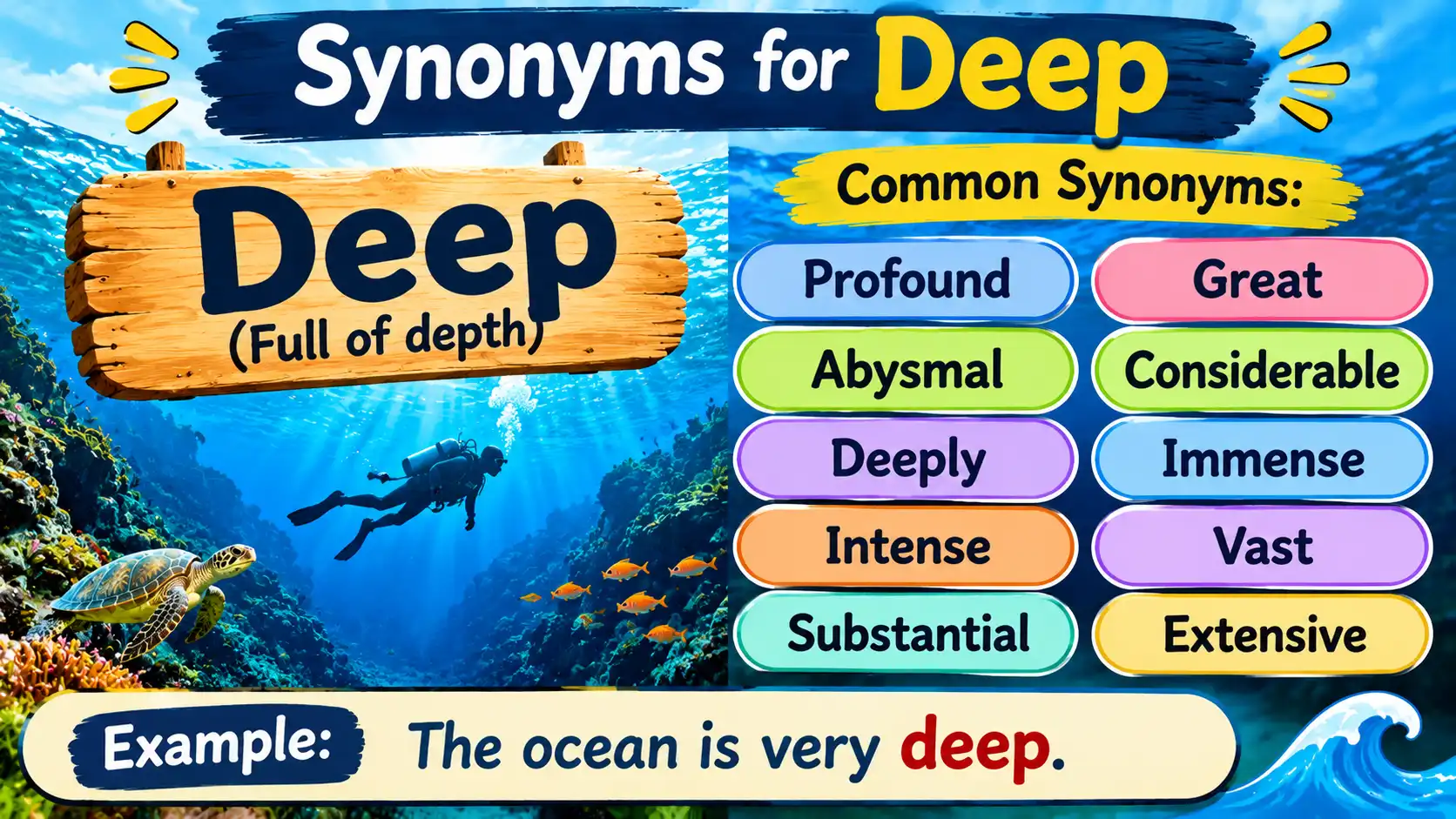
What Is Deep?
Deep describes something that goes far down, far inside, or far below the surface. The closest synonym is profound, because both words can mean great depth in thought or feeling. Other common synonyms include bottomless, intense, heartfelt, and thorough. Context decides the right one: a lake, a thought, a voice, or a color.
Priya was getting married in Mumbai, and she wanted to thank her grandmother in a toast. “Deep thanks” sounded flat, so she wrote “heartfelt gratitude” instead. At 6 p.m., her grandmother wiped away a tear.
Deep means far down or far inside, and it can describe water, thoughts, feelings, voices, and colors. A deep lake, a deep idea, and a deep voice are not deep in the same way. Learning synonyms for deep helps you choose the word that matches your exact meaning. Your writing becomes clearer and more moving. By the end, you will know 14 alternatives and when to use each one.
Table of 14 Synonyms for Deep
| No. | Synonym | Part of Speech | Simple Meaning |
|---|---|---|---|
| 1 | Profound | Adjective | Very deep in meaning or effect |
| 2 | Fathomless | Adjective | Too deep to measure |
| 3 | Bottomless | Adjective | So deep it seems endless |
| 4 | Cavernous | Adjective | Huge and deep, like a cave |
| 5 | Intense | Adjective | Very strong in feeling |
| 6 | Heartfelt | Adjective | Deep and sincere in emotion |
| 7 | Deep-seated | Adjective | Firmly rooted, hard to change |
| 8 | In-depth | Adjective | Covering a subject in detail |
| 9 | Thorough | Adjective | Careful and complete |
| 10 | Resonant | Adjective | Deep, full, and echoing in sound |
| 11 | Rich | Adjective | Deep and full in color or tone |
| 12 | Low | Adjective | Deep in pitch, like a voice |
| 13 | Sound | Adjective | Deep and undisturbed, like sleep |
| 14 | Dark | Adjective | Deep in shade, like a color |
Table of Contents
- Introduction
- Table of 14 Synonyms for Deep
- Quick Facts About Deep
- Meaning and Usage of Deep
- Grammar and Sentence Patterns for Deep
-
- Profound
-
- Fathomless
-
- Bottomless
-
- Cavernous
-
- Intense
-
- Heartfelt
-
- Deep-seated
-
- In-depth
-
- Thorough
-
- Resonant
-
- Rich
-
- Low
-
- Sound
-
- Dark
- Choose the Right Synonym for Deep
- Deep Synonyms by Category
- Antonyms of Deep
- Words Commonly Confused with Deep
- Common Mistakes with Deep
- Writing Tips for Deep
- American vs. British English Notes for Deep
- Practice Exercises for Deep
- Frequently Asked Questions
- Quick Vocabulary Quiz on Deep
- Conclusion
Quick Facts About Deep
- Focus keyword: deep
- Part of speech: adjective (also an adverb, as in “dig deep”)
- Pronunciation: “deep,” rhyming with “keep”
- IPA: /diːp/
- Syllables: 1
- Origin: From Old English dēop, meaning “deep” or “profound.”
- Word forms: deeper, deepest, deeply, depth, deepen
- Formality: neutral
- Difficulty: easy
- CEFR level: A2
Meaning and Usage of Deep
Deep has four main uses. First, it means far down, as in a deep well. Second, it means strong or serious, as in deep feeling or deep thought. Third, it describes low sounds and rich colors, as in a deep voice or deep red. Fourth, it means heavy and undisturbed, as in deep sleep.
People use it in many contexts:
- Water and spaces: “The pool is 3 meters deep.”
- Thoughts and feelings: “She felt a deep love for her village.”
- Sounds and colors: “He has a deep voice.”
Examples:
- Divers swam 30 meters down into a deep sinkhole near Cancun.
- After a long shift, Mr. Tanaka fell into deep sleep on the train to Osaka.
Grammar and Sentence Patterns for Deep
Basic patterns:
- be + deep: “The lake is deep.”
- deep + noun: “a deep breath”
- measurement + deep: “The hole is 2 meters deep.”
- deeply + adjective or participle: “She was deeply moved.”
Common pairings:
- deep in thought / debt: “Mark sat deep in thought at the Seoul café.”
- deep into + noun: “We talked deep into the night.”
- deeply + feeling word: “Aisha was deeply grateful for the help.”
- dig deep: “The runner dug deep for the final 400 meters.”
- run deep: “Their friendship runs deep.”
Frequent mistake: Learners use deep before a feeling word. Say “deeply sorry,” never “deep sorry.”
1. Profound
Meaning: Profound means very deep in meaning, feeling, or effect.
Examples:
- Dr. Amina’s lecture in Nairobi had a profound effect on her 200 students.
- Leo felt profound sadness when his old school in Dublin closed.
Best Used When: You describe serious ideas, big emotions, or strong influence.
Tone: Formal, serious
Common Collocations: profound impact, profound sadness, profound silence
2. Fathomless
Meaning: Fathomless means too deep to measure or understand.
Examples:
- Divers stared into the fathomless blue of a sinkhole in Mexico.
- Nadia showed fathomless patience with her 30 young students.
Best Used When: You describe water, space, or feelings that seem to have no limit.
Tone: Literary, poetic
Common Collocations: fathomless depths, fathomless love, fathomless sea
3. Bottomless
Meaning: Bottomless means so deep that it seems to have no end.
Examples:
- The kids peered into a bottomless well in a Tuscan village.
- Marcus has a bottomless appetite and finished 4 slices of pizza.
Best Used When: You describe pits, wells, or endless supplies in a vivid way.
Tone: Casual to literary
Common Collocations: bottomless pit, bottomless well, bottomless cup
4. Cavernous
Meaning: Cavernous means huge and deep, like a cave. (Related term, used for large spaces.)
Examples:
- Their voices echoed in the cavernous hall of Grand Central in New York.
- Ravi searched his cavernous backpack for 5 minutes.
Best Used When: You describe big, hollow, echoing spaces.
Tone: Descriptive, slightly literary
Common Collocations: cavernous hall, cavernous space, cavernous room
5. Intense
Meaning: Intense means very strong in feeling or effect. (Related term, used for emotion and force.)
Examples:
- Sofia felt intense joy when she crossed the finish line in Berlin.
- The intense heat in Dubai reached 45 degrees.
Best Used When: You describe strong emotions, heat, or focus.
Tone: Neutral
Common Collocations: intense feeling, intense heat, intense focus
6. Heartfelt
Meaning: Heartfelt means deep and sincere in emotion.
Examples:
- Grandma Rosa gave a heartfelt apology to her neighbor on Maple Street.
- Mr. Alvarez wrote a heartfelt thank-you note to his 12 volunteers.
Best Used When: You describe thanks, wishes, or apologies that come from the heart.
Tone: Warm, emotional
Common Collocations: heartfelt thanks, heartfelt apology, heartfelt message
7. Deep-seated
Meaning: Deep-seated means firmly rooted and hard to change.
Examples:
- Kenji had a deep-seated fear of water after falling into a pond at age 6.
- The two towns shared a deep-seated rivalry that lasted 50 years.
Best Used When: You describe fears, beliefs, or problems that run far back.
Tone: Formal, serious
Common Collocations: deep-seated fear, deep-seated belief, deep-seated problem
8. In-depth
Meaning: In-depth means covering a subject in great detail. (Related term, used for study and reports.)
Examples:
- Hannah wrote an in-depth report of 25 pages on the Amazon rainforest.
- The museum in Cairo offers in-depth tours that last 3 hours.
Best Used When: You describe reports, interviews, or studies that go into detail.
Tone: Formal, professional
Common Collocations: in-depth analysis, in-depth interview, in-depth study
9. Thorough
Meaning: Thorough means careful and complete. (Related term, used for work and checks.)
Examples:
- Dr. Singh gave a thorough check-up in 45 minutes.
- Our guide in Rome gave a thorough history of the Colosseum.
Best Used When: You praise work that leaves nothing out.
Tone: Neutral, professional
Common Collocations: thorough search, thorough check, thorough review
10. Resonant
Meaning: Resonant means deep, full, and echoing in sound.
Examples:
- The choir’s resonant voices filled the church in Vienna.
- Mr. Okafor has a resonant laugh that carries across the playground.
Best Used When: You describe rich, echoing voices, bells, or music.
Tone: Literary, formal
Common Collocations: resonant voice, resonant tone, resonant sound
11. Rich
Meaning: Rich means deep and full in color, sound, or flavor.
Examples:
- Lena painted her door a rich red in her Lisbon flat.
- The cellist’s rich tone filled the concert hall in Seoul.
Best Used When: You describe colors, sounds, or tastes that feel full and strong.
Tone: Neutral, descriptive
Common Collocations: rich color, rich flavor, rich tone
12. Low
Meaning: Low means deep in pitch, like a voice or a musical note. (Related term, used for sound.)
Examples:
- Our bus driver, Mr. Khan, has a low voice that calms the kids.
- The tuba played a low note that rattled the windows of a Dublin pub.
Best Used When: You describe voices and notes that sit low in pitch.
Tone: Neutral
Common Collocations: low voice, low note, low tone
13. Sound
Meaning: Sound means deep and undisturbed, used mainly for sleep. (Related term, a synonym of deep only in this sense.)
Examples:
- After 10 hours of hiking in Nepal, Dan fell into a sound sleep.
- Eight hours of sound sleep helped Mia feel fresh for her exam.
Best Used When: You describe sleep that nothing interrupts.
Tone: Neutral
Common Collocations: sound sleep, sound sleeper
14. Dark
Meaning: Dark means deep in shade, used for colors. (Related term, a synonym of deep only for color.)
Examples:
- Carlos wore a dark blue suit to his interview in Madrid.
- The dark green leaves of the fig tree shaded the yard.
Best Used When: You describe colors that look deep and strong.
Tone: Neutral
Common Collocations: dark blue, dark green, dark shade
Choose the Right Synonym for Deep
| If you mean… | Use this word |
|---|---|
| Great depth in thought or meaning | Profound |
| Water too deep to measure | Fathomless |
| A huge, echoing space | Cavernous |
| A sincere emotion | Heartfelt |
| A belief that is hard to change | Deep-seated |
| A detailed study | In-depth |
| A deep, full voice | Resonant |
| Sleep nothing can interrupt | Sound |
Deep Synonyms by Category
Thought and feeling: profound, intense, heartfelt, deep-seated Use these for ideas, emotions, and beliefs.
Physical depth: fathomless, bottomless, cavernous Pick these for water, wells, caves, and big spaces.
Study and detail: in-depth, thorough These fit reports, checks, and research.
Sound and color: resonant, rich, low, dark Use them for voices, music, and shades.
Sleep: sound Use it only for deep, calm sleep.
Antonyms of Deep
| # | Antonym | Simple Meaning | Example |
|---|---|---|---|
| 1 | Shallow | Not deep, with little depth | The shallow pool was only 1 meter deep. |
| 2 | Superficial | Only on the surface | Her superficial review took 5 minutes. |
| 3 | High | High in pitch | The flute played a high note. |
| 4 | Pale | Light in color | Ana chose a pale pink dress for the party. |
| 5 | Light | Easily disturbed, like sleep | Dad is a light sleeper in our Chicago flat. |
| 6 | Mild | Not strong in feeling | Tom felt mild interest in the 2-hour lecture. |
| 7 | Trivial | Not important or serious | They argued about a trivial matter for 10 minutes. |
Related Expressions: still waters run deep, dig deep, in deep water, deep down, go off the deep end
Word Family: depth (noun), deepen (verb), deeply (adverb), deeper and deepest (comparative and superlative), deep-seated (adjective)
Words Commonly Confused with Deep
Deeply
Difference: Deeply is an adverb that describes verbs, feelings, and adjectives. Deep is mostly an adjective.
Example: Maya was deeply grateful for the help.
Depth
Difference: Depth is a noun that names how deep something is. Deep describes the thing itself.
Example: Divers measured the depth of the lake at 40 meters.
Deepen
Difference: Deepen is a verb that means “to make deeper.” It describes action, not a quality.
Example: Workers will deepen the canal by 2 meters.
Thick
Difference: Thick describes distance through an object, while deep describes distance down or inward. Snow is deep, but a wall is thick.
Example: The old wall in Prague is 1 meter thick.
Common Mistakes with Deep
Mistake: The pool is deep 3 meters.
Correction: The pool is 3 meters deep.
Why: The measurement comes before deep.
Mistake: She is deep sorry about the delay.
Correction: She is deeply sorry about the delay.
Why: Use the adverb deeply before a feeling word.
Mistake: He was deep in the thought.
Correction: He was deep in thought.
Why: This fixed phrase has no article.
Mistake: The lake is more deep than the pond.
Correction: The lake is deeper than the pond.
Why: Short adjectives usually add -er for comparison.
Writing Tips for Deep
- Emails: Choose a neutral, professional tone. “We offer an in-depth review of your account” sounds clear and polite.
- Essays: Pick formal words. “The book had a profound influence on her thinking” sounds academic.
- Blog posts: Use friendly, vivid words. “Grab a rich, dark roast and settle in” feels natural.
- Stories: Use sensory, literary words. “A fathomless silence settled over the lake” paints a picture.
- Social media: Keep it warm and short. “Heartfelt thanks to everyone who came!” fits a post.
American vs. British English Notes for Deep
There is no real difference in meaning or pronunciation for deep and its synonyms between American and British English.
Practice Exercises for Deep
- Fill in the blank: The cellist’s ____ tone filled the hall (deep and full in sound).
- Fill in the blank: Dr. Park sent a ____ thank-you note (deep and sincere).
- Rewrite: Replace “deep” with a better word: “We explored a deep cave under the mountain.”
- Rewrite: Replace “deep” with a formal word: “She wrote a deep report of 30 pages.”
- Match: Link each word to its meaning.
- a. Fathomless
- b. Deep-seated
- c. Resonant
- d. Thorough
-
- Firmly rooted
-
- Too deep to measure
-
- Careful and complete
-
- Deep and echoing
FAQs
What is another word for deep?
Profound is the best choice for ideas and feelings. For water or space, try bottomless, fathomless, or cavernous. For a voice, use low or resonant. The right word depends on what you describe, so check the context first. Each word paints a slightly different picture.
What is the closest synonym for deep?
Profound is usually the closest. Both words can describe great depth in thought, feeling, or effect. Profound sounds more formal, so it suits essays, speeches, and serious writing. In daily speech, deep is still the most natural choice for water and voices.
Is it okay to say “deep thanks”?
It is understandable, but less common. Most speakers say deepest thanks, heartfelt thanks, or deeply grateful. These phrases sound warmer and more natural. For a quick text, plain thanks is perfectly fine. Save the stronger versions for toasts, cards, and speeches.
Is deep formal or informal?
Deep is neutral, so you can use it in emails, essays, and conversation. Some synonyms change the tone. Fathomless and resonant feel literary, while profound and in-depth sound formal. Low and sound are plain and everyday. Choose the word that fits your reader.
What is the opposite of deep?
The most common opposite is shallow, for water and for ideas. Fr voices, the opposite is high. For colors, use pale or light. Fr sleep, use light. Choose by meaning, since deep has several different opposites. Each one fits a different situation.
Is “deep” the same as “deeply”?
No. Deep is mostly an adjective, as in a deep lake. Deeply is an adverb that describes verbs and feelings, as in deeply moved. You can say dig deep, but you would say deeply sorry. When in doubt, use deeply before a feeling word.
Quick Vocabulary Quiz on Deep
- Which word fits a sincere thank-you note? A) Heartfelt B) Cavernous C) Low D) Dark
- Which word fits water too deep to measure? A) Rich B) Fathomless C) Thorough D) Sound
- Which word describes a huge, echoing hall? A) Cavernous B) Intense C) Shallow D) Heartfelt
- Which word describes a deep, full singing voice? A) In-depth B) Dark C) Resonant D) Deep-seated
- Which word describes a fear that is hard to change? A) Deep-seated B) Sound C) Thorough D) Low
Conclusion
Synonyms for deep make your vocabulary richer and your writing more precise. Profound, cavernous, heartfelt, and resonant all share an idea of depth, yet each fits a different moment. Context decides the best choice, so always ask what you are describing.
Try these words in your emails, essays, articles, and conversations.
30-second challenge: Write 3 sentences today using 3 different synonyms from this list.
Words with the right depth leave a lasting mark.