What Is Serendipity?
Serendipity means the luck of finding something good when you were not looking for it. It is a happy surprise, like finding a kind friend in a new city. Words such as chance, luck, and fortune carry a close sense. This word fits moments that feel lucky and sweet at the same time.
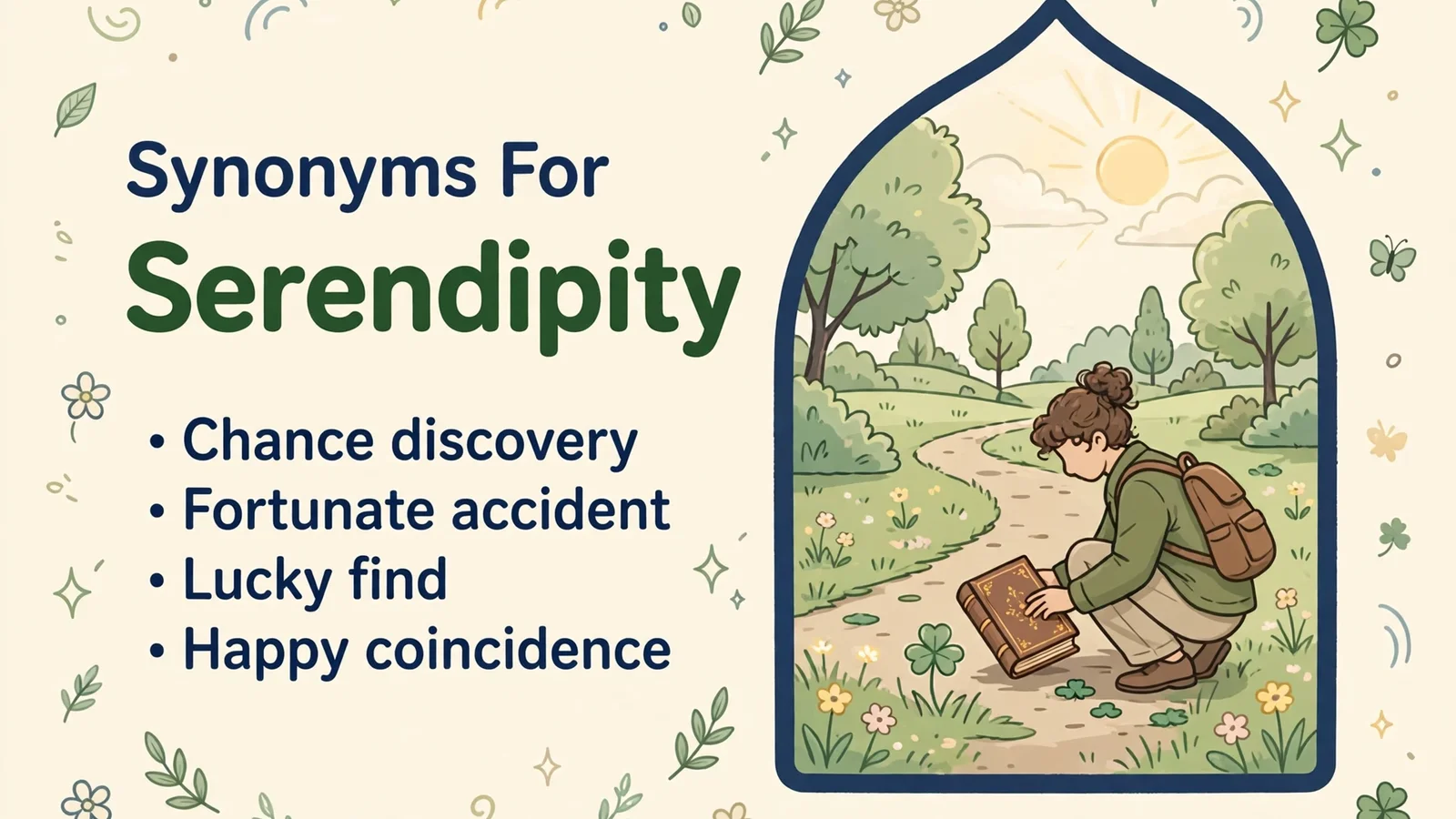
Maya walked into a small library in Lisbon on a rainy Tuesday. She wanted one book about maps, but a loose page fell from a shelf and landed near her shoe. That page held a note from a traveler who had visited her hometown in 1987. Maya smiled and kept the note in her bag for years. Moments like this one show why serendipity feels so special. It is not planned, and it is not earned by hard work alone. A small turn can change a whole day. This guide gives you 12 simple words for such moments, with clear meanings and real examples. By the end, you will pick the right word fast and use it with ease in your own writing and talk.
Table of 12 Synonyms for Serendipity
| No. | Synonym | Part of Speech | Simple Meaning |
|---|---|---|---|
| 1 | chance | noun | Good luck by accident |
| 2 | luck | noun | Good things by chance |
| 3 | fortune | noun | Luck, good or bad |
| 4 | coincidence | noun | Same time, no plan |
| 5 | fate | noun | Power that plans life |
| 6 | providence | noun | Kind care from above |
| 7 | fluke | noun | Lucky hit by chance |
| 8 | happenstance | noun | Chance event, no plan |
| 9 | kismet | noun | Fate or fixed destiny |
| 10 | destiny | noun | Future fixed by fate |
| 11 | accident | noun | Event with no plan |
| 12 | windfall | noun | Sudden gift of money |
Table of Contents
- What Is Serendipity?
- Introduction
- Table of 12 Synonyms for Serendipity
- Table of Contents
- Quick Facts About Serendipity
- Meaning and Usage of Serendipity
- Grammar and Sentence Patterns for Serendipity
- Chance
- Luck
- Fortune
- Coincidence
- Fate
- Providence
- Fluke
- Happenstance
- Kismet
- Destiny
- Accident
- Windfall
- Choose the Right Synonym for Serendipity
- Serendipity Synonyms by Category
- Antonyms of Serendipity
- Words Commonly Confused with Serendipity
- Common Mistakes with Serendipity
- Writing Tips for Serendipity
- American vs. British English Notes for Serendipity
- Practice Exercises for Serendipity
- Frequently Asked Questions
- Quick Vocabulary Quiz on Serendipity
- Conclusion
Quick Facts About Serendipity
- Part of Speech: Noun
- Pronunciation: ser-en-DIP-i-tee
- Syllables: 5
- Origin: Horace Walpole made this word in 1754. He took it from a Persian tale, “The Three Princes of Serendip”. Serendip was an old name for Sri Lanka.
- Other Forms: serendipitous (adjective), serendipitously (adverb)
- Formality: Neutral to slightly formal. It fits both friendly talk and formal writing.
- Difficulty: Advanced. It is a rare word, so use it with care.
Meaning and Usage of Serendipity
Serendipity is a noun. It means the luck of finding good things when you did not look for them. Use it for happy surprises, kind meetings, and lucky finds. It fits tales, blogs, and talks about life. It does not fit sad news or bad luck. Keep it rare in one text, since one use has more force than five. Two quick lines show it well. “By serendipity, Hana found a first edition book in a market in Cairo.” “It was serendipity that Tom met his future wife at a bus stop in Leeds.”
Grammar and Sentence Patterns for Serendipity
- by serendipity: “By serendipity, Omar found a rare map in a shop in Fez.”
- a moment of serendipity: “That walk in the park was a moment of pure serendipity for Jane.”
- pure serendipity: “It was pure serendipity that Dan met his old friend in Rome.”
- serendipity led to: “Serendipity led to a new job for Priya in 2022.”
Common mistake: “The sad news came by serendipity.”
Correction: “The sad news came as a shock.”
Why: Serendipity is always glad, so it cannot fit sad news.
1. Chance
Meaning: Chance means something good or bad that happens without a plan.
Examples:
- “Ravi met his best friend by chance at gate 4 of Delhi station in 2019.”
- “By chance, Lina found a 50 euro note in her old coat in March.”
Best Used When: Use it for any event that came without a plan.
Tone: Neutral
Common Collocations: by chance, a chance meeting, take a chance
Connotation: It feels plain and open. It can be good or bad.
When Not to Use This Word: Do not use it when the find was clearly happy and sweet, since chance lacks that warm sense.
2. Luck
Meaning: Luck means good or bad things that come by chance.
Examples:
- “Tom won a bike in a raffle at his school fair in June.”
- “Ana passed her driving test on her third try and called it pure luck.”
Best Used When: Use it for a win or loss that came from chance.
Tone: Casual
Common Collocations: good luck, bad luck, a stroke of luck
Connotation: It feels light and daily. It can be good or bad.
When Not to Use This Word: Do not use it when you want to stress a surprise find, since luck is too wide.
3. Fortune
Meaning: Fortune means luck, good or bad, that shapes a life.
Examples:
- “Omar built his small shop after a turn of fortune in 2021.”
- “Elena thanked fortune when her lost ring came back after two years.”
Best Used When: Use it for big turns of luck in life or in tales.
Tone: Formal
Common Collocations: good fortune, a stroke of fortune, fortune smiled
Connotation: It feels grand and old. It can sound a bit formal.
When Not to Use This Word: Do not use it for small daily surprises, since fortune sounds too big.
4. Coincidence
Meaning: Coincidence means two things happen at the same time by chance.
Examples:
- “Ben and Sara wore the same red shirt to a party in Bristol on Friday.”
- “Two old friends met at gate 7 of the airport at the same hour.”
Best Used When: Use it when two events match in time with no plan.
Tone: Neutral
Common Collocations: a strange coincidence, pure coincidence, by coincidence
Connotation: It feels plain and factual. It says nothing about luck.
When Not to Use This Word: Do not use it when the event brought a clear gain, since coincidence lacks that glad sense.
5. Fate
Meaning: Fate means a power that is said to plan what will happen.
Examples:
- “Nina felt fate had led her to a new job in Toronto in 2023.”
- “Khalid met his wife on a train to Lahore and called it fate.”
Best Used When: Use it when an event feels meant to be.
Tone: Serious
Common Collocations: twist of fate, fate decided, sealed by fate
Connotation: It feels deep and fixed. It can sound heavy.
When Not to Use This Word: Do not use it for a light, happy surprise, since fate sounds too fixed.
6. Providence
Meaning: Providence means kind care from God or from a higher power.
Examples:
- “After the storm, Ruth thanked providence for her safe home in Kent.”
- “Mark saw providence in the gift of food that came on a hard day.”
Best Used When: Use it when a good event feels like a gift from above.
Tone: Formal
Common Collocations: divine providence, the hand of providence, trust in providence
Connotation: It feels holy and calm. It fits faith and old tales.
When Not to Use This Word: Do not use it in plain daily talk, since it sounds old and formal.
7. Fluke
Meaning: A fluke is a lucky hit that comes by chance, not by skill.
Examples:
- “Dan scored a goal by a fluke in the last minute of the match.”
- “Zoe passed a hard quiz by a fluke after she guessed 8 answers right.”
Best Used When: Use it for a lucky hit that skill did not cause.
Tone: Casual
Common Collocations: a total fluke, a lucky fluke, by a fluke
Connotation: It feels light and a bit funny. It can sound less proud.
When Not to Use This Word: Do not use it for a prized find, since a fluke can sound like a cheap win.
8. Happenstance
Meaning: Happenstance means a chance event with no plan at all.
Examples:
- “By happenstance, Ali sat next to his future boss on a bus in Dubai.”
- “Mia found her dream flat by happenstance on a walk in Leeds.”
Best Used When: Use it for a chance event in a tale or a soft tone.
Tone: Gentle
Common Collocations: pure happenstance, by happenstance, a bit of happenstance
Connotation: It feels soft and rare. It suits books and tales.
When Not to Use This Word: Do not use it in quick daily talk, since many readers will not know it.
9. Kismet
Meaning: Kismet means fate or a fixed path in life.
Examples:
- “Aisha called it kismet when she met her old friend in Istanbul after ten years.”
- “Leo felt kismet had brought him back to his home town in 2022.”
Best Used When: Use it when a meeting feels written in the stars.
Tone: Poetic
Common Collocations: call it kismet, a touch of kismet, kismet brought us
Connotation: It feels warm and poetic. It comes from Turkish and Arabic roots.
When Not to Use This Word: Do not use it in formal work writing, since it sounds like a tale.
10. Destiny
Meaning: Destiny means the future path that fate has fixed for a person.
Examples:
- “Rosa felt destiny had led her to teach in a small school in Peru.”
- “Sam met his band mate on a plane to Sydney and called it destiny.”
Best Used When: Use it for a life path or a big meeting that feels fixed.
Tone: Serious
Common Collocations: meet your destiny, a twist of destiny, destiny called
Connotation: It feels grand and deep. It suits big life turns.
When Not to Use This Word: Do not use it for a small lucky find, since destiny sounds too big.
11. Accident
Meaning: An accident is an event that happens with no plan.
Examples:
- “By accident, Noor found her lost keys in a shoe box after three days.”
- “Tim found a rare coin by accident in his grandad’s old desk drawer.”
Best Used When: Use it when something was found or met with no plan.
Tone: Neutral
Common Collocations: by accident, a happy accident, pure accident
Connotation: It feels plain. It can sound bad, so add “happy” for a good sense.
When Not to Use This Word: Do not use it alone for a glad find, since it can sound like a mishap.
12. Windfall
Meaning: A windfall is a sudden gain, often money, that comes by chance.
Examples:
- “Priya got a windfall of 2,000 pounds from an old bond her aunt left her.”
- “A windfall of 500 dollars helped Jack fix his shop roof in April.”
Best Used When: Use it for sudden money or a gain that came free.
Tone: Positive
Common Collocations: a windfall gain, a tax windfall, a sudden windfall
Connotation: It feels glad and rich. It points to a real gain.
When Not to Use This Word: Do not use it for a meeting or a find with no money, since windfall means a gain.
Choose the Right Synonym for Serendipity
| If you mean… | Use this word |
|---|---|
| A plain event with no plan | chance |
| A daily win from luck | luck |
| A big turn of luck in life | fortune |
| Two events at the same time | coincidence |
| A meeting that feels meant to be | fate |
| A lucky hit with no skill | fluke |
| A soft, rare chance event | happenstance |
| A life path that feels fixed | destiny |
| Sudden money or a free gain | windfall |
Serendipity Synonyms by Category
- Pure Chance: chance, coincidence, accident, happenstance
- Luck and Gain: luck, fortune, fluke, windfall
- Fate and Higher Power: fate, destiny, kismet, providence
Antonyms of Serendipity
| # | Antonym | Simple Meaning | Example |
|---|---|---|---|
| 1 | misfortune | Bad luck | “After the flood, the town faced misfortune for a whole year.” |
| 2 | bad luck | Unlucky events | “Sara had bad luck when her car broke down twice in one week.” |
| 3 | design | A set plan | “The park was built by design, not by chance.” |
| 4 | plan | A fixed course | “Our trip went by plan, with each stop set in advance.” |
| 5 | intention | A clear aim | “Lena joined the club by intention, not by luck.” |
| 6 | predictability | Events you can foresee | “The train came with full predictability at 9 a.m. each day.” |
Related Expressions: a happy accident; right place, right time; a stroke of luck; a lucky break; a pleasant surprise.
Word Family: serendipity (noun); serendipitous (adjective); serendipitously (adverb). Serendipity is the base form, and the other two forms grow from it.
Words Commonly Confused with Serendipity
- Coincidence: It means two things match in time. It lacks the glad find. Example: “It was a coincidence that both wore blue on Monday.”
- Luck: It is a wide word for good or bad chance. It lacks the surprise find. Example: “Sam had luck in the draw and won a mug.”
- Fate: It means a fixed path in life. It lacks the light surprise. Example: “Nina felt fate had sent her to Rome.”
- Fortune: It can mean wealth or big luck. It lacks the small sweet find. Example: “Omar made a fortune from his small shop.”
Common Mistakes with Serendipity
1. Mistake: “The crash was pure serendipity.” Correction: “The crash was pure misfortune.” Why: Serendipity is always glad, so it cannot fit a sad event. 2. Mistake: “I found my keys by serendipity each day.” Correction: “I found my keys by luck today.” Why: Serendipity is rare, so daily use makes it weak. 3. Mistake: “Serendipity means good luck in a game.” Correction: “Serendipity means a good find you were not looking for.” Why: A game win is luck, but serendipity needs a surprise find. 4. Mistake: “It was serendipity that we both wore red.” Correction: “It was a coincidence that we both wore red.” Why: A match in time with no gain is a coincidence, not serendipity.
Writing Tips for Serendipity
- Emails: Use it once for a kind chance meeting, then keep the rest of the mail plain.
- Essays: Place it in a key line about a lucky find, and add a clear example right after it.
- Blog posts: Use it in a title or a first line to catch the eye, then use plain words after that.
- Stories: Let a hero find a key item by serendipity, and show the joy in one short scene.
- Social media: Pair it with a short tale of a lucky find and one bright photo.
American vs. British English Notes for Serendipity
Serendipity is spelled and used the same way in American and British English. No change is needed.
Practice Exercises for Serendipity
1. Fill in the blank: “By pure ___, Anna met her old teacher in a shop in York.” 2. Pick the best word (chance, fluke, or windfall) for this line: “He got 1,000 pounds from a bond he had lost.” 3. Write one line of your own with serendipity and a clear place in it. 4. Match each word with its sense: fate, coincidence, kismet, windfall. 5. Rewrite this line with a better word: “It was serendipity that both buses came at 8 a.m.”
FAQs
What is the definition of serendipity?
Serendipity is the luck of finding something good when you were not looking for it. It means a happy surprise that comes by chance, not by plan. A lost book, a new friend, or a kind meeting can all show serendipity.
What does serendipity mean?
Serendipity means finding good things by accident. You did not plan it, and you did not search for it, yet it still came to you. The feeling is warm and glad, like a gift from a normal day. It fits lucky finds and sweet surprises.
Is serendipity a positive word?
Yes, serendipity is a positive word. It always points to a good result that came by chance. People use it for happy finds, kind meetings, and lucky turns in life. Never use it for a sad event or a loss.
What is an example of serendipity?
Imagine Sara visits a market in Cairo to buy bread. She meets an old school friend near stall number 12, and they start a small shop a year later. Sara did not plan this meeting. It came by chance and brought her joy.
What is the difference between serendipity and luck?
Luck is a wide word. It can be good or bad, and it can come from a game or a test. Serendipity is more exact. It means a good find you were not looking for. All serendipity is luck, but not all luck is serendipity.
Can serendipity be used in formal writing?
Yes, you can use serendipity in formal writing. It is a real word with a clear sense, and it fits essays, reports, and talks. Keep it rare, though. One use in a text is enough, so save it for the best moment.
Quick Vocabulary Quiz on Serendipity
- What does serendipity mean?
A) A planned win
B) A lucky find you did not look for
C) A sad loss
D) A fixed test - Which word fits sudden money best?
A) fate
B) windfall
C) coincidence
D) accident - Which line shows serendipity?
A) “I planned my trip for weeks.”
B) “I found a rare book in a shop I had never seen.”
C) “I lost my keys again.”
D) “I took a test on Monday.” - Which word means two events at the same time?
A) kismet
B) providence
C) coincidence
D) destiny - Which word should you NOT use for a sad event?
A) misfortune
B) bad luck
C) serendipity
D) design
Conclusion
Serendipity gives a name to the best kind of surprise, the good find that comes when you least look for it. You now have 12 words to pick from, from plain chance to warm kismet. Keep them close, and use the one that fits the moment best. For the full dictionary sense, see the Cambridge entry here: https://dictionary.cambridge.org/dictionary/english/serendipity. Now try a 30-second challenge: write one line about a lucky find in your own life. You can do it, and each small line makes your English shine a bit more.