Featured Snippet Answer
The closest simple synonym for index is list, especially when you mean an ordered list that helps you find information, like the one at the back of a book. Other options include directory, catalog, and register. When index means a sign or measure, use indicator or gauge instead.
You are finishing a school report. You have used the word “index” three times, and it is starting to sound repetitive. What else can you say?
An index is a list that helps you find information quickly. The most common example is the alphabetical list at the back of a book. The word can also mean a sign or measure, as in the “UV index” on a weather app.
In this guide, you will learn simple synonyms for index, plus clear meanings and real examples. Knowing other words for index helps you avoid repeating yourself. It also helps you pick the most accurate word in essays, emails, and blog posts. Let’s dive in.
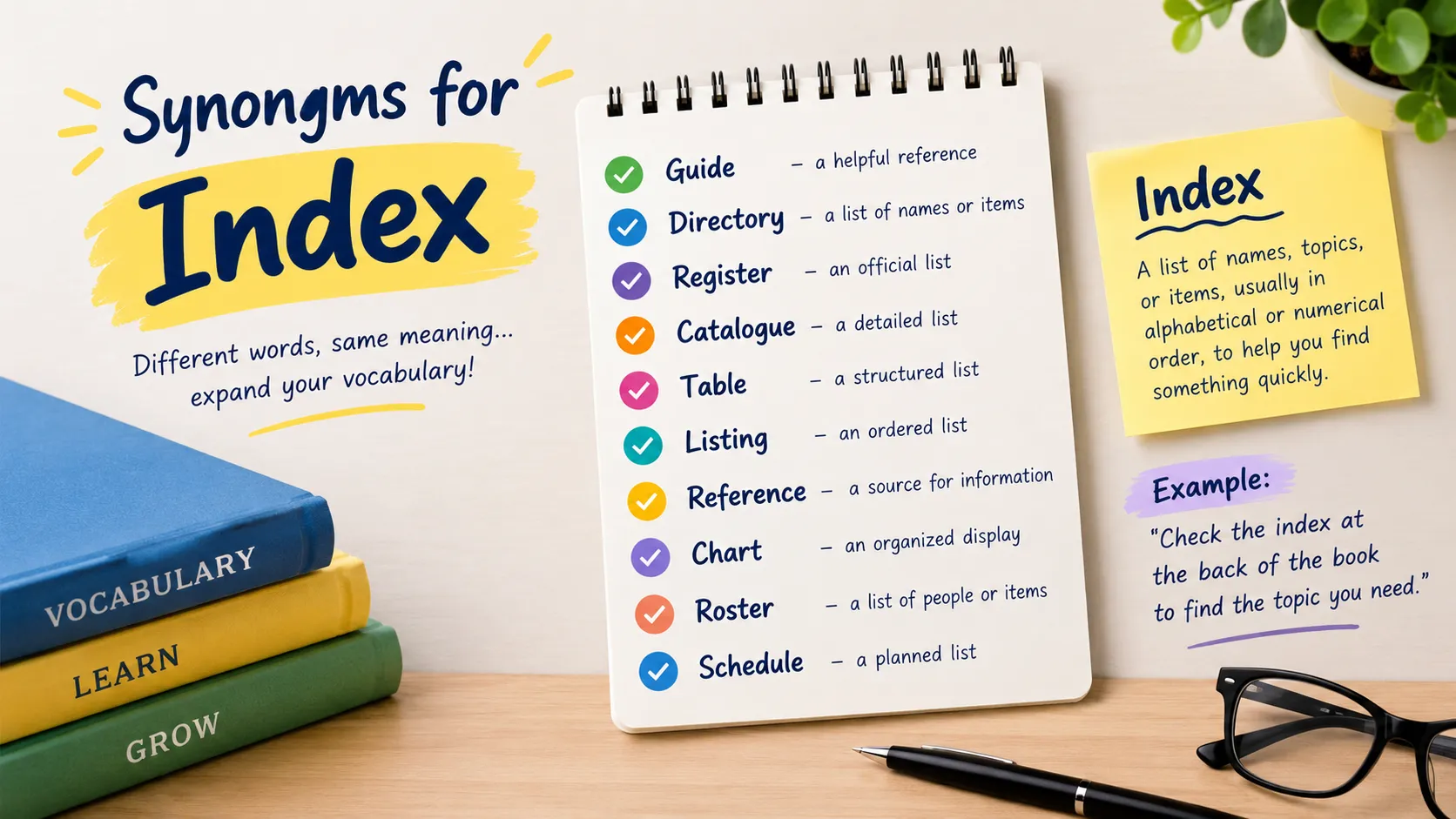
Synonyms for Index
Index has two common noun meanings: a list that helps you find things, and a sign or measure of something. The words below fit one meaning or the other, so check the context before you swap. Some are true synonyms. Others are only related terms, and they are clearly labeled.
| # | Synonym | Relationship | Direct Replacement | Difficulty | Best Used For |
|---|---|---|---|---|---|
| 1 | List | Near synonym | Sometimes | Beginner | Daily conversation, general writing |
| 2 | Directory | Near synonym | Sometimes | Beginner | Business writing, technical writing |
| 3 | Catalog | Near synonym | Sometimes | Intermediate | Libraries, shops, business writing |
| 4 | Register | Contextual alternative | No | Intermediate | Official records, formal writing |
| 5 | Indicator | Contextual alternative | Sometimes | Intermediate | Academic, business, technical writing |
| 6 | Pointer | Contextual alternative | Sometimes | Intermediate | Daily conversation, technical writing |
| 7 | Sign | Contextual alternative | Sometimes | Beginner | Daily conversation, general writing |
| 8 | Gauge | Contextual alternative | Sometimes | Intermediate | Business writing, journalism |
| 9 | Table of Contents | Related term | No | Beginner | Books, reports, academic writing |
| 10 | Glossary | Related term | No | Intermediate | Textbooks, academic writing |
| 11 | Inventory | Related term | No | Intermediate | Business writing, technical writing |
| 12 | Benchmark | Related term | No | Intermediate | Business, finance, academic writing |
Table of Contents
- Antonyms of Index
- Words Commonly Confused with Index
- Frequently Asked Questions
- Conclusion
Quick Facts About Index
- Focus keyword: index
- Part of speech: noun (also a verb, as in “to index a book”)
- Pronunciation guide: IN-deks
- IPA: /ˈɪndɛks/
- Syllables: 2 (in-dex)
- Word origin: Index comes from a Latin word that meant “pointer” or “forefinger.” That is why we still say “index finger.”
- Other word forms: indexes and indices (plural), indexed, indexing, indexer
- Formality level: Neutral
- Difficulty level: Beginner to Intermediate
Meaning and Usage of Index
An index is a tool that helps you find something. In a book, it is a list of topics or names, usually in alphabetical order, with the page numbers where they appear.
The word also has a second common meaning. An index can be a number or sign that shows the level of something. Think of the “stock market index,” the “UV index,” or the “body mass index.”
You will see the word in many places:
- Books and reports: “Look in the index for the page on volcanoes.”
- Weather and health: “The UV index is high today, so wear sunscreen.”
- News and finance: “The price index rose again this month.”
- Computers: “The search tool builds an index of your files.”
1. List: A Synonym for Index
Relationship: Near synonym
Direct Replacement: Sometimes
Difficulty Level: Beginner
Meaning: A list is a set of names or items written one after another.
Difference: An index is a special kind of list. It is arranged in a set order and shows where to find things. A plain list can follow any order.
Best Used For: Daily conversation, general writing
Examples:
- Add milk to the shopping list before you leave.
- She keeps a list of books she wants to read this year.
2. Directory: A Synonym for Index
Relationship: Near synonym
Direct Replacement: Sometimes
Difficulty Level: Beginner
Meaning: A directory is a list of people, businesses, or files arranged so you can find them easily.
Difference: An index points to where information appears. A directory usually gives names, addresses, or locations.
Best Used For: Daily conversation, business writing, technical writing
Examples:
- The lobby directory says the dentist is on the fourth floor.
- I saved the photos in a new directory on my laptop.
3. Catalog: A Synonym for Index
Relationship: Near synonym
Direct Replacement: Sometimes
Difficulty Level: Intermediate
Meaning: A catalog (also spelled “catalogue”) is a complete list of items, such as books in a library or products in a store.
Difference: A catalog lists what is available, often with short descriptions. An index helps you find information inside one book or collection.
Best Used For: Libraries, shopping, business writing
Examples:
- The library’s online catalog shows the book is on the second shelf.
- She flipped through the furniture catalog, looking for a new sofa.
4. Register: A Synonym for Index
Relationship: Contextual alternative
Direct Replacement: No
Difficulty Level: Intermediate
Meaning: A register is an official list of names or events that is kept for records.
Difference: A register records facts, such as who attended or who owns something, and it is kept up to date. An index helps you search.
Best Used For: Official records, formal writing
Examples:
- The teacher checked the register to see who was absent.
- You can find the property’s owner in the land register.
5. Indicator: A Synonym for Index
Relationship: Contextual alternative (for the “sign or measure” meaning)
Direct Replacement: Sometimes
Difficulty Level: Intermediate
Meaning: An indicator is something that shows the condition or level of something else.
Difference: An index is often a number worked out from several measures. An indicator is a broader word for any sign or signal.
Best Used For: Academic writing, business writing, technical writing
Examples:
- Rising prices are one indicator that the economy is heating up.
- The warning light is an indicator that the tire pressure is low.
6. Pointer: A Synonym for Index
Relationship: Contextual alternative
Direct Replacement: Sometimes
Difficulty Level: Intermediate
Meaning: A pointer is something that points to a direction, a place, or a piece of information.
Difference: “Index” comes from a Latin word for a pointing finger, so the two ideas are close. “Pointer” can also mean a helpful tip.
Best Used For: Daily conversation, technical writing
Examples:
7. Sign: A Synonym for Index
Relationship: Contextual alternative (for the “sign or measure” meaning)
Direct Replacement: Sometimes
Difficulty Level: Beginner
Meaning: A sign is something that shows that a thing exists or is happening.
Difference: “Sign” is simpler and sounds more casual. “Index” sounds more formal and often points to something that can be measured.
Best Used For: Daily conversation, general writing
Examples:
- Dark clouds are usually a sign of rain.
- Yawning in a meeting is not always a sign of boredom.
8. Gauge: A Synonym for Index
Relationship: Contextual alternative (for the “sign or measure” meaning)
Direct Replacement: Sometimes
Difficulty Level: Intermediate
Meaning: A gauge is a way to measure or judge something.
Difference: An index is usually a number based on data. A gauge is a broader word, and it can also mean a device, like a fuel gauge.
Best Used For: Business writing, journalism, technical writing
Examples:
- The survey is a useful gauge of how customers feel.
- Check the fuel gauge before you leave town.
9. Table of Contents: A Related Term for Index
Relationship: Related term (not a direct synonym)
Direct Replacement: No
Difficulty Level: Beginner
Meaning: A table of contents is a list at the front of a book that shows the chapters and the pages where they start.
Difference: It follows the order of the book and gives only big sections. An index is usually alphabetical, sits at the back, and covers many small topics.
Best Used For: Books, reports, academic writing
Examples:
- I skimmed the table of contents to see which chapter covers grammar.
- Our team report needs a table of contents before we send it.
10. Glossary: A Related Term for Index
Relationship: Related term (not a direct synonym)
Direct Replacement: No
Difficulty Level: Intermediate
Meaning: A glossary is a short dictionary of special words used in a book or subject.
Difference: A glossary explains what words mean. An index tells you where topics appear.
Best Used For: Textbooks, academic writing, technical guides
Examples:
- The glossary at the end explained every medical term in the guide.
- I checked the glossary to learn what “APR” meant on the loan form.
11. Inventory: A Related Term for Index
Relationship: Related term (not a direct synonym)
Direct Replacement: No
Difficulty Level: Intermediate
Meaning: An inventory is a full list of the items in a place, such as goods in a store.
Difference: An inventory counts and records what you have. An index helps you find information.
Best Used For: Business writing, technical writing
Examples:
- The shop closes early on Sunday to count its inventory.
- We made an inventory of everything in the apartment before moving out.
12. Benchmark: A Related Term for Index
Relationship: Related term (not a direct synonym)
Direct Replacement: No
Difficulty Level: Intermediate
Meaning: A benchmark is a standard that you use to compare other things.
Difference: A stock market index often works as a benchmark, but a benchmark is not a list or a sign. It is a point of comparison.
Best Used For: Business writing, finance, academic writing
Examples:
- The company set last year’s sales as its benchmark for growth.
- Her time in the first race became the benchmark for the whole team.
Antonyms of Index
Index has no true antonym. It is a tool word, so it does not have a natural opposite. The words below only contrast with it in idea or purpose.
| # | Contrast Word | Simple Meaning | Example |
|---|---|---|---|
| 1 | Body text | The main part of a book, as opposed to the tools that help you find things in it | The index is short, but the body text runs for 300 pages. |
| 2 | Content | The material inside something, not the list that points to it | The content of the report was strong, and the index made it easy to use. |
| 3 | Disorder | A lack of order, which is the problem an index helps solve | Without an index, the files were in complete disorder. |
Words Commonly Confused with Index
Appendix
Difference: An appendix is extra material at the end of a book or report, such as charts or data. It adds information. An index only helps you find information.
Example: The survey questions are in Appendix B.
Bibliography
Difference: A bibliography is a list of the books and sources an author used. An index is a list of topics inside the book itself.
Example: She added twelve new books to her bibliography.
Footnote
Difference: A footnote is a short note at the bottom of a page that gives extra information or a source. It does not help you search the book.
Example: The footnote explains where the quote came from.
Indices
Difference: “Indices” is not a different word. It is another plural of “index.” “Indexes” is common for books, while “indices” is common in math, science, and finance.
Example: The report tracks several price indices over ten years.
FAQs
What is another word for index?
Another word for index is list, directory, or catalog, when you mean something that helps you find information. If you mean a sign or measure, try indicator, sign, or gauge. The best choice depends on how you use the word, so check the sentence first.
What is the closest synonym for index?
List is the closest simple synonym, and directory and catalog are also close. All three organize information so people can find it. However, an index is more specific. It usually points you to where a topic appears, often in alphabetical order with page numbers, while a plain list can follow any order.
Can I replace index with indicator?
Sometimes. You can use indicator when index means a sign or measure of something, such as a trend or a level. You cannot use it for a book index. For example, you would not say “the indicator at the back of the book.” Always match the word to the meaning.
Is index formal or informal?
Index is a neutral word. People use it in everyday talk, school work, and business writing. It sounds a bit more technical when it names a measure, such as a price index or the UV index. In casual speech, people often say list, sign, or measure instead.
What is the plural of index?
Both indexes and indices are correct. Indexes is common when you talk about books and lists. Indices is more common in math, science, and finance. For example, you might say “the book has two indexes” but “stock indices rose today.” Choose one form and use it consistently in your writing.
Which synonym is best for a book index?
For a book, no single word replaces index exactly. Table of contents is a related but different tool, since it appears at the front and follows chapter order. If you need a simple word, use list. In formal writing, it is usually best to keep the word index, because readers expect it.
Conclusion
Learning synonyms for index helps you say exactly what you mean. A list, a directory, and a catalog are not the same thing. An indicator or a gauge shows something different from a book index. The right word makes your writing clearer and your vocabulary stronger.
Always check the context before you swap one word for another. Then practice your new words in emails, essays, articles, and conversations. Small word choices add up, so keep learning one word at a time.