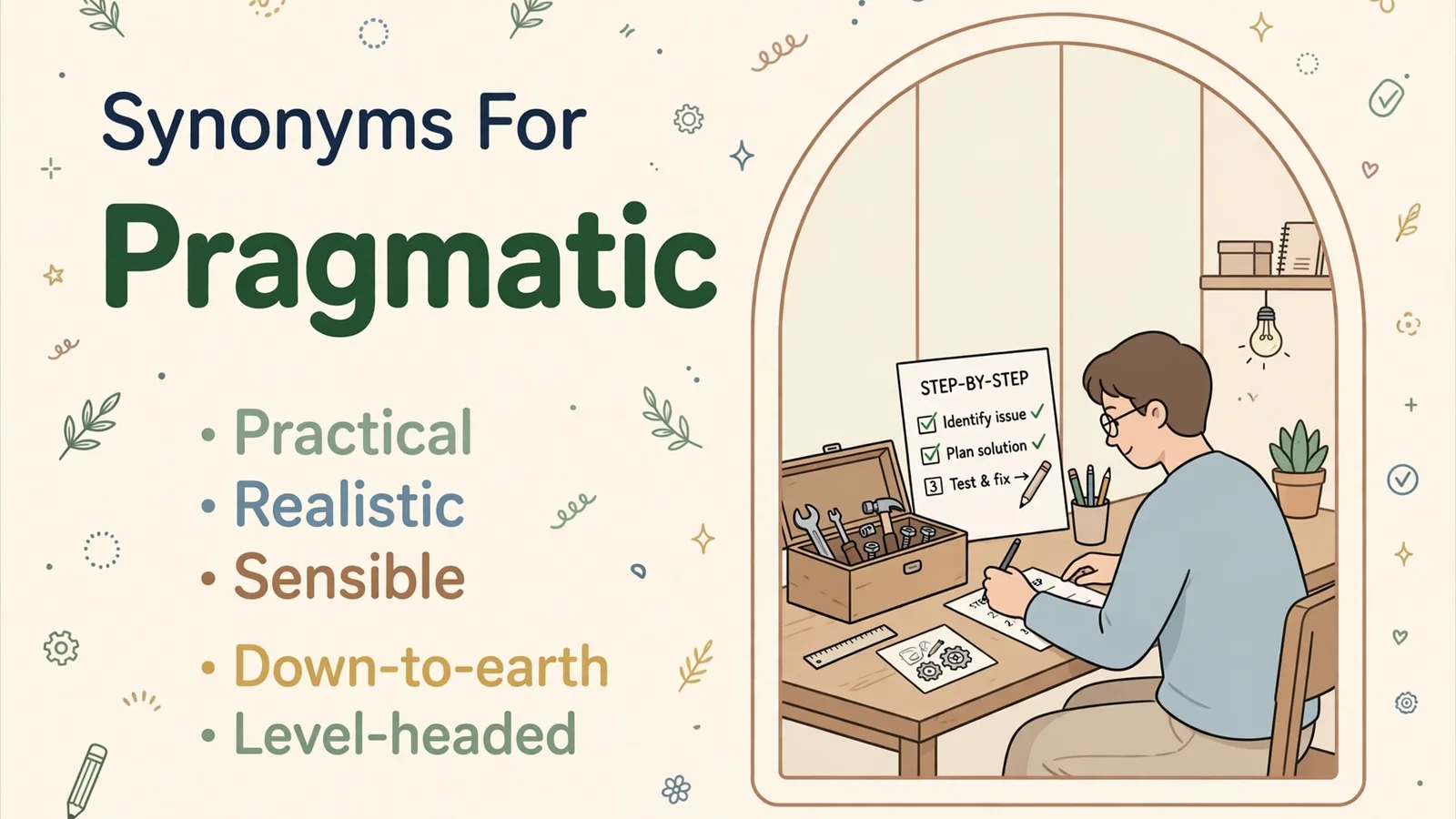
What Is Pragmatic?
Pragmatic means dealing with problems in a practical way instead of following fixed ideas or theories. A pragmatic person looks at what works in real life and chooses the best step for the time. This word often links to practical, realistic, sensible, reasonable, and level-headed choices. It fits work, study, and daily plans.
On a rainy Monday in Lahore, Sara had only three hours to finish a school project. Her team wanted a perfect design, but the printer at the library was broken and the files were too large to send by email. Sara changed the plan in five minutes, used simple slides, and printed the key pages at a nearby shop for 200 rupees. The project scored an A, and her teacher praised her clear plan. Her choice shows the heart of this word. By the end, you will know 12 simple synonyms for pragmatic and pick the right one with ease.
Table of 12 Synonyms for Pragmatic
| No. | Synonym | Part of Speech | Simple Meaning |
|---|---|---|---|
| 1 | practical | Adjective | Useful in real life |
| 2 | realistic | Adjective | Based on real facts |
| 3 | sensible | Adjective | Wise and sound choice |
| 4 | reasonable | Adjective | Fair and not extreme |
| 5 | down-to-earth | Adjective | Plain and easy to understand |
| 6 | matter-of-fact | Adjective | Plain and without fuss |
| 7 | no-nonsense | Adjective | Direct and very serious |
| 8 | results-oriented | Adjective | Focused on clear results |
| 9 | businesslike | Adjective | Calm, neat, and work-like |
| 10 | efficient | Adjective | Quick with little waste |
| 11 | logical | Adjective | Clear and based on reason |
| 12 | level-headed | Adjective | Calm and clear in mind |
Table of Contents
1. What Is Pragmatic? 2. Introduction 3. Table of 12 Synonyms for Pragmatic 4. Table of Contents 5. Quick Facts About Pragmatic 6. Meaning and Usage of Pragmatic 7. Grammar and Sentence Patterns for Pragmatic 8. 1. Practical 9. 2. Realistic 10. 3. Sensible 11. 4. Reasonable 12. 5. Down-to-Earth 13. 6. Matter-of-Fact 14. 7. No-Nonsense 15. 8. Results-Oriented 16. 9. Businesslike 17. 10. Efficient 18. 11. Logical 19. 12. Level-Headed 20. Choose the Right Synonym for Pragmatic 21. Pragmatic Synonyms by Category 22. Antonyms of Pragmatic 23. Words Commonly Confused with Pragmatic 24. Common Mistakes with Pragmatic 25. Writing Tips for Pragmatic 26. American vs. British English Notes for Pragmatic 27. Practice Exercises for Pragmatic 28. Frequently Asked Questions 29. Quick Vocabulary Quiz on Pragmatic 30. Conclusion
Quick Facts About Pragmatic
- Part of Speech: Adjective
- Pronunciation: prag-MAT-ik
- Syllables: 3 (prag-mat-ic)
- Origin: It comes from the Greek word pragma, which means a deed or an act.
- Other Forms: pragmatically (adverb), pragmatism (noun), pragmatist (noun)
- Formality: Neutral to formal. It fits school, work, and daily talk.
- Difficulty: Medium. It is a useful word for upper school learners.
Meaning and Usage of Pragmatic
Pragmatic describes a person, a plan, or a choice that focuses on what works in the real world. A pragmatic leader picks a simple plan that can start today. A pragmatic student picks a study method that fits the time left. The word often fits work, money, health, and school plans. It does not mean cold or careless. It means wise, calm, and focused on a good result. Use it when a person drops a perfect plan and picks a workable plan instead. It adds a clear, adult tone to a sentence.
Grammar and Sentence Patterns for Pragmatic
- Pragmatic about + noun: She is pragmatic about money and saves 500 rupees each week.
- Pragmatic approach to + noun: We need a pragmatic approach to this traffic problem in Karachi.
- Pragmatic solution to + noun: The team found a pragmatic solution to the late bus service.
- Pragmatic decision on + noun: Ali made a pragmatic decision on the school trip after the rain.
- Be pragmatic in + noun phrase: Be pragmatic in your plans and pick two goals for this month.
Common Mistake: Do not use pragmatic for a person who only cares about money. Say “He is pragmatic about costs” for a wise plan, not “He is greedy.” The first means wise use of money, while the second means love of money.
1. Practical
Meaning: Practical means useful in real life and easy to use.
Examples:
- Sara bought a practical school bag with three pockets for 1,500 rupees in Lahore.
- Omar chose a practical plan and fixed the broken fan in 20 minutes with a spare wire.
Best Used When: You talk about a thing or plan that works well in daily life.
Tone: Neutral
Common Collocations: practical plan, practical solution, practical advice
Connotation: Positive. It shows a useful and wise choice.
When Not to Use This Word: Do not use it for a dream or a feeling that has no real use.
2. Realistic
Meaning: Realistic means based on real facts and true limits.
Examples:
- Hina set a realistic goal to read 10 pages each night for 30 days.
- The coach gave a realistic plan to win two games in the first month.
Best Used When: You talk about a goal or plan that fits real time and skill.
Tone: Neutral
Common Collocations: realistic goal, realistic plan, realistic view
Connotation: Positive. It shows clear and honest thinking.
When Not to Use This Word: Do not use it for a wild dream with no link to real facts.
3. Sensible
Meaning: Sensible means wise and based on good sense.
Examples:
- Ahmed made a sensible choice and saved 2,000 rupees for his new books.
- Maria took a sensible route to school and reached class in 15 minutes.
Best Used When: You praise a wise and safe choice.
Tone: Warm
Common Collocations: sensible choice, sensible plan, sensible advice
Connotation: Positive. It shows care and good sense.
When Not to Use This Word: Do not use it for a quick guess with no thought.
4. Reasonable
Meaning: Reasonable means fair and not too much or too little.
Examples:
- The shop gave a reasonable price of 800 rupees for the blue shirt.
- Bilal asked for a reasonable time of two days to finish the report.
Best Used When: You talk about a fair price, time, or demand.
Tone: Neutral
Common Collocations: reasonable price, reasonable time, reasonable request
Connotation: Positive. It shows fairness and balance.
When Not to Use This Word: Do not use it for a very high price or a harsh demand.
5. Down-to-Earth
Meaning: Down-to-earth means plain, real, and easy to talk to.
Examples:
- Mr. Khan is a down-to-earth teacher who helps 40 students with simple words.
- Ayesha gave a down-to-earth talk at the school hall on Friday morning.
Best Used When: You describe a plain and friendly person or style.
Tone: Warm
Common Collocations: down-to-earth person, down-to-earth style, down-to-earth talk
Connotation: Positive. It shows honesty and a simple style.
When Not to Use This Word: Do not use it for a proud person or a fancy speech.
6. Matter-of-Fact
Meaning: Matter-of-fact means plain, direct, and without extra feeling.
Examples:
- The nurse gave a matter-of-fact report on the 10 patients in Ward 3.
- Zain spoke in a matter-of-fact tone about the test on Monday.
Best Used When: You describe a plain and direct way of speaking.
Tone: Neutral
Common Collocations: matter-of-fact tone, matter-of-fact way, matter-of-fact report
Connotation: Neutral. It shows calm and plain speech.
When Not to Use This Word: Do not use it for a warm or excited speech.
7. No-Nonsense
Meaning: No-nonsense means direct, serious, and free from silly talk.
Examples:
- Coach Ali gave a no-nonsense plan to the 15 players before the final match.
- The boss used a no-nonsense style in the meeting at 9 a.m. on Tuesday.
Best Used When: You describe a strict and direct person or plan.
Tone: Firm
Common Collocations: no-nonsense style, no-nonsense plan, no-nonsense boss
Connotation: Positive. It shows focus and clear rules.
When Not to Use This Word: Do not use it for a soft or playful talk.
8. Results-Oriented
Meaning: Results-oriented means focused on the final result, not on talk.
Examples:
- Sana is a results-oriented manager who raised sales by 20 percent in three months.
- The team took a results-oriented path and finished the bridge work in 60 days.
Best Used When: You talk about work that aims at a clear end goal.
Tone: Professional
Common Collocations: results-oriented team, results-oriented plan, results-oriented leader
Connotation: Positive. It shows drive and clear aims.
When Not to Use This Word: Do not use it for slow work with no clear goal.
9. Businesslike
Meaning: Businesslike means calm, neat, and fit for work.
Examples:
- Farah wrote a businesslike email to the bank manager in Islamabad on Monday.
- The clerk used a businesslike tone at the front desk of the city office.
Best Used When: You describe a neat and work-like style.
Tone: Formal
Common Collocations: businesslike manner, businesslike tone, businesslike email
Connotation: Neutral. It shows a clean and work-like style.
When Not to Use This Word: Do not use it for a casual chat with close friends.
10. Efficient
Meaning: Efficient means fast and smart with little waste of time or money.
Examples:
- The new bus route is efficient and saves 30 minutes for 200 riders each day.
- Lina used an efficient plan and cooked lunch for six guests in 40 minutes.
Best Used When: You praise a fast and smart way of doing work.
Tone: Positive
Common Collocations: efficient plan, efficient way, efficient system
Connotation: Positive. It shows skill and good use of time.
When Not to Use This Word: Do not use it for a slow or wasteful method.
11. Logical
Meaning: Logical means clear and based on good reason.
Examples:
- The teacher gave a logical reason for the new rule to 25 students in Class 8.
- Usman made a logical choice and took the train at 7 a.m. to reach work on time.
Best Used When: You talk about a clear step that follows from facts.
Tone: Neutral
Common Collocations: logical choice, logical step, logical reason
Connotation: Positive. It shows clear and sound thought.
When Not to Use This Word: Do not use it for a choice based on a feeling only.
12. Level-Headed
Meaning: Level-headed means calm and clear in the mind, even in stress.
Examples:
- During the fire drill, the level-headed guard led 120 students out in five minutes.
- Nadia stayed level-headed and solved the maths problem in the last 10 minutes of the test.
Best Used When: You praise a calm person in a hard time.
Tone: Warm
Common Collocations: level-headed leader, level-headed choice, level-headed mind
Connotation: Positive. It shows calm and wise control.
When Not to Use This Word: Do not use it for a person who panics fast.
Choose the Right Synonym for Pragmatic
| If you mean… | Use this word |
|---|---|
| A useful thing or plan | practical |
| A goal that fits real facts | realistic |
| A wise and safe choice | sensible |
| A fair price, time, or demand | reasonable |
| A plain and friendly person | down-to-earth |
| A direct and serious style | no-nonsense |
| Work that aims at a clear end | results-oriented |
| A calm mind in a hard time | level-headed |
Pragmatic Synonyms by Category
- Wise Choices: practical, sensible, reasonable, logical
- Real Life Focus: realistic, down-to-earth, matter-of-fact
- Work Style: results-oriented, businesslike, efficient, no-nonsense
- Calm Mind: level-headed, sensible, logical
Antonyms of Pragmatic
| # | Antonym | Simple Meaning | Example |
|---|---|---|---|
| 1 | idealistic | Based on dreams, not facts | Sara had an idealistic plan to build a school in one week. |
| 2 | impractical | Not useful in real life | The impractical plan needed 500 workers and 10 crore rupees. |
| 3 | unrealistic | Not based on real facts | His unrealistic goal was to read 200 books in one month. |
| 4 | dogmatic | Fixed on one set of rules | The dogmatic boss refused to hear the team in the Monday meeting. |
| 5 | illogical | Not based on clear reason | Her illogical choice wasted three hours on a closed road. |
| 6 | foolish | Lacking good sense | It was foolish to spend 5,000 rupees on a broken phone. |
Related Expressions: think on your feet, keep it simple, take a practical view, face the facts, cut to the chase
Word Family: pragmatic (adjective), pragmatically (adverb), pragmatism (noun), pragmatist (noun)
Words Commonly Confused with Pragmatic
- Pragmatic vs. Idealistic: Pragmatic means you pick what works in real life, while idealistic means you chase a perfect dream. Example: A pragmatic plan uses the school bus at 7 a.m., but an idealistic plan hopes for a new bus in one day.
- Pragmatic vs. Theoretical: Pragmatic means you use facts and real steps, while theoretical means you talk about ideas with no test in real life. Example: A pragmatic cook uses the rice in the kitchen, but a theoretical cook talks about a new recipe book.
- Pragmatic vs. Dogmatic: Pragmatic means you change the plan when facts change, while dogmatic means you stick to one rule even when it fails. Example: A pragmatic teacher drops a hard test after rain, but a dogmatic teacher keeps it at 8 a.m.
- Pragmatic vs. Opportunistic: Pragmatic means you pick a wise and fair step, while opportunistic means you grab a gain with no care for rules. Example: A pragmatic shop owner cuts the price by 100 rupees, but an opportunistic seller doubles it during a flood.
Common Mistakes with Pragmatic
- Mistake: He is pragmatic, so he has no feelings.
Correction: He is pragmatic, so he picks a wise plan. Why: Pragmatic means wise and real, not cold or without care.
- Mistake: This is a pragmatic dream.
Correction: This is a pragmatic plan. Why: Pragmatic fits a plan or a choice, not a dream.
- Mistake: She is very pragmatic about her ideal world.
Correction: She is very pragmatic about her daily work. Why: Pragmatic links to real life, not to a perfect world.
- Mistake: Use pragmatic as a noun: The pragmatic of the plan is good.
Correction: The pragmatic side of the plan is good. Why: Pragmatic is an adjective, so it needs a noun with it.
Writing Tips for Pragmatic
- Emails: Use it for a clear work choice, such as “Let us take a pragmatic view of the budget for March.”
- Essays: Use it once in a key line, then back it with a fact or a number.
- Blog Posts: Pair it with a real case, such as a plan that saved time or money.
- Stories: Show it through a choice, such as a hero who drops a grand plan and picks a simple path.
- Social Media: Keep the line short, such as “Stay pragmatic. Pick the step that works today.”
American vs. British English Notes for Pragmatic
There is no key difference in meaning, spelling, or use of pragmatic in American and British English.
Practice Exercises for Pragmatic
1. Fill in the blank: A ___ plan fits the time and money we have today. 2. Pick the best synonym for this line: “She stayed calm and made a clear choice in the storm.” Choose from sensible, level-headed, or businesslike. 3. Write one line with pragmatic about your school or work day, and add a time or a place. 4. Change this line to use a synonym: “He took a pragmatic view of the trip.” 5. Write two lines: one with pragmatic, and one with its antonym idealistic.
FAQs
What is the definition of pragmatic?
Pragmatic means dealing with a problem in a practical way that fits real life. A pragmatic person picks a workable plan instead of a perfect plan. The word is an adjective. It often links to wise choices in work, school, and daily life, where time, money, and facts matter most.
What does pragmatic mean?
It means you look at facts, time, and cost, then pick the step that works best. A pragmatic thinker does not chase a dream plan that cannot start. The focus stays on a clear result. In short, it means smart, calm, and real world thinking for daily plans and hard choices.
What is a synonym for pragmatic?
A close synonym is practical. Other good choices are realistic, sensible, reasonable, and level-headed. Pick practical for a useful thing, realistic for a goal that fits real facts, and sensible for a wise choice. Each word fits a small change in sense, so pick the one that fits your line best.
Is pragmatic a positive word?
Yes, in most cases it is a positive word. It shows wise, calm, and clear thinking. People praise a pragmatic leader or a pragmatic plan. Yet the tone can turn cold if a person drops all care for feelings. Use it for smart plans, and add kind words when feelings also matter.
How can I use pragmatic in a sentence?
Use it before a noun, such as a pragmatic plan, or after a verb, such as be pragmatic. Say: We took a pragmatic view of the trip and left at 6 a.m. to beat the rain. Add a fact, such as a time or a place, to make the use feel real.
Quick Vocabulary Quiz on Pragmatic
1. What does pragmatic mean? A. Only dreams, with no real facts B. What works in real life C. Only old rules, with no change D. Only luck, with no plan 2. Which word is the closest synonym for pragmatic? A. Idealistic B. Dogmatic C. Practical D. Foolish 3. Pick the best line: “She made a ___ choice and saved money for her books.” A. Impractical B. Sensible C. Illogical D. Dogmatic 4. Which word is an antonym of pragmatic? A. Realistic B. Logical C. Idealistic D. Efficient 5. Which line uses pragmatic in the right way? A. We took a pragmatic view and left at 6 a.m. to beat the rain. B. He had a pragmatic dream with no plan at all. C. The pragmatic of the plan was very good. D. She felt pragmatic and cried all day.
Conclusion
Pragmatic is a small word with a big use in daily life. It helps you pick a plan that works, not a plan that only sounds good. You now know 12 synonyms, from practical and realistic to level-headed, with clear examples for each one. Learn more at the Cambridge Dictionary: https://dictionary.cambridge.org/dictionary/english/pragmatic. Now take the 30-second challenge: use pragmatic in one line about your day today. You can do it, and each small step will grow your English.