What Is Melancholy?
Melancholy is a deep, quiet sadness that stays for a long time. It is more than a short bad mood. A person with melancholy feels low, slow, and thoughtful inside. Common synonyms are sadness, sorrow, gloom, grief, and wistfulness. You can use this word for a mood, a song, or a grey autumn day.
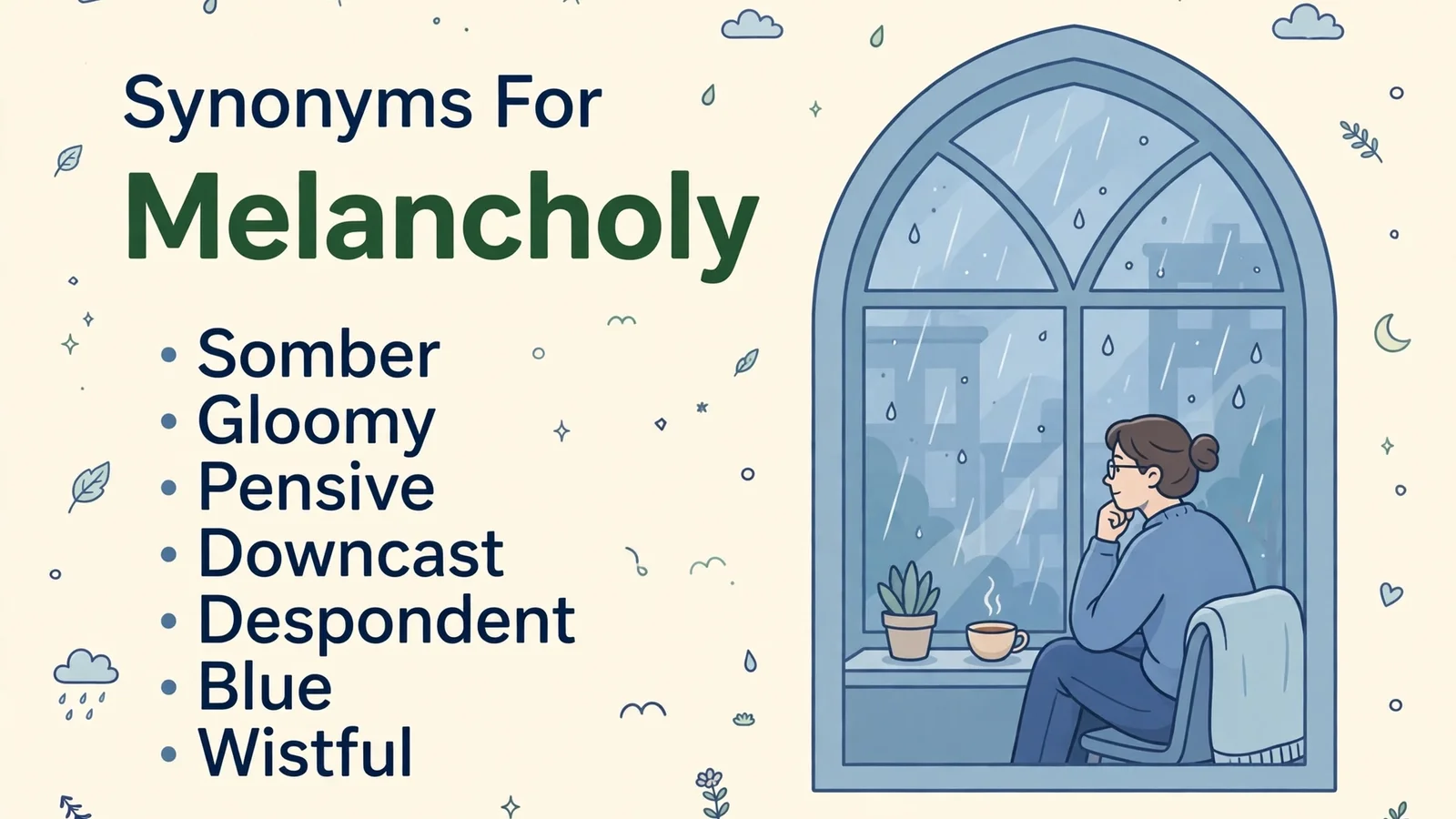
Maya sat by the window of her small flat in Bristol on a rainy Sunday. She held a warm cup of tea with both hands and watched drops run down the glass. Her old school friend had moved to Canada last week, and the flat felt too quiet without their long evening talks. Maya was not crying, but a soft heaviness stayed in her chest all day. Many people know this quiet feeling, and they want the right word for it. Each part below gives a clear meaning, two real examples, and a tip on when to use the word. By the end, you will know 12 simple synonyms for melancholy and pick the best one each time.
Table of 12 Synonyms for Melancholy
| No. | Synonym | Part of Speech | Simple Meaning |
|---|---|---|---|
| 1 | sadness | noun | A feeling of being unhappy |
| 2 | sorrow | noun | Deep sadness from loss |
| 3 | gloom | noun | Dark and sad feeling |
| 4 | grief | noun | Strong sadness after loss |
| 5 | misery | noun | Great unhappiness and pain |
| 6 | despondency | noun | Loss of hope and courage |
| 7 | wistfulness | noun | Sad wish for past times |
| 8 | blues | noun | Sad and low mood (informal) |
| 9 | heartache | noun | Deep emotional pain |
| 10 | despair | noun | Total loss of hope |
| 11 | mournfulness | noun | Sadness shown while mourning |
| 12 | dejection | noun | Sad and low spirits |
Table of Contents
1. What Is Melancholy? 2. Introduction 3. Table of 12 Synonyms for Melancholy 4. Table of Contents 5. Quick Facts About Melancholy 6. Meaning and Usage of Melancholy 7. Grammar and Sentence Patterns for Melancholy 8. Sadness 9. Sorrow 10. Gloom 11. Grief 12. Misery 13. Despondency 14. Wistfulness 15. Blues 16. Heartache 17. Despair 18. Mournfulness 19. Dejection 20. Choose the Right Synonym for Melancholy 21. Melancholy Synonyms by Category 22. Antonyms of Melancholy 23. Words Commonly Confused with Melancholy 24. Common Mistakes with Melancholy 25. Writing Tips for Melancholy 26. American vs. British English Notes for Melancholy 27. Practice Exercises for Melancholy 28. Frequently Asked Questions 29. Quick Vocabulary Quiz on Melancholy 30. Conclusion
Quick Facts About Melancholy
- Part of speech: noun and adjective. As a noun, it means a deep sadness. As an adjective, it describes a sad mood or a sad song.
- Pronunciation: MEL-un-kol-ee.
- Syllables: 4 (mel-an-chol-y).
- Origin: It comes from old Greek words for black bile. Long ago, people linked black bile with a sad mood.
- Other forms: melancholic, melancholically.
- Formality: formal and literary. You see it more in books and poems than in daily chat.
- Difficulty: intermediate. Learners at grade 6 and above can use it with care.
Meaning and Usage of Melancholy
Melancholy as a noun means a deep, quiet sadness. It often lasts longer than normal sadness and feels calm more than loud. As an adjective, melancholy describes a person, a song, a place, or a day that feels sad in a soft way. For example, a melancholy song can make listeners feel thoughtful and still. Use the noun for the feeling itself, and use the adjective to describe a thing or a mood. In stories, writers use this word to set a slow and thoughtful tone. In daily speech, sadness or feeling low often sounds more natural.
Grammar and Sentence Patterns for Melancholy
- melancholy about something: She felt melancholy about leaving her home in Leeds after 10 years.
- melancholy over something: Tom felt melancholy over the end of his football season at age 16.
- a sense of melancholy: A sense of melancholy filled the old hall in York on the last night.
- filled with melancholy: The letter from her brother in Sydney filled Anna with melancholy.
- in a melancholy mood: Jack sat in a melancholy mood for 2 hours after the rain started.
Common mistake: “The news melancholy me.” Correction: “The news made me feel melancholy.” Why: Melancholy is not a verb, so it cannot take an object like this. Use “feel melancholy” or “made me feel melancholy” instead.
1. Sadness
Meaning: Sadness is the feeling of being unhappy when something bad happens.
Examples:
- Sara felt sadness when her cat Milo died at age 12 in June.
- Ben felt sadness after his team lost the final match 3-1 in Manchester.
Best Used When: Use it for a general unhappy feeling in daily life.
Tone: Neutral
Common Collocations: deep sadness, great sadness, overcome with sadness
Connotation: It is mild and general, with no strong blame or shame.
When Not to Use This Word: Do not use it for a very deep loss, where grief fits better.
2. Sorrow
Meaning: Sorrow is a deep sadness, often from loss or regret.
Examples:
- Elena felt sorrow when she read her grandmother’s last letter from Rome.
- David carried sorrow for 5 years after his best friend moved to Australia.
Best Used When: Use it for a serious and lasting sadness.
Tone: Serious
Common Collocations: deep sorrow, great sorrow, express sorrow
Connotation: It sounds formal and heavy, with respect for the loss.
When Not to Use This Word: Do not use it for a small daily upset, where sadness fits better.
3. Gloom
Meaning: Gloom is a dark feeling of sadness with little hope.
Examples:
- A sense of gloom filled the office in London after 20 jobs were cut.
- Rain and grey skies brought gloom to the small town of Bath for a week.
Best Used When: Use it for a dark mood that covers a place or a group.
Tone: Dark
Common Collocations: sense of gloom, deep gloom, gloom and doom
Connotation: It feels heavy and dark, like a cloud over the mind.
When Not to Use This Word: Do not use it for a light or short sadness.
4. Grief
Meaning: Grief is strong sadness after the death of a person or a big loss.
Examples:
- Maria felt grief for months after her father died in March at age 68.
- The whole school in Leeds shared grief after the loss of a young teacher.
Best Used When: Use it for the pain that follows death or a major loss.
Tone: Intense
Common Collocations: deep grief, grief and loss, overcome with grief
Connotation: It is deep and painful, but it is also a normal human response.
When Not to Use This Word: Do not use it for a small setback, like a lost game.
5. Misery
Meaning: Misery is great unhappiness that often comes with pain or trouble.
Examples:
- Cold and rain made the camping trip in Wales a misery for 8 students.
- Lack of sleep caused misery for Omar during his 12-hour night shifts.
Best Used When: Use it when unhappiness is strong and hard to bear.
Tone: Strong
Common Collocations: sheer misery, human misery, life of misery
Connotation: It is very negative and points to real suffering.
When Not to Use This Word: Do not use it for a mild or quiet sadness.
6. Despondency
Meaning: Despondency is the loss of hope and courage after failure or bad news.
Examples:
- After 3 failed job interviews in Bristol, Liam sank into despondency.
- The team felt despondency when they lost 5 matches in a row in April.
Best Used When: Use it when someone has lost hope and feels low.
Tone: Heavy
Common Collocations: deep despondency, sink into despondency, mood of despondency
Connotation: It is formal and serious, with a sense of giving up.
When Not to Use This Word: Do not use it in casual chat, where “feeling low” fits better.
7. Wistfulness
Meaning: Wistfulness is a sad and gentle wish for a past time or person.
Examples:
- Anna felt wistfulness when she saw photos from her school days in 2015.
- Old songs from the 1990s filled Mark with wistfulness on his drive home.
Best Used When: Use it for a soft, thoughtful longing for the past.
Tone: Gentle
Common Collocations: wistfulness for the past, quiet wistfulness, sense of wistfulness
Connotation: It is tender and sweet, even though it is sad.
When Not to Use This Word: Do not use it for fresh pain or anger.
8. Blues
Meaning: The blues is a sad and low mood, often for a short time.
Examples:
- Rain on Monday gave Sara the blues before her 9 a.m. class in Leeds.
- After his team lost 2-0, Jack had the blues for the whole evening.
Best Used When: Use it in casual speech for a short, low mood.
Tone: Casual
Common Collocations: have the blues, feel the blues, Monday blues
Connotation: It is light and informal, not deep or formal.
When Not to Use This Word: Do not use it in formal writing or for a serious loss.
9. Heartache
Meaning: Heartache is deep emotional pain, often from love or loss.
Examples:
- Emma felt heartache for a year after her first love ended in 2024.
- His heartache grew when he read the old letters from his wife in York.
Best Used When: Use it for personal pain from love, loss, or parting.
Tone: Emotional
Common Collocations: deep heartache, cause heartache, heartache and pain
Connotation: It is personal and tender, tied to the heart.
When Not to Use This Word: Do not use it for a general bad mood with no clear cause.
10. Despair
Meaning: Despair is the total loss of hope that things will get better.
Examples:
- After the flood ruined 40 homes in Kent, many people felt despair.
- Sara felt despair when she failed her final exam for the second time.
Best Used When: Use it when hope is gone and the feeling is very strong.
Tone: Desperate
Common Collocations: deep despair, sense of despair, in despair
Connotation: It is very strong and dark, with no hope left.
When Not to Use This Word: Do not use it for a small worry or a short low mood.
11. Mournfulness
Meaning: Mournfulness is a sad state shown while mourning a loss.
Examples:
- A mournfulness filled the church in York during the service for 200 people.
- Her voice had a mournfulness that touched 30 listeners at the concert.
Best Used When: Use it to describe a sad sound, voice, or scene linked to mourning.
Tone: Solemn
Common Collocations: quiet mournfulness, deep mournfulness, air of mournfulness
Connotation: It is formal and respectful, tied to grief and remembrance.
When Not to Use This Word: Do not use it for a casual or light sadness.
12. Dejection
Meaning: Dejection is a sad and low feeling after failure or bad news.
Examples:
- Tom felt dejection when he missed the last train to London at 11 p.m.
- The team showed dejection after losing the cup final by 1 goal in May.
Best Used When: Use it for a low mood after a clear failure.
Tone: Low
Common Collocations: deep dejection, look of dejection, mood of dejection
Connotation: It is formal and quiet, with a sense of defeat.
When Not to Use This Word: Do not use it for deep grief after a death.
Choose the Right Synonym for Melancholy
| If you mean… | Use this word |
|---|---|
| A general unhappy feeling | sadness |
| Deep sadness from loss | sorrow |
| A dark mood over a place | gloom |
| Pain after a death | grief |
| A soft wish for the past | wistfulness |
| A short low mood in casual talk | blues |
| Total loss of hope | despair |
| A low mood after failure | dejection |
Melancholy Synonyms by Category
- Gentle sadness: sadness, wistfulness, blues. These words fit soft, daily low moods.
- Deep pain: grief, heartache, despair. Use these for strong pain and loss.
- Low mood: gloom, misery, dejection. These words describe a heavy, low state.
- Long, quiet sadness: sorrow, despondency, mournfulness. These words fit a slow sadness that lasts.
Antonyms of Melancholy
| # | Antonym | Simple Meaning | Example |
|---|---|---|---|
| 1 | joy | A feeling of great happiness | The joy on 200 faces lit up the hall in Leeds on the wedding day. |
| 2 | happiness | A state of feeling pleased | Her happiness grew when she passed 5 exams in June. |
| 3 | cheerfulness | A bright and happy manner | His cheerfulness helped 10 new students feel at home in York. |
| 4 | delight | Great pleasure and joy | The children felt delight when snow fell for 3 hours in Kent. |
| 5 | elation | A feeling of great joy | Elation filled the team after they won the final 2-1 in May. |
| 6 | hope | A wish for a good future | Hope returned when 50 volunteers came to help in Bristol. |
| 7 | contentment | A calm feeling of being satisfied | Contentment filled Anna as she read by the fire for 2 hours. |
Related Expressions: a heavy heart, feeling down, in low spirits, a cloud over someone, down in the dumps
Word Family: melancholy (noun and adjective), melancholic (adjective), melancholically (adverb)
Words Commonly Confused with Melancholy
Melancholy vs. depression: Melancholy is a mood or a feeling of quiet sadness. Depression is a medical condition that lasts longer and needs care. Example: She felt melancholy on a rainy day in York, but depression needs help from a doctor in Leeds.
Melancholy vs. sadness: Sadness is a general unhappy feeling. Melancholy is deeper, quieter, and lasts longer. Example: He felt sadness when his team lost 2-0, yet melancholy stayed with him for weeks after his move to Canada.
Melancholy vs. nostalgia: Nostalgia is a warm wish for the past. Melancholy is a sad, heavy mood that may have no past link. Example: Old photos from 2010 gave her nostalgia, but the grey winter in Bristol gave her melancholy.
Melancholy vs. grief: Grief follows a clear loss, often a death. Melancholy can come with no clear cause. Example: Grief filled the family after the death in March, while melancholy filled the quiet house for months after.
Common Mistakes with Melancholy
| Mistake | Correction | Why |
|---|---|---|
| “It melancholy me.” | “It made me feel melancholy.” | Melancholy is not a verb. |
| “I am in melancholy.” | “I feel melancholy.” | Use “feel” or “in a melancholy mood” for the state. |
| “He is a melancholy.” | “He is melancholic.” | As a noun for a person, melancholy is wrong. Use the adjective form. |
| “She felt melancholy for her exam.” | “She felt anxious about her exam.” | Melancholy is a quiet sadness, not worry before a test. |
Writing Tips for Melancholy
- Emails: Keep it simple and use “feeling low” in work emails. Save melancholy for a personal note to a friend.
- Essays: Use melancholy once to set a thoughtful tone, then support it with a clear example from a book or a place.
- Blog posts: Pair melancholy with a story, like a rainy day in Bristol, so readers can feel the mood.
- Stories: Show melancholy through action, such as a slow walk home for 2 miles in the rain.
- Social media: Use a short line with one synonym, such as “A quiet sadness on a grey day in Leeds,” and add a photo.
American vs. British English Notes for Melancholy
There is no real difference in meaning or spelling between American and British English for melancholy. Both use the same word in the same way.
Practice Exercises for Melancholy
1. Fill in the blank: “After her friend moved to Canada, Maya felt a deep ______ for weeks.” Use one synonym from this article. 2. Pick the best word for this case: Tom lost hope after 3 failed interviews in Bristol. Which synonym fits best? 3. Write 2 sentences with “wistfulness” about a place you miss. Add a name and a year. 4. Change this sentence to use “gloom”: “The office felt dark and sad after 20 jobs were cut in London.” 5. Write a short paragraph of 3 sentences about a rainy day in York. Use melancholy once and one synonym once.
FAQs
What is the definition of melancholy?
Melancholy is a deep, quiet sadness that stays for a long time. It is more than a short bad mood. A person with melancholy feels low, slow, and thoughtful inside. It can describe a feeling, a mood, a song, or a grey day.
What does melancholy mean?
Melancholy means a deep and lasting sadness with a quiet, thoughtful feel. It can also mean sad in a soft way when it describes a song, a voice, or a place. A melancholy day feels grey and slow, and the feeling often stays for days or weeks.
What is a synonym for melancholy?
A common synonym for melancholy is sadness, and other good choices are sorrow, gloom, grief, and wistfulness. Pick sadness for a general low feeling, sorrow or grief for a deep loss, and wistfulness for a soft wish for the past.
Is melancholy a noun or an adjective?
Melancholy is both a noun and an adjective. As a noun, it names the feeling itself, as in “a deep melancholy filled the old hall in York.” As an adjective, it describes a person, a song, or a day, as in “a melancholy song played for 3 minutes.” The noun is the main focus here.
How do you use melancholy in a sentence?
You can say, “She felt melancholy after her friend moved to Canada last week.” You can also use it as an adjective, as in “He played a melancholy tune for 5 minutes in Leeds.” Keep the sentence short, and add a name, a place, or a time to make it real.
Quick Vocabulary Quiz on Melancholy
1. Which word means a deep, quiet sadness that lasts a long time? A. Joy B. Melancholy C. Anger D. Excitement 2. Which synonym fits a soft wish for the past? A. Despair B. Misery C. Wistfulness D. Gloom 3. Which word is best for pain after the death of a loved one? A. Blues B. Grief C. Dejection D. Wistfulness 4. Which sentence uses melancholy in the right way? A. “It melancholy me.” B. “She felt melancholy after her friend moved to Canada.” C. “He is a melancholy.” D. “The melancholy ran fast.” 5. Which word means the total loss of hope? A. Sadness B. Sorrow C. Despair D. Heartache
Conclusion
Melancholy is a deep, quiet sadness, and now you have 12 clear words to describe it. Pick sadness for daily use, sorrow or grief for a deep loss, and wistfulness for a soft wish for the past. The right word makes your writing clear and honest. . Take the 30-second challenge now: say one sentence with melancholy about a rainy day. You can do this, and your words will grow stronger each day.