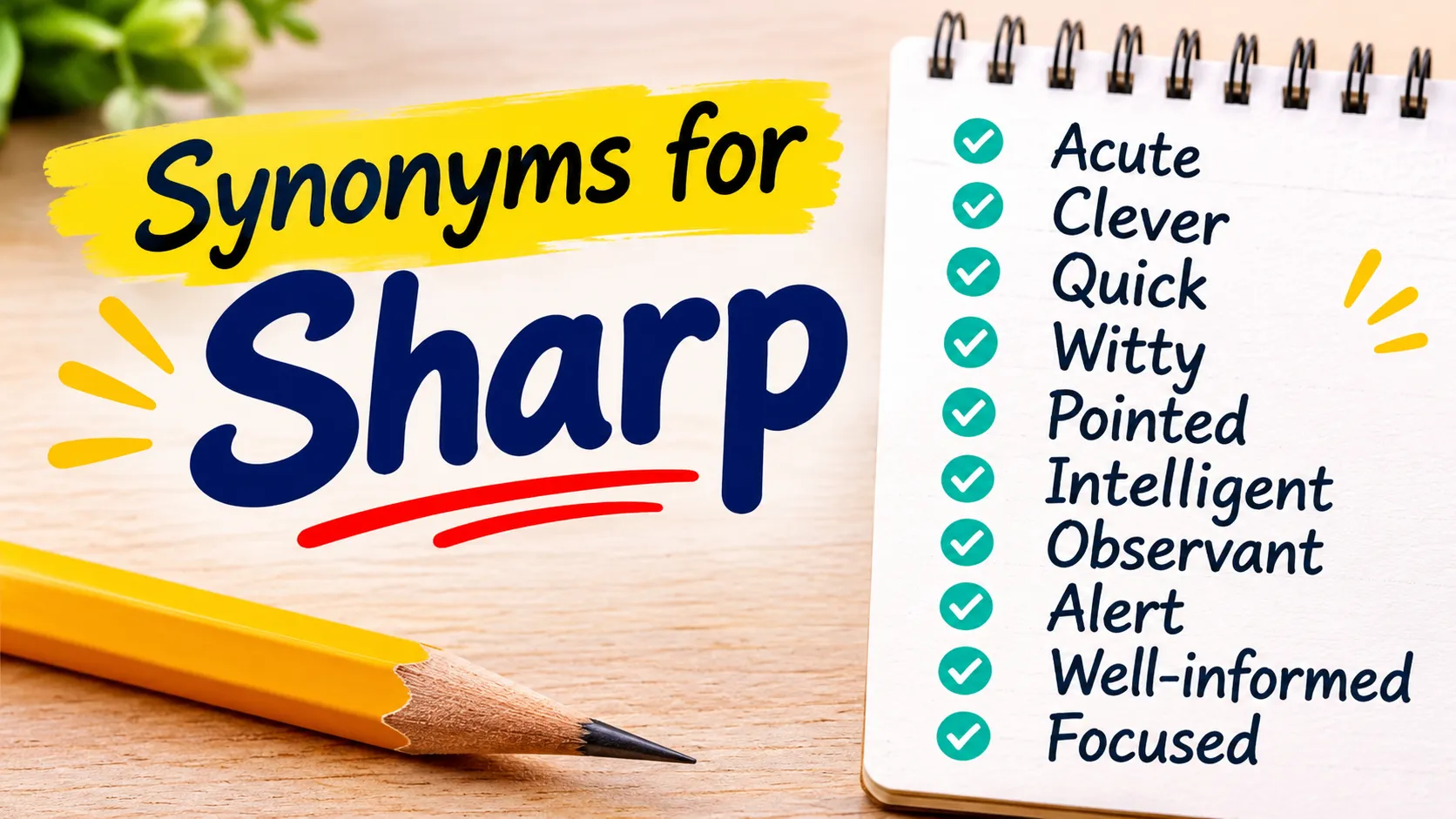
Sharp means having a fine edge or point that can cut, or being quick and clever in thinking. The closest synonym is keen, since both describe something that cuts easily or a mind that works fast. Other close options include pointed, acute, astute, and razor-sharp, depending on If you mean a blade or a brain.
Marcus picked up the old kitchen knife, ran his thumb lightly across the blade, and winced. “This thing is sharp enough to slice paper,” he said, setting it carefully back in the drawer.
That’s one kind of sharp. But sharp also describes a mind that catches every detail, a pain that hits suddenly, or a turn in the road that comes out of nowhere. Because the word covers so much ground, writers often reach for synonyms for sharp to match the exact feeling they want, If that’s a blade, a comment, or a quick thinker.
This guide walks through genuine synonyms for sharp, shows how each one differs, and gives you real examples for every context. By the end, you will know exactly which word to reach for the next time “sharp” feels too plain.
Table of 18 Synonyms for Sharp
| No. | Synonym | Part of Speech | Simple Meaning |
|---|---|---|---|
| 1 | Keen | Adjective | Having a fine, cutting edge |
| 2 | Pointed | Adjective | Having a sharp tip |
| 3 | Jagged | Adjective | Having rough, uneven sharp edges |
| 4 | Razor-sharp | Adjective | Extremely sharp, like a razor |
| 5 | Honed | Adjective | Sharpened through careful practice |
| 6 | Piercing | Adjective | Sharp enough to cut through |
| 7 | Acute | Adjective | Intensely sharp, especially pain |
| 8 | Cutting | Adjective | Sharp and harsh, often in speech |
| 9 | Incisive | Adjective | Sharp and clear in thought |
| 10 | Astute | Adjective | Mentally sharp and quick to judge |
| 11 | Quick-witted | Adjective | Fast and sharp in thinking |
| 12 | Clever | Adjective | Mentally sharp and smart |
| 13 | Shrewd | Adjective | Sharp in practical judgment |
| 14 | Perceptive | Adjective | Sharp at noticing small details |
| 15 | Abrupt | Adjective | Sharp and sudden in change |
| 16 | Sudden | Adjective | Happening sharply, without warning |
| 17 | Stinging | Adjective | Sharp and painful, physically or emotionally |
| 18 | Severe | Adjective | Sharp and intense in degree |
Table of Contents
- Introduction
- Table of 18 Synonyms for Sharp
- Quick Facts About Sharp
- Meaning and Usage of Sharp
- Grammar and Sentence Patterns for Sharp
- Keen
- Pointed
- Jagged
- Razor-sharp
- Honed
- Piercing
- Acute
- Cutting
- Incisive
- Astute
- Quick-witted
- Clever
- Shrewd
- Perceptive
- Abrupt
- Sudden
- Stinging
- Severe
- Choose the Right Synonym for Sharp
- Sharp Synonyms by Category
- Antonyms of Sharp
- Words Commonly Confused with Sharp
- Common Mistakes with Sharp
- Writing Tips for Sharp
- American vs. British English Notes for Sharp
- Practice Exercises for Sharp
- Frequently Asked Questions
- Quick Vocabulary Quiz on Sharp
- Conclusion
Quick Facts About Sharp
- Focus keyword: Sharp
- Part of speech: Adjective
- Simple pronunciation guide: SHARP
- Number of syllables: 1
- Word origin: Comes from the Old English word “scearp,” meaning cutting or keen
- Other word forms: Sharply (adverb), sharpness (noun), sharpen (verb)
- Formality level: Neutral, fits both casual and formal writing
- Difficulty level: Beginner
- CEFR level: A2
Meaning and Usage of Sharp
Sharp describes something with a fine edge or point that can cut easily, like a knife or a pencil tip. It also describes a quick, clever mind or a sudden, intense feeling.
People use sharp constantly in daily speech. A chef might say, “Keep your knives sharp,” while a teacher might praise a student for a sharp answer. Drivers talk about a sharp turn, and doctors describe a sharp pain.
Because sharp stretches across so many situations, picking the right synonym helps your sentence land with more precision.
Grammar and Sentence Patterns for Sharp
Sharp follows a simple adjective pattern: subject + be verb + sharp, as in “The knife is sharp.” Most synonyms on this list follow the same structure.
Several synonyms pair with specific prepositions. Here are the patterns to remember:
- Keen on something: “She’s keen on learning new languages.”
- Pointed at something: “The stick was pointed at the target.”
- Acute at sensing something: “He’s acute at sensing tension in a room.”
- Perceptive about people: “She’s perceptive about how others feel.”
- Severe with someone: “The coach was severe with the team after the loss.”
One common mistake is writing “keen to” when the meaning calls for “keen on,” since both exist but mean different things. “Keen to learn” means eager to start, while “keen on learning” means genuinely interested in the subject. Mixing these up can confuse the sentence’s meaning, so match the preposition to the intended sense.
1. Keen
Meaning: Keen describes something with a fine, effective cutting edge, or someone eager and enthusiastic.
Examples:
- Grandpa kept his old hunting knife keen enough to split a hair down the middle.
- Priya seemed keen to start her new job at the design studio in Austin.
Best Used When: Describing a sharp blade or strong enthusiasm for something.
Tone: Neutral
Common Collocations: keen edge, keen interest, keen eye
2. Pointed
Meaning: Pointed describes something that narrows to a sharp tip.
Examples:
- The fence around the garden had pointed iron spikes along the top.
- She wore pointed shoes that clicked loudly across the marble floor.
Best Used When: Describing the shape of an object that ends in a sharp tip.
Tone: Neutral
Common Collocations: pointed stick, pointed question, pointed remark
3. Jagged
Meaning: Jagged describes something with rough, uneven, sharp edges.
Examples:
- The hikers near Boulder had to climb over jagged rocks for nearly two miles.
- A jagged crack ran across the windshield after the hailstorm hit Denver.
Best Used When: Describing broken or torn surfaces with rough edges.
Tone: Neutral, slightly dramatic
Common Collocations: jagged edge, jagged rocks, jagged line
4. Razor-sharp
Meaning: Razor-sharp describes something extremely sharp, as sharp as a razor blade.
Examples:
- The sushi chef in Tokyo used a razor-sharp knife to slice the tuna paper-thin.
- Her razor-sharp wit made every meeting with the marketing team more entertaining.
Best Used When: Emphasizing extreme sharpness, either physical or mental.
Tone: Vivid, emphatic
Common Collocations: razor-sharp blade, razor-sharp focus, razor-sharp wit
5. Honed
Meaning: Honed describes something sharpened or improved through careful, repeated practice.
Examples:
- After ten years as a surgeon, Dr. Alvarez had honed her skills to near perfection.
- The carpenter honed the chisel until it could slice through oak cleanly.
Best Used When: Describing a skill or blade improved gradually over time.
Tone: Formal, respectful
Common Collocations: honed skill, honed blade, honed instinct
6. Piercing
Meaning: Piercing describes something sharp enough to cut through or penetrate deeply.
Examples:
- The alarm let out a piercing sound that woke the entire dormitory in Chicago.
- His piercing gaze made the nervous intern forget what she was about to say.
Best Used When: Describing sharp sounds, stares, or sensations that feel intense.
Tone: Intense, dramatic
Common Collocations: piercing scream, piercing eyes, piercing cold
7. Acute
Meaning: Acute describes something intensely sharp, especially pain, senses, or awareness.
Examples:
- The patient described an acute pain in his lower back after the car accident.
- Dogs have an acute sense of smell far beyond what humans can detect.
Best Used When: Describing intense sensations, pain, or a sharply developed sense.
Tone: Formal, clinical
Common Collocations: acute pain, acute awareness, acute angle
8. Cutting
Meaning: Cutting describes something sharp and harsh, often used for hurtful words.
Examples:
- Her cutting remark about his presentation left him silent for the rest of the meeting.
- The critic’s cutting review nearly ended the young director’s career.
Best Used When: Describing harsh, hurtful comments or criticism.
Tone: Harsh, negative
Common Collocations: cutting remark, cutting criticism, cutting wit
9. Incisive
Meaning: Incisive describes thinking or speech that is sharp, clear, and direct.
Examples:
- Her incisive questions during the interview caught the candidate off guard.
- The lawyer’s incisive argument convinced the jury within twenty minutes.
Best Used When: Describing sharp, precise thinking or analysis.
Tone: Formal, intellectual
Common Collocations: incisive comment, incisive analysis, incisive mind
10. Astute
Meaning: Astute describes someone mentally sharp and quick to judge situations accurately.
Examples:
- The astute investor noticed the warning signs months before the market crashed.
- Mrs. Chen, an astute negotiator, saved the company nearly two million dollars.
Best Used When: Describing someone skilled at judging people or situations correctly.
Tone: Formal, respectful
Common Collocations: astute observer, astute judgment, astute businessman
11. Quick-witted
Meaning: Quick-witted describes someone who thinks and responds fast and sharply.
Examples:
- The quick-witted comedian turned a heckler’s insult into the biggest laugh of the night.
- Her quick-witted response during the debate earned applause from the whole audience.
Best Used When: Describing fast, clever thinking in conversation or pressure situations.
Tone: Casual, admiring
Common Collocations: quick-witted reply, quick-witted humor, quick-witted response
12. Clever
Meaning: Clever describes someone mentally sharp, smart, and good at solving problems.
Examples:
- The clever twelve-year-old built a working robot out of spare parts in his garage.
- It was a clever idea to split the delivery routes between two drivers.
Best Used When: Describing general intelligence or a smart solution to a problem.
Tone: Casual, neutral
Common Collocations: clever idea, clever trick, clever solution
13. Shrewd
Meaning: Shrewd describes someone sharp in practical judgment, especially in business or strategy.
Examples:
- The shrewd landlord raised the rent only after checking what nearby apartments charged.
- Her shrewd planning helped the small bakery survive its first difficult winter.
Best Used When: Describing practical, strategic thinking, often in money or business matters.
Tone: Formal, slightly cautious
Common Collocations: shrewd businessman, shrewd move, shrewd decision
14. Perceptive
Meaning: Perceptive describes someone sharp at noticing small details or emotions others miss.
Examples:
- Her perceptive comment about his tone revealed she noticed he was upset.
- The perceptive teacher spotted the quiet student’s talent within the first week.
Best Used When: Describing someone who notices subtle details, especially about people.
Tone: Warm, formal
Common Collocations: perceptive observer, perceptive comment, perceptive insight
15. Abrupt
Meaning: Abrupt describes something sharp and sudden, often a change or an ending.
Examples:
- The meeting came to an abrupt end when the fire alarm went off.
- His abrupt reply made her wonder if she had said something wrong.
Best Used When: Describing sudden changes in tone, direction, or conversation.
Tone: Neutral, slightly negative
Common Collocations: abrupt stop, abrupt change, abrupt ending
16. Sudden
Meaning: Sudden describes something that happens sharply, quickly, and without warning.
Examples:
- A sudden downpour forced the picnic in Central Park to end early.
- His sudden decision to move to Portland surprised his entire family.
Best Used When: Describing unexpected events or quick changes in a situation.
Tone: Neutral
Common Collocations: sudden change, sudden noise, sudden decision
17. Stinging
Meaning: Stinging describes something sharp and painful, either physically or emotionally.
Examples:
- The stinging wind on the ski slope made her eyes water instantly.
- His stinging comment about her cooking stayed with her for days.
Best Used When: Describing physical pain or emotionally hurtful words.
Tone: Intense, negative
Common Collocations: stinging pain, stinging remark, stinging cold
18. Severe
Meaning: Severe describes something sharp and intense in degree, often serious or harsh.
Examples:
- The hospital reported a severe shortage of nurses during the winter flu season.
- Her severe expression told the children they were in real trouble this time.
Best Used When: Describing serious intensity, harsh conditions, or strict behavior.
Tone: Formal, serious
Common Collocations: severe weather, severe pain, severe punishment
Choose the Right Synonym for Sharp
| If you mean… | Use this word |
|---|---|
| A blade with a fine edge | Keen or razor-sharp |
| A rough, uneven edge | Jagged |
| A skill improved through practice | Honed |
| Sudden, intense pain | Acute or stinging |
| A harsh or hurtful comment | Cutting |
| Clear, direct thinking | Incisive |
| Good judgment about people or situations | Astute or shrewd |
| Fast thinking in conversation | Quick-witted |
| Noticing small details about people | Perceptive |
| A sudden change or event | Abrupt or sudden |
The strongest synonym is simply the one that matches your exact meaning, If that’s a blade, a mind, or a moment.
Sharp Synonyms by Category
Physical sharpness: Keen, pointed, jagged, razor-sharp, honed, piercing. These fit blades, edges, and points you can touch or see.
Mental sharpness: Astute, quick-witted, clever, shrewd, perceptive, incisive. These describe fast or accurate thinking.
Sharp pain or sensation: Acute, stinging, piercing. These describe intense physical or emotional feelings.
Sharp speech or behavior: Cutting, severe. These describe harsh words or strict reactions.
Sudden change: Abrupt, sudden. These describe quick, unexpected shifts in direction or tone.
Antonyms of Sharp
| # | Antonym | Simple Meaning | Example |
|---|---|---|---|
| 1 | Dull | Not sharp, blunt | The old scissors were too dull to cut the paper. |
| 2 | Blunt | Having no sharp edge | He used a blunt knife and struggled to slice the bread. |
| 3 | Gentle | Mild, not intense | Her gentle correction felt kind instead of harsh. |
| 4 | Slow-witted | Mentally slow | He felt slow-witted after staying up all night studying. |
| 5 | Mild | Not intense or severe | The doctor said it was only mild pain, nothing serious. |
| 6 | Smooth | Even, without rough edges | The polished stone felt smooth against her palm. |
| 7 | Gradual | Happening slowly over time | The change in temperature was gradual, not sudden. |
Related Expressions: sharp as a tack, sharp tongue, sharp eye, sharp turn, sharp dressed
Word Family: sharp (adjective), sharply (adverb), sharpness (noun), sharpen (verb)
Words Commonly Confused with Sharp
Sharp vs. Spicy
Difference: Sharp can describe a strong, tangy taste, especially in cheese, while spicy specifically means hot from chili or pepper.
Example: The cheddar had a sharp, tangy flavor, while the salsa was spicy enough to make him cough.
Sharp vs. Harsh
Difference: Harsh describes something unpleasantly rough or severe, while sharp more often describes precision, speed, or a fine edge.
Example: Her harsh tone during the argument felt very different from her usual sharp, clear explanations.
Sharp vs. Fast
Difference: Fast describes speed alone, while sharp (in the mental sense) describes quick thinking combined with accuracy.
Example: He’s fast at typing, but his sister is sharp enough to spot the errors he misses.
Sharp vs. Intelligent
Difference: Intelligent is a broader, more formal word for overall mental ability, while sharp often suggests quick, in-the-moment thinking.
Example: She’s highly intelligent overall, but her sharp comebacks are what people remember most.
Common Mistakes with Sharp
Mistake: “He is sharp at mathematics.”
Correction: “He is sharp with mathematics” or “He has a sharp mind for mathematics.”
Why: “Sharp at” sounds unnatural in this context; “sharp with” or a restructured sentence fits better.
Mistake: “The pain was sharp during three days.”
Correction: “The pain was sharp for three days.”
Why: English uses “for” with a duration of time, not “during.”
Mistake: “She gave a sharply answer.”
Correction: “She gave a sharp answer” or “She answered sharply.”
Why: Sharp is the adjective form used before a noun, while sharply is the adverb form used with a verb.
Mistake: “He has keen on cars.”
Correction: “He is keen on cars.”
Why: Keen needs the verb “to be” before it, since it functions as an adjective, not a standalone verb phrase.
Writing Tips for Sharp
Emails: Use “prompt” or “quick” instead of sharp when describing fast responses, since sharp can sound too casual in professional messages. Try: “Thank you for your prompt reply.”
Essays: Use incisive or acute when discussing sharp analysis or arguments, since these sound more academic. Try: “The author offers an incisive critique of modern education.”
Blog posts: Use clever or quick-witted for a conversational, friendly tone readers enjoy. Try: “Here’s a clever trick to save time every morning.”
Stories: Use piercing or stinging to create vivid, emotional imagery in descriptive scenes. Try: “A piercing wind cut through the empty street.”
Social media: Use razor-sharp or sharp-eyed for punchy, attention-grabbing captions. Try: “Razor-sharp focus, zero distractions today.”
American vs. British English Notes for Sharp
Sharp is used the same way in both American and British English, with no major difference in meaning or pronunciation. Both varieties use “sharp” for blades, pain, and quick thinking identically.
One small difference appears in casual speech: British English sometimes uses “sharpish” informally to mean “soon” or “quickly,” as in “Get here sharpish.” This usage is less common in American English, where “quickly” or “fast” is preferred instead.
Practice Exercises for Sharp
- Fill in the blank: The chef kept his knives ______ (having a fine edge) at all times.
- Rewrite this sentence using a synonym for sharp: “The pain in her shoulder was very sharp.”
- Fill in the blank: His ______ (quick-thinking) response surprised everyone at the debate.
- Match the synonym to its meaning: Jagged, Astute, Abrupt, Honed → (a) sudden, (b) rough-edged, (c) sharpened through practice, (d) good judgment
- Rewrite this sentence using a different synonym: “She made a cutting remark about his cooking.”
Frequently Asked Questions
What is another word for sharp?
Keen, pointed, acute, and astute are all strong alternatives for sharp. Each one fits a different context, so keen works well for blades, while astute suits sharp judgment or thinking.
What is the closest synonym for sharp?
Keen is the closest synonym for sharp. Both words describe a fine cutting edge or strong enthusiasm, and they can often replace each other directly.
Can I replace sharp with this synonym?
In many sentences, yes. Words like keen, acute, and clever work as direct replacements, though more specific words like jagged or cutting only fit certain contexts, such as rough edges or harsh comments.
Is sharp formal or informal?
Sharp works in both formal and informal writing, making it a flexible, neutral word. In academic writing, though, incisive or acute often sound more precise and professional.
What is the opposite of sharp?
Dull, blunt, and mild are common opposites of sharp. These words describe something without a fine edge or without intensity, the reverse of sharp’s meaning.
Why do people say someone is “sharp as a tack”?
This common phrase means someone is extremely quick-witted and mentally alert. It compares a person’s sharp thinking to the fine point of a tack, a small, pointed pin.
Which synonym is best in a particular context?
Context decides the best choice. Use keen or razor-sharp for blades, acute for pain, astute or shrewd for judgment, and cutting for harsh words.
Quick Vocabulary Quiz on Sharp
- Which word best describes a knife sharpened through years of practice? A) Jagged B) Honed C) Abrupt D) Mild
- Which word fits a sudden, unexpected ending to a conversation? A) Keen B) Astute C) Abrupt D) Perceptive
- Which word best describes someone who notices small details about people? A) Severe B) Perceptive C) Jagged D) Sudden
- Which word fits a harsh, hurtful comment? A) Cutting B) Clever C) Keen D) Honed
- Which word describes an intense, sudden pain? A) Dull B) Acute C) Gentle D) Smooth
Conclusion
Synonyms for sharp give your writing more precision, If you’re describing a blade, a quick mind, or a sudden change. Words like keen, astute, and cutting each carry their own shade of meaning, and choosing the right one makes your sentence feel sharper too.
Context always matters, since a word that fits a kitchen knife rarely fits a clever remark. Try using three of these synonyms in your own sentences today, If in an email, a story, or a quick text to a friend. A small vocabulary shift like this can make your writing noticeably more precise.