What Is Blunt?
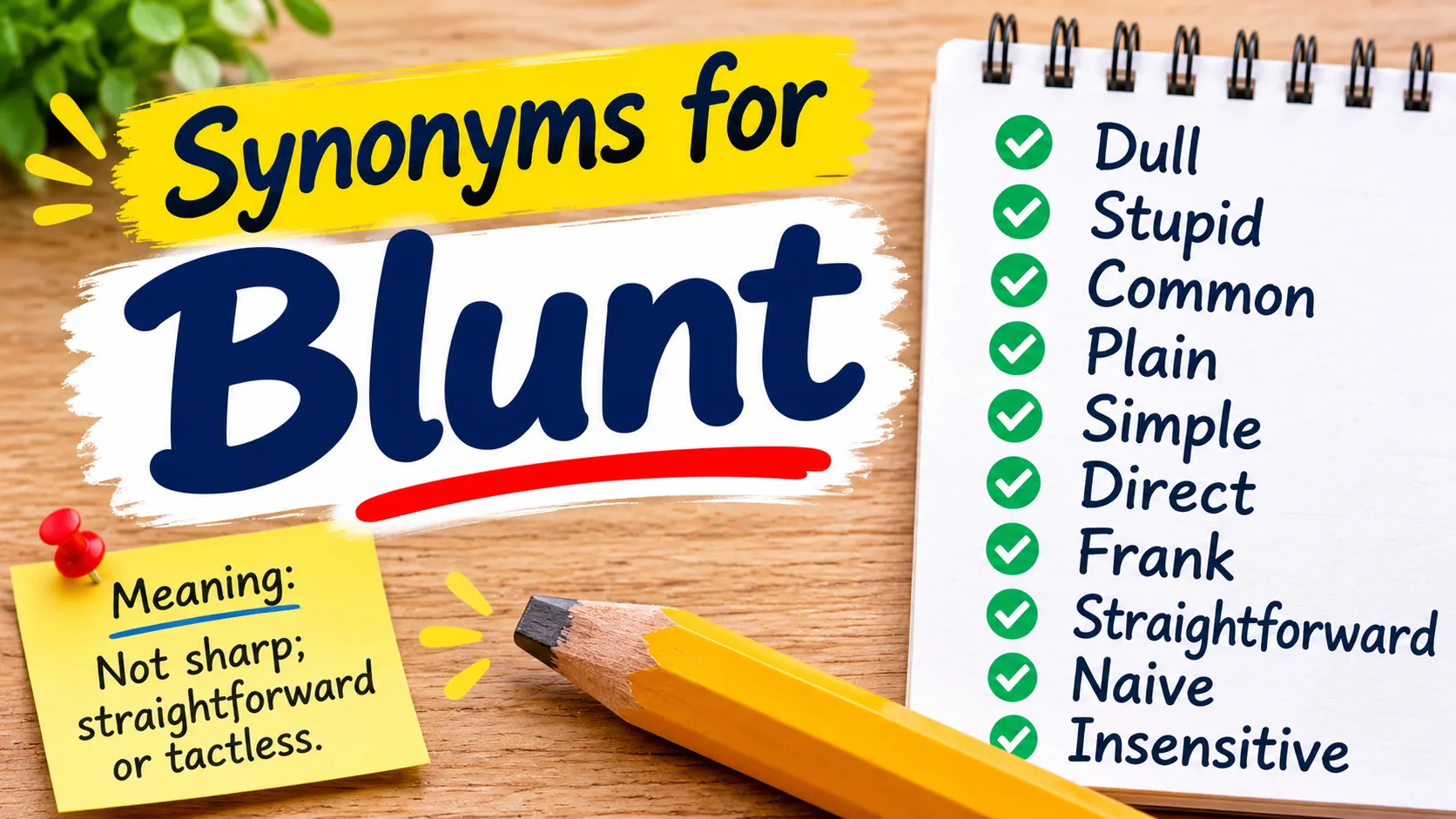
Blunt describes something without a sharp edge or point, or someone who speaks very directly without softening their words. The closest synonym is dull, since both describe a worn, unsharpened edge. Other close options include frank, candid, and straightforward, which fit the direct-speech sense of blunt.
Sarah handed the knife back to her roommate and shook her head. “This thing is completely blunt,” she said. “It won’t even cut through a tomato.”
That’s one meaning of blunt. But the word also describes people, like the coworker who tells you exactly what he thinks of your report without any sugarcoating. Because blunt covers both a dull blade and a direct personality, writers often need synonyms for blunt to match the exact situation, If that’s a knife, a comment, or a personality trait.
This guide breaks down real synonyms for blunt, shows how each one differs, and gives you clear examples for both meanings. By the end, you will know exactly which word fits a dull edge and which one fits a direct conversation.
Table of 16 Synonyms for Blunt
| No. | Synonym | Part of Speech | Simple Meaning |
|---|---|---|---|
| 1 | Dull | Adjective | Not sharp, worn down |
| 2 | Unsharpened | Adjective | Never given a cutting edge |
| 3 | Rounded | Adjective | Having a smooth, curved edge |
| 4 | Frank | Adjective | Open and direct in speech |
| 5 | Candid | Adjective | Truthful and openly honest |
| 6 | Straightforward | Adjective | Clear and direct, no hidden meaning |
| 7 | Outspoken | Adjective | Bold and direct in opinions |
| 8 | Curt | Adjective | Rudely brief and direct |
| 9 | Brusque | Adjective | Abrupt and blunt in manner |
| 10 | Tactless | Adjective | Direct without care for feelings |
| 11 | Forthright | Adjective | Direct and honest, without hesitation |
| 12 | Plainspoken | Adjective | Speaking simply and directly |
| 13 | Direct | Adjective | Clear and to the point |
| 14 | Abrupt | Adjective | Sudden and blunt in tone |
| 15 | Plain | Adjective | Simple and clearly stated |
| 16 | Matter-of-fact | Adjective | Stated plainly, without emotion |
Table of Contents
- Introduction
- Table of 16 Synonyms for Blunt
- Quick Facts About Blunt
- Meaning and Usage of Blunt
- Grammar and Sentence Patterns for Blunt
- Dull
- Unsharpened
- Rounded
- Frank
- Candid
- Straightforward
- Outspoken
- Curt
- Brusque
- Tactless
- Forthright
- Plainspoken
- Direct
- Abrupt
- Plain
- Matter-of-fact
- Choose the Right Synonym for Blunt
- Blunt Synonyms by Category
- Antonyms of Blunt
- Words Commonly Confused with Blunt
- Common Mistakes with Blunt
- Writing Tips for Blunt
- American vs. British English Notes for Blunt
- Practice Exercises for Blunt
- Frequently Asked Questions
- Quick Vocabulary Quiz on Blunt
- Conclusion
Quick Facts About Blunt
- Focus keyword: Blunt
- Part of speech: Adjective
- Simple pronunciation guide: BLUHNT
- Number of syllables: 1
- Word origin: Comes from Middle English, likely related to Old Norse words meaning dull or weak
- Other word forms: Bluntly (adverb), bluntness (noun)
- Formality level: Neutral, fits both casual and formal writing
- Difficulty level: Beginner
- CEFR level: B1
Meaning and Usage of Blunt
Blunt describes something without a sharp edge, like a worn-out pencil or a dull knife. It also describes someone who speaks very directly, often without softening difficult truths.
People use blunt constantly in daily speech. A cook might complain, “This cutting board knife is too blunt to slice onions,” while a manager might warn a new hire, “Be ready, our director can be pretty blunt during reviews.” Both uses share the same core idea: something without a gentle edge.
Because blunt describes both objects and people, choosing the right synonym helps readers understand exactly which sense you mean.
Grammar and Sentence Patterns for Blunt
Blunt follows a simple adjective pattern: subject + be verb + blunt, as in “The scissors are blunt.” Most synonyms on this list follow the same basic structure.
Several synonyms pair naturally with specific prepositions. Here are the patterns worth remembering:
- Blunt about something: “He was blunt about the company’s financial troubles.”
- Frank with someone: “She was frank with her sister about the wedding costs.”
- Candid about a topic: “The actor was candid about his struggles with anxiety.”
- Direct with someone: “Try to be direct with your boss about the deadline.”
- Tactless toward someone: “His comment seemed tactless toward the grieving family.”
One common mistake is writing “blunt to” instead of “blunt about” or “blunt with,” since “blunt to” sounds incorrect in English. Say “She was blunt about her opinion,” never “She was blunt to her opinion.”
1. Dull
Meaning: Dull describes a blade or edge that has lost its sharpness through use or wear.
Examples:
- The chef in the diner kept complaining that the steak knives were too dull to cut through anything.
- After years of use, Marcus finally replaced his dull garden shears with a new pair.
Best Used When: Describing a worn-out, unsharp object like a knife, blade, or pencil.
Tone: Neutral
Common Collocations: dull blade, dull knife, dull edge
2. Unsharpened
Meaning: Unsharpened describes something that has never been given a cutting edge or fine point.
Examples:
- The teacher reminded the students to bring an unsharpened pencil for the exam, just in case.
- He accidentally grabbed an unsharpened knife from the drawer and struggled to slice the bread.
Best Used When: Describing something that was never sharpened in the first place.
Tone: Neutral, literal
Common Collocations: unsharpened pencil, unsharpened blade, unsharpened tool
3. Rounded
Meaning: Rounded describes an edge or point that curves smoothly instead of coming to a sharp tip.
Examples:
- Safety scissors for kids usually have rounded tips to prevent accidental cuts.
- The old wooden spoon had a rounded edge, worn soft from decades of use.
Best Used When: Describing a smooth, curved edge rather than a sharp point.
Tone: Neutral
Common Collocations: rounded edge, rounded tip, rounded corner
4. Frank
Meaning: Frank describes someone who speaks openly and directly, without hiding their true opinion.
Examples:
- Dr. Patel was frank with her patient about the risks of the surgery.
- My uncle gave a frank assessment of the business plan, and it wasn’t encouraging.
Best Used When: Describing honest, open speech in a respectful or professional setting.
Tone: Neutral, respectful
Common Collocations: frank discussion, frank opinion, frank conversation
5. Candid
Meaning: Candid describes speech or behavior that is truthful and openly honest, often unexpectedly so.
Examples:
- The senator gave a surprisingly candid interview about her party’s recent failures.
- In a candid moment, the coach admitted the team wasn’t ready for the championship.
Best Used When: Describing unusually open honesty, especially from someone usually guarded.
Tone: Formal, respectful
Common Collocations: candid interview, candid admission, candid photo
6. Straightforward
Meaning: Straightforward describes something clear and direct, without hidden meaning or complication.
Examples:
- Give me a straightforward answer: are we meeting the deadline on Friday or not?
- The instructions for assembling the shelf were refreshingly straightforward.
Best Used When: Describing clear communication or simple, uncomplicated situations.
Tone: Neutral
Common Collocations: straightforward answer, straightforward plan, straightforward process
7. Outspoken
Meaning: Outspoken describes someone bold and direct in sharing opinions, even controversial ones.
Examples:
- The outspoken city council member criticized the new parking policy at every meeting.
- She has always been outspoken about equal pay in her workplace.
Best Used When: Describing someone who speaks boldly, especially on public or controversial issues.
Tone: Formal, assertive
Common Collocations: outspoken critic, outspoken activist, outspoken opinion
8. Curt
Meaning: Curt describes speech that is rudely brief and lacking in warmth.
Examples:
- His curt reply to her detailed email left her wondering if she had upset him.
- The receptionist gave a curt “no appointments available” before hanging up.
Best Used When: Describing short, somewhat rude responses that feel dismissive.
Tone: Negative, cold
Common Collocations: curt reply, curt response, curt tone
9. Brusque
Meaning: Brusque describes an abrupt, blunt manner that can feel rude or unfriendly.
Examples:
- The surgeon had a brusque bedside manner, but his patients trusted his skill completely.
- Her brusque tone during the meeting made the new intern nervous to speak up.
Best Used When: Describing someone whose directness feels harsh or unfriendly.
Tone: Formal, negative
Common Collocations: brusque manner, brusque tone, brusque reply
10. Tactless
Meaning: Tactless describes someone who speaks directly without considering how their words affect others.
Examples:
- His tactless joke about her weight ruined the entire birthday dinner.
- It was tactless of him to mention the layoffs during the holiday party.
Best Used When: Describing hurtful directness that shows no awareness of feelings.
Tone: Negative
Common Collocations: tactless comment, tactless remark, tactless joke
11. Forthright
Meaning: Forthright describes someone direct and honest, without hesitation or evasion.
Examples:
- The witness gave a forthright account of what happened that night in Denver.
- She was forthright about needing a raise before agreeing to take on more work.
Best Used When: Describing confident, honest directness, often in formal situations.
Tone: Formal, respectful
Common Collocations: forthright answer, forthright manner, forthright statement
12. Plainspoken
Meaning: Plainspoken describes someone who speaks simply and directly, without fancy language.
Examples:
- The plainspoken farmer explained the drought’s effects in simple, clear terms.
- Her plainspoken style made complex financial topics easy for beginners to understand.
Best Used When: Describing simple, clear, no-frills communication.
Tone: Warm, neutral
Common Collocations: plainspoken manner, plainspoken style, plainspoken advice
13. Direct
Meaning: Direct describes communication that goes straight to the point without unnecessary detail.
Examples:
- Be direct with the landlord about the broken heater; don’t just hint at it.
- Her direct feedback helped the writer fix the article’s biggest problems quickly.
Best Used When: Describing clear, to-the-point communication in almost any setting.
Tone: Neutral
Common Collocations: direct feedback, direct answer, direct approach
14. Abrupt
Meaning: Abrupt describes a sudden, blunt tone or action, often feeling rushed or unexpected.
Examples:
- His abrupt “we’re done here” ended the negotiation before anyone could respond.
- The meeting ended with an abrupt announcement that caught everyone off guard.
Best Used When: Describing sudden, sharp shifts in tone or unexpected endings.
Tone: Neutral, slightly negative
Common Collocations: abrupt ending, abrupt tone, abrupt change
15. Plain
Meaning: Plain describes something simple and clearly stated, without decoration or complexity.
Examples:
- Let me put this in plain terms: the project is three weeks behind schedule.
- Her plain honesty about the restaurant’s declining sales surprised the investors.
Best Used When: Describing simple, clear statements without exaggeration.
Tone: Neutral
Common Collocations: plain terms, plain honesty, plain language
16. Matter-of-fact
Meaning: Matter-of-fact describes something stated plainly and directly, without emotion attached.
Examples:
- The doctor’s matter-of-fact tone made the diagnosis feel less frightening somehow.
- He gave a matter-of-fact explanation of why the flight had been delayed three hours.
Best Used When: Describing calm, emotion-free directness, often in serious situations.
Tone: Neutral, calm
Common Collocations: matter-of-fact tone, matter-of-fact explanation, matter-of-fact response
Choose the Right Synonym for Blunt
| If you mean… | Use this word |
|---|---|
| A knife or blade with no edge | Dull or unsharpened |
| A smooth, curved tip | Rounded |
| Honest speech in a respectful setting | Frank or candid |
| Clear communication with no hidden meaning | Straightforward or direct |
| Bold opinions shared publicly | Outspoken or forthright |
| Short, somewhat rude replies | Curt |
| Directness that feels harsh | Brusque |
| Hurtful honesty with no care for feelings | Tactless |
| Simple, no-frills explanation | Plainspoken or plain |
| Calm, emotion-free directness | Matter-of-fact |
The strongest synonym is simply the one that matches your exact meaning, If that’s a dull blade or a direct conversation.
Blunt Synonyms by Category
Physical dullness: Dull, unsharpened, rounded. These fit knives, blades, and tools without a sharp edge.
Honest, respectful directness: Frank, candid, straightforward, direct, forthright, plainspoken, plain, matter-of-fact. These describe clear communication without rudeness.
Bold, public directness: Outspoken. This fits someone who shares opinions confidently, often on controversial topics.
Harsh or hurtful directness: Curt, brusque, tactless, abrupt. These describe bluntness that can feel cold, rude, or careless of others’ feelings.
Antonyms of Blunt
| # | Antonym | Simple Meaning | Example |
|---|---|---|---|
| 1 | Sharp | Having a fine cutting edge | The new knife was sharp enough to slice tomatoes easily. |
| 2 | Pointed | Having a fine, narrow tip | The pencil had a freshly pointed tip. |
| 3 | Diplomatic | Careful and tactful in speech | She gave a diplomatic answer that avoided hurting anyone’s feelings. |
| 4 | Tactful | Sensitive to others’ feelings | His tactful wording softened the bad news considerably. |
| 5 | Subtle | Indirect, not obvious | Her subtle hint was easy to miss if you weren’t paying attention. |
| 6 | Vague | Unclear, not specific | His vague answer left everyone more confused than before. |
| 7 | Gentle | Mild and soft in manner | The nurse used a gentle tone to calm the frightened child. |
Related Expressions: blunt instrument, blunt force, blunt truth, speak bluntly, blunt honesty
Word Family: blunt (adjective), bluntly (adverb), bluntness (noun)
Words Commonly Confused with Blunt
Blunt vs. Rude
Difference: Blunt means direct and honest, while rude specifically means disrespectful or impolite, which blunt doesn’t always imply.
Example: His blunt feedback was helpful, but his rude tone afterward wasn’t necessary.
Blunt vs. Dull
Difference: Dull can describe a lack of sharpness like blunt, but dull also means boring or uninteresting, a meaning blunt doesn’t share.
Example: The knife was dull, and so was the lecture that followed dinner.
Blunt vs. Harsh
Difference: Harsh describes something unpleasantly severe or cruel, while blunt simply means direct, without necessarily being unkind.
Example: His blunt comment stated the facts plainly, but her harsh tone made it feel like an attack.
Blunt vs. Honest
Difference: Honest means truthful in general, while blunt specifically means delivering that truth without softening it.
Example: She’s always honest, but she’s also blunt enough to tell you exactly what she thinks.
Common Mistakes with Blunt
Mistake: “He was blunt to me about the mistake.”
Correction: “He was blunt with me about the mistake.”
Why: Blunt pairs naturally with “with” when describing how someone speaks to another person.
Mistake: “The knife became blunted over the years.”
Correction: “The knife became blunt over the years.”
Why: “Blunted” exists as a verb form, but for describing a current state, “became blunt” is the natural adjective usage.
Mistake: “She gave a bluntness answer.”
Correction: “She gave a blunt answer.”
Why: Blunt is the adjective form used before a noun, while bluntness is the noun form used on its own.
Mistake: “He spoke very blunt during the meeting.”
Correction: “He spoke very bluntly during the meeting.”
Why: Bluntly is the adverb form used to describe how someone spoke, while blunt describes the person or object directly.
Writing Tips for Blunt
Emails: Use “direct” or “straightforward” instead of blunt when giving feedback, since these sound more professional. Try: “I want to be direct about the timeline concerns.”
Essays: Use candid or forthright when discussing honest, open analysis. Try: “The report offers a candid look at the company’s failures.”
Blog posts: Use plainspoken or straightforward for a friendly, approachable tone. Try: “Here’s a plainspoken guide to saving money this year.”
Stories: Use curt or brusque to show a character’s harsh or impatient personality through dialogue. Try: “Fine,” he said curtly, already walking away.
Social media: Use outspoken or frank for confident, opinion-driven captions. Try: “Staying outspoken about issues that matter to me.”
American vs. British English Notes for Blunt
Blunt is used the same way in both American and British English, with no major difference in meaning or pronunciation. Both varieties use it for dull objects and direct speech identically.
There is no notable regional difference in how blunt’s synonyms, like frank, candid, or curt, are used either. All of these words appear naturally in both American and British writing and conversation.
Practice Exercises for Blunt
- Fill in the blank: The old axe was too ______ (not sharp) to chop the firewood.
- Rewrite this sentence using a synonym for blunt: “He was very blunt about his disappointment.”
- Fill in the blank: Her ______ (bold and public) opinions often surprised her coworkers.
- Match the synonym to its meaning: Curt, Candid, Rounded, Tactless → (a) rudely brief, (b) openly honest, (c) smooth edge, (d) careless of feelings
- Rewrite this sentence using a different synonym: “His blunt reply ended the conversation quickly.”
Frequently Asked Questions
What is another word for blunt?
Dull, frank, candid, and direct are all strong alternatives for blunt. Each one fits a different context, so dull works well for knives, while frank or candid suits honest speech.
What is the closest synonym for blunt?
Dull is the closest synonym for blunt when describing objects, while frank is closest for describing direct speech. The right choice depends on which meaning you need.
Can I replace blunt with this synonym?
In many sentences, yes. Words like dull, direct, and straightforward work as direct replacements, though more specific words like tactless or brusque only fit certain harsh or impolite contexts.
Is blunt formal or informal?
Blunt works in both formal and informal writing, making it a flexible, neutral word. In professional settings, though, direct or candid often sound more polished and appropriate.
What is the opposite of blunt?
Sharp, diplomatic, and tactful are common opposites of blunt. These words describe a fine edge or careful, considerate speech, the reverse of blunt’s meaning.
Is it rude to call someone blunt?
Not necessarily. Calling someone blunt simply describes their direct communication style, and many people see it as a compliment rather than an insult, unlike calling someone rude or tactless.
Which synonym is best in a particular context?
Context decides the best choice. Use dull or unsharpened for objects, frank or candid for respectful honesty, and curt or brusque when directness feels harsh or unkind.
Quick Vocabulary Quiz on Blunt
- Which word best describes a knife that won’t cut anything? A) Frank B) Dull C) Outspoken D) Candid
- Which word fits someone who shares bold opinions publicly? A) Rounded B) Curt C) Outspoken D) Plain
- Which word describes a short, somewhat rude reply? A) Candid B) Curt C) Forthright D) Plainspoken
- Which word best fits hurtful honesty with no care for feelings? A) Direct B) Tactless C) Frank D) Straightforward
- Which word describes calm, emotion-free directness? A) Brusque B) Matter-of-fact C) Sharp D) Vague
Conclusion
Synonyms for blunt help your writing match the exact meaning you want, If you’re describing a dull knife or someone’s straight-talking personality. Words like frank, candid, and curt each carry a slightly different shade, from respectful honesty to harsh directness.
Context always matters here, since a word that fits a worn-out blade rarely fits a difficult conversation. Try using three of these synonyms in your own sentences today, If in an email, a story, or a quick chat with a friend. Small changes like these can sharpen your vocabulary right away.