What Is Wide?
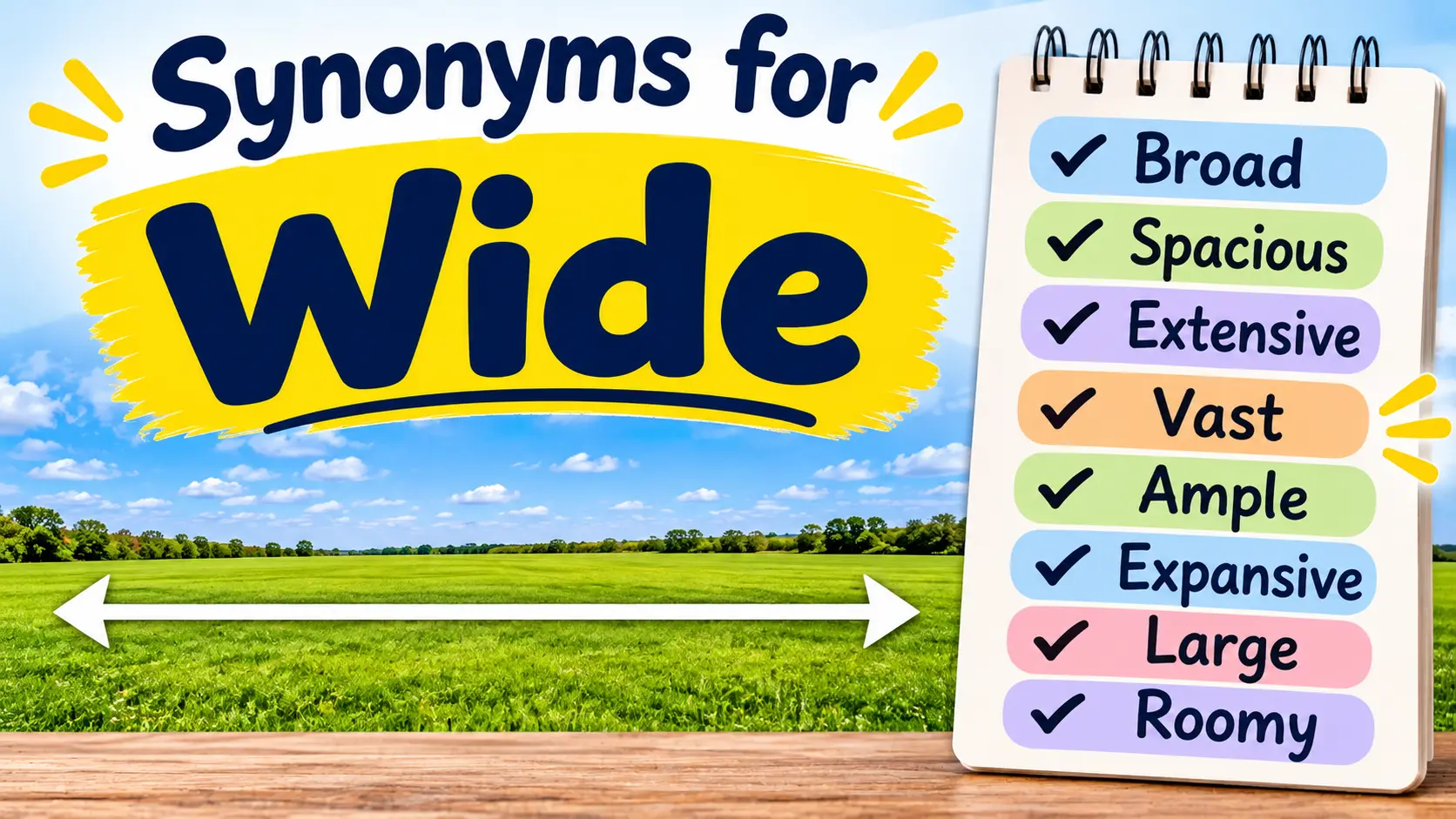
Wide describes something with a large distance from side to side. The closest synonym is broad, because both words describe width. Other common synonyms include vast, spacious, extensive, and ample. The right choice depends on what you describe: a river, a room, a smile, or a range of topics.
Last spring, Daniel from Toronto described the Niagara River in his travel blog. He wrote “a wide river,” “a wide smile,” “a wide choice of cafes,” and “wide jeans” in one post. His editor smiled and wrote, “Same word, four different pictures.”
That is the challenge with wide. It is easy to learn, but it fits many situations. A wide road, a wide room, and a wide range are not wide in the same way.
Learning synonyms for wide solves this. Your writing becomes clearer and more vivid. By the end, you will know 16 alternatives and exactly when to use each one.
Table of 16 Synonyms for Wide
| No. | Synonym | Part of Speech | Simple Meaning |
|---|---|---|---|
| 1 | Broad | Adjective | Large from side to side |
| 2 | Vast | Adjective | Extremely large in area |
| 3 | Expansive | Adjective | Covering a large open area |
| 4 | Spacious | Adjective | Having plenty of room inside |
| 5 | Roomy | Adjective | Comfortably large inside |
| 6 | Extensive | Adjective | Covering a large area or range |
| 7 | Sweeping | Adjective | Wide in range or effect |
| 8 | Comprehensive | Adjective | Covering nearly everything |
| 9 | Widespread | Adjective | Found over a large area |
| 10 | Ample | Adjective | More than enough |
| 11 | Baggy | Adjective | Loose and wide-fitting |
| 12 | Loose | Adjective | Not tight on the body |
| 13 | Gaping | Adjective | Open very wide |
| 14 | Immense | Adjective | Extremely large in size |
| 15 | Far-reaching | Adjective | Having wide effects |
| 16 | Open | Adjective | Not closed, opened wide |
Table of Contents
- Introduction
- Table of 16 Synonyms for Wide
- Quick Facts About Wide
- Meaning and Usage of Wide
- Grammar and Sentence Patterns for Wide
-
- Broad
-
- Vast
-
- Expansive
-
- Spacious
-
- Roomy
-
- Extensive
-
- Sweeping
-
- Comprehensive
-
- Widespread
-
- Ample
-
- Baggy
-
- Loose
-
- Gaping
-
- Immense
-
- Far-reaching
-
- Open
- Choose the Right Synonym for Wide
- Wide Synonyms by Category
- Antonyms of Wide
- Words Commonly Confused with Wide
- Common Mistakes with Wide
- Writing Tips for Wide
- American vs. British English Notes for Wide
- Practice Exercises for Wide
- Frequently Asked Questions
- Quick Vocabulary Quiz on Wide
- Conclusion
Quick Facts About Wide
- Focus keyword: wide
- Part of speech: adjective (also an adverb, as in “open the door wide”)
- Pronunciation: “wide,” rhyming with “side”
- IPA: /waɪd/
- Syllables: 1
- Origin: From Old English wīd, meaning “broad” or “spacious.”
- Word forms: wider, widest, widely, width, widen, widespread
- Formality: neutral
- Difficulty: easy
- CEFR level: A1
Meaning and Usage of Wide
Wide means having a large distance from one side to the other. It also means covering a large range, as in a wide choice. In a third sense, it describes something fully open, as in wide eyes.
People use it in many contexts:
- Places and objects: “The street in front of our hotel is very wide.”
- Range and choice: “The shop sells a wide range of teas.”
- Open things: “The baby’s eyes were wide with surprise.”
Examples:
- The Mississippi River near St. Louis is more than 1 kilometer wide.
- Hira gave a wide smile when she saw her 3 cousins at the airport.
Grammar and Sentence Patterns for Wide
Basic patterns:
- be + wide: “The corridor is wide.”
- wide + noun: “a wide river”
- measurement + wide: “The gate is 4 meters wide.”
- wide as an adverb: “Open your mouth wide.”
Common pairings:
- a wide range of + noun: “The library has a wide range of novels.”
- a wide variety of + noun: “Lagos markets sell a wide variety of fabrics.”
- wide open: “The windows were wide open in July.”
- wide awake: “Sam was wide awake at 3 a.m.”
- widely + verb or adjective: “The song is widely known in Brazil.”
Frequent mistake: Learners put the measurement after “wide.” Say “50 meters wide,” never “wide 50 meters.”
1. Broad
Meaning: Broad means large from side to side.
Examples:
- Mr. Alvarez has broad shoulders from 20 years of rowing in Seville.
- A broad avenue leads to the palace in Vienna.
Best Used When: You describe shoulders, roads, rivers, or smiles.
Tone: Neutral
Common Collocations: broad shoulders, broad smile, broad street
2. Vast
Meaning: Vast means extremely large in area.
Examples:
- The vast Sahara covers about 9 million square kilometers.
- Noor stared at the vast ocean from her Karachi beach house.
Best Used When: You describe deserts, oceans, skies, or huge amounts.
Tone: Strong, slightly formal
Common Collocations: vast desert, vast majority, vast amount
3. Expansive
Meaning: Expansive means covering a large, open area.
Examples:
- The hotel has an expansive lawn near Lake Geneva.
- From the hilltop, Carlos saw an expansive valley full of vineyards.
Best Used When: You describe open land, views, or gardens.
Tone: Formal, descriptive
Common Collocations: expansive view, expansive lawn, expansive space
4. Spacious
Meaning: Spacious means having plenty of room inside.
Examples:
- Their spacious flat in Edinburgh has 4 bedrooms.
- Ayesha loves the spacious kitchen in her new Lahore home.
Best Used When: You describe rooms, homes, offices, or cars.
Tone: Positive, neutral
Common Collocations: spacious room, spacious apartment, spacious interior
5. Roomy
Meaning: Roomy means comfortably large inside.
Examples:
- Our roomy van carried 7 friends to Banff.
- Tom packed 3 suitcases into the roomy trunk of his Toyota.
Best Used When: You talk casually about cars, bags, or clothes.
Tone: Casual, friendly
Common Collocations: roomy car, roomy bag, roomy cabin
6. Extensive
Meaning: Extensive means covering a large area or a large range.
Examples:
- The Louvre in Paris has an extensive collection of art.
- Dr. Rahman did extensive research for 5 years before publishing.
Best Used When: You describe collections, research, damage, or networks.
Tone: Formal
Common Collocations: extensive research, extensive network, extensive damage
7. Sweeping
Meaning: Sweeping means wide in range or effect, or wide and curving.
Examples:
- The mayor of Chicago announced sweeping changes to bus routes.
- A sweeping staircase rises 12 steps to the grand hall in Prague.
Best Used When: You describe big changes, views, or curved shapes.
Tone: Dramatic, formal
Common Collocations: sweeping changes, sweeping view, sweeping statement
8. Comprehensive
Meaning: Comprehensive means covering nearly everything.
Examples:
- Priya wrote a comprehensive guide to the 40 best trails in Nepal.
- The clinic offers a comprehensive health check for $120.
Best Used When: You describe guides, tests, reports, or plans.
Tone: Formal, professional
Common Collocations: comprehensive guide, comprehensive review, comprehensive plan
9. Widespread
Meaning: Widespread means found or happening over a large area or among many people.
Examples:
- Heavy rain caused widespread flooding in Sindh in August.
- Mobile banking is now widespread across Kenya.
Best Used When: You describe problems, beliefs, or trends affecting many places or people.
Tone: Neutral, news style
Common Collocations: widespread belief, widespread support, widespread damage
10. Ample
Meaning: Ample means more than enough. (Related term, used for amount, not for physical width.)
Examples:
- The cabin had ample space for 6 hikers.
- Leila arrived with ample time before her 9 a.m. flight to Rome.
Best Used When: You describe space, time, or supplies that are plentiful.
Tone: Formal, positive
Common Collocations: ample space, ample time, ample opportunity
11. Baggy
Meaning: Baggy means loose and wide-fitting, usually about clothes.
Examples:
- Jamal wore baggy jeans to the Seoul street market.
- Her baggy sweater kept her warm on the 6 a.m. ferry in Seattle.
Best Used When: You describe loose, comfortable clothing.
Tone: Casual
Common Collocations: baggy jeans, baggy sweater, baggy shirt
12. Loose
Meaning: Loose means not tight, so it leaves wide room around the body.
Examples:
- Rosa chose a loose cotton dress for the hot day in Mumbai.
- The tailor made the trousers 2 inches looser at the waist.
Best Used When: You describe clothes that fit freely.
Tone: Neutral
Common Collocations: loose clothes, loose fit, loose sleeves
13. Gaping
Meaning: Gaping means open very wide, often in a surprising or ugly way.
Examples:
- A gaping hole appeared in the road near Delhi after the storm.
- The kids stood with gaping mouths at the 30-meter whale statue in Oslo.
Best Used When: You describe holes, wounds, mouths, or gaps that look shockingly wide.
Tone: Dramatic, often negative
Common Collocations: gaping hole, gaping wound, gaping mouth
14. Immense
Meaning: Immense means extremely large in size or degree. (Related term, stronger than wide.)
Examples:
- The immense stadium in Dhaka holds 36,000 fans.
- Mina felt immense pride on her graduation day in Boston.
Best Used When: You want a powerful word for something enormous.
Tone: Strong, formal
Common Collocations: immense size, immense pressure, immense value
15. Far-reaching
Meaning: Far-reaching means having effects over a wide area or many people. (Related term, used for impact, not physical width.)
Examples:
- The new tax law had far-reaching effects across Pakistan.
- Marie Curie’s discoveries in Paris had far-reaching results for medicine.
Best Used When: You describe decisions, laws, or ideas with a big impact.
Tone: Formal, serious
Common Collocations: far-reaching effects, far-reaching changes, far-reaching impact
16. Open
Meaning: Open means not closed, so it can fill the same role as “wide” in “wide open.” (Related term, only a synonym in this sense.)
Examples:
- Omar left the garage door open all night in Calgary.
- The shop in Istanbul stays open until 11 p.m.
Best Used When: You describe doors, windows, mouths, or eyes that are not closed.
Tone: Neutral
Common Collocations: open door, open window, open eyes
Choose the Right Synonym for Wide
| If you mean… | Use this word |
|---|---|
| A road, river, or shoulders | Broad |
| A giant desert or ocean | Vast |
| A room with lots of space | Spacious |
| A car or bag with lots of space | Roomy |
| A large collection or study | Extensive |
| A trend found in many places | Widespread |
| Loose, comfortable clothes | Baggy |
| A shockingly big hole | Gaping |
Wide Synonyms by Category
Physical width: broad, expansive, vast, immense Use these for land, water, roads, and big objects.
Space inside: spacious, roomy, ample Pick these for rooms, cars, and bags.
Range and impact: extensive, sweeping, comprehensive, widespread, far-reaching These fit reports, changes, trends, and laws.
Clothing: baggy, loose Use these for clothes that do not fit tightly.
Openness: gaping, open Use these for holes, mouths, doors, and eyes.
Antonyms of Wide
| # | Antonym | Simple Meaning | Example |
|---|---|---|---|
| 1 | Narrow | Small in width | The narrow lane in Venice is only 1 meter wide. |
| 2 | Thin | Small in thickness | Kenji wore a thin scarf in Sapporo. |
| 3 | Tight | Fitting closely | Sara’s tight shoes hurt after 5 kilometers. |
| 4 | Cramped | Too small for comfort | The cramped office in Manila held 12 desks. |
| 5 | Limited | Small in range or amount | The cafe has a limited menu of 6 dishes. |
| 6 | Closed | Not open | The bank is closed on Sundays. |
| 7 | Confined | Held in a small space | The confined cat tried to escape the box. |
Related Expressions: wide open spaces, wide awake, wide of the mark, give someone a wide berth, a wide-eyed look
Word Family: width (noun), widen (verb), widely (adverb), wider and widest (comparative and superlative), widespread (adjective)
Words Commonly Confused with Wide
Widely
Difference: Widely is an adverb that means “by many people” or “over a large area.” It does not mean “open to a large size.”
Example: The author is widely read in Japan.
Width
Difference: Width is a noun. It names the measurement, while wide describes it.
Example: The width of the table is 90 centimeters.
Wild
Difference: Wild means natural or not controlled. It looks similar but has nothing to do with size.
Example: We saw a wild elephant in Kenya.
Large
Difference: Large talks about overall size, while wide talks only about distance across. A tall tower can be large but not wide.
Example: The large house has 8 rooms.
Common Mistakes with Wide
Mistake: The river is wide 50 meters.
Correction: The river is 50 meters wide.
Why: The measurement comes before “wide.”
Mistake: The shop has a wide of choices.
Correction: The shop has a wide range of choices.
Why: “Wide” needs a noun like “range” or “variety” before “of.”
Mistake: Please open the window widely.
Correction: Please open the window wide.
Why: After “open,” we use the adverb wide, not widely.
Mistake: This road is more wide than that one.
Correction: This road is wider than that one.
Why: Short adjectives usually add -er for comparison.
Writing Tips for Wide
- Emails: Choose a clear, neutral tone. “We offer a comprehensive list of services” sounds professional.
- Essays: Pick formal, precise words. “The policy had far-reaching effects” sounds academic.
- Blog posts: Use friendly, vivid words. “A spacious cafe with a broad terrace” is natural.
- Stories: Use dramatic, sensory words. “A vast desert” and “a gaping hole” paint a picture.
- Social media: Keep it light. “Baggy jeans are back!” fits a casual post.
American vs. British English Notes for Wide
There is no real difference in meaning or pronunciation for wide and its synonyms between American and British English.
Practice Exercises for Wide
- Fill in the blank: Our new flat in Leeds is very ____ (has plenty of room inside).
- Fill in the blank: The storm caused ____ flooding across 4 districts (found over a large area).
- Rewrite: Replace “wide” with a better word: “We crossed the wide desert.”
- Rewrite: Replace “wide” with a casual word: “He wore wide jeans.”
- Match: Link each word to its meaning.
- a. Gaping
- b. Ample
- c. Comprehensive
- d. Roomy
-
- Covering nearly everything
-
- Comfortably large inside
-
- Open very wide
-
- More than enough
FAQs
What is another word for wide?
Broad is the most common alternative.Choose spacious or roomy when describing rooms. Vast works best for huge areas, while extensive, sweeping, or widespread describe a broad range or effect.
The best word depends on what you describe, so check the context first.
What is the closest synonym for wide?
Broad is usually the closest. Both words describe a large distance from side to side, and both work for roads, rivers, and shoulders. Broad can sound a little more formal, but the two are often interchangeable.
Can I say “wide” and “broad” in the same way?
Often yes, but not always. We say “broad shoulders” and “a wide smile” or “a broad smile.” However, “wide open” and “wide awake” are fixed phrases. In those, “broad” sounds wrong.
Is wide formal or informal?
Wide is neutral, so you can use it in emails, essays, and conversation. Some synonyms change the tone: roomy and baggy are casual, while expansive and comprehensive are more formal.
What is the opposite of wide?
The most common opposite is narrow, especially for roads and spaces. For clothes, the opposite is tight. For a range of choices, limited is a good opposite.
Why do people say “the door is wide open” and not “widely open”?
In this phrase, “wide” works as an adverb and means “fully.” “Widely” means “by many people,” as in “widely known.” So say “wide open,” and use “widely” only for the second idea.
Quick Vocabulary Quiz on Wide
- Which word fits a huge desert? A) Roomy B) Vast C) Baggy D) Tight
- Which word describes a car with lots of space inside? A) Gaping B) Roomy C) Narrow D) Sweeping
- Which word best fits a guide that covers every topic? A) Comprehensive B) Loose C) Gaping D) Open
- Which word describes jeans that fit loosely and casually? A) Ample B) Baggy C) Immense D) Vast
- Which word fits a flood that affected many towns? A) Widespread B) Roomy C) Baggy D) Cramped
Conclusion
Synonyms for wide make your vocabulary richer and your writing sharper. Broad, vast, spacious, and widespread all say “wide,” but each paints a different picture. Context decides which one is right, so always ask what you are describing.
Try these words in your emails, essays, articles, and conversations.
30-second challenge: Write 3 sentences today using 3 different synonyms from this list.
Small words, used well, make a big difference.