What Is Thin?
Thin describes something or someone with little width, thickness, or body fat. The closest synonym is slim, which means pleasantly thin. Other common synonyms include slender, skinny, lean, narrow, and sparse. The best choice depends on what you describe: a person, an object, hair, or a liquid.
Last winter, Maria from Lisbon wrote a story about her grandfather. In one paragraph, she used “thin” five times: his body, his scarf, his hair, his soup, and the ice on the river. Her teacher circled every one and wrote, “Which kind of thin?”
That is the problem with thin. It is a simple word, but it covers many different ideas. A thin person, a thin wall, and thin soup are not thin in the same way.
Learning synonyms for thin fixes this. Your writing becomes clearer, warmer, and more exact. By the end, you will know 16 alternatives and exactly when to use each one.
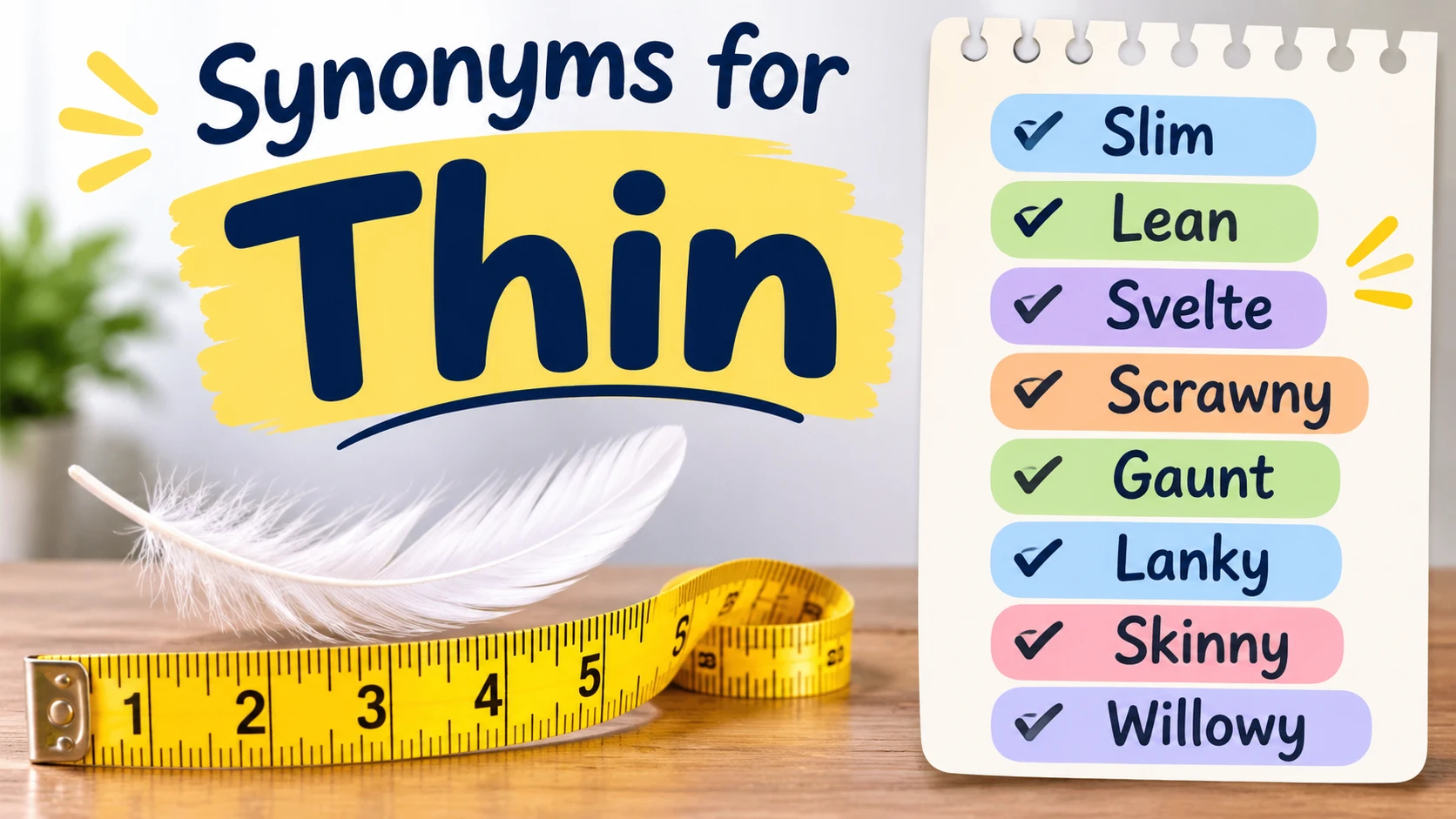
Table of 16 Synonyms for Thin
| No. | Synonym | Part of Speech | Simple Meaning |
|---|---|---|---|
| 1 | Slim | Adjective | Attractively thin |
| 2 | Slender | Adjective | Gracefully thin and narrow |
| 3 | Skinny | Adjective | Very thin, often too thin |
| 4 | Lean | Adjective | Thin, with little fat |
| 5 | Lanky | Adjective | Tall, thin, and awkward |
| 6 | Gaunt | Adjective | Thin and tired-looking |
| 7 | Scrawny | Adjective | Thin and weak-looking |
| 8 | Slight | Adjective | Small and delicate in build |
| 9 | Svelte | Adjective | Elegantly slim |
| 10 | Emaciated | Adjective | Dangerously thin from hunger or illness |
| 11 | Narrow | Adjective | Small in width |
| 12 | Fine | Adjective | Very thin, like a thread |
| 13 | Sheer | Adjective | So thin you see through it |
| 14 | Sparse | Adjective | Thin in amount, with gaps |
| 15 | Wispy | Adjective | Thin, light, and in small strands |
| 16 | Watery | Adjective | Thin and runny, like diluted liquid |
Table of Contents
- Introduction
- Table of 16 Synonyms for Thin
- Quick Facts About Thin
- Meaning and Usage of Thin
- Grammar and Sentence Patterns for Thin
-
- Slim
-
- Slender
-
- Skinny
-
- Lean
-
- Lanky
-
- Gaunt
-
- Scrawny
-
- Slight
-
- Svelte
-
- Emaciated
-
- Narrow
-
- Fine
-
- Sheer
-
- Sparse
-
- Wispy
-
- Watery
- Choose the Right Synonym for Thin
- Thin Synonyms by Category
- Antonyms of Thin
- Words Commonly Confused with Thin
- Common Mistakes with Thin
- Writing Tips for Thin
- American vs. British English Notes for Thin
- Practice Exercises for Thin
- Frequently Asked Questions
- Quick Vocabulary Quiz on Thin
- Conclusion
Quick Facts About Thin
- Focus keyword: thin
- Part of speech: adjective (also a verb, as in “thin out the carrots”)
- Pronunciation: “thin,” with the “th” sound as in “think”
- IPA: /θɪn/
- Syllables: 1
- Origin: From Old English þynne, which meant “not thick.” It is related to words in other Germanic languages.
- Word forms: thinner, thinnest, thinly, thinness, thinned
- Formality: neutral
- Difficulty: easy
- CEFR level: A2
Meaning and Usage of Thin
Thin means having a small distance between two sides. It also means having little fat on the body. In a third sense, it describes something not dense, such as thin hair or thin soup.
People use it in many contexts:
- Bodies: “Her brother is tall and thin.”
- Objects: “The wall in our Karachi flat is paper thin.”
- Liquids and density: “The sauce was too thin.”
Examples:
- Kenji wore a thin jacket to the 3 °C morning market in Sapporo.
- The soup tasted thin, so Aisha added 2 spoons of cream.
Grammar and Sentence Patterns for Thin
Basic patterns:
- be + thin: “My cousin is thin.”
- look / seem / get + thin: “You look thin after your trip.”
- thin + noun: “a thin blanket”
- thin (verb) + out: “Thin out the seedlings.”
Common pairings:
- thin on top (hair): “My uncle Raza is going thin on top.”
- thin from + cause: “He grew thin from months of hard training.”
- thin in the face: “She looked thin in the face after the flu.”
- too thin for + noun: “This coat is too thin for January in Toronto.”
- thin enough to + verb: “The paper was thin enough to read through.”
Frequent mistake: Learners say “more thin.” The correct form is thinner. One-syllable adjectives usually take -er.
1. Slim
Meaning: Slim describes a body that is attractively thin.
Examples:
- Priya looked slim in her navy suit at the Mumbai wedding.
- Hamza bought a slim laptop that weighs only 1.1 kg.
Best Used When: You want a polite, positive word for a body or a design.
Tone: Positive, neutral
Common Collocations: slim figure, slim fit, slim chance
2. Slender
Meaning: Slender describes something long, narrow, and graceful.
Examples:
- A slender birch tree stood beside Grandma’s cottage in Oslo.
- Elena held a slender glass with 150 ml of sparkling water.
Best Used When: You describe elegant people, fingers, trees, or objects.
Tone: Graceful, slightly formal
Common Collocations: slender fingers, slender neck, slender margin
3. Skinny
Meaning: Skinny means very thin, sometimes too thin.
Examples:
- Tom was a skinny 14-year-old when he joined the Leeds football club.
- Sana wore skinny jeans on a 9-hour flight to Doha.
Best Used When: You talk casually about clothes, drinks, or friends you know well.
Tone: Casual (can sound rude about a person)
Common Collocations: skinny jeans, skinny kid, skinny latte
4. Lean
Meaning: Lean means thin with little fat, often in a fit, healthy way.
Examples:
- Marcus, a 35-year-old sprinter from Kingston, has a lean build.
- The butcher in Lahore sold lean beef with under 10% fat.
Best Used When: You talk about athletes, muscles, or meat.
Tone: Neutral, positive
Common Collocations: lean muscle, lean meat, lean body
5. Lanky
Meaning: Lanky means tall, thin, and a little awkward in movement.
Examples:
- Ben, a lanky 6-foot-4 student, bumped his head on a doorframe in Dublin.
- Our lanky goalkeeper Ravi reached the top corner with ease.
Best Used When: You describe tall, thin teenagers or sportspeople in a friendly way.
Tone: Casual, playful
Common Collocations: lanky teenager, lanky frame, lanky legs
6. Gaunt
Meaning: Gaunt means very thin, with a tired or sick-looking face.
Examples:
- After 3 weeks of flu, Mr. Okafor looked gaunt.
- The gaunt traveler reached the Himalayan village at midnight.
Best Used When: You describe a person who looks worn out by illness, worry, or hardship.
Tone: Serious, literary
Common Collocations: gaunt face, gaunt figure, look gaunt
7. Scrawny
Meaning: Scrawny means thin and weak-looking.
Examples:
- A scrawny stray cat curled up outside a bakery in Istanbul.
- At 12, Leo was scrawny, but he could lift 40 kg by age 16.
Best Used When: You describe small animals, chickens, or young kids in a casual way.
Tone: Informal, often negative
Common Collocations: scrawny chicken, scrawny kid, scrawny neck
8. Slight
Meaning: Slight describes a small, delicate body.
Examples:
- Amina’s slight frame hid a powerful voice in the Cairo choir.
- Though slight, Mr. Chen won 3 judo medals in Osaka.
Best Used When: You describe a small, light build without judging it.
Tone: Neutral, polite
Common Collocations: slight build, slight figure, slight frame
9. Svelte
Meaning: Svelte means smoothly slim and stylish.
Examples:
- At 70, Rosa stayed svelte by swimming 30 laps every morning.
- The svelte sports car slid through the streets of Monaco.
Best Used When: You want a stylish compliment for a person or a sleek object.
Tone: Formal, admiring
Common Collocations: svelte figure, svelte design, svelte model
10. Emaciated
Meaning: Emaciated means extremely thin because of hunger or illness.
Examples:
- Rescuers found an emaciated horse near a farm outside Lahore.
- After 40 days lost at sea, the sailor was emaciated.
Best Used When: You describe a serious health or hunger situation, such as in news or medical writing.
Tone: Serious, clinical
Common Collocations: emaciated body, emaciated animal, look emaciated
11. Narrow
Meaning: Narrow means thin in width, and it is not used for body fat. (Related term, not a direct synonym of thin for people.)
Examples:
- The narrow lane in Venice is only 1 meter wide.
- Tariq walked along a narrow path in the Hunza valley.
Best Used When: You describe roads, paths, doors, or spaces.
Tone: Neutral
Common Collocations: narrow street, narrow escape, narrow margin
12. Fine
Meaning: Fine means very thin and delicate, like thread or hair.
Examples:
- Sofia sewed with fine thread only 0.2 mm wide.
- Baby Ali has soft, fine hair.
Best Used When: You describe hair, thread, sand, or lines.
Tone: Neutral
Common Collocations: fine hair, fine powder, fine line
13. Sheer
Meaning: Sheer means so thin that you can see through it. (Here, only this fabric sense is a synonym of thin.)
Examples:
- Nadia wore a sheer scarf in Dubai’s summer heat.
- The sheer curtains in room 12 let the sunlight in.
Best Used When: You describe fabric, stockings, or curtains.
Tone: Neutral, fashion-related
Common Collocations: sheer fabric, sheer curtains, sheer tights
14. Sparse
Meaning: Sparse means thinly spread, with gaps. (Related term, used for amount or density.)
Examples:
- Mr. Davies’ hair grew sparse after he turned 55.
- The Gobi Desert has only sparse grass.
Best Used When: You describe hair, plants, or population that is not thick or full.
Tone: Neutral, slightly formal
Common Collocations: sparse hair, sparse population, sparse vegetation
15. Wispy
Meaning: Wispy means thin, light, and in small, loose strands. (Related term, used for hair, clouds, and smoke.)
Examples:
- Wispy clouds floated over Mount Fuji at 6 a.m.
- Grandma Helen’s wispy white hair moved in the breeze.
Best Used When: You paint a soft, delicate picture.
Tone: Literary, gentle
Common Collocations: wispy hair, wispy clouds, wispy smoke
16. Watery
Meaning: Watery means thin and runny, like a liquid with too much water. (Related term, close to thin only for liquids.)
Examples:
- The soup at the 2 a.m. diner in Chicago was watery.
- Zara’s watery paint dripped down the 3-meter wall.
Best Used When: You criticize a sauce, soup, paint, or drink that is too thin.
Tone: Casual, often negative
Common Collocations: watery soup, watery sauce, watery coffee
Choose the Right Synonym for Thin
| If you mean… | Use this word |
|---|---|
| A graceful, attractive body | Slender |
| A friendly compliment on someone’s body | Slim |
| A fit, muscular, low-fat body | Lean |
| A very thin person who looks unwell | Gaunt |
| A road or path with small width | Narrow |
| Fabric you can see through | Sheer |
| A runny soup or sauce | Watery |
| Hair with gaps | Sparse |
Thin Synonyms by Category
Body (positive or neutral): slim, slender, svelte, lean, slight Use these when you want to sound kind or neutral.
Body (very thin or unhealthy): skinny, scrawny, gaunt, emaciated, lanky Use these carefully. Most sound negative or serious.
Width and objects: narrow, fine, sheer This group fits roads, thread, and fabric.
Hair and density: sparse, wispy, fine Pick these for hair, clouds, grass, or crowds.
Liquids: watery Use it for soup, sauce, paint, and drinks.
Antonyms of Thin
| # | Antonym | Simple Meaning | Example |
|---|---|---|---|
| 1 | Thick | Large distance between sides | Dev ate a thick slice of bread. |
| 2 | Fat | Having a lot of body fat | The fat cat slept on the sofa in Madrid. |
| 3 | Stout | Strong and somewhat heavy | The stout baker lifted 20 kg of flour. |
| 4 | Broad | Wide | Lina crossed the broad river at 7 a.m. |
| 5 | Dense | Closely packed | A dense forest covers 60% of the island. |
| 6 | Plump | Pleasantly rounded | The plump baby in Seoul laughed loudly. |
| 7 | Heavy | Weighing a lot | Omar carried a heavy 25 kg bag. |
Related Expressions: thin air, on thin ice, spread yourself too thin, thin on the ground, a thin line between
Word Family: thinness (noun), thin (verb), thinly (adverb), thinner and thinnest (comparative and superlative)
Words Commonly Confused with Thin
Tin
Difference: Tin is a soft metal, or a metal container. It is not a description of size.
Example: Grandma stores cookies in a tin from Edinburgh.
Thing
Difference: Thing means an object or idea. Learners sometimes mix up the endings because the words look and sound similar.
Example: The best thing about Paris is its bakeries.
Thick
Difference: Thick is the opposite of thin, so it never replaces it.
Example: Wear a thick coat in Moscow in January.
Light
Difference: Light talks about weight, while thin talks about width or body shape. A thin book can be heavy.
Example: My 2 kg backpack feels light.
Common Mistakes with Thin
Mistake: She is more thin than her sister.
Correction: She is thinner than her sister.
Why: Short adjectives usually add -er for comparison.
Mistake: We drove along a thin road.
Correction: We drove along a narrow road.
Why: Roads have width, so we say narrow.
Mistake: I told Maya she looks skinny, but she felt hurt.
Correction: I told Maya she looks slim.
Why: Skinny can sound negative, so slim is safer for compliments.
Mistake: This is the thiner blanket.
Correction: This is the thinner blanket.
Why: Double the final n after a short vowel before adding -er.
Writing Tips for Thin
- Emails: Choose a neutral tone. “Please use a fine pen” is clear and polite.
- Essays: Pick precise, formal words. “The country has a sparse population” sounds academic.
- Blog posts: Use friendly, vivid words. “A slim laptop that fits any bag” is natural.
- Stories: Use sensory, literary words. “Wispy clouds” and “a gaunt face” paint a picture.
- Social media: Keep it light. “Skinny jeans for the win!” fits a casual post.
American vs. British English Notes for Thin
There is no real difference in meaning or pronunciation for thin and its synonyms between American and British English.
Practice Exercises for Thin
- Fill in the blank: The soup was too ____ (runny liquid).
- Fill in the blank: After the long illness, Mr. Khan looked ____ (very thin and tired).
- Rewrite: Replace “thin” with a better word: “We walked down a thin street.”
- Rewrite: Replace “thin” with a gentle compliment: “My aunt has a thin figure.”
- Match: Link each word to its meaning.
- a. Sheer
- b. Lanky
- c. Sparse
- d. Scrawny
-
- Tall and awkwardly thin
-
- Thin and weak-looking
-
- See-through
-
- Thinly spread, with gaps
Frequently Asked Questions
What is another word for thin?
Slim is the most common alternative for a person. For objects, use narrow, fine, or sheer. For liquids, use watery. The right word depends on what you describe, so think about the context first.
What is the closest synonym for thin?
Slim is usually the closest. It keeps the idea of little body width and adds a positive feeling. Slender is similar but sounds more graceful and formal. Both work well for people, trees, and objects.
Can I say “skinny” to compliment someone?
It is risky. Many people hear skinny as too thin or unhealthy. Slim, slender, or lean are safer choices. Use skinny only with close friends or for clothes, such as skinny jeans.
Is thin formal or informal?
Thin is neutral, so you can use it in emails, essays, and conversation. Some synonyms change the tone: skinny and scrawny are casual, while svelte and emaciated are more formal or serious.
What is the opposite of thin?
The most common opposite is thick, especially for objects. For bodies, fat, stout, and plump are common, though they can sound harsh. For density, dense is a good opposite, as in a dense forest.
Why does my teacher say “thin road” sounds wrong?
Thin usually describes thickness or body shape, while roads have width. English speakers say a narrow road instead. This small collocation rule helps your writing sound natural.
Quick Vocabulary Quiz on Thin
- Which word fits a very thin, unwell-looking traveler? A) Slim B) Gaunt C) Sheer D) Narrow
- Which word describes a see-through curtain? A) Sparse B) Lean C) Sheer D) Lanky
- Which word best describes a runny soup? A) Watery B) Svelte C) Slender D) Wispy
- Which word describes a tall, thin, awkward teenager? A) Fine B) Slight C) Lanky D) Lean
- Which word fits a path only one meter wide? A) Narrow B) Emaciated C) Scrawny D) Svelte
Conclusion
Synonyms for thin make your vocabulary richer and your writing sharper. Slim, gaunt, narrow, and watery all describe “thin,” but each paints a different picture. Context decides which one is right, so always ask what you are describing.
Try these words in your emails, essays, articles, and conversations.
30-second challenge: Write 3 sentences today using 3 different synonyms from this list.
Small words, used well, make a big difference.