Featured Snippet Answer
The closest synonym for “came” is “arrived.” Both words describe reaching a place or moment in the past tense. “Arrived” works well in most situations, from formal writing to casual conversation, making it a safe and natural replacement for “came” in almost any sentence
Have you ever written the word “came” three times in one paragraph? It happens to everyone. Maybe you wrote, “She came home. Then her brother came too. Later, the mail came.”
That’s a lot of “came” for one story. Learning synonyms for came can fix this problem fast.
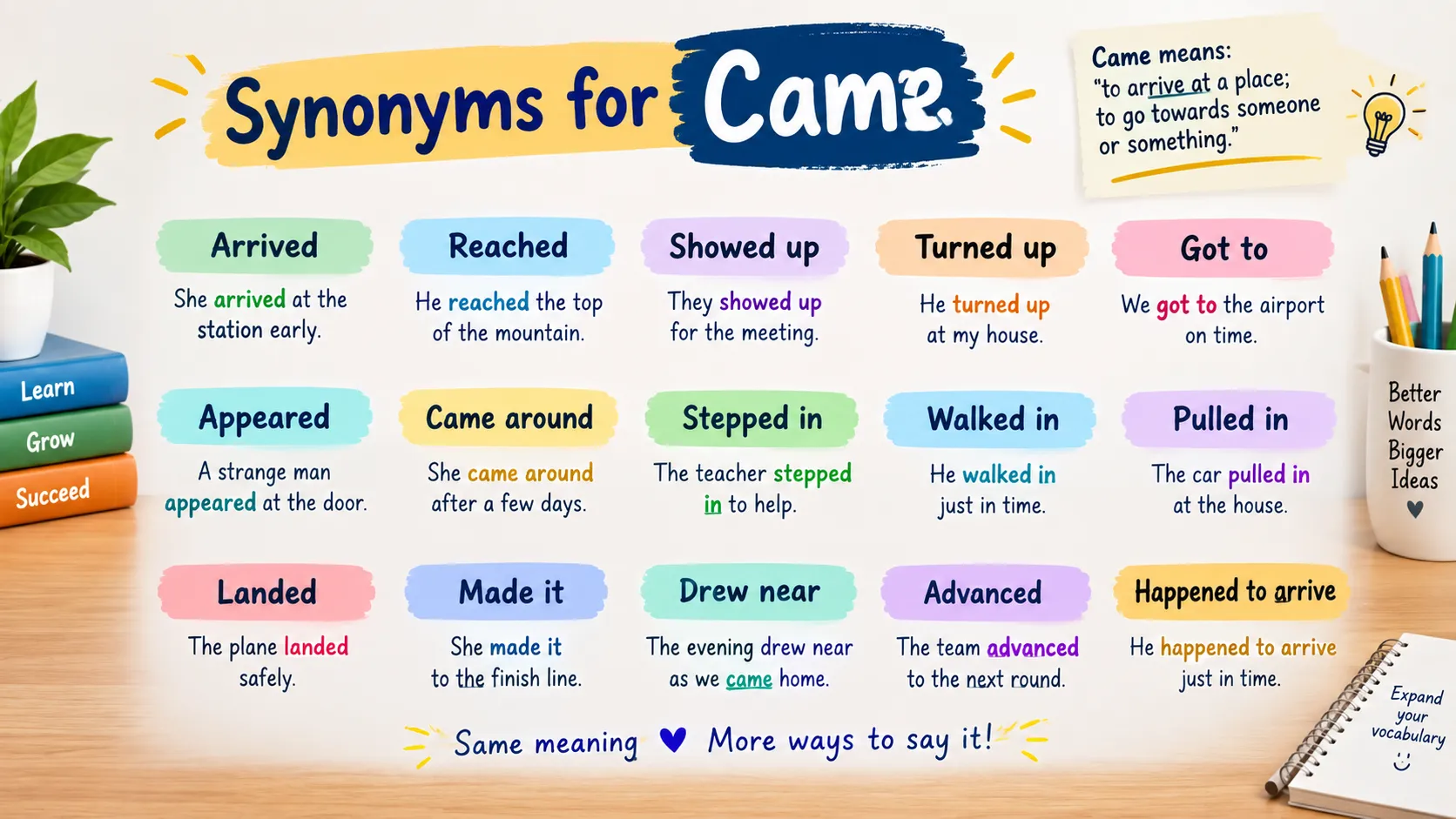
“Came” is the past tense of “come.” It simply means someone or something arrived or reached a place. But English has many other words that say the same thing with more color and detail. Using different synonyms for came makes your writing sound more natural and interesting to read.
Synonyms for Came
| # | Synonym | Relationship | Direct Replacement | Difficulty | Best Used For |
| 1 | Arrived | Exact synonym | Yes | Beginner | Daily conversation, writing |
| 2 | Appeared | Near synonym | Sometimes | Beginner | Storytelling |
| 3 | Showed up | Contextual alternative | Yes | Beginner | Casual conversation |
| 4 | Turned up | Contextual alternative | Yes | Intermediate | Casual conversation |
| 5 | Reached | Near synonym | Sometimes | Beginner | Travel, directions |
| 6 | Approached | Near synonym | Sometimes | Intermediate | Descriptive writing |
| 7 | Entered | Contextual alternative | Sometimes | Beginner | Formal writing |
| 8 | Emerged | Near synonym | Sometimes | Intermediate | Literary writing |
| 9 | Landed | Contextual alternative | Sometimes | Beginner | Travel writing |
| 10 | Arrived at | Contextual alternative | Yes | Beginner | Academic writing |
| 11 | Descended | Related term | No | Advanced | Literary writing |
| 12 | Materialized | Related term | No | Advanced | Creative writing |
| 13 | Popped up | Contextual alternative | Sometimes | Beginner | Casual conversation |
| 14 | Rolled in | Contextual alternative | Sometimes | Intermediate | Casual, weather |
| 15 | Pulled up | Contextual alternative | Sometimes | Intermediate | Casual, vehicles |
| 16 | Made it | Contextual alternative | Yes | Beginner | Daily conversation |
| 17 | Got here/there | Contextual alternative | Yes | Beginner | Daily conversation |
| 18 | Journeyed | Related term | No | Advanced | Literary writing |
| 19 | Visited | Related term | No | Intermediate | Descriptive writing |
| 20 | Surfaced | Related term | No | Advanced | Literary, figurative use |
Table of Contents
- Arrived
- Appeared
- Showed Up
- Turned Up
- Reached
- Approached
- Entered
- Emerged
- Landed
- Made It
Quick Facts About Came
- Focus keyword: came
- Part of speech: verb (past tense of “come”)
- Simple pronunciation: kaym
- Number of syllables: 1
- Word origin: From Old English “cuman,” meaning to move toward or arrive
- Other word forms: come (present), coming (present participle), comes (third person singular)
- Formality level: Neutral (used in both formal and informal English)
- Difficulty level: Beginner
Meaning and Usage of Came
“Came” means someone or something arrived or moved toward a place. It is the simple past tense of “come.”
We use it to talk about a past arrival, event, or change. For example: “The rain came suddenly” or “He came to the meeting late.”
It’s also used in phrases like “came to realize” (started to understand) or “came across” (found by chance). These phrasal forms add extra meaning beyond simple arrival.
Examples:
- “The bus came ten minutes late.”
- “Good news came from the doctor this morning.”
1. Arrived: A Synonym for Came
Relationship: Exact synonym
Direct Replacement: Yes
Difficulty Level: Beginner
Meaning: To reach a destination or place.
Difference: “Arrived” sounds slightly more formal than “came” but means exactly the same thing in most contexts.
Best Used For: Daily conversation, business writing, academic writing
Examples:
- “My package finally arrived after two weeks of waiting.”
- “By the time we arrived at the theater, the movie had already started.”
2. Appeared: A Synonym for Came
Relationship: Near synonym
Direct Replacement: Sometimes
Difficulty Level: Beginner
Meaning: To become visible or suddenly present.
Difference: “Appeared” focuses on something becoming visible, while “came” simply means arriving. Not every arrival is sudden or visual.
Best Used For: Storytelling, creative writing
Examples:
- “A strange light appeared on the horizon just before sunset.”
- “Her old friend appeared at the door, holding a bouquet of flowers.”
3. Showed Up: A Synonym for Came
Relationship: Contextual alternative
Direct Replacement: Yes
Difficulty Level: Beginner
Meaning: To arrive somewhere, often unexpectedly or informally.
Difference: “Showed up” is casual and often implies a surprise or lack of planning, unlike the neutral tone of “came.”
Best Used For: Casual conversation, daily conversation
Examples:
- “He showed up an hour late without even calling first.”
- “My cousin showed up at the party without an invitation.”
4. Turned Up: A Synonym for Came
Relationship: Contextual alternative
Direct Replacement: Yes
Difficulty Level: Intermediate
Meaning: To arrive, often unexpectedly.
Difference: Similar to “showed up,” this phrase is informal and works best in spoken English rather than formal writing.
Best Used For: Casual conversation
Examples:
- “The lost dog turned up three days later, tired but safe.”
- “Guess who turned up at my office today? My old college roommate.”
5. Reached: A Synonym for Came
Relationship: Near synonym
Direct Replacement: Sometimes
Difficulty Level: Beginner
Meaning: To get to a place or point after traveling.
Difference: “Reached” often emphasizes effort or distance traveled, while “came” is more neutral.
Best Used For: Travel writing, academic writing
Examples:
- “We reached the summit just as the sun was rising.”
- “The letter finally reached her after being lost in the mail.”
6. Approached: A Synonym for Came
Relationship: Near synonym
Direct Replacement: Sometimes
Difficulty Level: Intermediate
Meaning: To move closer to something or someone.
Difference: “Approached” describes the process of getting closer, while “came” can describe the completed action of arrival.
Best Used For: Descriptive writing, literature
Examples:
- “A stranger approached the counter and asked for directions.”
- “As winter approached, the town began preparing for snow.”
7. Entered: A Synonym for Came
Relationship: Contextual alternative
Direct Replacement: Sometimes
Difficulty Level: Beginner
Meaning: To come or go into a place.
Difference: “Entered” specifically means going inside a space, while “came” can refer to any kind of arrival, indoors or outdoors.
Best Used For: Formal writing, business writing
Examples:
- “The manager entered the room just as the meeting began.”
- “She entered the contest hoping to win first place.”
8. Emerged: A Synonym for Came
Relationship: Near synonym
Direct Replacement: Sometimes
Difficulty Level: Intermediate
Meaning: To come out from a hidden or enclosed place.
Difference: “Emerged” suggests coming from somewhere hidden, like water or shadows, which “came” does not necessarily imply.
Best Used For: Literary writing, creative writing
Examples:
- “The diver emerged from the water, gasping for air.”
- “New evidence emerged during the trial’s second week.”
9. Landed: A Synonym for Came
Relationship: Contextual alternative
Direct Replacement: Sometimes
Difficulty Level: Beginner
Meaning: To arrive, often by air, or to end up somewhere.
Difference: “Landed” is mostly used for flights or figurative arrivals, such as landing a job, unlike the general use of “came.”
Best Used For: Travel writing, daily conversation
Examples:
- “Our flight landed two hours later than expected.”
- “After months of searching, she finally landed a great job.”
10. Made It: A Synonym for Came
Relationship: Contextual alternative
Direct Replacement: Yes
Difficulty Level: Beginner
Meaning: To successfully arrive or achieve something.
Difference: “Made it” often carries a sense of achievement or relief, which plain “came” does not.
Best Used For: Daily conversation, casual writing
Examples:
- “We made it to the airport just in time for boarding.”
- “Despite the traffic, they made it to the wedding on time.”
Antonyms of Came
| # | Antonym | Simple Meaning | Example |
| 1 | Left | To go away from a place | “She left before anyone noticed.” |
| 2 | Departed | To leave, often formally | “The train departed right on schedule.” |
| 3 | Went | To move away or travel somewhere | “He went home after the show.” |
| 4 | Vanished | To disappear suddenly | “The cat vanished into the bushes.” |
| 5 | Exited | To go out of a place | “They exited the building calmly.” |
| 6 | Retreated | To move back or away | “The soldiers retreated at nightfall.” |
Words Commonly Confused with Came
Come
Difference: “Come” is the present tense form, while “came” is strictly past tense. Many learners mix these up in speech.
Example: “I come here every day” (present) versus “I came here yesterday” (past).
Became
Difference: “Became” means changing into something new, not arriving somewhere. It’s a different verb entirely, though it looks similar.
Example: “She became a doctor after years of study.”
Came to
Difference: This phrase can mean “arrived at” or “regained consciousness,” so context matters a lot here.
Example: “He came to after fainting on the stage.”
Overcame
Difference: “Overcame” means to successfully deal with a problem or difficulty, not to arrive physically anywhere.
Example: “She overcame her fear of public speaking.”
FAQs
What is another word for came?
“Arrived” is the most common and natural synonym for “came.” It means the same thing—reaching a place or moment in time—and fits smoothly into almost any sentence, whether formal or casual.
What is the closest synonym for came?
“Arrived” is the closest match because it shares the exact meaning and can replace “came” in nearly every context without changing the sentence’s tone or meaning.
Can I replace came with any synonym?
Not always. Words like “showed up” work in casual speech, but “entered” only fits when talking about going inside a place. Always check the context before choosing.
Is came formal or informal?
“Came” is neutral. It works fine in both formal writing and everyday conversation, unlike some synonyms that lean more casual or more formal.
What is the opposite of came?
The opposite of “came” is “left” or “departed,” since these words describe moving away from a place instead of arriving.
Which synonym is best for storytelling?
“Appeared” and “emerged” work well in storytelling because they add a sense of surprise or mystery that plain “came” doesn’t have.
Conclusion
Learning synonyms for came helps you avoid repeating the same word again and again. It also makes your writing feel more vivid and specific.
Words like “arrived,” “showed up,” and “emerged” each add their own shade of meaning. Choosing the right one depends on your context and tone.
Try using these new words in your next email, essay, or story. Small changes like this can make a big difference in how your writing sounds.