What Is Thick?
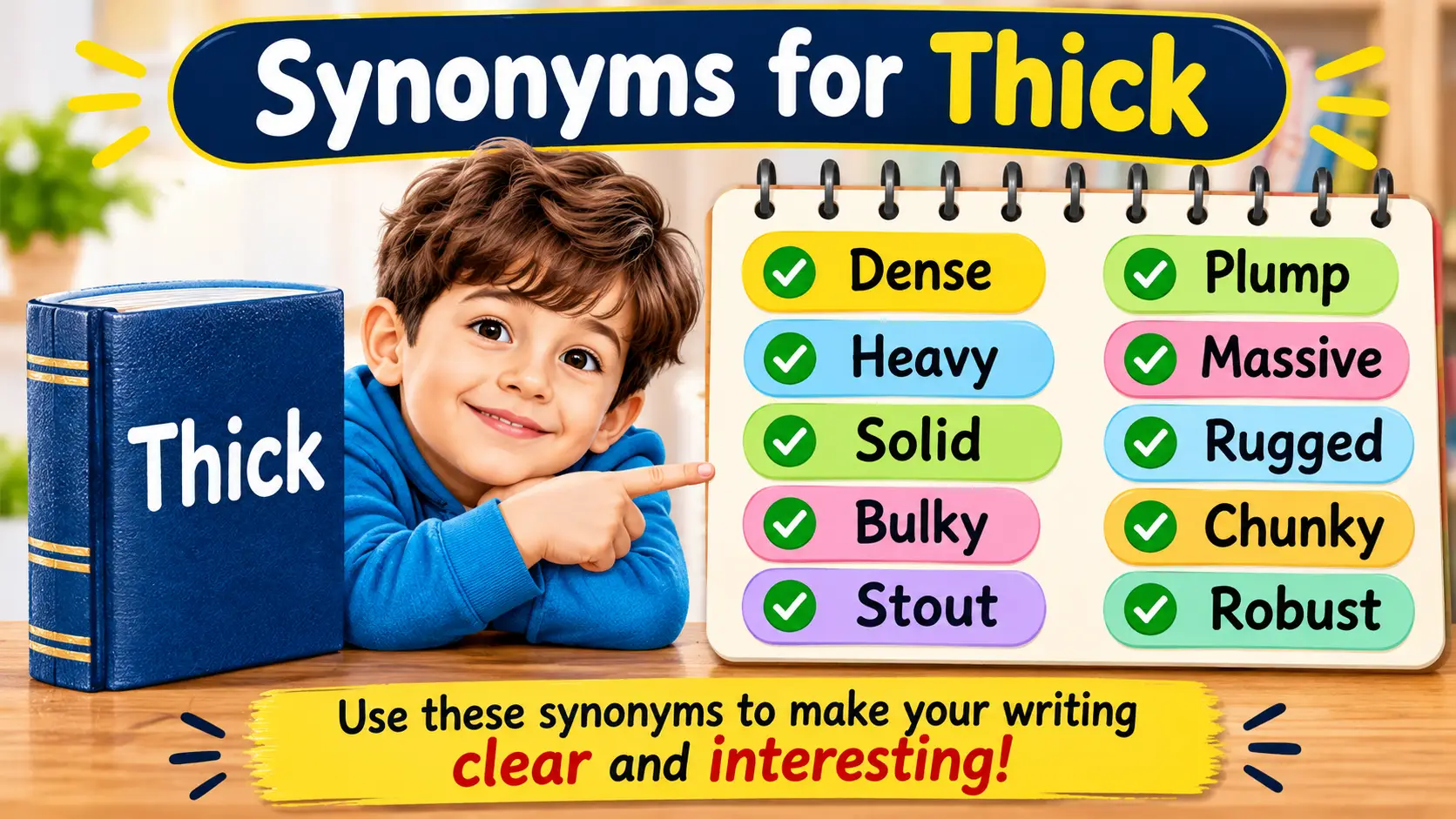
Thick means large in width from one side to the other, or dense and not runny. The closest synonyms are chunky, bulky, hefty, dense, and viscous. Each fits a different situation: chunky and hefty suit solid objects, dense suits crowds or fog, and viscous suits liquids.
Maya Patel stared at her blog draft. She had written “a thick soup” three times in one paragraph, and the soup from her grandmother’s kitchen in Leicester deserved better.
So she swapped in “hearty,” “chunky,” and “velvety.” Suddenly the soup came alive.
Thick is a useful word, but it is also a very busy one. It can describe a 5 cm book, a bowl of porridge, or a forest. Learning synonyms for thick helps you say exactly what you mean. It also keeps your writing fresh.
By the end, you will know 15 other words for thick and exactly when to use each one.
Table of 15 Synonyms for Thick
| No. | Synonym | Part of Speech | Simple Meaning |
|---|---|---|---|
| 1 | Chunky | Adjective | Thick and solid in shape |
| 2 | Bulky | Adjective | Large and thick, hard to carry |
| 3 | Hefty | Adjective | Thick, heavy, and solid |
| 4 | Stout | Adjective | Thick and strong |
| 5 | Fat | Adjective | Wide from side to side |
| 6 | Broad | Adjective | Wide across |
| 7 | Wide | Adjective | Large from side to side |
| 8 | Heavy | Adjective | Thick and of great weight |
| 9 | Substantial | Adjective | Large, solid, and strong |
| 10 | Dense | Adjective | Packed closely together |
| 11 | Bushy | Adjective | Thick and full, like hair |
| 12 | Lush | Adjective | Thick, green, and healthy |
| 13 | Viscous | Adjective | Thick and slow-flowing |
| 14 | Gloopy | Adjective | Thick and sticky (informal) |
| 15 | Concentrated | Adjective | Strong, with little water |
Table of Contents
- Introduction
- Table of 15 Synonyms for Thick
- Quick Facts About Thick
- Meaning and Usage of Thick
- Grammar and Sentence Patterns for Thick
-
- Chunky
-
- Bulky
-
- Hefty
-
- Stout
-
- Fat
-
- Broad
-
- Wide
-
- Heavy
-
- Substantial
-
- Dense
-
- Bushy
-
- Lush
-
- Viscous
-
- Gloopy
-
- Concentrated
- Choose the Right Synonym for Thick
- Thick Synonyms by Category
- Antonyms of Thick
- Words Commonly Confused with Thick
- Common Mistakes with Thick
- Writing Tips for Thick
- American vs. British English Notes for Thick
- Practice Exercises for Thick
- Frequently Asked Questions
- Quick Vocabulary Quiz on Thick
- Conclusion
Quick Facts About Thick
- Focus keyword: thick
- Part of speech: adjective (also an adverb and a noun)
- Simple pronunciation: thik
- IPA: /θɪk/
- Syllables: 1
- Word origin: It comes from Old English þicce, meaning “dense” or “not thin.”
- Other word forms: thicker, thickest, thickly, thickness, thicken, thickener
- Formality level: neutral
- Difficulty level: easy
- CEFR level: A2
Meaning and Usage of Thick
Thick has three main meanings. First, it describes something with a large distance between its two sides, such as a thick book. Second, it describes liquids that do not flow easily, such as thick gravy. Third, it describes things packed closely together, such as thick fog or thick hair.
You will see it in everyday talk, recipes, and descriptions of nature.
- The steak was almost 4 cm thick.
- Thick fog covered the Golden Gate Bridge by 7 a.m.
A note on slang: In informal British English, thick can also mean “not clever.” This can sound rude, and it is not a true synonym of the meanings above. This article focuses on the physical meanings only.
Grammar and Sentence Patterns for Thick
Thick is an adjective. It usually comes before a noun, or after a linking verb like is or looks.
Basic pattern: subject + be + thick, or thick + noun.
- The walls are thick.
- She wore a thick scarf.
Pairings readers must get right:
- Number + unit + thick: The ice was 10 cm thick.
- Thick with + noun: The air was thick with smoke.
- Thick as + noun (idiom): Tom and Ali are as thick as thieves, meaning very close friends.
- Thick + noun: Priya ordered a thick milkshake.
- Thicker / thickest: This is the thickest blanket we own.
Frequent mistake: Learners say “thick of 5 cm.” The correct form is “5 cm thick.”
1. Chunky
Meaning: Chunky describes something thick and solid, often with visible pieces.
Examples:
- Grandma Rosa’s chunky vegetable soup had 6 kinds of vegetables.
- Leo bought a chunky knit sweater in Edinburgh for £45.
Best Used When: You describe food with pieces, or heavy, thick fabric.
Tone: Casual, friendly
Common Collocations: chunky soup, chunky sweater, chunky jewelry
2. Bulky
Meaning: Bulky describes something large and thick that takes up a lot of space.
Examples:
- Hana struggled to fit her bulky winter coat into a small locker in Toronto.
- The bulky parcel weighed 8 kilograms.
Best Used When: Size and awkwardness matter more than weight.
Tone: Neutral
Common Collocations: bulky coat, bulky package, bulky furniture
3. Hefty
Meaning: Hefty describes something thick, heavy, and solid.
Examples:
- Carlos carried a hefty dictionary to his class in Madrid.
- The hefty cable was 3 cm wide.
Best Used When: You want to stress both thickness and weight.
Tone: Informal, slightly humorous
Common Collocations: hefty book, hefty bill, hefty slice
4. Stout
Meaning: Stout describes something thick and strong, built to last.
Examples:
- Farmer Joe tied the gate with a stout rope.
- A stout oak post, 12 inches across, held up the barn in Vermont.
Best Used When: You want to show strength and sturdiness.
Tone: Formal, slightly old-fashioned
Common Collocations: stout walking stick, stout wall, stout branch
5. Fat
Meaning: Fat describes an object that is wide from one side to the other.
Examples:
- Nina read a fat novel of 900 pages on her flight to Dubai.
- He sharpened a fat pencil for his little brother, Sam.
Best Used When: You describe objects like books, pencils, or envelopes.
Tone: Casual (it can be rude if used about people)
Common Collocations: fat book, fat envelope, fat marker
6. Broad
Meaning: Broad describes something wide across, often in a pleasing or strong way.
Examples:
- The broad oak table in Aunt Mei’s kitchen seats 10 people.
- Marcus has broad shoulders from years of rowing on the Thames.
Best Used When: You describe width, not depth, especially in bodies and objects.
Tone: Neutral
Common Collocations: broad shoulders, broad river, broad smile
7. Wide
Meaning: Wide describes something with a large distance from side to side.
Examples:
- The wide belt measured 6 cm.
- Sofia painted a wide stripe down the middle of the road sign in Lima.
Best Used When: You need a plain, simple word for width.
Tone: Neutral
Common Collocations: wide belt, wide road, wide gap
8. Heavy
Meaning: Heavy describes something thick in a way that feels weighty or hard to move through.
Examples:
- Ben wore heavy boots in the 2 feet of snow in Montana.
- A heavy blanket kept little Ava warm all night.
Best Used When: Clothes, fabric, smoke, or rain feel thick and weighty.
Tone: Neutral
Common Collocations: heavy coat, heavy rain, heavy smoke
9. Substantial
Meaning: Substantial describes something large, solid, and well made.
Examples:
- The substantial stone wall around the castle in Wales is 2 meters thick.
- Olivia ate a substantial breakfast of eggs, toast, and beans.
Best Used When: You want a formal word for solid and impressive.
Tone: Formal
Common Collocations: substantial wall, substantial meal, substantial amount
10. Dense
Meaning: Dense describes things packed closely together so it is hard to see or move through.
Examples:
- Dense fog closed Heathrow Airport for 3 hours.
- Omar got lost in the dense forest near Seattle.
Best Used When: You describe fog, crowds, forests, or smoke.
Tone: Neutral, slightly formal
Common Collocations: dense fog, dense forest, dense crowd
11. Bushy
Meaning: Bushy describes hair, fur, or plants that grow thick and full.
Examples:
- Grandpa Ken has bushy eyebrows and a laugh you can hear from Chicago.
- The fox in the Yorkshire hills had a bushy tail.
Best Used When: You describe hair, beards, tails, or garden plants.
Tone: Casual, descriptive
Common Collocations: bushy eyebrows, bushy beard, bushy tail
12. Lush
Meaning: Lush describes plants that are thick, green, and healthy.
Examples:
- After 3 weeks of rain, the lawn in Cork looked lush.
- Zara photographed the lush jungle in Costa Rica.
Best Used When: You describe rich, healthy plant growth.
Tone: Positive, literary
Common Collocations: lush garden, lush forest, lush green grass
13. Viscous
Meaning: Viscous describes a liquid that is thick and flows slowly.
Examples:
- The lab report said the oil became viscous at 5 degrees Celsius.
- Dr. Lin tested a viscous syrup at a food plant in Osaka.
Best Used When: You write about science, cooking, or technical topics.
Tone: Formal, technical
Common Collocations: viscous liquid, viscous oil, viscous fluid
14. Gloopy
Meaning: Gloopy describes a liquid or sauce that is thick, sticky, and a bit messy.
Examples:
- The gloopy porridge stuck to Jack’s spoon at a hostel in Glasgow.
- Mum’s gloopy paint covered 2 brushes.
Best Used When: You describe messy food or paint in a playful way.
Tone: Very informal, playful
Common Collocations: gloopy sauce, gloopy mud, gloopy paint
15. Concentrated
Meaning: Concentrated describes a liquid that is strong and thick because it has little water.
Examples:
- Chef Aiko used concentrated tomato paste to make the sauce richer.
- The label said to mix 1 part concentrated juice with 4 parts water.
Best Used When: You describe juices, sauces, or cleaning products.
Tone: Neutral, technical
Common Collocations: concentrated juice, concentrated paste, concentrated formula
Choose the Right Synonym for Thick
| If you mean… | Use this word |
|---|---|
| A soup or stew with visible pieces | Chunky |
| A large, awkward coat or package | Bulky |
| A heavy, solid book or object | Hefty |
| A strong, sturdy wall or rope | Stout |
| Fog, smoke, or a forest packed tightly | Dense |
| Full, healthy plants or green grass | Lush |
| A slow-flowing liquid in a science text | Viscous |
| A formal word for solid and large | Substantial |
Thick Synonyms by Category
Size and shape (objects)
- Chunky, bulky, hefty, fat, stout, broad, wide
- Best when you describe how big or solid something is.
Weight and strength
- Heavy, substantial, stout
- Best when thickness suggests power or durability.
Packed and full (nature and hair)
- Dense, bushy, lush
- Best for fog, forests, eyebrows, and gardens.
Liquids and food
- Viscous, gloopy, concentrated, chunky
- Best for sauces, soups, paint, and science writing.
Antonyms of Thick
| # | Antonym | Simple Meaning | Example |
|---|---|---|---|
| 1 | Thin | Small distance from side to side | Ellie wore a thin jacket in Miami. |
| 2 | Slim | Pleasantly narrow or slender | The slim phone was only 7 mm deep. |
| 3 | Narrow | Small in width | The narrow lane in Lisbon fits one car. |
| 4 | Sparse | Few and far apart | Dad has sparse hair at the front. |
| 5 | Runny | Flowing easily like water | The runny sauce dripped off Ravi’s plate. |
| 6 | Watery | Containing too much water | Her tea at the station cafe was watery. |
| 7 | Fine | Very thin in size | Use fine thread for a 2 mm stitch. |
| 8 | Light | Not heavy or dense | A light mist covered the hills. |
Related Expressions: thick as thieves, through thick and thin, thick-skinned, in the thick of things, a thick accent
Word Family: thicken (verb), thickener (noun), thickness (noun), thickly (adverb), thicker and thickest (comparative and superlative)
Words Commonly Confused with Thick
Wide
Difference: Wide measures distance across a flat surface. Thick measures distance through an object, from one face to the other.
Example: The shelf is 30 cm wide and 3 cm thick.
Deep
Difference: Deep measures how far down something goes, like water or a hole. Thick describes layers or density.
Example: The pool in Sydney is 2 meters deep.
Dense
Difference: Dense means packed closely. A thin object can still be dense, like a small lead ball.
Example: A dense crowd filled the square in Rome.
Tick
Difference: Tick sounds almost the same to many learners. It means a small mark or a small bug, not something wide or dense.
Example: Please put a tick next to your name on the list.
Common Mistakes with Thick
Mistake: The wall is thick of 20 cm.
Correction: The wall is 20 cm thick.
Why: Put the number and unit before thick.
Mistake: The air was thick of smoke.
Correction: The air was thick with smoke.
Why: Use with after thick when you say what fills the space.
Mistake: The soup is very thickly.
Correction: The soup is very thick.
Why: After is, use the adjective thick, not the adverb thickly.
Mistake: She is thick, so she carried a thick suitcase.
Correction: She carried a bulky suitcase.
Why: Do not call people “thick” to describe their bodies, because it can sound rude or confusing.
Writing Tips for Thick
- Emails: Choose neutral or formal words like substantial. Example: “a substantial report of 40 pages.”
- Essays: Use precise words like dense or viscous. Example: “a dense layer of volcanic ash.”
- Blog posts: Use friendly words like chunky and hefty. Example: “a chunky, hearty stew.”
- Stories: Use vivid, literary words like lush and bushy. Example: “a lush, whispering forest.”
- Social media: Use playful, informal words like gloopy. Example: “gloopy cheese sauce on everything.”
American vs. British English Notes for Thick
The spelling and pronunciation of thick are the same in both varieties. Chunky and gloopy feel more common in British English, especially in cooking talk. Americans often say “thick” or “hearty” for the same ideas. In British English, thick can also be slang for “not clever,” so be careful in casual speech.
Practice Exercises for Thick
- Fill in the blank: The soup was full of vegetables, so it was very ______. (hint: has solid pieces)
- Fill in the blank: Tara could not see the road through the ______ fog. (hint: packed closely)
- Rewrite: Use a synonym for thick in this sentence: “He carried a thick book to class.”
- Rewrite: Use a synonym for thick in this sentence: “The thick sauce moved slowly.”
- Match each word to its meaning:
- Lush
- Bushy
- Viscous
- Bulky
- Hefty
a) Slow-flowing, like syrup b) Thick and green, like plants c) Heavy and solid d) Large and awkward to carry e) Thick and full, like eyebrows
Frequently Asked Questions
What is another word for thick?
Common words are chunky, bulky, hefty, dense, and viscous. The best choice depends on what you describe. Use chunky for food with pieces, dense for fog, and viscous for slow liquids. Pick the word that matches your situation.
What is the closest synonym for thick?
For objects, hefty and bulky are very close. Fr liquids, viscous is closest. Fr fog or forests, dense works best. No single word fits every meaning, so match the synonym to your context.
Can I replace thick with broad?
Sometimes. Broad means wide across, so it suits shoulders, rivers, and tables. It does not suit soup or fog. A broad belt is fine, but “broad gravy” sounds strange. Check the meaning before you swap.
Is thick formal or informal?
Thick is neutral. You can use it in emails, essays, and daily talk. Words like gloopy and hefty are more informal, while viscous and substantial sound more formal.
What is the opposite of thick?
The most common opposite is thin. Fr liquids, use runny or watery. Fr hair and plants, use sparse. For width, use narrow or slim.
Why does my friend get upset when I call her “thick”?
In British English, thick can mean “not smart,” which feels like an insult. Some people also use it about bodies. To be safe, describe objects, food, and nature with it, and use kinder words for people.
Quick Vocabulary Quiz on Thick
- Which word best describes a heavy winter coat that takes up lots of space? A) Runny B) Bulky C) Sparse D) Fine
- Which word suits a slow-flowing oil in a science report? A) Gloopy B) Lush C) Viscous D) Bushy
- Which word best describes a forest where you cannot see far? A) Dense B) Narrow C) Watery D) Light
- Which word fits eyebrows that grow thick and full? A) Concentrated B) Bushy C) Slim D) Wide
- Which word is the most formal for a large, solid meal? A) Gloopy B) Chunky C) Substantial D) Fat
Conclusion
Synonyms make your vocabulary richer and your writing clearer. Instead of repeating thick, you can choose words that show size, weight, texture, or strength. Context matters, because viscous belongs in a science report while chunky belongs in a recipe blog.
Practice these words in emails, essays, articles, and conversations.
30-second challenge: Write 3 sentences today, each using a different synonym from this list.
Small word choices make big differences. Keep practicing!