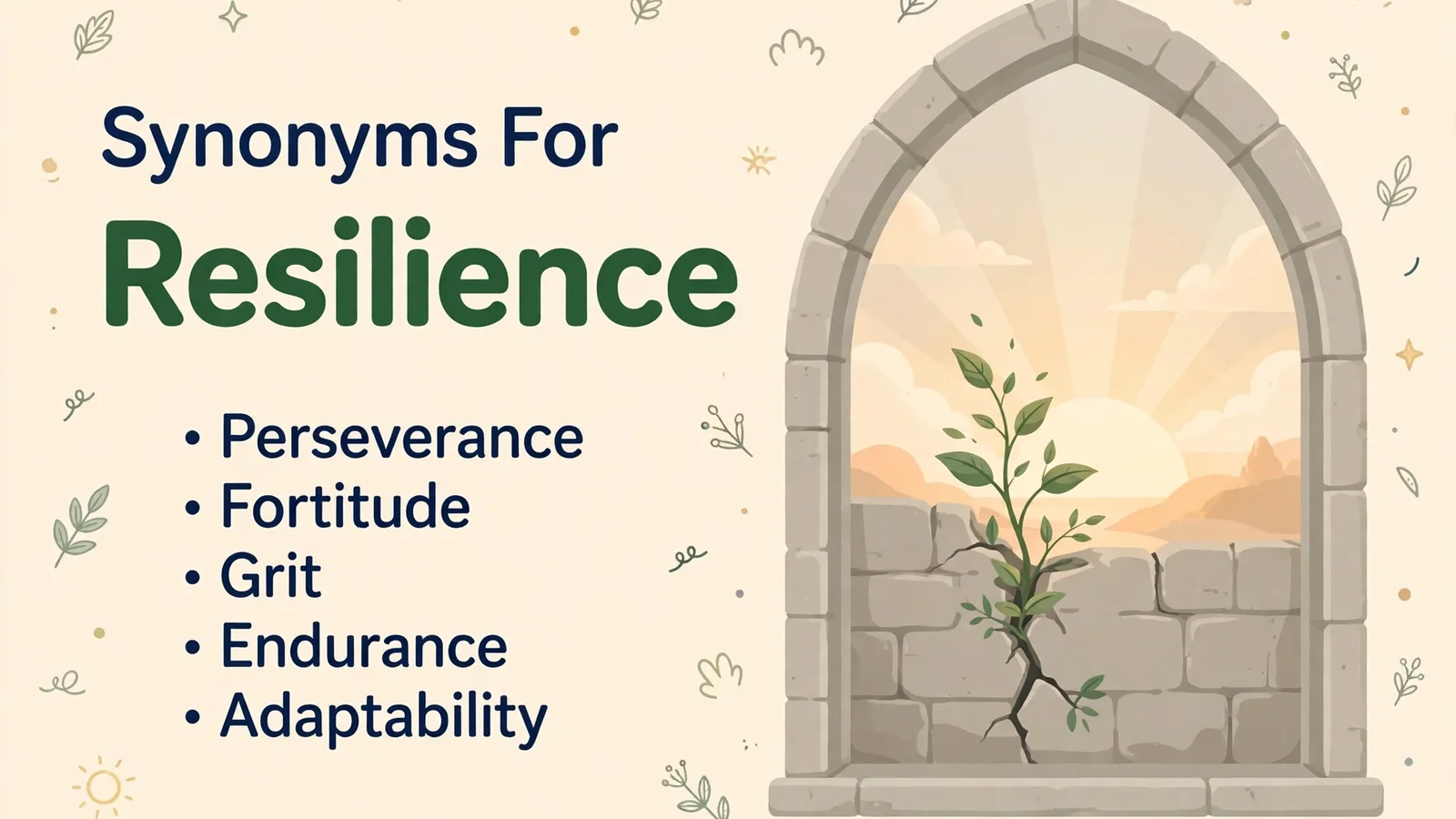
What Is Resilience?
Resilience is the ability to recover quickly after a hard time and keep going. It means you bend under pressure but you do not break. Toughness, strength, endurance, recovery, and grit are close words for it. A resilient person faces a setback, learns from it, and tries again with fresh hope.
Maya lost her job at a small bakery in Austin on a rainy Monday in March. She had worked there for three years, and the news hit her hard. For two days she stayed home and felt lost. Then she made a simple plan on a sheet of paper. She called three old customers, baked twelve loaves of bread, and sold them at a local market on Saturday. Her small stall grew week by week. Maya did not win because life was easy. She won because she kept going after a fall. By the end, you will know twelve strong words for resilience and pick the right one every time.
Table of 12 Synonyms for Resilience
| No. | Synonym | Part of Speech | Simple Meaning |
|---|---|---|---|
| 1 | toughness | noun | Strength to face hard times |
| 2 | strength | noun | Power of body or mind |
| 3 | flexibility | noun | Ability to bend without breaking |
| 4 | adaptability | noun | Skill to adjust to change |
| 5 | endurance | noun | Power to keep going long |
| 6 | recovery | noun | Return to a normal state |
| 7 | hardiness | noun | Ability to bear harsh conditions |
| 8 | elasticity | noun | Ability to stretch and return |
| 9 | buoyancy | noun | Cheerful spirit that stays afloat |
| 10 | grit | noun | Brave effort over a long time |
| 11 | stamina | noun | Energy to last through effort |
| 12 | fortitude | noun | Courage in pain or trouble |
Table of Contents
1. What Is Resilience? 2. Introduction 3. Table of 12 Synonyms for Resilience 4. Table of Contents 5. Quick Facts About Resilience 6. Meaning and Usage of Resilience 7. Grammar and Sentence Patterns for Resilience 8. Toughness 9. Strength 10. Flexibility 11. Adaptability 12. Endurance 13. Recovery 14. Hardiness 15. Elasticity 16. Buoyancy 17. Grit 18. Stamina 19. Fortitude 20. Choose the Right Synonym for Resilience 21. Resilience Synonyms by Category 22. Antonyms of Resilience 23. Words Commonly Confused with Resilience 24. Common Mistakes with Resilience 25. Writing Tips for Resilience 26. American vs. British English Notes for Resilience 27. Practice Exercises for Resilience 28. Frequently Asked Questions 29. Quick Vocabulary Quiz on Resilience 30. Conclusion
Quick Facts About Resilience
- Part of speech: noun
- Pronunciation: re-ZIL-ee-uhns
- Syllables: 4 (re-sil-i-ence)
- Origin: It comes from the Latin word resilire, which means “to spring back.” The idea is simple. A thing springs back to its first shape after it is bent or pressed.
- Other forms: resilient (adjective), resiliently (adverb)
- Formality: neutral. You can use it in school essays, work emails, and everyday talk.
- Difficulty: intermediate. Most learners meet this word in reading and in talks about health, work, and sport.
Meaning and Usage of Resilience
Resilience means the power to bounce back after trouble. A person with resilience does not stay down after a loss. A city shows resilience when it rebuilds after a flood. A team shows resilience when it loses a match and still trains hard the next day. Use the word when you talk about recovery, courage, and steady hope. It fits talks about health, school, work, sport, and daily life. The word feels warm and positive. Resilience does not mean you never feel sad. Instead, you feel sad and still move ahead, step by step.
Grammar and Sentence Patterns for Resilience
- resilience in the face of something: “Her resilience in the face of job loss inspired her team of six.”
- resilience after something: “His resilience after the knee injury helped him return to football in five months.”
- resilience to something: “The town built resilience to floods with new walls along the river.”
- show resilience: “The young runners showed resilience on the hot 10-kilometre course.”
- build resilience: “Daily walks and good sleep build resilience over time.”
Common mistake: “Her resilience was very strong to the failure.” Correction: “Her resilience helped her face the failure.” The word resilience does not take “strong to” after it. Use a verb like “helped” or a phrase like “in the face of” instead.
1. Toughness
Meaning: Toughness is the strength to face pain, fear, or hard work without giving up.
Examples:
- Sara showed toughness when she finished the 5-kilometre race in Denver with a sore ankle.
- The toughness of the young fire crew in Oregon saved twelve homes from the wildfire.
Best Used When: You talk about a person who stays firm in a hard or painful time.
Tone: Strong
Common Collocations: mental toughness, physical toughness, toughness of spirit
Connotation: Positive and bold. It paints a picture of a fighter.
When Not to Use This Word: Do not use it for soft or gentle recovery. It can sound harsh in a kind talk.
2. Strength
Meaning: Strength is the power of the body or the mind to do hard things.
Examples:
- After her surgery in March, Lina built strength with short walks around her block each morning.
- The strength of the small team in Chicago helped them finish the 40-page report in two days.
Best Used When: You talk about power, health, or inner courage in a general way.
Tone: Positive
Common Collocations: inner strength, great strength, strength of character
Connotation: Positive and wide. It can mean muscle power or strong will.
When Not to Use This Word: Do not use it when you mean a quick bounce back after a loss. Recovery fits better there.
3. Flexibility
Meaning: Flexibility is the ability to bend or change without breaking.
Examples:
- Omar showed flexibility when his flight to London was delayed by four hours and he worked from the airport cafe.
- The flexibility of the new school plan in Miami let 300 pupils learn from home on rainy days.
Best Used When: You talk about plans, rules, or people that change with ease.
Tone: Neutral
Common Collocations: mental flexibility, flexibility in plans, show flexibility
Connotation: Positive and calm. It suggests a smart and open mind.
When Not to Use This Word: Do not use it for long pain or grief. It fits change, not sorrow.
4. Adaptability
Meaning: Adaptability is the skill to adjust fast when life changes.
Examples:
- Nina showed adaptability when her office in Seattle moved online and she learned video calls in one week.
- The adaptability of the farmers in Iowa helped them switch crops after a dry summer of 2023.
Best Used When: You talk about new places, new jobs, or new rules.
Tone: Positive
Common Collocations: great adaptability, adaptability to change, test of adaptability
Connotation: Positive and smart. It praises quick and clever change.
When Not to Use This Word: Do not use it for deep pain or loss. It fits new settings, not hurt.
5. Endurance
Meaning: Endurance is the power to keep going through a long and hard time.
Examples:
- Tom showed endurance when he cycled 120 kilometres across Texas in the summer heat.
- The endurance of the nurses in Boston during the long winter kept the small clinic open every day.
Best Used When: You talk about long effort, long pain, or long races.
Tone: Strong
Common Collocations: great endurance, test of endurance, physical endurance
Connotation: Positive and steady. It honours patience over a long time.
When Not to Use This Word: Do not use it for a short setback. It needs a long road.
6. Recovery
Meaning: Recovery is the return to a good or normal state after illness, loss, or trouble.
Examples:
- After his leg fracture in April, Ben made a full recovery in eight weeks with daily exercise.
- The recovery of the small shop in Houston took six months after the flood.
Best Used When: You talk about health, money, or life getting back to normal.
Tone: Hopeful
Common Collocations: full recovery, speedy recovery, path to recovery
Connotation: Positive and hopeful. It points to a better time ahead.
When Not to Use This Word: Do not use it when nothing was lost. It needs a fall first.
7. Hardiness
Meaning: Hardiness is the ability to bear cold, heat, or rough conditions without harm.
Examples:
- The hardiness of the pine trees in Alaska lets them live through winters of minus 30 degrees.
- Jack showed hardiness when he worked on the windy farm in Kansas for ten hours a day.
Best Used When: You talk about nature, plants, animals, or people in rough places.
Tone: Strong
Common Collocations: plant hardiness, hardiness zone, great hardiness
Connotation: Positive and tough. It suggests a body or plant built for rough times.
When Not to Use This Word: Do not use it for feelings or office work. It fits bodies and nature best.
8. Elasticity
Meaning: Elasticity is the ability to stretch and then return to the first shape.
Examples:
- The elasticity of the rubber band in the school lab let it stretch twice its length.
- Her elasticity in the talks in Geneva helped the two teams reach a deal after three days.
Best Used When: You talk about things that stretch, or plans that bend and return.
Tone: Neutral
Common Collocations: price elasticity, elasticity of demand, mental elasticity
Connotation: Neutral and exact. It is a science word in many uses.
When Not to Use This Word: Do not use it for grief or illness. It can sound cold there.
9. Buoyancy
Meaning: Buoyancy is a cheerful spirit that stays up even in hard times.
Examples:
- Ana kept her buoyancy after she lost the art contest in Paris and painted ten new pictures.
- The buoyancy of the market in New York gave small shop owners hope in 2024.
Best Used When: You talk about mood, hope, or a market that stays bright.
Tone: Cheerful
Common Collocations: natural buoyancy, buoyancy of spirit, economic buoyancy
Connotation: Positive and light. It feels like floating, not sinking.
When Not to Use This Word: Do not use it for serious grief. It can sound too light there.
10. Grit
Meaning: Grit is brave and steady effort toward a goal over a long time.
Examples:
- With grit, Leo practised piano for two hours each day and won the school prize in May.
- The grit of the marathon runners in Boston carried them through the last five miles in rain.
Best Used When: You talk about long goals, study, sport, or hard work.
Tone: Bold
Common Collocations: true grit, grit and determination, show grit
Connotation: Positive and fierce. It praises a person who never quits.
When Not to Use This Word: Do not use it for a quick fix. Grit needs time and effort.
11. Stamina
Meaning: Stamina is the energy to last through long physical or mental effort.
Examples:
- Riya built stamina by running three mornings a week around the lake in Delhi.
- The stamina of the exam pupils in Cairo helped them sit for a four-hour test without a break.
Best Used When: You talk about sport, long work, or long study.
Tone: Strong
Common Collocations: great stamina, physical stamina, stamina training
Connotation: Positive and healthy. It suggests a strong body and mind.
When Not to Use This Word: Do not use it for a short task. Stamina is about lasting long.
12. Fortitude
Meaning: Fortitude is quiet courage in pain, danger, or trouble.
Examples:
- With fortitude, Mrs. Hale faced her illness in York and still read to her five grandchildren each week.
- The fortitude of the soldiers in the cold camp in Norway kept hope alive for forty days.
Best Used When: You talk about brave calm in deep pain or danger.
Tone: Noble
Common Collocations: moral fortitude, great fortitude, fortitude in adversity
Connotation: Positive and noble. It sounds formal and deep.
When Not to Use This Word: Do not use it in light daily talk. It can sound too grand for small troubles.
Choose the Right Synonym for Resilience
| If you mean… | Use this word |
|---|---|
| Firm power in a hard time | toughness |
| General power of body or mind | strength |
| Easy change in plans | flexibility |
| Fast adjustment to a new setting | adaptability |
| Long effort through pain | endurance |
| Return to normal after a loss | recovery |
| Cheerful spirit that stays up | buoyancy |
| Brave effort toward a long goal | grit |
Resilience Synonyms by Category
- Inner power: toughness, strength, fortitude, grit
- Change and adjustment: flexibility, adaptability, elasticity
- Lasting through time: endurance, stamina, hardiness
- Return and hope: recovery, buoyancy
Antonyms of Resilience
| # | Antonym | Simple Meaning | Example |
|---|---|---|---|
| 1 | fragility | Easy to break | The fragility of the glass vase in the hall made the children careful. |
| 2 | weakness | Lack of power | His weakness after the flu kept him in bed for three days. |
| 3 | vulnerability | Open to harm | The vulnerability of the small town to floods worried its 2,000 people. |
| 4 | rigidity | Refusal to bend | The rigidity of the old rule in the club blocked new members for years. |
| 5 | despair | Loss of all hope | Her despair after the fire in July faded when friends in Leeds gave aid. |
| 6 | surrender | Giving up the fight | The surrender of the tired team in the last minute shocked 500 fans. |
Related Expressions: bounce back, keep your chin up, weather the storm, stand your ground, pick yourself up
Word Family: resilient (adjective), resilience (noun), resiliently (adverb)
Words Commonly Confused with Resilience
- Resilience vs. toughness: Toughness is firm power in a hard time. Resilience adds the bounce back after a fall. Example: “Mark showed toughness in the match, and resilience when he lost and trained again for six weeks.”
- Resilience vs. patience: Patience is calm waiting. Resilience is active recovery after a hard hit. Example: “Sara waited with patience for the bus, and showed resilience after her exam failure in June.”
- Resilience vs. optimism: Optimism is hope for a good result. Resilience is action after a bad result. Example: “Ali felt optimism before the test, and resilience after he failed it in April.”
- Resilience vs. stubbornness: Stubbornness refuses to change. Resilience bends, learns, and tries a new way. Example: “Her stubbornness kept the old plan, but her resilience helped her try a fresh plan in July.”
Common Mistakes with Resilience
| Mistake | Correction | Why |
|---|---|---|
| “Her resilience was very strong to the failure.” | “Her resilience helped her face the failure.” | Resilience does not take “strong to” after it. |
| “He has a resilience.” | “He has resilience.” | Resilience is uncountable. Do not use “a” with it. |
| “The resilience of the team was happy.” | “The resilience of the team was clear.” | A quality cannot be happy. Use “clear” or “strong.” |
| “She showed resilient in the game.” | “She showed resilience in the game.” | Use the noun resilience after “showed,” not the adjective resilient. |
Writing Tips for Resilience
- Emails: Use it in a warm line of thanks. “Thank you for your resilience during the busy week in June.”
- Essays: Define it first, then give one clear story with a name and a place.
- Blog posts: Pair it with a synonym like grit or recovery so the reader learns a new word too.
- Stories: Show it through action, not a label. Let the hero fall, rest, and rise again.
- Social media: Keep it short and bright. “Small steps. Big bounce back. That is resilience.”
American vs. British English Notes for Resilience
There is no difference in meaning or spelling between American and British English for resilience.
Practice Exercises for Resilience
1. Write two sentences with resilience about a pupil who failed a test in May. 2. Fill the gap: “Her ______ after the flood in July gave hope to 200 neighbours.” (Use a synonym from the list.) 3. Pick the best word for a long race: endurance or buoyancy? Give one reason. 4. Rewrite this line with grit: “He worked hard for a long time to win the prize.” 5. Write a short paragraph of five lines about a shop that reopened after a fire. Use two synonyms from this article.
Frequently Asked Questions
What is the definition of resilience?
Resilience is the ability to recover quickly after a hard time and keep going. It means you bend under pressure but you do not break. A resilient person faces a loss, learns from it, and tries again with fresh hope and steady effort.
What does resilience mean?
Resilience means the power to bounce back after trouble, illness, or loss. It is not a lack of pain. It is the choice to rise after a fall, heal at your own pace, and move ahead step by step with courage.
What is the best synonym for resilience?
The best synonym depends on the sense you need. Use toughness for firm power, endurance for long effort, recovery for a return to normal, and grit for brave work toward a long goal. Each word fits a different kind of hard time.
Is resilience a skill or a trait?
Resilience is both a trait and a skill. Some people feel brave by nature. Yet anyone can build it with good sleep, kind friends, small goals, and daily practice over weeks and months.
How can I build resilience in daily life?
Start small and stay steady. Sleep well, walk each day, talk to a trusted friend, and break big tasks into small steps. Face one hard thing at a time, learn from each setback, and keep a simple record of your wins.
What is an example of resilience in real life?
A shop owner in Houston lost her store in a flood in 2023. She cleaned the shop with ten helpers, reopened in six months, and served 100 customers on her first day back. That slow and steady return is resilience.
Quick Vocabulary Quiz on Resilience
1. Which word means the power to keep going through a long and hard time? – A. Buoyancy – B. Endurance – C. Elasticity – D. Rigidity 2. Which synonym fits a cheerful spirit that stays up in hard times? – A. Grit – B. Stamina – C. Buoyancy – D. Fragility 3. Which word means a return to a normal state after illness or loss? – A. Recovery – B. Stubbornness – C. Rigidity – D. Despair 4. Which word is an antonym of resilience? – A. Toughness – B. Fortitude – C. Fragility – D. Adaptability 5. Fill the gap: “With ______, Leo practised piano for two hours each day and won the prize.” – A. fragility – B. grit – C. despair – D. surrender
Conclusion
Resilience is a small word with a big heart. It means you fall, you heal, and you rise again. Toughness, endurance, recovery, and grit are your tools for hard days. Learn one word each day and use it in a real sentence. For a clear definition, see the Cambridge Dictionary entry for resilience. Now take the 30-second challenge: say one hard time you beat and name the synonym that fits it best. You are stronger than you think, and your next step starts now.