Featured Snippet Answer
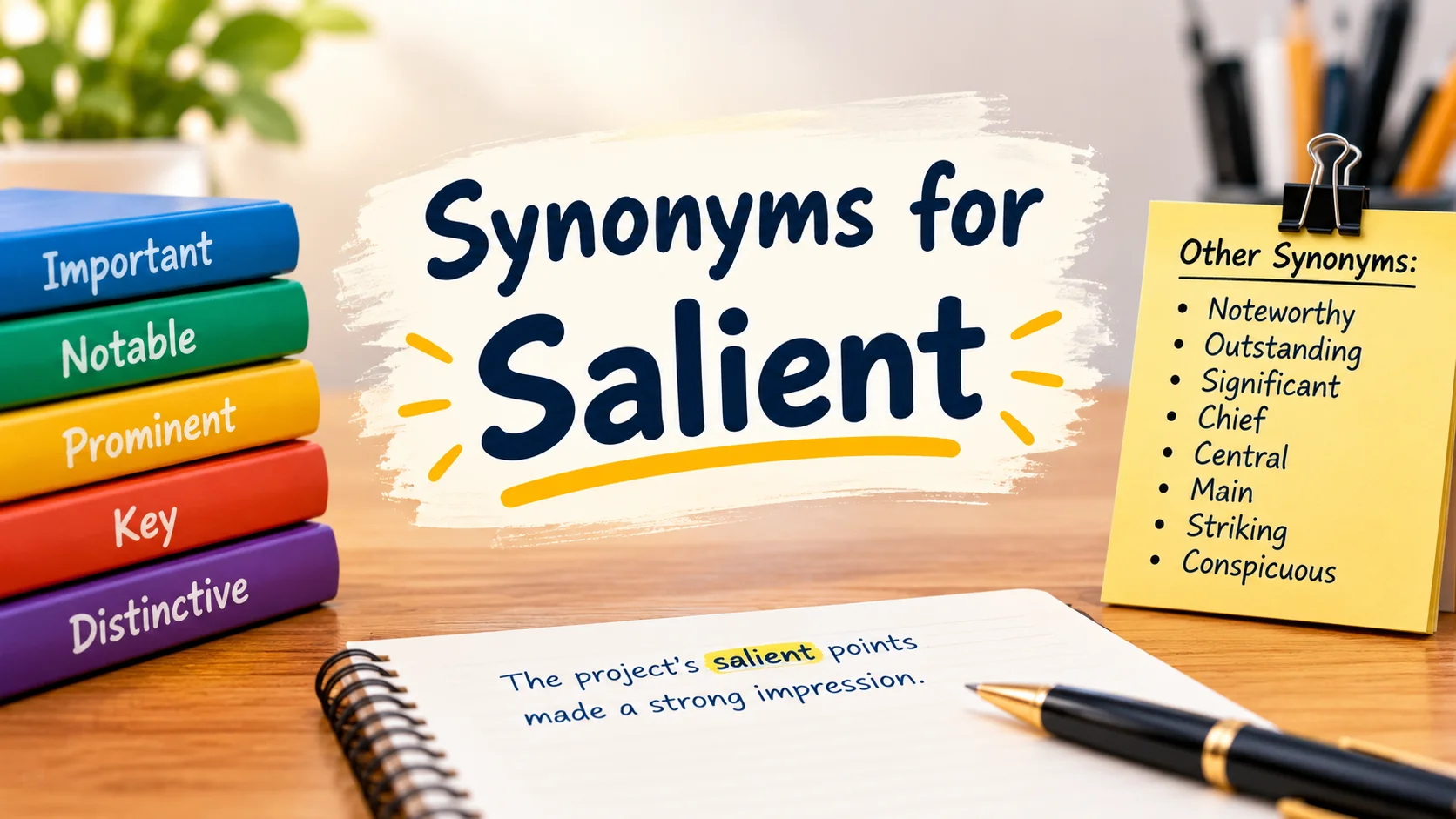
A common synonym for salient is prominent. Both words describe something that stands out clearly and is easy to notice. “Salient” often points to the most important or relevant detail in a topic, while “prominent” can describe anything that is easily seen or well known.
Have you ever read a research paper or a news article and come across the word “salient” and wondered exactly what it meant? You’re not alone. It’s a word that sounds formal, but its meaning is actually simple.
Salient means something that stands out or is the most important part of a topic. For example, a teacher might ask students to summarize the salient points of a lecture. Learning synonyms for salient helps you avoid repeating the same word and gives your writing more variety.
This guide breaks down the best alternatives to salient. You’ll get simple meanings, clear differences, and real examples for students, writers, and everyday English speakers.
Synonyms for Salient
Here is a quick summary table of the best alternatives to salient.
| # | Synonym | Relationship | Direct Replacement | Difficulty | Best Used For |
|---|---|---|---|---|---|
| 1 | Prominent | Exact synonym | Yes | Intermediate | Academic writing, descriptions |
| 2 | Conspicuous | Exact synonym | Yes | Advanced | Formal writing, literature |
| 3 | Noticeable | Near synonym | Sometimes | Beginner | Everyday conversation |
| 4 | Striking | Near synonym | Sometimes | Intermediate | Creative writing, descriptions |
| 5 | Notable | Near synonym | Sometimes | Intermediate | Academic and business writing |
| 6 | Significant | Near synonym | Sometimes | Intermediate | Academic and business writing |
| 7 | Outstanding | Near synonym | Sometimes | Intermediate | Praising achievements or features |
| 8 | Remarkable | Near synonym | Sometimes | Intermediate | Describing impressive details |
| 9 | Pronounced | Near synonym | Sometimes | Advanced | Academic and technical writing |
| 10 | Obvious | Near synonym | Sometimes | Beginner | Everyday conversation |
| 11 | Key | Contextual alternative | Sometimes | Beginner | Summarizing important points |
| 12 | Main | Contextual alternative | Sometimes | Beginner | Everyday and academic writing |
| 13 | Principal | Contextual alternative | Sometimes | Advanced | Formal or academic writing |
| 14 | Central | Contextual alternative | Sometimes | Intermediate | Academic writing |
| 15 | Chief | Contextual alternative | Sometimes | Intermediate | Formal writing |
| 16 | Marked | Contextual alternative | Sometimes | Advanced | Academic and technical writing |
Table of Contents
- Prominent
- Conspicuous
- Noticeable
- Striking
- Notable
- Significant
- Outstanding
- Remarkable
- Pronounced
- Obvious
- Key
- Main
- Principal
- Central
- Chief
- Marked
Quick Facts About Salient
- Focus keyword: salient
- Part of speech: adjective
- Simple pronunciation: SAY-lee-uhnt
- IPA: /ˈseɪliənt/
- Number of syllables: 3
- Word origin: From the Latin word “saliens,” meaning “leaping” or “jumping out,” originally used to describe a point that projects outward
- Other word forms: salience (noun), saliently (adverb)
- Formality level: Formal; common in academic and professional writing
- Difficulty level: Advanced
- CEFR level: C1
Meaning and Usage of Salient
Salient means something that is most noticeable or most important about a topic. It’s often used to highlight the key details in a discussion, report, or argument.
You’ll often see “salient” in academic writing, research papers, and professional discussions. It usually appears before words like “points,” “features,” or “details.”
For example: “The report highlighted the salient features of the new policy.” Another example: “She summarized the salient points from the meeting for her team.”
1. Prominent: A Synonym for Salient
Relationship: Exact synonym
Direct Replacement: Yes
Difficulty Level: Intermediate
Meaning: Prominent means easily noticed or standing out clearly.
Difference: “Prominent” can describe people, objects, or ideas, while “salient” is mostly used for ideas, details, or features.
Best Used For: Academic writing, descriptions
Examples:
- The most prominent feature of the design was its bright color scheme.
- He became a prominent figure in the local business community.
2. Conspicuous: A Synonym for Salient
Relationship: Exact synonym
Direct Replacement: Yes
Difficulty Level: Advanced
Meaning: Conspicuous means very easy to notice, often in a way that draws attention.
Difference: “Conspicuous” often implies something unusual or attention-grabbing, while “salient” focuses more on importance.
Best Used For: Formal writing, literature
Examples:
- Her bright red coat was conspicuous in the crowded room.
- The error was conspicuous enough that everyone noticed it immediately.
3. Noticeable: A Synonym for Salient
Relationship: Near synonym
Direct Replacement: Sometimes
Difficulty Level: Beginner
Meaning: Noticeable means easy to see or recognize.
Difference: “Noticeable” is simpler and more casual than “salient,” which sounds more formal and academic.
Best Used For: Everyday conversation
Examples:
- There was a noticeable change in his mood after the good news.
- The difference in quality was noticeable right away.
4. Striking: A Synonym for Salient
Relationship: Near synonym
Direct Replacement: Sometimes
Difficulty Level: Intermediate
Meaning: Striking means very noticeable, often because it’s impressive or unusual.
Difference: “Striking” often carries a stronger emotional impact than “salient,” which is more neutral.
Best Used For: Creative writing, descriptions
Examples:
- The striking similarity between the two paintings surprised the art critics.
- Her presentation made a striking impression on the entire team.
5. Notable: A Synonym for Salient
Relationship: Near synonym
Direct Replacement: Sometimes
Difficulty Level: Intermediate
Meaning: Notable means worth noticing or remembering because it’s important or interesting.
Difference: “Notable” often describes achievements or events, while “salient” usually describes key details or features.
Best Used For: Academic and business writing
Examples:
- There was a notable increase in sales after the marketing campaign.
- His notable contribution to the project earned him recognition.
6. Significant: A Synonym for Salient
Relationship: Near synonym
Direct Replacement: Sometimes
Difficulty Level: Intermediate
Meaning: Significant means important enough to have a real effect or meaning.
Difference: “Significant” focuses on importance and impact, while “salient” focuses more on standing out clearly.
Best Used For: Academic and business writing
Examples:
- The study found a significant link between sleep and productivity.
- There was a significant delay in shipping this month.
7. Outstanding: A Synonym for Salient
Relationship: Near synonym
Direct Replacement: Sometimes
Difficulty Level: Intermediate
Meaning: Outstanding means exceptionally good or easily noticed for being impressive.
Difference: “Outstanding” usually carries a positive tone, while “salient” is more neutral and simply points to what stands out.
Best Used For: Praising achievements or features
Examples:
- Her outstanding performance earned her the top award.
- The outstanding design details set this product apart from others.
8. Remarkable: A Synonym for Salient
Relationship: Near synonym
Direct Replacement: Sometimes
Difficulty Level: Intermediate
Meaning: Remarkable means unusual or impressive enough to be worth mentioning.
Difference: “Remarkable” often expresses surprise or admiration, while “salient” is more about relevance and importance.
Best Used For: Describing impressive details
Examples:
- The remarkable recovery of the patient surprised the entire medical team.
- It’s remarkable how quickly the new employee learned the system.
9. Pronounced: A Synonym for Salient
Relationship: Near synonym
Direct Replacement: Sometimes
Difficulty Level: Advanced
Meaning: Pronounced means very noticeable or clearly present.
Difference: “Pronounced” is often used to describe qualities, effects, or differences, while “salient” is broader and can describe entire points or ideas.
Best Used For: Academic and technical writing
Examples:
- There was a pronounced difference between the two test results.
- His accent became more pronounced when he talked about his hometown.
10. Obvious: A Synonym for Salient
Relationship: Near synonym
Direct Replacement: Sometimes
Difficulty Level: Beginner
Meaning: Obvious means easy to see or understand without needing explanation.
Difference: “Obvious” is simpler and more direct, while “salient” often implies importance, not just visibility.
Best Used For: Everyday conversation
Examples:
- It was obvious that she was upset about the news.
- The solution to the problem was fairly obvious once we looked closely.
11. Key: A Contextual Alternative for Salient
Relationship: Contextual alternative
Direct Replacement: Sometimes
Difficulty Level: Beginner
Meaning: Key means essential or very important to a situation.
Difference: “Key” highlights importance in a simple way, while “salient” can also imply that something is easy to notice.
Best Used For: Summarizing important points
Examples:
- The key issue in the meeting was the budget shortfall.
- Communication is a key factor in any successful team.
12. Main: A Contextual Alternative for Salient
Relationship: Contextual alternative
Direct Replacement: Sometimes
Difficulty Level: Beginner
Meaning: Main means the most important part of something.
Difference: “Main” is more casual and general than “salient,” which sounds more formal and precise.
Best Used For: Everyday and academic writing
Examples:
- The main reason for the delay was bad weather.
- Her main argument focused on cost savings.
13. Principal: A Contextual Alternative for Salient
Relationship: Contextual alternative
Direct Replacement: Sometimes
Difficulty Level: Advanced
Meaning: Principal means first in importance or rank.
Difference: “Principal” is more formal and often used in official or academic contexts, unlike the broader use of “salient.”
Best Used For: Formal or academic writing
Examples:
- The principal cause of the accident was driver fatigue.
- Cost was the principal concern during the renovation.
14. Central: A Contextual Alternative for Salient
Relationship: Contextual alternative
Direct Replacement: Sometimes
Difficulty Level: Intermediate
Meaning: Central means forming the main or most important part of something.
Difference: “Central” often describes a core theme or idea, while “salient” can describe multiple standout details at once.
Best Used For: Academic writing
Examples:
- Trust is central to any healthy relationship.
- The central theme of the novel is loss and recovery.
15. Chief: A Contextual Alternative for Salient
Relationship: Contextual alternative
Direct Replacement: Sometimes
Difficulty Level: Intermediate
Meaning: Chief means main or most important, often used to describe a primary cause or concern.
Difference: “Chief” sounds slightly more formal and is often paired with words like “concern” or “reason,” unlike the more flexible “salient.”
Best Used For: Formal writing
Examples:
- Safety was the chief concern during the inspection.
- The chief benefit of the new system is faster processing.
16. Marked: A Contextual Alternative for Salient
Relationship: Contextual alternative
Direct Replacement: Sometimes
Difficulty Level: Advanced
Meaning: Marked means very noticeable, often describing a clear change or difference.
Difference: “Marked” usually describes a change or contrast, while “salient” can describe standout features without implying change.
Best Used For: Academic and technical writing
Examples:
- There was a marked improvement in his grades this semester.
- The marked contrast between the two designs surprised the judges.
Antonyms of Salient
| # | Antonym | Simple Meaning | Example |
|---|---|---|---|
| 1 | Inconspicuous | Not easily noticed | The small crack was inconspicuous at first glance. |
| 2 | Unnoticeable | Difficult to notice or detect | The stain was unnoticeable once the shirt was washed. |
| 3 | Insignificant | Not important enough to matter | The price difference was insignificant compared to the quality. |
| 4 | Minor | Small or less important | It was only a minor issue in the overall report. |
| 5 | Trivial | Of little value or importance | The mistake was trivial and easy to fix. |
| 6 | Unremarkable | Not interesting or impressive | The restaurant’s food was unremarkable but affordable. |
Words Commonly Confused with Salient
Silent
Difference: “Silent” means making no sound, while “salient” refers to something standing out or being important. The two words only look similar in spelling.
Example: The salient point in her speech came right after a long, silent pause.
Salience
Difference: “Salience” is the noun form, describing the quality of being noticeable or important, while “salient” is the adjective used to describe something directly.
Example: The salience of the issue grew as more people called it a salient concern.
Prominent
Difference: “Prominent” can describe people, places, or things that are widely known, while “salient” is mostly used for ideas, features, or details within a topic.
Example: The salient details of the case made the lawyer a prominent name in the legal community.
Relevant
Difference: “Relevant” means connected or applicable to a topic, while “salient” means standing out as especially important within that topic.
Example: Not every relevant fact in the report was salient enough to include in the summary.
FAQs
What is another word for salient?
A common alternative is “prominent,” which describes something that stands out clearly. Other good options include “notable,” “significant,” and “key,” depending on the context.
What is the closest synonym for salient?
“Prominent” is one of the closest synonyms, since both words describe something that clearly stands out. “Conspicuous” is another strong match, especially in formal writing.
Can I replace salient with any of these synonyms?
Not always. Words like “key” or “main” work well when summarizing important points, but words like “conspicuous” fit better when describing something visually noticeable.
Is salient formal or informal?
“Salient” is a formal word. It’s most common in academic writing, research papers, and professional discussions rather than casual conversation.
What is the opposite of salient?
Common opposites include “inconspicuous,” “insignificant,” and “unremarkable.” These words describe something that doesn’t stand out or matter much.
Which synonym for salient works best in academic writing?
“Significant,” “notable,” and “prominent” all work well in academic writing, since they sound formal and clearly highlight important details.
Conclusion
Learning synonyms for salient helps your writing sound more precise, especially in academic or professional contexts. Instead of repeating the same word, you can choose one that matches the exact idea you want to express, whether it’s importance, visibility, or impact.
Context always matters. A research paper might call for “significant” or “notable,” while a casual conversation might feel more natural with “noticeable” or “obvious.” Try using these alternatives in your essays, reports, and everyday writing.