Featured Snippet Answer
A common synonym for dangers is risks. Both words describe situations that could cause harm, injury, or loss. “Dangers” often points to the source of harm itself, while “risks” focuses more on the chance that harm might happen, so the two words are frequently used together.
Have you ever written a safety report or a warning message and used the word “dangers” three times in one paragraph? It happens more often than you’d think. Repeating the same word can make your writing feel flat and repetitive.
That’s where synonyms come in handy. Learning other words for dangers helps your writing sound clearer and more natural. It also helps you choose the exact word that matches the level of risk you’re describing.
In this guide, you’ll find accurate, easy-to-understand synonyms for dangers. Each one comes with a clear meaning, a difficulty level, and real examples. Whether you’re a student, blogger, or everyday writer, this list will help you say “dangers” in new ways.
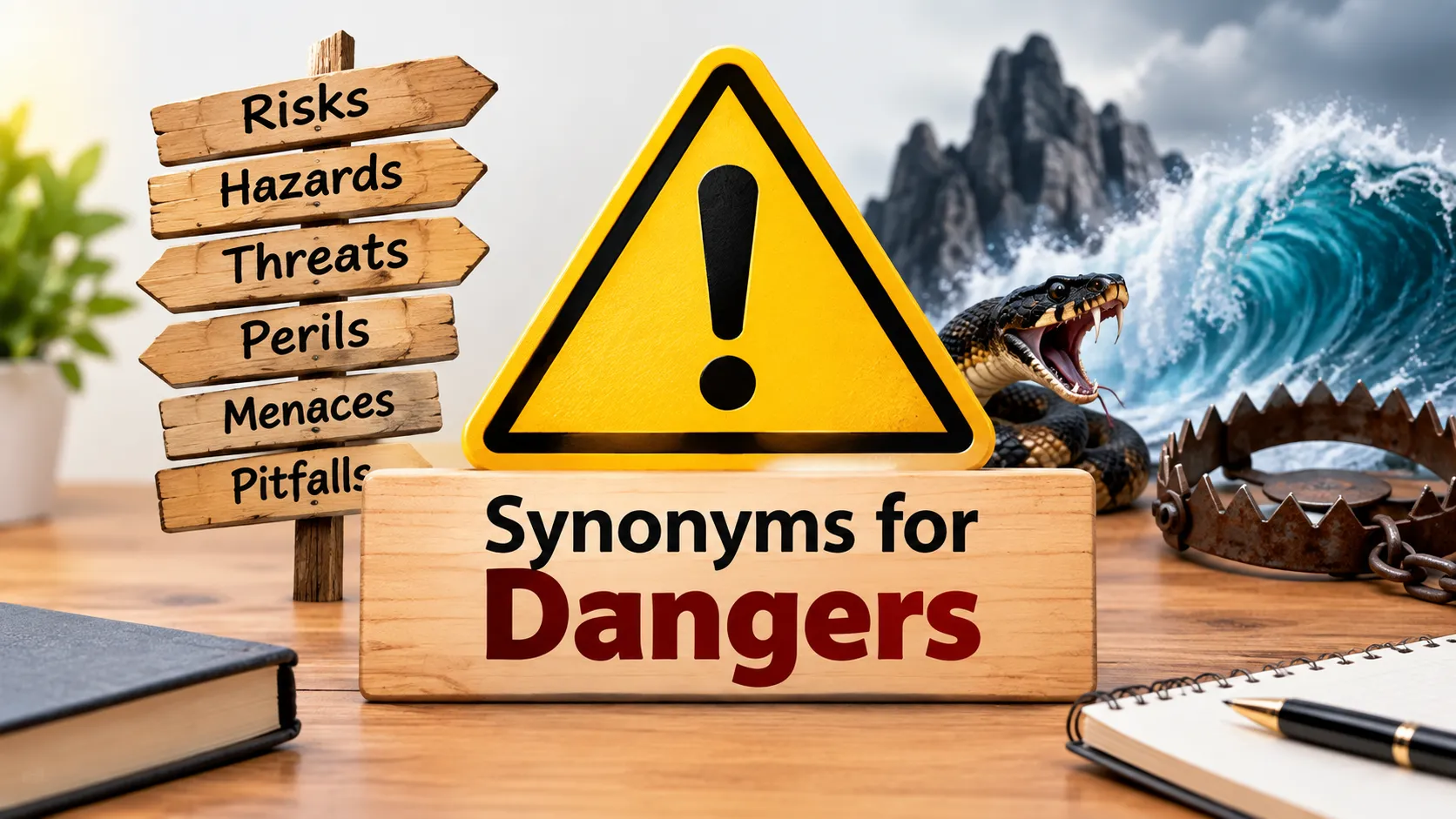
Synonyms for Dangers
Here is a quick summary table of the most useful synonyms for dangers. Use it to find the right word fast, then scroll down for full explanations.
| # | Synonym | Relationship | Direct Replacement | Difficulty | Best Used For |
|---|---|---|---|---|---|
| 1 | Risks | Near synonym | Sometimes | Beginner | Reports, everyday warnings |
| 2 | Hazards | Exact synonym | Yes | Intermediate | Safety writing, workplaces |
| 3 | Perils | Exact synonym | Yes | Advanced | Literary or formal writing |
| 4 | Threats | Near synonym | Sometimes | Beginner | Security, general warnings |
| 5 | Menaces | Near synonym | Sometimes | Advanced | Describing serious dangers |
| 6 | Jeopardy | Contextual alternative | Sometimes | Advanced | Legal or formal contexts |
| 7 | Pitfalls | Contextual alternative | Sometimes | Intermediate | Warning about mistakes |
| 8 | Traps | Contextual alternative | Sometimes | Beginner | Everyday conversation |
| 9 | Snares | Contextual alternative | No | Advanced | Literary writing |
| 10 | Liabilities | Contextual alternative | Sometimes | Advanced | Business or legal writing |
| 11 | Vulnerabilities | Related term | No | Advanced | Technical or security writing |
| 12 | Exposures | Related term | No | Advanced | Business, insurance writing |
| 13 | Harms | Related term | No | Beginner | General warnings |
| 14 | Insecurities | Related term | No | Intermediate | Describing unsafe situations |
| 15 | Troubles | Related term | Sometimes | Beginner | Everyday conversation |
Table of Contents
- Risks
- Hazards
- Perils
- Threats
- Menaces
- Jeopardy
- Pitfalls
- Traps
- Snares
- Liabilities
- Vulnerabilities
- Exposures
- Harms
- Insecurities
- Troubles
Quick Facts About Dangers
- Focus keyword: dangers
- Part of speech: noun (plural of “danger”)
- Simple pronunciation: DAYN-jerz
- IPA: /ˈdeɪndʒərz/
- Number of syllables: 2
- Word origin: From the Old French word “dangier,” which traces back to the Latin “dominium,” meaning power or control
- Other word forms: danger (singular), dangerous (adjective), dangerously (adverb)
- Formality level: Neutral, works in both formal and everyday writing
- Difficulty level: Beginner
- CEFR level: A2
Meaning and Usage of Dangers
Dangers are things, situations, or conditions that could cause harm, injury, or loss. The word is often used to warn people about possible risks.
People use “dangers” in many contexts, from everyday conversation to safety manuals and news reports. It can describe physical risks, like a dangerous road, or broader risks, like the dangers of a bad decision.
For example, you might say, “The dangers of texting while driving are well known.” Another example: “She warned us about the dangers of the hiking trail.”
1. Risks: A Synonym for Dangers
Relationship: Near synonym
Direct Replacement: Sometimes
Difficulty Level: Beginner
Meaning: Risks are the chances that something harmful might happen.
Difference: “Risks” focuses on the possibility of harm, while “dangers” often points to the actual source of harm.
Best Used For: Reports, everyday warnings
Examples:
- The risks of skipping regular car maintenance can add up over time.
- We discussed the risks before agreeing to the new business plan.
2. Hazards: A Synonym for Dangers
Relationship: Exact synonym
Direct Replacement: Yes
Difficulty Level: Intermediate
Meaning: Hazards are specific sources of danger, often found in physical environments.
Difference: “Hazards” is commonly used in safety and workplace settings, while “dangers” is more general.
Best Used For: Safety writing, workplaces
Examples:
- The construction site had several hazards, like loose wires and wet floors.
- Fire hazards are common in older buildings with outdated wiring.
3. Perils: A Synonym for Dangers
Relationship: Exact synonym
Direct Replacement: Yes
Difficulty Level: Advanced
Meaning: Perils are serious dangers, often ones that involve real risk of harm.
Difference: “Perils” sounds more dramatic and formal than “dangers,” and it’s often used in literature or serious writing.
Best Used For: Literary or formal writing
Examples:
- The novel described the perils of crossing the frozen lake.
- They faced many perils during their journey through the mountains.
4. Threats: A Synonym for Dangers
Relationship: Near synonym
Direct Replacement: Sometimes
Difficulty Level: Beginner
Meaning: Threats are things or actions that could cause harm in the future.
Difference: “Threats” often implies an active source of harm, while “dangers” can describe a broader or more passive risk.
Best Used For: Security, general warnings
Examples:
- Cybersecurity experts warned about new threats to personal data.
- The coach reminded the team about the threats posed by the rival players.
5. Menaces: A Synonym for Dangers
Relationship: Near synonym
Direct Replacement: Sometimes
Difficulty Level: Advanced
Meaning: Menaces are serious or ongoing sources of danger, often ones that feel threatening.
Difference: “Menaces” carries a stronger, more alarming tone than “dangers.”
Best Used For: Describing serious dangers
Examples:
- Pollution remains one of the biggest menaces to public health.
- The old bridge was considered a menace to anyone who tried to cross it.
6. Jeopardy: A Synonym for Dangers
Relationship: Contextual alternative
Direct Replacement: Sometimes
Difficulty Level: Advanced
Meaning: Jeopardy means a state of being at risk of harm or loss.
Difference: “Jeopardy” is more formal and often used to describe a specific risky situation, rather than dangers in general.
Best Used For: Legal or formal contexts
Examples:
- The company’s finances were put in jeopardy after the failed merger.
- Her decision put the entire project in jeopardy.
7. Pitfalls: A Synonym for Dangers
Relationship: Contextual alternative
Direct Replacement: Sometimes
Difficulty Level: Intermediate
Meaning: Pitfalls are hidden problems or mistakes that can cause trouble later.
Difference: “Pitfalls” usually refers to dangers tied to mistakes or poor decisions, not physical harm.
Best Used For: Warning about mistakes
Examples:
- The guide explained common pitfalls to avoid when starting a business.
- One of the biggest pitfalls in cooking is not reading the recipe first.
8. Traps: A Synonym for Dangers
Relationship: Contextual alternative
Direct Replacement: Sometimes
Difficulty Level: Beginner
Meaning: Traps are situations designed or likely to cause harm or trouble.
Difference: “Traps” often implies a hidden or tricky danger, while “dangers” can be obvious or visible.
Best Used For: Everyday conversation
Examples:
- Falling into debt traps is easier than most people realize.
- The scammer set a trap that many people fell for.
9. Snares: A Synonym for Dangers
Relationship: Contextual alternative
Direct Replacement: No
Difficulty Level: Advanced
Meaning: Snares are hidden dangers or traps, often used in a figurative sense.
Difference: “Snares” is more poetic and less commonly used in everyday speech compared to “dangers.”
Best Used For: Literary writing
Examples:
- The story described the snares hidden along the forest path.
- He warned his students about the snares of overconfidence.
10. Liabilities: A Synonym for Dangers
Relationship: Contextual alternative
Direct Replacement: Sometimes
Difficulty Level: Advanced
Meaning: Liabilities are risks or responsibilities that could lead to harm or loss, often in a legal or financial sense.
Difference: “Liabilities” focuses on responsibility and consequences, while “dangers” focuses on the risk of harm itself.
Best Used For: Business or legal writing
Examples:
- The insurance policy covers several potential liabilities.
- Ignoring safety codes can create serious liabilities for a company.
11. Vulnerabilities: A Related Term for Dangers
Relationship: Related term
Direct Replacement: No
Difficulty Level: Advanced
Meaning: Vulnerabilities are weaknesses that make someone or something more open to harm.
Difference: “Vulnerabilities” describes weak points, not the dangers themselves.
Best Used For: Technical or security writing
Examples:
- The software update fixed several security vulnerabilities.
- Understanding your vulnerabilities can help you prepare for challenges.
12. Exposures: A Related Term for Dangers
Relationship: Related term
Direct Replacement: No
Difficulty Level: Advanced
Meaning: Exposures refer to the extent to which someone is open to harm or risk.
Difference: “Exposures” measures how much risk someone faces, rather than naming the danger itself.
Best Used For: Business, insurance writing
Examples:
- The report outlined the company’s financial exposures for the year.
- Limiting sun exposure can reduce certain health risks.
13. Harms: A Related Term for Dangers
Relationship: Related term
Direct Replacement: No
Difficulty Level: Beginner
Meaning: Harms are the negative effects or damage that dangers can cause.
Difference: “Harms” describes the result of danger, not the danger itself.
Best Used For: General warnings
Examples:
- The campaign focused on the harms of smoking.
- Doctors explained the harms of skipping regular checkups.
14. Insecurities: A Related Term for Dangers
Relationship: Related term
Direct Replacement: No
Difficulty Level: Intermediate
Meaning: Insecurities refer to a lack of safety or stability in a situation.
Difference: “Insecurities” describes a state of being unsafe, rather than a specific source of harm.
Best Used For: Describing unsafe situations
Examples:
- The report highlighted insecurities in the region’s food supply.
- Job insecurities have increased stress for many workers this year.
15. Troubles: A Related Term for Dangers
Relationship: Related term
Direct Replacement: Sometimes
Difficulty Level: Beginner
Meaning: Troubles are problems or difficulties that can arise, sometimes linked to danger.
Difference: “Troubles” is broader and doesn’t always involve physical harm, unlike “dangers.”
Best Used For: Everyday conversation
Examples:
- Financial troubles can lead to a lot of stress for families.
- He ran into troubles halfway through the hiking trip.
Antonyms of Dangers
| # | Antonym | Simple Meaning | Example |
|---|---|---|---|
| 1 | Safety | A state of being free from harm | Workplace safety is the company’s top priority. |
| 2 | Security | Protection from risk or threat | The new locks improved the building’s security. |
| 3 | Protection | Something that keeps a person or thing safe | The helmet offers protection during the ride. |
| 4 | Safeguard | A measure taken to prevent harm | The policy acts as a safeguard against fraud. |
| 5 | Immunity | Being protected or unaffected by harm | The vaccine provides immunity against the virus. |
| 6 | Shelter | A place or state of protection from danger | The cabin offered shelter during the storm. |
Words Commonly Confused with Dangers
Risk
Difference: Risk refers to the chance that harm might happen, while dangers refer to the actual sources of harm.
Example: There is a risk of injury because of the dangers on the construction site.
Hazard
Difference: A hazard is a specific, identifiable source of danger, while “dangers” can be broader and less specific.
Example: The spilled oil was a hazard, adding to the dangers already present in the garage.
Threat
Difference: A threat usually involves an active or intentional source of harm, while dangers can exist without any intent behind them.
Example: The storm was a natural danger, but the looter posed a direct threat.
Harm
Difference: Harm is the damage or injury that results, while dangers are the conditions that could lead to that harm.
Example: The dangers of the icy road caused harm to several drivers that morning.
FAQs
What is another word for dangers?
A common alternative is “risks,” which describes the chance that harm might occur. Other options include “hazards,” “threats,” and “perils,” depending on how serious or specific the danger is.
What is the closest synonym for dangers?
“Hazards” is one of the closest synonyms, especially in safety-related writing. Both words describe real sources of harm, though “hazards” often sounds slightly more technical.
Can I replace dangers with any of these synonyms?
Not always. Words like “vulnerabilities” or “exposures” describe risk in a more indirect way, while “hazards” and “perils” can usually replace “dangers” directly.
Is dangers formal or informal?
“Dangers” is a neutral word. It works well in both everyday conversation and formal writing, such as safety reports or news articles.
What is the opposite of dangers?
Common opposites include “safety,” “security,” and “protection.” These words describe conditions where harm is unlikely or prevented.
Which synonym for dangers works best in a safety report?
“Hazards” is often the best choice for safety reports, since it clearly points to identifiable sources of harm in a workplace or environment.
Conclusion
Learning synonyms for dangers helps your writing feel more precise and varied. Instead of repeating the same word, you can choose one that matches the exact type of risk you’re describing, whether it’s a hidden pitfall or a serious threat.
Context always matters. A workplace report might call for “hazards,” while a personal essay might feel more natural with “risks” or “troubles.” Try using these alternatives in your emails, essays, and everyday conversations.