Featured Snippet Answer
The closest synonym for “implied” is “suggested.” Both words describe something that is hinted at rather than stated directly. “Suggested” works in almost any sentence, from casual talk to formal writing, making it a reliable replacement for “implied.”
Have you ever read between the lines of a text message? Maybe your friend didn’t say “I’m upset,” but their short reply implied it clearly.
That’s exactly what the word “implied” means. It describes something that is hinted at, not stated directly.
Writers use “implied” often, but repeating it too much can make writing feel flat. Learning synonyms for implied helps you express the same idea in fresh, varied ways. Whether you’re writing an essay, a story, or an email, these alternative words for implied will make your message clearer and more natural.
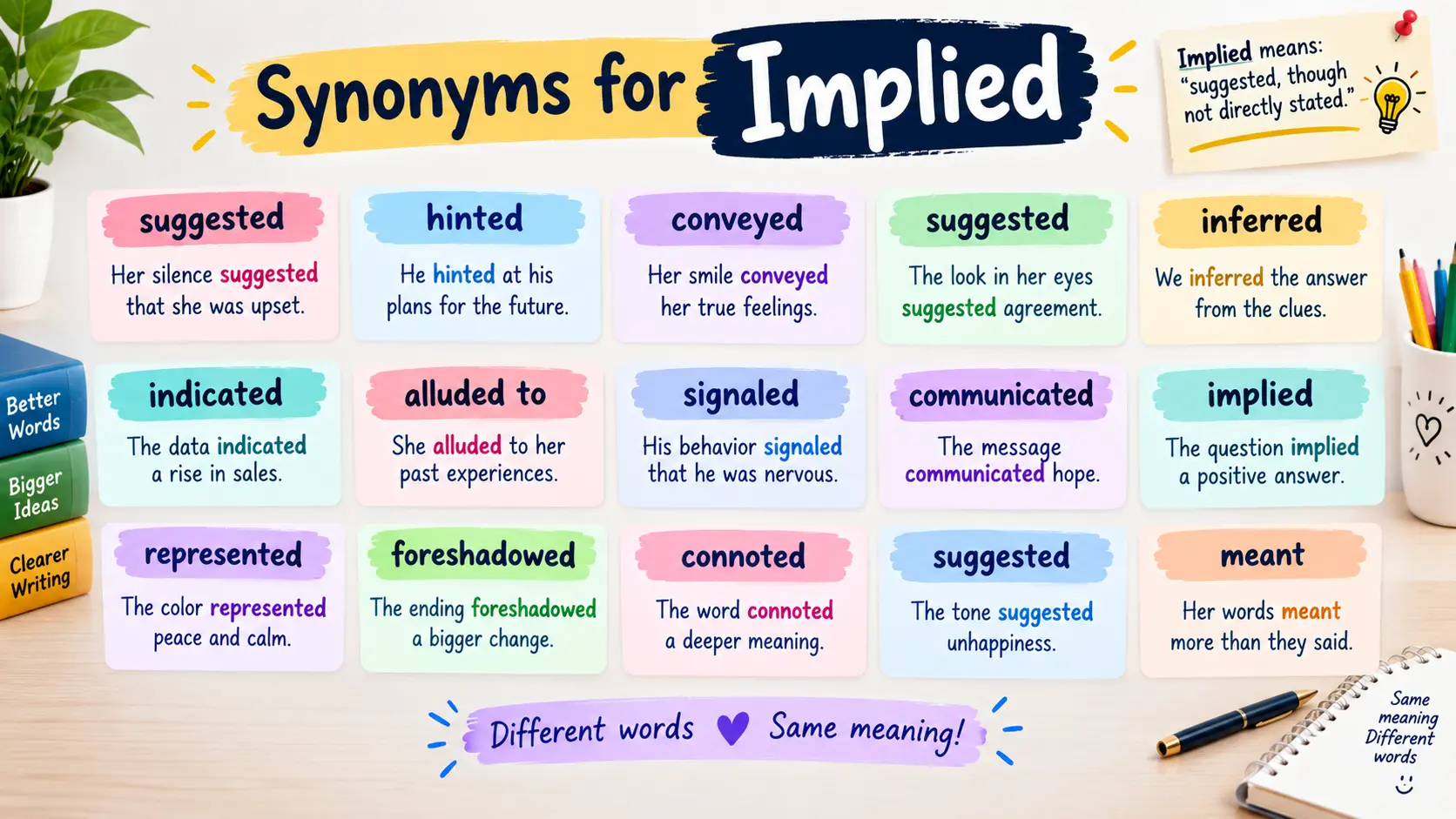
Synonyms for Implied
| # | Synonym | Relationship | Direct Replacement | Difficulty | Best Used For |
|---|---|---|---|---|---|
| 1 | Suggested | Exact synonym | Yes | Beginner | Daily conversation, writing |
| 2 | Hinted | Near synonym | Yes | Beginner | Daily conversation |
| 3 | Insinuated | Near synonym | Sometimes | Advanced | Formal, negative contexts |
| 4 | Indicated | Exact synonym | Yes | Intermediate | Business writing |
| 5 | Inferred | Related term | No | Intermediate | Academic writing |
| 6 | Intimated | Near synonym | Sometimes | Advanced | Formal writing |
| 7 | Alluded to | Contextual alternative | Sometimes | Intermediate | Literary writing |
| 8 | Implicit | Related term | No | Intermediate | Academic, legal writing |
| 9 | Signaled | Contextual alternative | Sometimes | Beginner | Daily conversation |
| 10 | Conveyed | Near synonym | Sometimes | Intermediate | Business writing |
| 11 | Meant | Contextual alternative | Sometimes | Beginner | Daily conversation |
| 12 | Implicated | Related term | No | Advanced | Legal, formal writing |
| 13 | Assumed | Related term | No | Beginner | Daily conversation |
| 14 | Expressed indirectly | Contextual alternative | Yes | Intermediate | Academic writing |
| 15 | Referred to | Contextual alternative | Sometimes | Beginner | Daily conversation |
| 16 | Left unsaid | Related term | No | Intermediate | Creative writing |
| 17 | Presumed | Related term | No | Intermediate | Formal writing |
| 18 | Foreshadowed | Related term | No | Advanced | Literature |
Table of Contents
- Suggested
- Hinted
- Insinuated
- Indicated
- Inferred
- Intimated
- Alluded To
- Implicit
- Signaled
- Antonyms
Quick Facts About Implied
- Focus keyword: implied
- Part of speech: verb (past tense/adjective form of “imply”)
- Simple pronunciation: im-PLYD
- Number of syllables: 2
- Word origin: From Latin “implicare,” meaning to fold in or entangle
- Other word forms: imply (present), implying (present participle), implies (third person singular), implication (noun)
- Formality level: Neutral to formal
- Difficulty level: Intermediate
Meaning and Usage of Implied
“Implied” means something was suggested or hinted at, without being said in plain words. It comes from the verb “imply.”
We use it when someone communicates an idea indirectly. For example: “Her silence implied she disagreed” or “The contract implied certain responsibilities.”
It’s often confused with “inferred,” but they work in opposite directions. The speaker “implies” something, while the listener “infers” it.
Examples:
- “His tone implied he wasn’t happy with the results.”
- “The report implied that sales would improve next quarter.”
1. Suggested: A Synonym for Implied
Relationship: Exact synonym
Direct Replacement: Yes
Difficulty Level: Beginner
Meaning: To put an idea forward without stating it directly.
Difference: “Suggested” is more neutral and common than “implied,” and it works well in almost any casual or formal sentence.
Best Used For: Daily conversation, business writing, academic writing
Examples:
- “Her raised eyebrow suggested she didn’t believe the excuse.”
- “The email suggested that the deadline might be extended.”
2. Hinted: A Synonym for Implied
Relationship: Near synonym
Direct Replacement: Yes
Difficulty Level: Beginner
Meaning: To give a small clue about something without saying it clearly.
Difference: “Hinted” often feels lighter and more playful than “implied,” which can sound more serious or formal.
Best Used For: Daily conversation, creative writing
Examples:
- “He hinted that he had a surprise planned for her birthday.”
- “The chef hinted that a new menu item was coming next month.”
3. Insinuated: A Synonym for Implied
Relationship: Near synonym
Direct Replacement: Sometimes
Difficulty Level: Advanced
Meaning: To suggest something negative or unpleasant in an indirect way.
Difference: “Insinuated” almost always carries a negative or accusing tone, while “implied” can be neutral or even positive.
Best Used For: Formal writing, conflict situations
Examples:
- “The coworker insinuated that the missing files were her fault.”
- “His comment insinuated that the team hadn’t worked hard enough.”
4. Indicated: A Synonym for Implied
Relationship: Exact synonym
Direct Replacement: Yes
Difficulty Level: Intermediate
Meaning: To point toward or show something, often through evidence or signs.
Difference: “Indicated” can be more direct and evidence-based, while “implied” is usually softer and more subtle.
Best Used For: Business writing, academic writing
Examples:
- “The test results indicated that the treatment was working.”
- “Her body language indicated she was nervous about the interview.”
5. Inferred: A Synonym for Implied
Relationship: Related term
Direct Replacement: No
Difficulty Level: Intermediate
Meaning: To reach a conclusion based on clues or evidence.
Difference: This word describes the listener’s action, not the speaker’s. You cannot say someone “inferred” a message the way you’d say they “implied” it.
Best Used For: Academic writing, daily conversation
Examples:
- “From his silence, she inferred that something was wrong.”
- “Readers can infer the character’s feelings from her actions alone.”
6. Intimated: A Synonym for Implied
Relationship: Near synonym
Direct Replacement: Sometimes
Difficulty Level: Advanced
Meaning: To suggest something in a subtle or gentle way.
Difference: “Intimated” is more formal and less common in everyday speech than “implied,” and it often suggests a private or delicate message.
Best Used For: Formal writing, literature
Examples:
- “The doctor intimated that recovery might take longer than expected.”
- “She intimated her plans to resign during a quiet conversation.”
7. Alluded To: A Synonym for Implied
Relationship: Contextual alternative
Direct Replacement: Sometimes
Difficulty Level: Intermediate
Meaning: To mention something indirectly, often by reference.
Difference: “Alluded to” usually involves referencing something specific, like an event or fact, rather than a general feeling or idea.
Best Used For: Literary writing, academic writing
Examples:
- “The speaker alluded to a scandal without naming anyone involved.”
- “In her essay, she alluded to a famous poem without quoting it directly.”
8. Implicit: A Synonym for Implied
Relationship: Related term
Direct Replacement: No
Difficulty Level: Intermediate
Meaning: Understood without being directly stated; built into the meaning itself.
Difference: “Implicit” is an adjective describing a quality, while “implied” is a verb describing an action someone took.
Best Used For: Academic writing, legal writing
Examples:
- “There was an implicit understanding that no one would discuss the topic.”
- “The contract had an implicit expectation of confidentiality.”
9. Signaled: A Synonym for Implied
Relationship: Contextual alternative
Direct Replacement: Sometimes
Difficulty Level: Beginner
Meaning: To show or communicate something through an action or gesture.
Difference: “Signaled” often involves a physical or clear cue, while “implied” can be purely verbal or written.
Best Used For: Daily conversation, descriptive writing
Examples:
- “Her tense posture signaled that she was uncomfortable with the question.”
- “The manager signaled his approval with a simple nod.”
10. Conveyed: A Synonym for Implied
Relationship: Near synonym
Direct Replacement: Sometimes
Difficulty Level: Intermediate
Meaning: To communicate or express a feeling or idea.
Difference: “Conveyed” can refer to both direct and indirect communication, while “implied” always refers to indirect meaning.
Best Used For: Business writing, creative writing
Examples:
- “His letter conveyed a sense of regret without ever using the word ‘sorry.'”
- “The painting conveyed a quiet sadness that words couldn’t capture.”
Antonyms of Implied
| # | Antonym | Simple Meaning | Example |
|---|---|---|---|
| 1 | Stated | Said clearly and directly | “She stated her opinion without hesitation.” |
| 2 | Declared | Announced openly and formally | “The company declared its profits publicly.” |
| 3 | Explicit | Fully and clearly expressed | “The instructions were explicit and easy to follow.” |
| 4 | Announced | Made known publicly and clearly | “They announced the winner in front of everyone.” |
| 5 | Specified | Stated in exact detail | “The contract specified every payment date.” |
| 6 | Expressed | Communicated openly and directly | “He expressed his concerns during the meeting.” |
Words Commonly Confused with Implied
Inferred
Difference: “Inferred” describes what a listener or reader concludes, while “implied” describes what a speaker or writer suggests. They describe opposite roles in communication.
Example: “The speaker implied doubt, so the audience inferred that the plan might fail.”
Implicit
Difference: “Implicit” is an adjective that describes something built into a situation, not an action someone performs, unlike the verb “implied.”
Example: “There was an implicit rule against interrupting during meetings.”
Implicated
Difference: “Implicated” means being involved or connected to something, often a crime or wrongdoing, which is very different from simply hinting at an idea.
Example: “Two employees were implicated in the accounting scandal.”
Insinuated
Difference: “Insinuated” almost always suggests something negative, while “implied” can be neutral, positive, or negative depending on context.
Example: “He insinuated that she had lied, which upset her deeply.”
Frequently Asked Questions
What is another word for implied?
“Suggested” is the most natural alternative to “implied.” It carries the same meaning of hinting at something without stating it directly, and it fits smoothly into both casual and formal writing.
What is the closest synonym for implied?
“Suggested” is the closest match in meaning and tone. Other close options include “hinted” and “indicated,” depending on how strong or subtle the suggestion is.
Can I replace implied with any synonym on this list?
Not always. Words like “insinuated” only fit negative situations, while “implicit” is an adjective, not a verb, so it needs a different sentence structure.
Is implied formal or informal?
“Implied” leans slightly formal but works fine in everyday writing and speech. It’s common in essays, reports, and everyday conversations alike.
What is the opposite of implied?
The opposite of “implied” is “stated” or “explicit,” since these words describe ideas expressed clearly and directly instead of hinted at.
What’s the difference between implied and inferred?
“Implied” is what the speaker does when hinting at something. “Inferred” is what the listener does when figuring out that hidden meaning. They work as a pair, but in opposite directions.
Conclusion
Learning synonyms for implied gives your writing more range and precision. Words like “suggested,” “hinted,” and “indicated” each carry a slightly different shade of meaning.
Choosing the right synonym depends on tone, context, and how strong the suggestion feels. Practice using these words in your emails, essays, and everyday conversations.
Small word choices like these can make your writing sound sharper and more confident.