Featured Snippet Answer
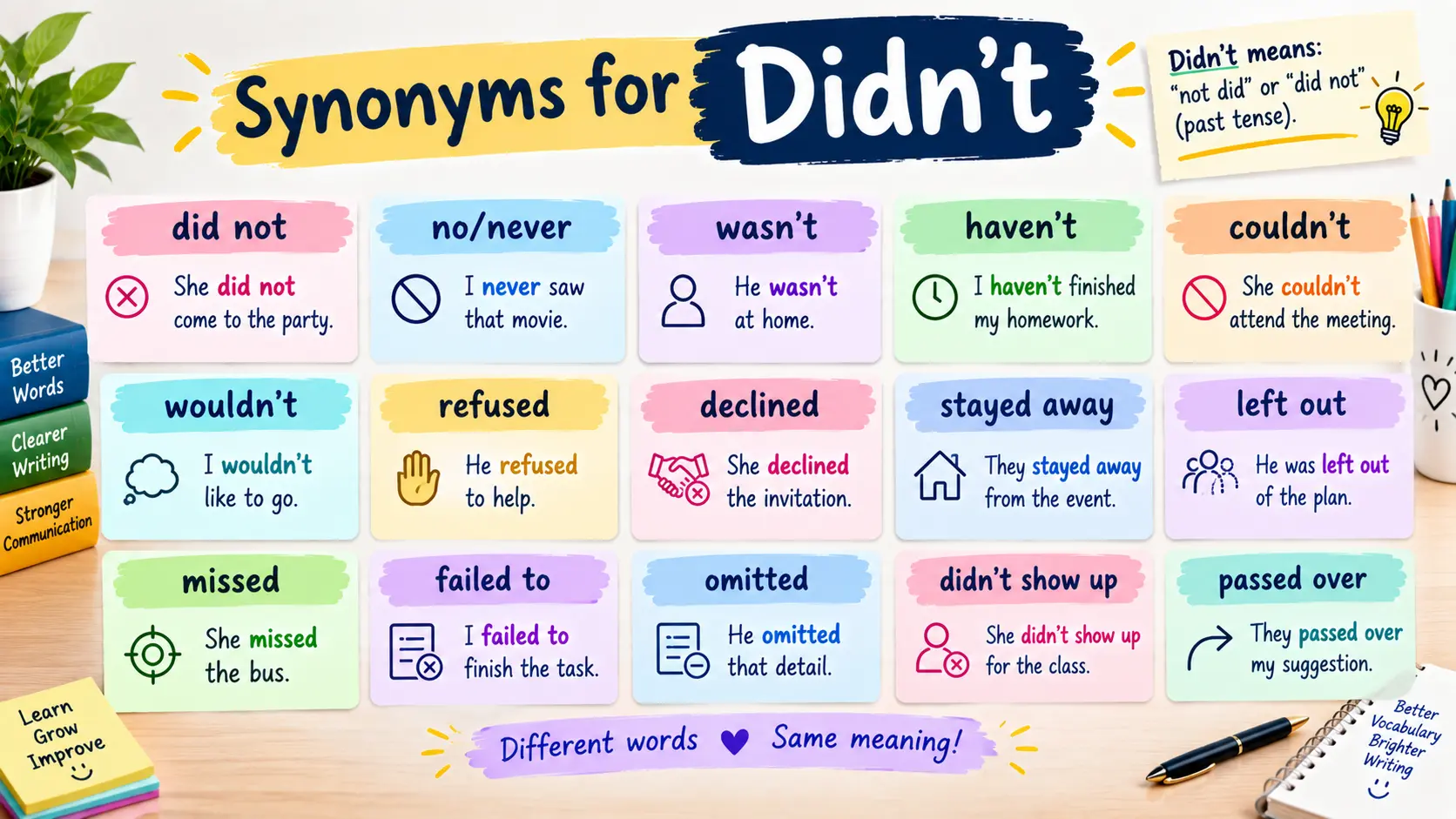
The closest synonym for “didn’t” is did not. Both express that a past action never happened. “Did not” is simply the full, formal version of the contraction “didn’t,” so you can use it whenever you want your writing to sound more formal or precise.
Have you ever texted a friend, “I didn’t get your message,” and then wondered if there’s a better way to say it? “Didn’t” is one of the most common words in English. We use it every day to talk about things that didn’t happen.
But saying “didn’t” over and over can make your writing feel repetitive. Learning synonyms for didn’t gives you more ways to express the same idea. It also helps you sound more formal, more precise, or more natural, depending on the situation.
This guide breaks down the best alternatives to didn’t. You’ll get simple meanings, clear differences, and real examples for students, writers, and everyday English speakers.
A quick note: the correct spelling of this word is “didn’t,” with an apostrophe. “Didnt” is a common typo, so keep the apostrophe in your own writing.
Synonyms for Didn’t
Here is a quick summary table of the best alternatives to didn’t.
| # | Synonym | Relationship | Direct Replacement | Difficulty | Best Used For |
|---|---|---|---|---|---|
| 1 | Did not | Exact synonym | Yes | Beginner | Formal writing, emphasis |
| 2 | Never | Near synonym | Sometimes | Beginner | Everyday conversation |
| 3 | Failed to | Near synonym | Sometimes | Intermediate | Describing a missed attempt |
| 4 | Couldn’t | Near synonym | Sometimes | Beginner | Talking about inability |
| 5 | Wasn’t able to | Contextual alternative | Sometimes | Beginner | Explaining a limitation |
| 6 | Was unable to | Contextual alternative | Sometimes | Intermediate | Formal or business writing |
| 7 | Neglected to | Contextual alternative | Sometimes | Advanced | Formal writing, forgetfulness |
| 8 | Declined to | Contextual alternative | Sometimes | Intermediate | Describing a choice |
| 9 | Refused to | Contextual alternative | Sometimes | Intermediate | Describing a strong choice |
| 10 | Chose not to | Contextual alternative | Sometimes | Beginner | Describing a decision |
| 11 | Omitted to | Related term | No | Advanced | Formal or legal writing |
| 12 | Hadn’t | Related term | Sometimes | Beginner | Talking about an earlier past action |
Table of Contents
- Did Not
- Never
- Failed To
- Couldn’t
- Wasn’t Able To
- Was Unable To
- Neglected To
- Declined To
- Refused To
- Chose Not To
- Omitted To
- Hadn’t
- Antonyms
Quick Facts About Didn’t
- Focus keyword: didn’t
- Part of speech: contraction (auxiliary verb “did” + “not”)
- Simple pronunciation: DID-uhnt
- IPA: /ˈdɪdnt/
- Number of syllables: 2
- Word origin: A contraction of “did not,” formed by joining the past tense of “do” with “not”
- Other word forms: did not (full form), doesn’t (present tense), don’t (present tense, general)
- Formality level: Informal to neutral; use “did not” in formal writing
- Difficulty level: Beginner
- CEFR level: A2
Meaning and Usage of Didn’t
“Didn’t” means that something did not happen in the past. It is the negative, past tense form of the verb “do.”
We use it to talk about actions, events, or habits that failed to occur. It’s one of the most common contractions in spoken and written English.
For example, you might say, “I didn’t finish my homework,” or “She didn’t call me back.” Both sentences describe something that was expected but did not happen.
1. Did Not: A Synonym for Didn’t
Relationship: Exact synonym
Direct Replacement: Yes
Difficulty Level: Beginner
Meaning: “Did not” is the full, uncontracted form of “didn’t.” It means exactly the same thing.
Difference: There is no meaning difference. “Did not” simply sounds more formal and is often preferred in written or professional English.
Best Used For: Formal writing, emphasis
Examples:
- I did not receive your email until this morning.
- The team did not finish the project on time.
2. Never: A Synonym for Didn’t
Relationship: Near synonym
Direct Replacement: Sometimes
Difficulty Level: Beginner
Meaning: “Never” means something did not happen at any point in time.
Difference: “Never” is stronger and often covers a longer period, while “didn’t” usually refers to one specific past moment.
Best Used For: Everyday conversation
Examples:
- He never showed up to the meeting.
- I never got a chance to thank her properly.
3. Failed To: A Synonym for Didn’t
Relationship: Near synonym
Direct Replacement: Sometimes
Difficulty Level: Intermediate
Meaning: “Failed to” means someone tried to do something but did not succeed.
Difference: “Failed to” suggests an attempt was made, while “didn’t” can simply mean the action never started.
Best Used For: Describing a missed attempt
Examples:
- She failed to submit the form before the deadline.
- The plan failed to consider our budget limits.
4. Couldn’t: A Synonym for Didn’t
Relationship: Near synonym
Direct Replacement: Sometimes
Difficulty Level: Beginner
Meaning: “Couldn’t” means someone was not able to do something.
Difference: “Couldn’t” points to a lack of ability or opportunity, while “didn’t” doesn’t explain the reason behind the missed action.
Best Used For: Talking about inability
Examples:
- I couldn’t finish the book before the movie came out.
- We couldn’t reach him on the phone last night.
5. Wasn’t Able To: A Synonym for Didn’t
Relationship: Contextual alternative
Direct Replacement: Sometimes
Difficulty Level: Beginner
Meaning: “Wasn’t able to” means a person lacked the ability, time, or chance to do something.
Difference: This phrase gently explains why the action didn’t happen, while “didn’t” just states that it didn’t.
Best Used For: Explaining a limitation
Examples:
- I wasn’t able to attend the party because I was sick.
- She wasn’t able to fix the printer before the meeting started.
6. Was Unable To: A Synonym for Didn’t
Relationship: Contextual alternative
Direct Replacement: Sometimes
Difficulty Level: Intermediate
Meaning: “Was unable to” means someone did not have the power or means to complete an action.
Difference: This phrase sounds more formal than “didn’t” and works well in professional or written contexts.
Best Used For: Formal or business writing
Examples:
- The company was unable to deliver the order on time.
- He was unable to attend due to a scheduling conflict.
7. Neglected To: A Synonym for Didn’t
Relationship: Contextual alternative
Direct Replacement: Sometimes
Difficulty Level: Advanced
Meaning: “Neglected to” means someone forgot or failed to do something they should have done.
Difference: This phrase adds a sense of carelessness or forgetfulness, which “didn’t” does not include on its own.
Best Used For: Formal writing, forgetfulness
Examples:
- He neglected to mention the extra fees before we signed the contract.
- She neglected to lock the door before leaving.
8. Declined To: A Synonym for Didn’t
Relationship: Contextual alternative
Direct Replacement: Sometimes
Difficulty Level: Intermediate
Meaning: “Declined to” means someone chose not to do something, often politely.
Difference: “Declined to” shows a clear choice was made, while “didn’t” can be neutral about the reason.
Best Used For: Describing a choice
Examples:
- The manager declined to comment on the rumors.
- She declined to join us for dinner that evening.
9. Refused To: A Synonym for Didn’t
Relationship: Contextual alternative
Direct Replacement: Sometimes
Difficulty Level: Intermediate
Meaning: “Refused to” means someone firmly decided not to do something.
Difference: “Refused to” carries a strong sense of resistance, while “didn’t” is much more neutral.
Best Used For: Describing a strong choice
Examples:
- He refused to apologize even after we explained the situation.
- The child refused to eat his vegetables.
10. Chose Not To: A Synonym for Didn’t
Relationship: Contextual alternative
Direct Replacement: Sometimes
Difficulty Level: Beginner
Meaning: “Chose not to” means a person made a decision to avoid doing something.
Difference: This phrase highlights that the outcome was a personal decision, not an accident or inability.
Best Used For: Describing a decision
Examples:
- I chose not to bring up the topic at dinner.
- She chose not to renew her gym membership this year.
11. Omitted To: A Related Term for Didn’t
Relationship: Related term
Direct Replacement: No
Difficulty Level: Advanced
Meaning: “Omitted to” means someone left out or skipped doing something, often unintentionally.
Difference: This phrase is very formal and mostly appears in legal or official writing, unlike the everyday word “didn’t.”
Best Used For: Formal or legal writing
Examples:
- The witness omitted to mention an important detail during questioning.
- The report omitted to include last quarter’s figures.
12. Hadn’t: A Related Term for Didn’t
Relationship: Related term
Direct Replacement: Sometimes
Difficulty Level: Beginner
Meaning: “Hadn’t” means something had not happened before another point in the past.
Difference: “Hadn’t” is used for an earlier past action compared to another past event, while “didn’t” refers to a single past action.
Best Used For: Talking about an earlier past action
Examples:
- By the time I arrived, they hadn’t started the meeting yet.
- He hadn’t eaten breakfast before the long hike.
Antonyms of Didn’t
| # | Antonym | Simple Meaning | Example |
|---|---|---|---|
| 1 | Did | To have completed an action in the past | I did finish the report last night. |
| 2 | Managed to | To succeed in doing something, often with effort | She managed to catch the last train. |
| 3 | Succeeded in | To achieve something you were trying to do | He succeeded in passing the exam. |
| 4 | Was able to | To have had the ability or chance to do something | We were able to fix the issue quickly. |
| 5 | Accomplished | To have completed something successfully | The team accomplished the goal ahead of schedule. |
Words Commonly Confused with Didn’t
Doesn’t
Difference: “Doesn’t” is the present tense negative form, used for actions happening now. “Didn’t” is only for the past.
Example: He doesn’t like coffee, but yesterday he didn’t drink tea either.
Don’t
Difference: “Don’t” is a general or present tense negative, often used for habits or commands. “Didn’t” always refers to the past.
Example: I don’t usually skip breakfast, but this morning I didn’t have time.
Wasn’t
Difference: “Wasn’t” is the negative form of “was,” used with being or state verbs. “Didn’t” is used with action verbs and the verb “do.”
Example: She wasn’t at home, so she didn’t answer the phone.
Hadn’t
Difference: “Hadn’t” refers to an action that had not happened before another past event, while “didn’t” refers to a single past action without that comparison.
Example: He hadn’t left the house when I didn’t get his text.
FAQs
What is another word for didn’t?
The most direct alternative is “did not,” which means exactly the same thing but sounds more formal. Other options include “never,” “failed to,” or “couldn’t,” depending on the situation you’re describing.
What is the closest synonym for didn’t?
“Did not” is the closest synonym because it is simply the full form of the same contraction. It carries the exact same meaning and can always replace “didn’t.”
Can I replace didn’t with any of these synonyms?
Not always. Words like “refused to” or “neglected to” add extra meaning, such as a choice or forgetfulness. Only “did not” can replace “didn’t” in every sentence without changing the meaning.
Is didn’t formal or informal?
“Didn’t” is informal to neutral. It’s common in speech and casual writing. For formal writing, such as reports or essays, “did not” is usually the better choice.
What is the opposite of didn’t?
The opposite of “didn’t” is “did,” which means an action did happen. Other opposites include “managed to” and “was able to.”
Why do I see “didnt” without an apostrophe sometimes?
“Didnt” without an apostrophe is a common spelling mistake. The correct spelling is always “didn’t,” with an apostrophe replacing the missing letter “o” from “not.”
Conclusion
Using synonyms for didn’t helps your writing sound more varied and precise. Instead of repeating the same word, you can choose one that fits your exact meaning, whether that’s inability, choice, or simple negation.
Context always matters. “Couldn’t” suggests inability, while “refused to” suggests a firm decision. Try using these alternatives in your emails, essays, and everyday conversations.
With a little practice, choosing the right word will start to feel natural.