Featured Snippet Answer
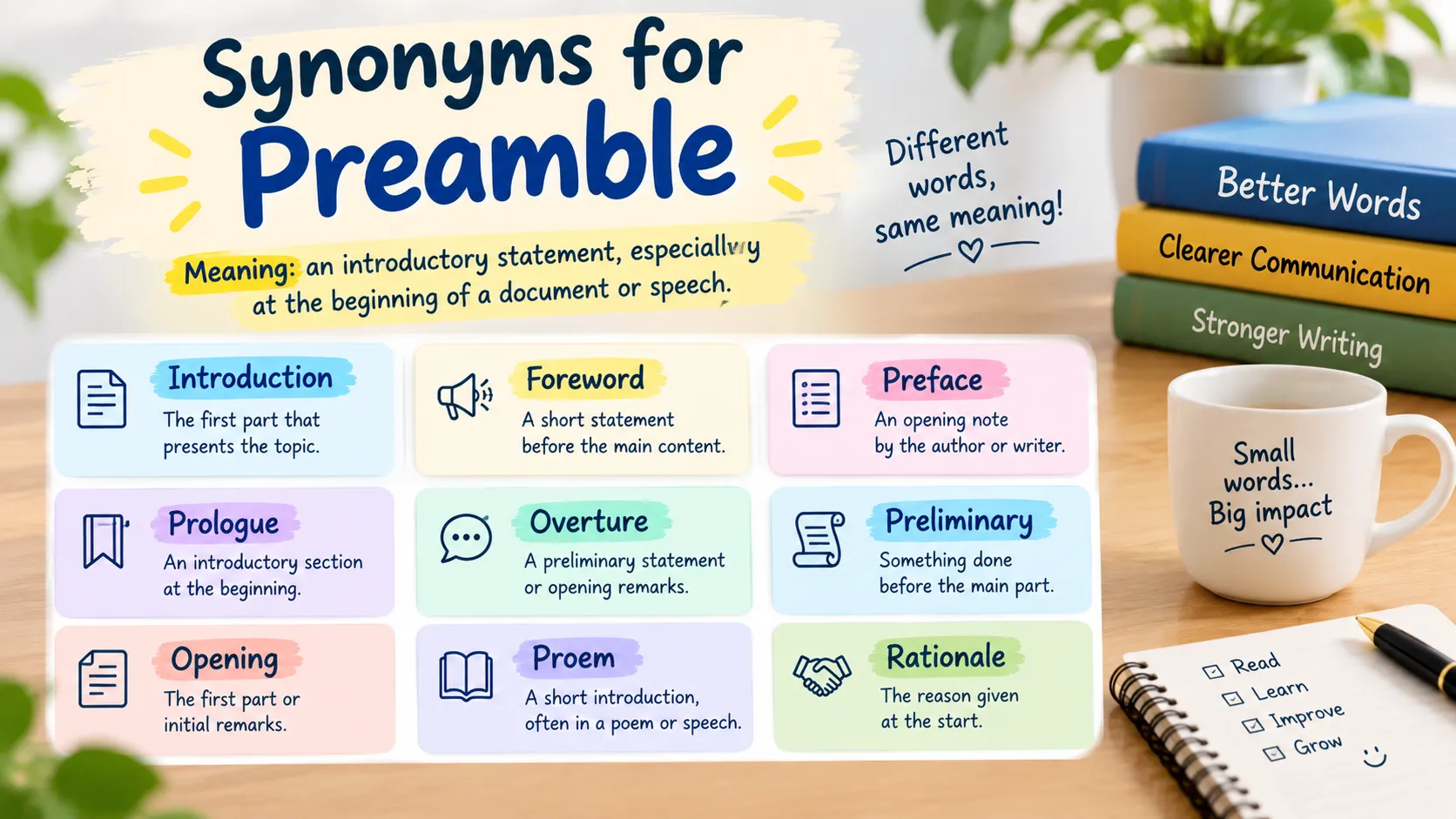
The closest synonym for preamble is preface, which means an introductory statement that comes before the main part of a document or speech. Both words describe text written to explain the purpose or background of what follows. “Preamble” is often used for formal or legal documents, while “preface” is more common in books.
Every constitution, contract, or formal speech usually starts with a short introductory section that explains its purpose. That section is called a preamble.
But if you’re writing about books, speeches, or legal documents, repeating “preamble” too often can make your writing feel stiff. That’s where synonyms for preamble become useful.
In this guide, you’ll find genuine, accurate synonyms for preamble, along with clear meanings and natural examples. Whether you’re writing an essay, a legal summary, or a blog post, you’ll find the right word here.
Synonyms for Preamble
| # | Synonym | Relationship | Direct Replacement | Difficulty | Best Used For |
|---|---|---|---|---|---|
| 1 | Preface | Exact synonym | Yes | Intermediate | Books, formal writing |
| 2 | Foreword | Near synonym | Yes | Intermediate | Books, published writing |
| 3 | Introduction | Near synonym | Yes | Beginner | Daily conversation, essays |
| 4 | Prologue | Near synonym | Sometimes | Intermediate | Literature, creative writing |
| 5 | Prelude | Near synonym | Sometimes | Intermediate | Creative writing, literature |
| 6 | Exordium | Exact synonym | Yes | Advanced | Academic writing, rhetoric |
| 7 | Proem | Exact synonym | Yes | Advanced | Literature, formal writing |
| 8 | Opening statement | Contextual alternative | Yes | Beginner | Legal writing, business writing |
| 9 | Introductory remarks | Contextual alternative | Sometimes | Beginner | Business writing, speeches |
| 10 | Lead-in | Contextual alternative | Sometimes | Beginner | Daily conversation |
| 11 | Overture | Contextual alternative | Sometimes | Advanced | Creative writing, figurative use |
| 12 | Precursor | Related term | No | Intermediate | Academic writing |
| 13 | Front matter | Related term | No | Advanced | Publishing, technical writing |
Table of Contents
- Preface
- Foreword
- Introduction
- Prologue
- Prelude
- Exordium
- Proem
- Opening Statement
- Introductory Remarks
- Lead-in
Quick Facts About Preamble
- Focus keyword: preamble
- Part of speech: Noun
- Simple pronunciation: PREE-am-buhl
- IPA pronunciation: /ˈpriːæmbəl/
- Number of syllables: 3
- Word origin: From Old French “preambule,” from Medieval Latin “praeambulum,” built from Latin “prae” (before) and “ambulare” (to walk) — literally “a walking before.”
- Other word forms: preambles (plural)
- Formality level: Formal
- Difficulty level: Intermediate to advanced
Meaning and Usage of Preamble
A “preamble” is an introductory statement placed at the beginning of a document, speech, or agreement. It usually explains the purpose, background, or intentions behind what follows.
People commonly use “preamble” when talking about legal documents, constitutions, contracts, and formal speeches. It sets the stage before the main content begins.
For example: “The preamble to the constitution explains the document’s core purpose.” Or: “She kept her preamble short before diving into the main proposal.”
1. Preface: A Synonym for Preamble
Relationship: Exact synonym
Direct Replacement: Yes
Difficulty Level: Intermediate
Meaning: An introductory statement, usually written by the author, placed at the start of a book.
Difference: “Preface” almost always refers to books, while “preamble” is more common in legal, political, or formal documents.
Best Used For: Books, formal writing
Examples:
- The author’s preface explained why she decided to write the memoir.
- I always skip the preface and jump straight to chapter one.
2. Foreword: A Synonym for Preamble
Relationship: Near synonym
Direct Replacement: Yes
Difficulty Level: Intermediate
Meaning: An introductory section of a book, often written by someone other than the author.
Difference: Unlike “preamble,” a “foreword” is typically written by a different person, such as an expert or a well-known figure.
Best Used For: Books, published writing
Examples:
- A famous historian wrote the foreword to his latest book.
- The foreword gave helpful context before the main chapters started.
3. Introduction: A Synonym for Preamble
Relationship: Near synonym
Direct Replacement: Yes
Difficulty Level: Beginner
Meaning: An opening section that presents the topic or purpose of a piece of writing.
Difference: “Introduction” is a broader, more casual term, while “preamble” often signals a formal or legal tone.
Best Used For: Daily conversation, essays
Examples:
- My essay’s introduction lays out the three main points I’ll cover.
- He gave a quick introduction before handing the meeting over to his manager.
4. Prologue: A Synonym for Preamble
Relationship: Near synonym
Direct Replacement: Sometimes
Difficulty Level: Intermediate
Meaning: An opening section of a play, novel, or film that sets up the story before the main plot begins.
Difference: “Prologue” is used almost exclusively in fiction and storytelling, while “preamble” fits formal and legal contexts better.
Best Used For: Literature, creative writing
Examples:
- The prologue hints at a mystery that isn’t solved until the final chapter.
- She added a short prologue to explain the story’s setting.
5. Prelude: A Synonym for Preamble
Relationship: Near synonym
Direct Replacement: Sometimes
Difficulty Level: Intermediate
Meaning: Something that comes before and introduces a larger event, often used figuratively.
Difference: “Prelude” often suggests that something bigger is about to happen, while “preamble” simply introduces a written or spoken statement.
Best Used For: Creative writing, literature
Examples:
- The quiet weeks felt like a prelude to something much bigger.
- The small protest turned out to be a prelude to a much larger movement.
6. Exordium: A Synonym for Preamble
Relationship: Exact synonym
Direct Replacement: Yes
Difficulty Level: Advanced
Meaning: The formal opening part of a speech, designed to gain the audience’s attention.
Difference: “Exordium” is a more technical, rhetorical term, while “preamble” is used more broadly in everyday and legal writing.
Best Used For: Academic writing, rhetoric
Examples:
- The professor explained how classical speakers used an exordium to win over the crowd.
- His exordium was so engaging that the audience fell silent immediately.
7. Proem: A Synonym for Preamble
Relationship: Exact synonym
Direct Replacement: Yes
Difficulty Level: Advanced
Meaning: A short introduction to a book, poem, or speech.
Difference: “Proem” is a rare, literary word, while “preamble” is far more common in modern formal writing.
Best Used For: Literature, formal writing
Examples:
- The poet’s proem set a reflective, quiet tone for the collection.
- Scholars still study the proem for clues about the author’s intentions.
8. Opening Statement: A Synonym for Preamble
Relationship: Contextual alternative
Direct Replacement: Yes
Difficulty Level: Beginner
Meaning: The first statement made in a document, speech, or legal proceeding.
Difference: “Opening statement” is more commonly used in legal and business settings, while “preamble” can also apply to constitutions and formal declarations.
Best Used For: Legal writing, business writing
Examples:
- The lawyer’s opening statement outlined the main argument clearly.
- Her opening statement set a confident tone for the rest of the presentation.
9. Introductory Remarks: A Synonym for Preamble
Relationship: Contextual alternative
Direct Replacement: Sometimes
Difficulty Level: Beginner
Meaning: Brief comments made at the start of a speech or meeting to introduce the topic.
Difference: “Introductory remarks” often sounds more spoken and informal than “preamble,” which leans toward written, formal documents.
Best Used For: Business writing, speeches
Examples:
- The CEO kept her introductory remarks short before the main presentation.
- His introductory remarks explained why the topic mattered to everyone in the room.
10. Lead-in: A Synonym for Preamble
Relationship: Contextual alternative
Direct Replacement: Sometimes
Difficulty Level: Beginner
Meaning: A short section or comment that introduces what comes next.
Difference: “Lead-in” is casual and conversational, while “preamble” almost always fits formal or written contexts.
Best Used For: Daily conversation
Examples:
- She gave a quick lead-in before playing the video for the class.
- That joke was a great lead-in to his main point.
Antonyms of Preamble
| # | Antonym | Simple Meaning | Example |
|---|---|---|---|
| 1 | Conclusion | The final part that wraps up a piece of writing | The conclusion summarized the report’s key findings. |
| 2 | Afterword | A closing section added after the main text | The author added an afterword explaining her research process. |
| 3 | Epilogue | A closing section of a story or play | The epilogue reveals what happened to the characters years later. |
| 4 | Postscript | A short note added after the main text is finished | She included a postscript apologizing for the delay. |
| 5 | Closing statement | The final remarks made at the end of something | His closing statement summarized the main argument clearly. |
| 6 | Ending | The last part of a piece of writing or speech | The ending felt rushed compared to the rest of the book. |
Words Commonly Confused with Preamble
Premise
Difference: A “premise” is an assumption or statement used as the basis for an argument, not an introductory section of text. “Preamble” introduces a document, while “premise” supports a conclusion.
Example: His entire argument rests on a premise that hasn’t been proven yet.
Prologue
Difference: “Prologue” is specific to fiction and storytelling, while “preamble” is more common in formal, legal, or official writing.
Example: The film’s prologue explains the fictional war that shaped the story.
Preface
Difference: “Preface” usually refers to the introductory section of a book, while “preamble” appears more often in legal or governmental documents.
Example: The editor asked the author to shorten the preface before publishing.
Precursor
Difference: A “precursor” is something that comes before and leads to something else, but it isn’t necessarily a written or spoken statement like a “preamble.”
Example: The small tremor was seen as a precursor to the larger earthquake.
Frequently Asked Questions
What is another word for preamble?
“Preface” is one of the closest words to “preamble,” especially for books. Other strong options include “introduction,” “opening statement,” and “prologue,” depending on the context.
What is the closest synonym for preamble?
“Preface” is generally the closest synonym, since both words describe an introductory statement placed before the main content. However, “preface” leans toward books, while “preamble” fits legal and formal documents.
Can I replace preamble with preface?
Yes, in most formal or written contexts, “preface” works as a direct replacement. For legal documents like constitutions, “preamble” remains the more accurate and expected term.
Is preamble formal or informal?
“Preamble” is a formal word. It appears most often in legal documents, constitutions, contracts, and official speeches rather than casual conversation.
What is the opposite of preamble?
Common opposites include “conclusion,” “epilogue,” and “closing statement.” These words describe sections that appear at the end of a document rather than the beginning.
Which synonym is best for a legal document?
“Opening statement” or “preamble” itself both work well in legal contexts. “Preface” and “prologue” aren’t suitable here, since they’re mainly used for books and fiction.
Conclusion
Learning synonyms for preamble gives your writing more variety and precision. Instead of repeating the same word, you can choose “preface,” “introduction,” or “opening statement” depending on the situation.
Context matters most when picking the right synonym, since each word carries a slightly different tone and setting. Try using a few of these words in your next email, essay, or speech, and notice how naturally they fit.