“Sole” is a small word. But it plays very different roles depending on how you use it.
In “the sole survivor of the crash,” sole is an adjective. It means only or single.
In “the sole of my shoe is worn out,” sole is a noun. It means the bottom surface of a foot or shoe.
Order “grilled sole” at a restaurant, and the sole becomes something else entirely, a type of flatfish.
These meanings feel unrelated in everyday English, even though they share a common word history. Most people who search for synonyms of “sole” actually mean the adjective sense as in sole owner, sole purpose, or sole custody.
This guide covers each meaning separately. You’ll find the right replacement word, understand the subtle differences between similar terms, and avoid the most common usage mistakes.
Quick example: “She was the sole author of the report” means she wrote it alone, with no co-writers.
Quick Answer Box
Most searches for synonyms of “sole” are looking for the adjective sense only, single, or exclusive, as in “sole owner” or “sole responsibility.”
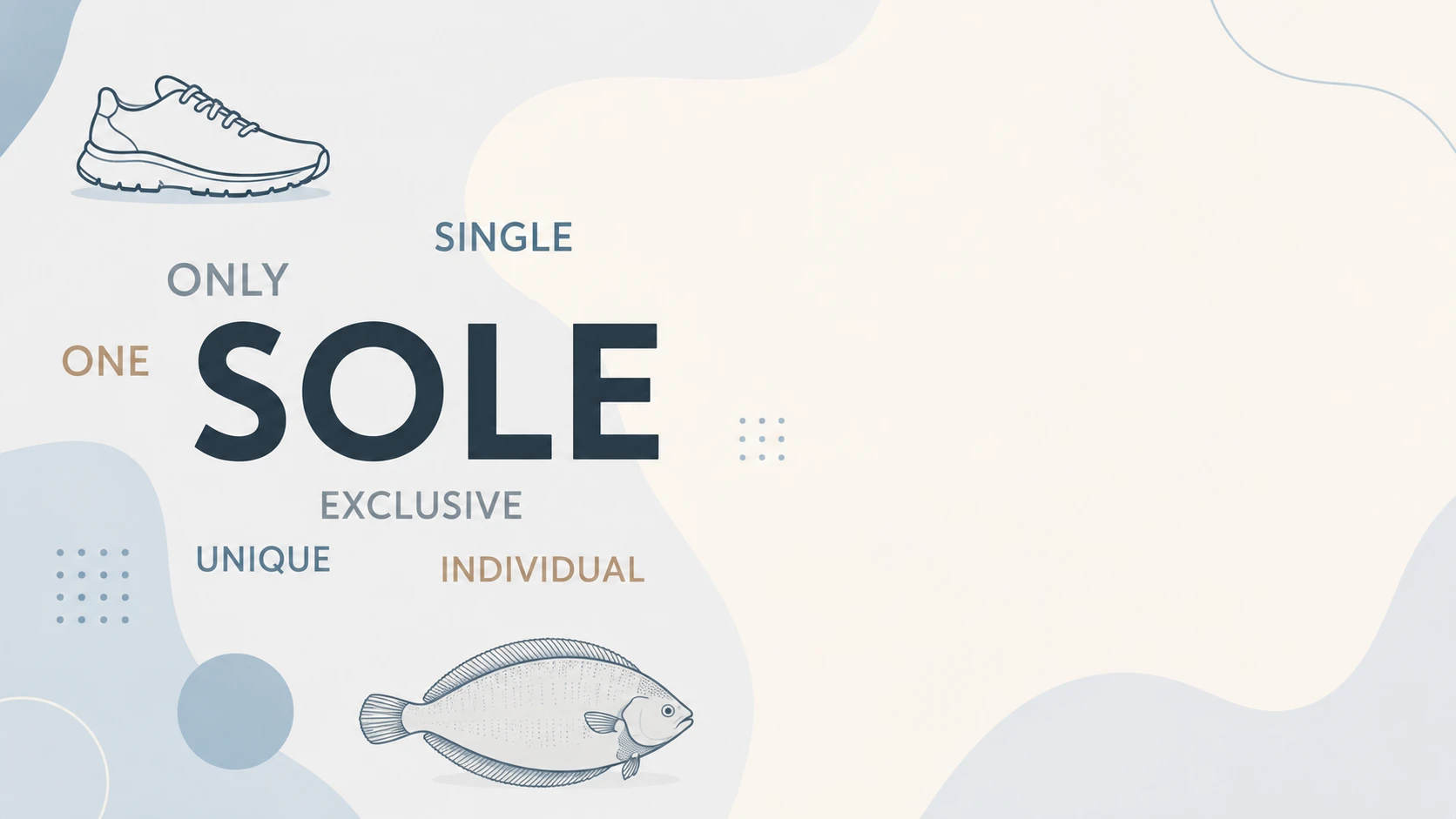
The closest synonyms here are only, single, and one.
If you mean the noun sole (bottom of a foot or shoe) or the fish, there’s no single exact synonym. These are specific terms, not general concepts, so this guide covers their related vocabulary in a separate section below.
Quick Synonyms Table
| Word | Context/Sense | Type |
| Only | Adjective single, no others | Exact Synonym |
| Single | Adjective one and no more | Exact Synonym |
| One | Adjective sole/lone quantity | Exact Synonym |
| Exclusive | Adjective reserved to one party | Close Alternative |
| Unique | Adjective one of a kind | Close Alternative |
| Individual | Adjective/Noun considered alone | Close Alternative |
| Singular | Adjective remarkable/unique or grammatically single | Close Alternative |
| Solitary | Adjective alone, unaccompanied | Related Vocabulary |
| Exclusivity | Noun state of being restricted to one | Related Vocabulary |
| Monopoly | Noun sole control of a market/resource | Related Vocabulary |
| Unaccompanied | Adjective without others present | Related Vocabulary |
| Undivided | Adjective not shared or split | Related Vocabulary |
| Unshared | Adjective not held jointly | Related Vocabulary |
Main Content
Only
Context/Sense: Adjective indicating there is no other of the kind. Type: Exact Synonym Meaning: Shows that something is the single one that exists or applies. Nothing else fits the category. When to Use: Neutral register. Works in formal and everyday writing alike. Example 1: He was the only witness to the accident. Example 2: This is the only copy of the contract we have. Similar Words: Single, exclusive Difference: “Only” is the plainest, most common substitute for “sole.” “Sole” tends to sound more formal or legalistic compared “sole proprietor” with “only owner.”
Single
Context/Sense: Adjective one in number, not multiple. Type: Exact Synonym Meaning: Refers to just one item, person, or instance. Emphasizes quantity, not exclusivity of access. When to Use: Fits formal, technical, and everyday contexts equally well. Example 1: There was a single reason for the delay. Example 2: The company operates under a single leadership structure. Similar Words: Only, individual Difference: “Single” emphasizes number one, not two or more. “Sole” leans more toward exclusivity: “sole decision-maker” means no one else shares that authority, not just that there’s one person.
One
Context/Sense: Adjective used before a noun to stress singularity. Type: Exact Synonym Meaning: A determiner that stresses there is exactly one of something, with no others involved. When to Use: Common in spoken and semi-formal English. Less common in strict legal or academic writing, where “sole” or “only” fits better. Example 1: She is the one person I trust with this decision. Example 2: There was one clear winner in the competition. Similar Words: Only, single Difference: “One” is more conversational and less precise than “sole.” It can sound emphatic “the one and only” rather than formal.
Exclusive
Context/Sense: Adjective restricted to a particular person, group, or purpose. Type: Close Alternative Meaning: Describes something limited to one party. Others are excluded from access or involvement. When to Use: Common in business, legal, and marketing contexts. Carries a sense of privilege or restriction, not just simple quantity. Example 1: The company holds exclusive rights to distribute the product. Example 2: Membership is exclusive to paying subscribers. Similar Words: Sole, restricted Difference: “Exclusive” is about excluding others from a shared resource or right. “Sole” simply states there’s only one holder. They overlap in phrases like “sole/exclusive distributor,” but “exclusive” can also describe something premium or restrictive without implying there’s literally only one of anything.
Unique
Context/Sense: Adjective being the only one of its kind. Type: Close Alternative Meaning: Describes something distinct or unlike anything else not simply the only instance present. When to Use: Best for descriptive or creative writing. Avoid in strict legal contexts, where you need precision about singularity, not distinctiveness. Example 1: Her approach to the problem was unique. Example 2: Each fingerprint is unique to the individual. Similar Words: Singular, one-of-a-kind Difference: “Unique” is about distinctiveness or rarity, not necessarily about being the only one present. A “unique” item could still have duplicates elsewhere in the world. “Sole” strictly means there is exactly one in the given context.
Individual
Context/Sense: Adjective (or noun) considered separately, on its own. Type: Close Alternative Meaning: Refers to something treated singly, apart from a group, or to one specific instance. When to Use: Common in formal, administrative, and academic writing. Example 1: Each individual request will be reviewed separately. Example 2: The individual components were tested before assembly. Similar Words: Single, particular Difference: “Individual” emphasizes separateness within a set looking at one item among many. “Sole” emphasizes that there are no others at all. “The individual owner” and “the sole owner” can overlap, but “individual” doesn’t rule out other owners existing elsewhere.
Singular
Context/Sense: Adjective remarkable or exceptional; also used in grammar to mean “not plural.” Type: Close Alternative Meaning: In general use, describes something notably distinctive. In grammar, it refers to a form indicating one item. When to Use: Formal or literary register for the “remarkable” sense. Technical register for the grammatical sense. Example 1: He showed singular dedication to the project. Example 2: “Sole” is a singular noun with the plural form “soles.” Similar Words: Exceptional, unique Difference: Outside grammar, “singular” rarely means “only one.” It usually means “remarkable” , a different meaning entirely from the plain quantitative sense of “sole.”
Context Section
The right synonym for “sole” depends entirely on which sense you mean:
- Adjective sense (only/single): “Only,” “single,” and “one” are safe, interchangeable choices in most sentences. “Exclusive” and “unique” only work when the nuance matches restriction versus distinctiveness.
- Noun sense foot/shoe: No true synonym exists. English simply doesn’t have another common word for “the underside of a foot or shoe.” Terms like “insole” or “footbed” name specific parts, not the whole sole.
- Noun sense fish: “Sole” names a specific flatfish, including varieties like Dover sole and lemon sole. Names like “flounder” or “plaice” are different species, not synonyms.
- Verb sense: To “sole” a shoe means to fit it with a new sole as in “resoling” boots. This is a specialized, non-interchangeable use.
Common Mistakes
- Using “unique” to mean “only one.” It actually emphasizes distinctiveness, not quantity so “the unique copy” is imprecise where “the only copy” is meant.
- Swapping “exclusive” for “sole” in legal or ownership contexts without checking the nuance. “Exclusive rights” can be shared among a defined group under one license, while “sole rights” implies one holder only.
- Treating “singular” as a casual synonym for “sole.” Outside grammar, “singular” usually means “remarkable,” not “only one.”
- Mixing up the noun (bottom of a shoe/foot, or the fish) with the adjective (only/single), then applying the wrong synonym list.
- Assuming “individual” always rules out anyone else being involved. It often just separates one item from a group, without excluding others.
- Overusing “sole” or its synonyms in formal writing when a simpler phrase like “the only” would read more naturally.
Comparison Table
| Word | Formality | Typical Usage Context | Connotation |
| Sole | Formal/legal | Ownership, responsibility, custody | Strict exclusivity, no sharing |
| Only | Neutral | General everyday use | Plain, straightforward |
| Single | Neutral–formal | Quantity, structure, status | Emphasizes “one,” not exclusivity |
| Exclusive | Formal/marketing | Rights, memberships, access | Privilege, restriction |
| Unique | Neutral–formal | Descriptions, qualities | Distinctiveness, rarity |
| Individual | Formal/administrative | Separating items within a group | Separateness, not exclusivity |
Real-Life Examples
- A lawyer drafting a contract writes: “The sole beneficiary of the policy is Maria Lopez.” She chooses “sole” over “only” for its formal, legally precise tone.
- A product manager announces: “We’ve secured exclusive distribution rights in Europe.” She uses “exclusive” because the agreement restricts other distributors it’s not just stating there’s one.
- A teacher explains grammar: “Fish is singular here, but sole can also be singular or plural depending on context.” She uses “singular” in its grammatical sense.
- A parent says: “He was the only one who remembered my birthday.” He picks the everyday, conversational “only” over the more formal “sole.”
Related Vocabulary
- Solitary being alone or without company. Related to the idea of “sole,” but describes a state, not a role or right.
- Exclusivity is the noun form of being restricted to one party. Connected to “exclusive.”
- Monopoly control over an entire market or resource by a single entity. A broader, economic concept tied to sole control.
- Unaccompanied without others present. Used for people or performances, not ownership or rights.
- Undivided not split or shared. Often paired with “attention” or “loyalty,” not ownership.
- Unshared not held jointly with others. A more literal, less formal cousin of “sole.”
- Insole the inner sole of a shoe. Topically related to the noun sense of “sole,” but not a synonym.
- Flatfish the broader fish category that includes sole, plaice, and flounder.
Pronunciation
- Sole: /soʊl/ (US), /səʊl/ (UK)
- Only: /ˈoʊnli/ (US), /ˈəʊnli/ (UK)
- Single: /ˈsɪŋɡəl/
- Exclusive: /ɪkˈskluːsɪv/
- Unique: /juˈniːk/
- Individual: /ˌɪndɪˈvɪdʒuəl/
Grammar Information
- Part of speech: “Sole” works as an adjective (only/single), a noun (bottom of a foot/shoe; a flatfish), and occasionally a verb (to fit a shoe with a new sole).
- Noun forms: Singular “sole,” plural “soles.” For the fish sense, “sole” can also stay unchanged in the plural, like “fish.”
- Verb forms: sole, soles, soled, soling as in “the cobbler soled the boots.”
- Adjective usage: As an adjective, “sole” is typically used right before a noun “sole owner,” “sole purpose.” It’s generally non-gradable: you won’t see “very sole” or “the solest.”
- Common collocations: sole proprietor, sole custody, sole purpose, sole survivor, sole discretion, sole authority.
FAQs
What does “sole” mean when used as an adjective?
It means “only” or “single” no other person, thing, or option is involved. As in “sole owner” or “sole reason.”
Is “sole” the same as “exclusive”?
Not exactly. “Sole” simply means there’s only one holder or party involved. “Exclusive” adds the sense that others are deliberately excluded from access to a slightly different legal or commercial meaning.
What’s the difference between the fish “sole” and the shoe part “sole”?
They’re unrelated in everyday meaning, despite the shared spelling and pronunciation. One is a flatfish like Dover sole. The other is the bottom surface of a foot or shoe.
Can “sole” be used as a verb?
Yes. To “sole” a shoe means to attach a new sole to it, common in shoe repair, as in “resolving” boots.
Is “singular” a good synonym for “sole”?
Generally no, outside of grammar. In everyday use, “singular” usually means “remarkable” or “exceptional,” not “only one.” It’s a poor substitute in most sentences.
Why do legal documents often use “sole” instead of “only”?
“Sole” carries a more formal, precise register common in legal and business writing “sole discretion,” “sole proprietor.” “Only” is more conversational, though both express the same core meaning.
Conclusion:
“Sole” is a compact word with several unrelated meanings, so identify the sense you need before picking a synonym. For the common adjective meaning “only” or “single” use “only,” “single,” or “one” in everyday writing. Want to emphasize restriction, distinctiveness, or separateness instead of plain quantity? Reach for “exclusive,” “unique,” or “individual.” For the noun senses the bottom of a shoe or foot, or the fish there’s no true synonym, only related vocabulary that names specific parts or categories.